 Block
Bloomfield, Illinois
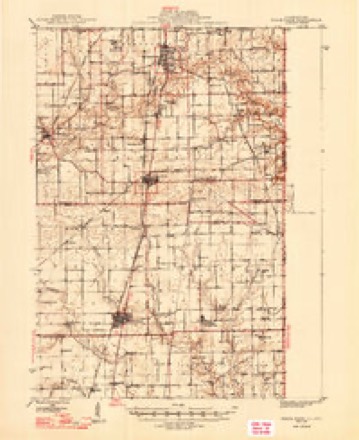
15 topographic sheets cover this place, the earliest surveyed in 1947 and the latest in 1998. It stands in Edgar Township. It lies in ZIP code area 61924. The Survey maps it on the Chrisman quadrangle.
Topographic sheets covering this place
8 surveys from 15 printed sheetsMatched by testing this settlement's coordinate against the published boundary of every sheet in the United States Geological Survey's historical collection. Each opens the scanned sheet at the Survey.
- 1947 USGS Ridge Farm quadrangle1:62500, 3 printings
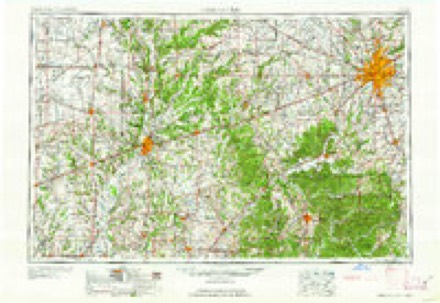
- 1953 USGS Indianapolis quadrangle1:250000, 4 printings
- 1956 USGS Indianapolis quadrangle1:250000
- 1957 USGS Indianapolis quadrangle1:250000, 2 printings
- 1962 USGS Indianapolis quadrangle1:250000
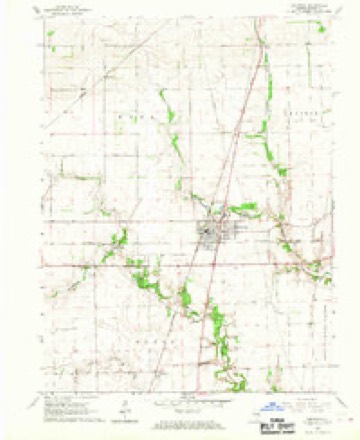
- 1966 USGS Chrisman quadrangle1:24000
- 1986 USGS Paris quadrangle1:100000, 2 printings
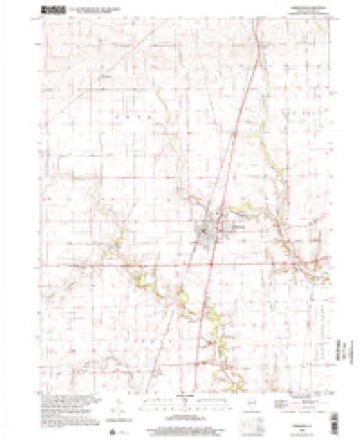
- 1998 USGS Chrisman quadrangle1:24000
In the county-history sources
6,944 words on this townshipThe History of Edgar County, Illinois, Containing a History of the County--its Cities, Towns, &c. : Directory of Its Tax-payers; War Records of Its Volunteers in the Late Rebellion Portraits of Early Settlers and Prominent Men; General and Local Statistics; Map of Edgar County; History of Illinois, Illustrated; History of the Northwest, Illustrated; Constitution of the United States, Miscellaneous Matters, &c., &c. Illustrated, published 1879 names this settlement in its chapter on Edgar Township. These are the passages that mention it, exactly as the scans read.
The early settlers of Sims Township came principally from Kentucky, Tennessee and the Carolinas. Their coming, settlement and their privations endured are the interesting parts of these pages, and to them we will devote the remainder of this history. The first settlers in Sims Township were Jacob and Thomas Rhoades, who, with their families, came from Kentucky as early as 1819 or 1820. Mr. Hall Sims, who came to what is now Elbridge Township in March, 1821, mentions Thomas Rhoades as living in Elbridge on his arrival. He afterward removed, he says, to near Big Creek. This was done the next year, from the best accounts given. Mr. Rhoades married a daughter of Thomas Foster, one of the pioneers on Sugar Creek. In after years, when the Mormon excitement came over this part of the State, it carried Mr. Rhoades away in its doctrine. He went with them in their journey West, it is stated, and from Utah to California where he became quite wealthy. He was not alone, by any means, in his infatuation for this peculiar sect, as Edgar County furnished several adherents to the church of the " Latter-day Saints.'' Almost contemporary with them were William Janes, Moses Williams, Aaron, Moses W., and John Darnall, Samuel Wells and William Craig. Mr. William Darnall, now living in Paris, says that when the county was organ¬ ized, in the spring of 1823, he thinks that Thomas and Jacob Rhoades and Mr. Wells were about the only settlers in this part of the new county. The others came in very shortly after, if indeed, some of them were not already located.
When the first settlers arrived, they found their neighbors were in what is now Hunter Township and on Sugar Creek in Elbridge. It is not likely there was any mill in the county at that date, and they were obliged to go to Palestine or to Terre Haute did they wish to avoid the laborious task of the mortar or grater. Each one of those named came in wagons, crossing the Ohio River at Louisville, or below the mouth of Salt River, thence to Vin¬ cennes, thence to Palestine where the land office was at that date, and where they could ascertain about unsold lands and unsettled parts of the State.
The cabin was constructed of unhewn logs, notched at the corners so as to fit closely together. The cracks were then chinked with split oak pieces, and daubed with mud. When dry, the wall was complete. A door was made by cutting out a place in the logs of the required width and height, the upper and lower log being cut only half through. " Jambs," as they were called, were next pinned on ; a door made of split slabs, hung on wooden hinges, and -fastened with a wooden latch, whose motive power was a leather thong hang¬ ing outside through a small gimblet-hole, bored a few inches above the latch. At night, the latch-string could be drawn in, and the door was secure. In pure pioneer times, it always hung out in the daytime, and was, in its silent way, a mute welcomer to all. It gave rise to the old expression, so fraught with cheer and hearty hospitality, and so well remembered by all. " My latch-string is always out," was a synonym for "you are always welcome," and was given with a true pioneer unselfishness. The roof of this humble abode was formed by shortening the logs at the end of the cabin after they reached the eaves, until the last one formed an apex. From one to the other was laid a stout pole, whose ends, like those of the two end-logs first laid above the eaves, projected several feet beyond the walls. Two or three feet farther down, another pole of a similar length was laid on, and so on until the end of the two logs referred to were reached. On these poles, layers of clapboards, "shakes" they were called in many localities, were laid, overlapping each other, and held on by weight-pples, which, in turn, maintained their position by means of short sticks of wood laid lengthwise between them. An aperture was next made in one end of the cabin, similar to the one made for the door and small windows, save that it was much lower and very broad. Stout oak pieces, about two feet in length, were split out, one end placed just inside the aperture, the other reach¬ ing outward, where it was crossed by a similar piece as long as the width of the aperture in the wall. These pieces formed a solid pen, and were carried up a little distance, where they were supported by smaller sticks, whose length and size diminished as they neared the top of the chimney. At the top, the open¬ ing would be little more than one foot square. These sticks were held in their place by being securely and thoroughly daubed with a mixture of mud and prairie-grass or straw. This mixture was very thickly applied to the inside of the fire-place and chimney ; while at the lower portion, flat stones were used for the inner wall and bottom. This completed the fire-place, and a very good one it was, too. Around it, in the evening, the family could gather to discuss their condition and prospects, visit with a neighbor, or entertain a stranger. A crane was fixed in the inside of it, on which kettles were suspended for the family cooking. Stoves were then not known here, and had they been, the pioneer could not have owned one. The cabin contained one room, which answered all purposes, and often accommodated as many as could find room to sleep on its floor. The furniture was, in many respects, fully in keeping with the other articles of household use. In many cabins, the writer has seen the bedsteads made by inserting a stout pole in one corner of the room, about four feet from one wall and six feet from the other. It was fastened at the bottom in the puncheon floor, did the cabin have one, or in the solid earth ; while the top was secured in a pole joist, or in the floor if a loft had been made. About three feet from the lower floor, a pole reaching from this post to the farther wall was placed, one end projecting through between the legs, the other fastened to the post, which, at this height, generally had a stout prong sticking out where a limb had been cut off. From this horizontal pole to the wall, slabs were laid, whose outer ends were supported between the logs comprising the wall. A short pole was commonly laid just inside the post to the wall, to form a counter support. On the slats, the bed was made, sometimes composed of dry grass, over which was fastened a quilt or sheet. If these could not be had, buffalo-skins could, forming a good substitute. Thanks to the provident ideas of the time, the wife had generally supplied herself with an outfit for a bed or two before her entrance on the matrimonial stage. It was then expected of her, and was considered a part of her marriage dowry.
Machine-read from a century-old scan, so expect the errors a machine makes: misspelled names, dropped words, stray characters.
Read the whole chapter on Edgar Township - it names this place 7 more 7 times.
Mines and quarries near this place
1 within 5 milesRegional context, not property-specific evidence. The federal mineral resources record lists 1 working within 5 miles of Bloomfield: 1 past producer. None of them still produces. What was taken out: Stone, Crushed/Broken. Distance is straight-line from the map coordinates, so a quarry counted here may appear on a neighbouring settlement's page as well.
| Where | Site | Commodity | Status | Recorded |
|---|---|---|---|---|
| Unnamed Limestone Quarry | Stone, Crushed/Broken | Past Producer |
Storms near this place
1 since 2022Regional context, not property-specific evidence. The National Weather Service names Bloomfield in 1 storm report in 2022: 1 thunderstorm wind. No death or injury is recorded in these reports. Each account below is quoted exactly as the forecast office filed it, from the NOAA Storm Events Database, and each date opens the federal record of that event.
| When | Event | Place named | Harm | What the report says |
|---|---|---|---|---|
| March 2022 | Thunderstorm Wind | Bloomfield | - | Several small tree branches were blown down. |
Nearest settlements
The eight closest, with where each one stands in the county. Distances are straight-line, computed from the Geographic Names Information System coordinates.
Provenance
This settlement is recorded in the Geographic Names Information System as feature 422476. The sheet list is computed by point-in-boundary test against the United States Geological Survey's historical topographic inventory. Both are works of the United States government and carry no copyright under 17 U.S.C. 105.
Mines and quarries. USGS Mineral Resources Data System (MRDS) https://mrdata.usgs.gov/mrds/ A work of the United States government, no copyright under 17 U.S.C. 105.
Storms. NOAA National Centers for Environmental Information, Storm Events Database https://www.ncei.noaa.gov/stormevents/ A work of the United States government, no copyright under 17 U.S.C. 105. Narratives are quoted verbatim from the National Weather Service report and are not edited or summarised.