Major Bibliographical References (Cite the books, articles, and other sources used in preparing this form on one or more continuation sheets.) Previous documentation on file (NPS): Primary location of additional data: X preliminary determination of individual listing (36 R State Historic Preservation Office CFR 67) has been requested - Other State agency - previously listed in the National Register - Federal agency - previously determined eligible by the National - Local government - University - designated a National Historic Landmark - Other U recorded by Historic American Buildings Survey O recorded by Historic American Engineering Record # 1908 Register ARCHITECTURE Architect/Builder individual distinction. Significant Dates Cuyahoga, Ohio Bibilography Property is: religious purposes. Harp Apartmemts (Enter categories from instructions) our history.
Name of repository: for National Register listing.) D Property has yielded, or is likely to yield, - A Property is associated with events that have made County and State 10. Geographical Data Acreage of Property UTM References (Place additional UTM references on a continuation sheet.) - See continuation sheet Verbal Boundary Description (Describe the boundaries of the property on a continuation sheet.) Boundary Justification 11. Form Prepared By Steven McQuillin, preservation consultant 3515 Archwood Ave. street & number . state . zip code Additional Documentation Submit the following items with the completed form: Continuation Sheets Representative black and white photographs of the property.
Additional items (Check with the SHPO or FPO for any additional items) Property Owner (Complete this item at the request of SHPO or FPO.) Shoreway Limited Partnership 44109 Zone Ohio Photographs Maps name organization Northing Cleveland telephone name/title Easting Cuyahoga, Ohio July 1999 6516 Detroit Ave. Harp_Apartments (216) 961-4242 less than one (Explain why the boundaries were selected on a continuation sheet.) city or town lame ot Property A USGS map (7.5 or 15 minute series) indicating the property's location. A Sketch map for historic districts and properties having large acreage or numerous resources. Paperwork Reduction Act Statement: This information is being collected for applications to the National Register of Historic Places to nominate a benelit in accordance with the National Historic Preservation Act, as amended (16 U.S.C. 470 et seq.).
Estimated Burden Statement: Public reporting burden for this form is estimated toaverage 18.1 hours per response including time for reviewing instructions, gathering and maintaining data, and completing and reviewing the form. Direct comments regarding this burden estimate or any aspect of this form to the Chief, Administrative Services Division, National Park Service, P.O. Box 37127, Washington, DC 20013-7127; and the Office of Management and Budget. Paperwork Reductions Projects (1024-0018). Washington, DC 20503.
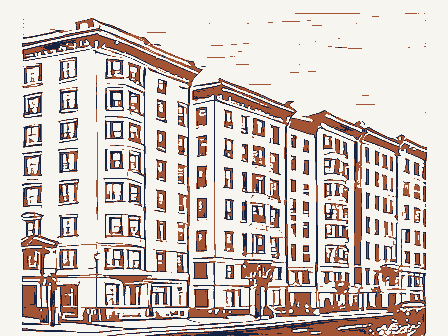
(216) 749-3515 NPS Form 10-900-a United States Department of the Interior National Park Service National Register of Historic Places Harp Apartments, Cuyahoga County, Ohio multi-family housing in Cleveland and was designed by one of the city's more prominent conveys a sense of grandeur not only to the commercial streetscape along Detroit Road but also to its primarily single-family surroundings along West 64th Street. This architectural character manifests itself in the classically-detailed two primary entrances to the building, with their bracketed hoods, the colossal arches above each entrance, the arched projections above each doorway at the roofline, and the bay windows with the tower-like corner bay element. The Harp Apartment building is being nominated under Criterion C as a specific building type and not for its architectural style. In 1908 Mrs.
Olive Harp Lawrence took out a permit to construct this apartment building at a cost of $25,000. She may have used her middle name for this building. George A. Grieble served as the architect and George A. Rutherford served as masonry contractor. Grieble was then a prominent Cleveland architect, designer of buildings that have been placed on the National Register of Historic Places due to their architectural significance. Among these is the Euclid-71st Building, designed about the same time and actually of simpler design than this building. There is also the Rose Building Annex, part of the Lower Prospect Historic District. Griebel's Fidelity Building, on East 6th between Euclid George Rutherford established one of the city's larger and better known construction companies in 1903, after having been partner in the firm Rutherford & Thompson since 1886.
He built several buildings for the Great Lakes Exposition, a bank building that still stands at 322 Euclid Ave., industrial buildings for White Motors and Industrial Rayon serving as president of the Builders Exchange, the Advertising Club, the Real Estate Board and the East Cleveland Board of Education. Tragically, George Rutherford was Continuation Sheet slain by an employee in 1936. construction firms, George Rutherford Company. In its architecture, this building neighborhood architects, George A. Grieble. It was built by one of the city's leading The Harp Apartment building is a representative example of early twentieth century and a mill building at 1645 Merwin Ave.Rutherford was active in the community, and Superior, is also listed on the National Register. OMB Approval No.
1024-0018 (8-86) United States Department of the Interior National Park Service National Register of Historic Places Continuation Sheet Harp Apartments, Cuyahoga County, Ohio The features that provide this building with its architectural character include the two entrances. Each of these has elaborate brackets with wreath motifs, which are formed from terra cotta. (photo 13) What is unusual are the arched parapets above each entrance at the roofline, which provide bold outlines against the sky. (photo 2) The tower-like because of its speckled coloration, its deeply recessed joints and its use in corbeled designs that form a boldly outlined cornice and arcading.
(photo 10) With respect to other apartment buildings, which have had various degrees of alterations, the Harp Apartments is relatively unaltered, surviving with its masonry exterior in good condition, its lobbies intact and each unit retaining its fireplace mantel and much original The Architect George A. Grieble was born in Delaware, Ohio in 1874 and attended Ohio Wesleyan University for two years. Afterward he served as superintendent of construction for the State of Ohio. Grieble developed a course of architecture at the International School of Correspondence. In the Cleveland area, his works included the Doan and Dreher blocks on Euclid Avenue. He designed the Nicholls Apartments in 1906 at 1563-69 East Boulevard (still standing). A few years later he designed a residence at 1157 East Boulevard. This house was designed under the firm name of Grieble & Fogle.
That same Euclid Building, 1900 Euclid Avenue. This building was known for years as home to several prominent Cleveland architects, including Frederick Striebinger, W. F. Ferguson and Walker & Weeks. He designed the B & O Shops in Lorain, the Jones Block in Ashtabula, the Kinsman Ice Cream Factory, Cleveland Bottling Works and Butler Engineering. In 1917 he designed the Sloan Building on Prospect Avenue, also known as the Rose Building Annex. This was a large terra cotta-clad commercial building. In 1919 Grieble designed the Euclid-71st Building and the Fidelity Building. From 1923-24 his plans. In 1929 Grieble was sentenced to four years at Leavenworth Penitentiary on the federal charge of using mails to defraud. Grieble was considered prominent enough to warrant a biography in Orth's History of Cleveland. detailing.
(8-86) year, Grieble designed the Harp Apartments.The next year, he was architect for the corner element with its small attic windows is a visually prominent feature, as are the bay OMB Approval No. 1024-0018 windows that flank each of the entrances. The brickwork is also of special interest Eaton and Rugby Hall apartments, East 73rd and Euclid, were constructed according to NPS Form 10-900-a NPS Form 10-900-a OMB Approval No. 1024-0018 United States Department of the Interior National Park Service National Register of Historic Places Continuation Sheet Tarp Apartments in the Context of Cleveland Apartment Building. city in the U. S. However, it had relatively few apartment buildings at that time. The city listed under "public halls, blocks and buildings". By 1903 the directory contained over three columns of apartment listings, which by 1908 had grown to 9 columns.
By 1910 the directory listed over 14 columns of apartments. By 1920 Cleveland had grown to become the nation's 5th largest city, with 796,841 residents. span clear through the building. Front entrances serve units on both sides, two per floor. Kitchens have rear doors that lead onto spacious balconies that also serve as a second space for windows in every room, including bathrooms, the building was designed to serving a limited number of units ensured that fires once started would generally not The1910 and 1920 census records do not show this as being built to serve an immigrant* one family was from Germany and another from England, but most were born in the United States and many of their parents were also born in this country. The records show The Harp is similar to the Hilliard Apartments, 2804-2906 Sackett Ave., about two miles southeast on the city's near west side.
That building was listed on the National Register but has been demolished. Like the Harp, it was strictly residential, not having a respond to health and safety issues. Fire walls and small common interior hallways it is not possible to categorize this as a home to those recently moved to the U. S., retired Harp Apartments was built during the early period of the apartment boom in the city. Its layout is like that of other early 2Oth century apartment buildings, with flat-type units that or young married couples.Instead, it seems like a microcosm of the city itself. commercial storefront. It likewise had about the same number of units and layout, with (8-86) that some residents were retired but many were in their 20s and 30s. From these records, spread very far. The rear porches and stairs provide a second safe means of egress.
population.In 1910,one family was from Scotland and another from Canada and in1920 Harp Apartments, Cuyahoga County, Ohio Section number 8 Page 3. directory of 1898-99 contained a listing of only 3 "apartments", with most apartments means of egress, with exterior stairways. In its form, with deep rear recesses providing Cleveland at the turn of the century had a population of 381,768, making it the 7th largest Cleveland had a population of 560,663, making it the nation's 6th largest city. By 1917 OMB Approval No. 1024-0018 United States Department of the Interior National Park Service National Register of Historic Places Harp Apartments, Cuyahoga County, Ohio housing stock by its elegant brick exterior, in this case, glazed orange brick, and on the National Register, but it is a slightly older and taller apartment building than the Harp.
But, like the Harp,it gains its distinction because of its massing, exterior also has a series of bay windows to provide more light and air and give the exterior a more varied appearance. The Kennedy Apartments, at 6425 Detroit, is a short distance from the Harp and is listed on the National Register. Like the Harp, it has a brick exterior, in this case mottled gray brick. It also has a distinctive tower-like corner Kennedy has a commercial storefront facing onto Detroit. McKinley Terrace, 1406 W. 81st St. and listed on the National Register, is a series of multi-story units and has a more Queen Anne character than the Harp, although both buildings have tower-like corner elements.
The McKinley has a series of porches that give each unit a greater sense of A review of these other nearby National Register-listed apartment buildings reveals that they gain their significance on the basis of their exterior architectural styling rather than on innovative floor plans or a past history of having been home to a particular immigrant Cleveland doubled in size. This was a timeframe during which apartment living in the city went from being uncommon and was not highlighted in the city directory to any great in the context of their neighborhoods, part of a second wave of construction. The Harp is an architecturally distinguished and visually prominent building in the context of its group or residents who can be categorized as standing apart from the general population. Cimperman, the Harp stands out as a special building in its neighborhood. classically inspired detailing.
buildings nearby. These buildings all fit into the timeframe of 1900-1920, a period when architectural styling and use of distinctive brickwork, in its case, orange glazed brick. It Continuation Sheet promoted in newspaper advertising. Many of the apartment buildings, like the Harp, are, surroundings.According to former Cleveland Landmarks Commission Director John D. The Jennings Apartments at 2716 W. 14th St., also on the city's near west side, is listed individuality, more in keeping with its rowhouse design.
extent, to a time when many.apartments were listed in the directory and were heavily prominence, although the Kennedy is on a major street corner, with other commercial two entrances that were identical.It was distinguished from its surrounding single-family Each building stands near single-family frame houses on side streets, giving it greater element and elaborate apartment entrance formed of cut sandstone.However, the NPS Form 10-900-a Section number 8 Page 4 : (8-86) NPS Form 10-900-a OMB Approval No. 1024-0018 United States Department of the Interior National Park Service Continuation Sheet Whereas the single-family housing surrounding them can be characterized as late likely that improved mass transit along each of the streets bordering these apartment buildings made them more desirable for apartments. When many houses surrounding the Harp were built, Detroit Ave.
was served by horse-drawn omnibuses. By the time of the electrified mass transit system. 2. Cleveland City Building Permit #21496 4. Orth's History of Cleveland, vol. 3, page 245 5. information on Grieble researched by Don Petit, Cleveland Landmarks Commission 6. Cleveland Press, May 21, 1929 "Clevelander Given 4-Year Fraud Term" Verbal Boundary Description Harp Apartments stands on a small urban lot at the northeast corner of Detroit Ave. and Bibliography 3. Ohio Historic Inventory form, August 1992 1. Cleveland City Directories, 1898-99, 1903-04, 1908-09, 1917-18 9. Cleveland Necrology File: Aug. 16, 1929 P-D death notice for Mrs. Lawrence Harp, Mayor Tom Johnson had established the five-cent fare on a modernized regional 8.1910, 1920 U. S. Census forms for Harp Apartments W. 64th St. The lot has a frontage of about 35 feet and its east lot line extends back about 7.
Cleveland Plain Dealer, June 30, 1936,"G. A. Rutherford Slain by Employee" National Register of Historic Places Harp Apartments, Cuyahoga County, Ohio nineteenth century, the apartment buildings date from the early twentieth century. It is (8-86) 82 feet from Detroit. Itis the only building on its lot.Permanent Parcel#002-12-020 OMB Approval No. 1024-0018 United States Department of the Interior National Park Service Continuation Sheet Harp Apartments, Cuyahoga County, Ohio Verbal Boundary Justification Name of property: Harp Apartments (same for all photographs) Location: Cuyahoga County, Ohio (same for all photographs) Photographer: Thomas Eastman (same for all photographs) Date taken: September 1999 (same for all photographs) Location of negatives: Detroit-Shoreway Community Development Organization, 6516 Detroit Ave., Cleveland, Ohio 44102 (same for all photographs) W. 64th St.
photo 2 - view along Detroit Ave. looking northeast and showing the Harp in the center photo 3 - closer view of the west elevation, looking southeast along w. 64th St. photo 4 - entranceway close-up view, looking northeast photo 5 - east elevation close-up view, looking northwest photo 6 - south elevation, looking north photo 7 - closer view of the south elevation, looking north, and showing part of the east or rear elevation photo 9 - south part of the east side and east part of the south side, looking northwest photo 10 - close-up view of the corner tower element, looking northeast photo 13 - close-up view of the north entrance door, looking east photo 14 - detail of a bracket by the entrance door, looking southeast photo 15 - north wall, looking southeast from W. 64th St.
photo 16 - interior 3rd floor stairwell windows, looking west photo 18 - typical closet door photo 19 - typical oak hardwood floor photo 17 - typical living room fireplace view (each suite has a fireplace) The boundary includes the historic property known as the Harp Apartments and the parcel and foyer area of land visually and historically associated with this building. photo 11 - upper part of the west elevation, looking northeast photo 20 - view inside a typical suite, looking from the living room into the dining room photo 8 - southeast corner of the building, looking north Photograph Key photo 1 -west and north elevations, looking northeast from the corner of Detroit Ave.and National Register of Historic Places Section number 10-11 _ Page 1.
NATIONAL PARK SERVICE NATIONAL REGISTER OF HISTORIC PLACES EVALUATION/RETURN SHEET NAME : DATE OF 45TH DAY: REASONS FOR REVIEW: LESS THAN 50 YEARS: OTHER : PROGRAM UNAPPROVED: REQUEST: N N SLR DRAFT: N COMMENT WAIVER: N ABSTRACT/ SUMMARY COMMENTS: DOCUMENTATION see attached comments Y/N see attached SLR Y/N REJECT DATE TELEPHONE 2/03/00 PROPERTY DISCIPLINE MULTIPLE REVIEWER RETURN 3/20/00 3/03/00 PERIOD: PDIL: National Register RECOM./CRITERIA NATIONAL: Harp Apartments SAMPLE: VACCEPT Entered in the DATE RECEIVED: DATE OF WEEKLY LIST: DATE OF 16TH DAY: UNITED STATES DEPARTMENT OF THE INTERIOR DATE OF PENDING LIST: APPEAL:N 2/15/00 HARP APARTMENTS#] Cuyahoga Corny CRACIUN HARP APARTMENTS #2 Cleveland, ohio HARP APARTMENTS +3 HARP APARTMENTS #A Clueland, Ohio HARP APARTMENTSH5 HARPAPARTMENTS #6 >23203** N N N-52 HARP APARTMENTS # HARP APARTMENTS $8 >232 B3** NN N-52 HARP APARTMENTS #9 >23203** N N N-62 HARP APARTMENTS #11 >232 NN N-52 HARP APARTMENTS #12 HARP APARTMENTS #13 >232G3** NNN-72 HARP APARTMENTS #14 Cleveland, Ohis HARP APARTMENTS#15 Clveland, Ohib HARP APARTMENTS #16 Clueland, Ohis >232 G3** NN N62 HARP APARTMENTS#17 Clveland, Ohió >232@3** NNN82 HARP APARTMENTS#|8 HARP APARTMENTS #19 Cleveland, Ohio HARP APARTMENTS $20 Cleveland,ohio HARP APARTMENTS ( DEPARTMENT OF THE INTERIOR 17-439120-4592600 CLEVELAND SOUTH QUADRANGLE 7.5 MINUTE SERIES (TOPOGRAPHIC) GEOLOGICAL SURVEY CLEVELAND SOUTH, OHIO CUYAHOGA COUNTY OHIO-CUYAHOGA CO 1081-D6-TF-024 Committees: Finance - Public Health - Public Safety - Public Service September 6, 1999 William Whitney, Executive Director Detroit Shoreway Community 6516 Detroit Avenue, Suite 1 Cleveland, Ohio 44102 RE: The Harp Apartments efforts to have it listed on the National Register of Historic Places.
The Harp Apartments project delivers several positive contributions to the neighborhood. For example, it involves the restoration of an important but deteriorating historic multifamily structure, and upset or change any of the original elements of the building while at the same time, mechanical service such as electrical, plumbing and heating have been upgraded to modern standards. Also, the Harp Apartments will provide high quality affordable housing that is located in an Detroit Shoreway has a long and successful history of community development, including secure financing to renovate the Harp Apartments and to list it on the National Register. Residence - 6109 W. Clinton Avenue - Cleveland, Ohio 44102 - (216) 961-5209 City Hall - Room220-601 Lakeside Avenue - Cleveland, Ohio 44114 - (216) 664-4235 - Fax (216) 664-3837 Sincerely, CLEVELAND Historic Designation Timothy J.
Melena Development Organization 1796 Office of the Council preserving our culturally and historically significant spaces is imperative to the successful regeneration Dear Mr. Whitney: space, and educational and religious institutions. Further, there are several organizations in close of our neighborhood.The renovation of the Harp building has been undertaken in a way that does not Councilman, Ward 17 Please accept this letter as my expressed support for the Harp Apartments project and your active area with easy access to public transportation, a grocery store, commercial amenities, recreational complex development projects like the Harp. Again, the City of Cleveland commends your efforts to proximity that are active in providing services ranging from job training to case management.
Detroit Shoreway Community Development Organization 6516 Detroit Avenue Cleveland, Ohio 44102 attempts to acquire this property for several years.The Northshore Neighbors has been and Northshore Neighbors Block Club also strongly supports the efforts to place the building on the National Register of Historic Places. Our neighborhood's history and heritage is an important part of residents' lives and we support the preservation of extraordinary places and buildings community, demonstrated through activities such as the Herman Park Peace Mural, regular to positively affect and direct the neighborhood through our continued participation and you providing input into this process. Regards, September 8, 1999 noted local Cleveland architect at the turn of the century. Robin Yates, Chairperson Dear Mr.
Whitney: Avenue and West 64th Street and has what we consider to be significant features that make it William Whitney, Director Northshore Neighbors Block Club This letter is in regards to the acquisition and rehabilitation of the Harp Apartments building at to express our strong support for this project. We understand the need for good, clean and walking patrols and strong participation in block club meetings and activities.We will continue 1389-1391 West 64th Street.On behalf of the Northshore Neighbors Block Club, I would like stand out as a marker of the early 1900s in Cleveland.Furthermore, it was designed by a As you know, the Northshore Neighbors Block Club is an active and vibrant voice of our Once again, I affirm our full support for this project and pledge our commitment to continue continues to be an active participant in providing input into this project.
that remind us of that history.The Harp building sits prominently at the intersection of Detroit Michael R. White, Mayor Robert Keiser, Secretary 601 Lakeside Avenue, Room 519 Cleveland, Ohio 44114 Ohio Historic Sites Preservation Advisory Board Ohio Historic Preservation Office 567 East Hudson Street Subject: Harp Apartment Building, 1389 West 64" Street Cleveland, Cuyahoga County, Ohio National Register of Historic Places On July 8, 1999, the Cleveland Landmarks Commission in its role as a Certified Local Government reviewed the proposed nomination of the Harp Apartment approval by the Ohio Historic Sites Prescrvation Advisory Board. RDK/dp Dear Sirs: September 9, 1999 Sincerely, Secretary 216/664-2531 City of Cleveland Commission voted unanimously to support the nomination and recommends City Planning Robert D.
Keiser Columbus, Ohio 43211-1030 Building, 1389 West 64 Street, to the National Register of Historic Places. The Ceveland Landmarks Commission 09/10/99 23:53 FAX An Equal Opportunity Emplaye
 Block
Block