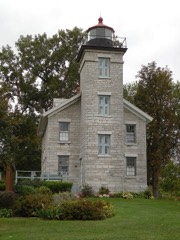
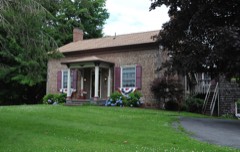
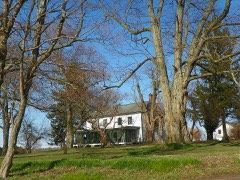
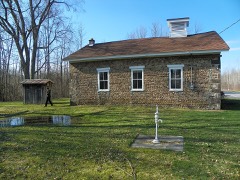
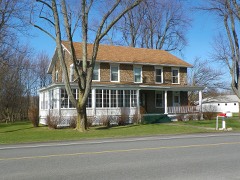
National Register reference number.80002787- the number the National Park Service assigned this property when it was listed, and the key its nomination file is catalogued under at the National Archives.
The settlement of the present town of Sodus began in 1794. The first buildings were erected at Sodus Point during that year. It is probable that surveyors, dand-agenta, explorers, and hunters may have had temporary cabins here and elsewhere in the town before this, but in 1794 Captain Williamson came on with a large party of workmen, choppers, surveyors, and builders. It was quite an 'eventful year for this lake section of country, covered as it then was with the -dark, dense forest. Williamson regarded Sodus bay as the commercial depot for the eastern portion of the Pultney estate, for which he was agent, and mingled with these business considerations a tinge of romance, excited by the beautiful bay and its pleasant surroundings. His views were far beyond what the locality has so far realized. The census of 1790 records no settlers north of Decker Robinson and Pierce Granger, in the town of Phelps. In 1794, Daniel Russell, in Williamson, was the sole settler in all the region north of Palmyra, unless Amos Richards, later noted, was living near him. Captain Williamson caused a tavern to be built at the Point, on the ground now occupied by the house of David Rogers, and a grist-mill on Salmon creek, in the woods south of the present site of Preston's mills, also a saw-mill a little farther north. He launched a yacht upon the bay, and made improvements during two years to the expense of twenty thousand dollars. He appointed Little and Moffat as land-agents, and secured Moses Gill and Jabez Sill to keep the tavern. He directed the building of two
In his family were seven sons, Artemas, Richard, George, Nathan, William, James, and Thomus. The first four are dead. There were three daughters, Mrs. Chester Kelly, Mrs. Robert Fellers, and Mrs. Stebbins, of Newark. Ammi Ellsworth, from Kast Windsor, Connceticut, came in 1801, and settled on the place daughter. With him came his brother-in-law, Asahel Osburn. They had been out the previous year, and Osburn had built o log housc and sowed ten acres in wheat on the present Irwin farm, and Ellsworth had also built a log house ready hay, but could obtain but ninety pounds. The road from that village, though laid out, was not worked, and the settlers drove over logs two feet in diameter by throwing down a small log on each side. Ellsworth stated that the only neighbors westward, then, were Daniel Russell, Amos Richards, and Elijah Brown. There was a log house built near Thornton's present place, and it was opened for a tavern ; yet Stephen Bushnell must have been a resident of the town, as he was chosen commissioner of highways in April, 1801. Mr. Ellsworth and wife lived to see the fields cleared and their descendants in the enjoyment of the fruits of their labors. These relatives number full seventy. Four of their children are living, the daughter mentioned, Ammi Ellsworth, in Michigan, Mrs. Samuel Danford, of Sodus, and Levi Ellsworth, from whom much valuable information herein contained was furnished. About 1801, Dr. William N. Lummis came to Sodus Point, from Philadelphia. He had explored the Genesee country to some extent in 1800, and now his ability, education, and enterprise made him a leader in the settlement, and foremost in every work of public improvement. Turncr's History of the Pultney Estate says of him, 'To indefatigable industry and perseverance he added extraordinary business talents, and to a vigorous intellect he added a thorough education, cultivated literary tastes and pursuits, which, in hours of relaxation from the sterner duties of life, made him an agreeable and instructive companion." A son, Benjamin Lummis, born at Sodus Point in 1804, still resides there. When the war of 1812 began, Dr. Lummis removed two miles west, to Salmon creek, his house standing a little east of the present house of John Preston. .The old Williamson mill having failed, Dr. Lummis built the grist-mill now carried on by George Preston, also a saw-mill, iron-forge, and several dwellinghouses. His house at the Point was burned during the attack upon it during the war. Dr. Thomas G. Lawson, from England, was an early settler near the Point, upon the place where B. B. Seaman now lives. He spent money freely in the improvement of his lands, but returned to England after a few years. In 1803, a marked event occurred in the settlement of the town. Colonel Peregrine Fitzhugh, of Maryland, who had been living at Geneva three years, came to Sodus Point with his family and slaves. It was quite an extensive cavalcade, the party on their journey. There were large Pennsylvania wagons, drawn by twenty-seven horses, and the family, counting slaves, numbered forty. / The colonel had been a soldier during the Revolution, and had been promoted td a position in Washington's life-guard. The slaves brought to Sodus became free within a few years, and formed quite a colony of their own, eighty in number, on the "'out-lots" of the 'city." They have scattered until at present but two or three families remain upon the site of the "settlement." In 1803, Joseph Hathaway settled near Thornton's present place, and the following year, Elder Seba Norton, the pioneer Baptist minister, settled on the place now owned by Reuben Boyd. He had served four years in the war of the Revolution, participating in the battles of Saratoga and Monmouth. He came from Unadilla to Marion, and after a short sojourn, came to Sodus. His strength of mind and his devotion to his profession compensated for the deficiencies of carly education, and insured him a long career of usefulness. He preached the gospel in the homes of the earliest settlers, literally "without money and without price." In 1806, Elder Gerum settled north of Wallington, on the Geneva road. John Corey came from Warren county the same year, and settled at South Sodus, on the farm now owned by Albert Smith. Margaret Campbell, later the wife of William Tinney, was at Sodus as early as 1804. A year previous to this, Matthew Clark was in Sodus, near the brick meeting-house, and Isaac Mason, not long after, chopped and cleared considerable land on the present farm of D. Wilcox. Jenks Pullen came from Phelps in 1807, and settled at South Sodus, on the farm now owned by Abram Shaw. In the list of town officers his name frequently occurs. Abner Torrey, also, came from the west side of Lake Champlain to Sodus in 1807. The same year, Samuel Warren came from Cheshire county, New Hampshire, to South Sodus, selected his location, returned for his family, consisting of his wife and six children, and brought them with wood-shod sleds drawn by oxen. He arrived in February, 1808, and brought out a coop of fowls anda cow. They made butter during the long journey, from the milk of the cow. Of Mr. Warren's sons, Elijah was for many years a Methodist preacher. Clark was pilot for Commodore Chauncey, on Lake Ontario, was in a number of naval actions, and at the battle of Sandy Creek. Gardner, father of A. P. Warren, of South Sodus, was also in the latter action. Samuel Warren, the father, died October 14, 1820. - Inthe year 1808, Silas F. Andrews settled at Sodus Centre. He was the grandfather of Joseph Andrews, and inhabited a log house opposite the present house of Elisha Mather. With the Warrens, or'contemporary with them, came William Young, an old sea-captain, and father of Joseph Young, of Sodus village. He settled on the McMullin place, south of Thornton's lime-kiln. In 1793, Daniel Arms came from Chenango county to Old Castle, Ontario county, then to Phelps, and in 1808 to Sodus, where he arrived with his family in October. The party built a fire by a stump and encamped by it the first night, in the open air.
Regional context, not property-specific
evidence. The
federal wildfire occurrence database
lists 147 fires within 5 miles of Customs House
between 2000 and 2020, burning about 129 acres in total. 7 started naturally. 36 were recorded as arson.
Distance is straight-line from the map coordinates, so a fire counted
here may appear on a neighbouring settlement's page as well.
Reported cause
Fires
Missing data/not specified/undetermined
86
Arson/incendiarism
36
Debris and open burning
10
Natural
7
Recreation and ceremony
4
Equipment and vehicle use
2
Smoking
1
Other causes
1
The most recent of
them, most recent first, with the day each was reported and the service
that recorded it.
Regional context, not property-specific
evidence. The federal mineral resources record lists
3 workings within 5 miles of Customs House: 2 producers, 1 past producer.
2 still produce. What was taken out: Sand and Gravel, Construction, Iron. Distance is straight-line from the
map coordinates, so a quarry counted here may appear on a neighbouring
settlement's page as well.
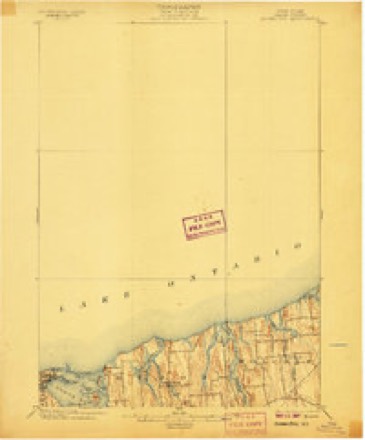
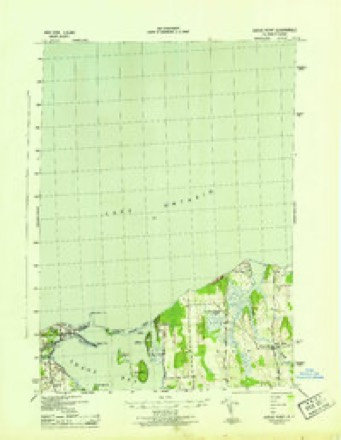
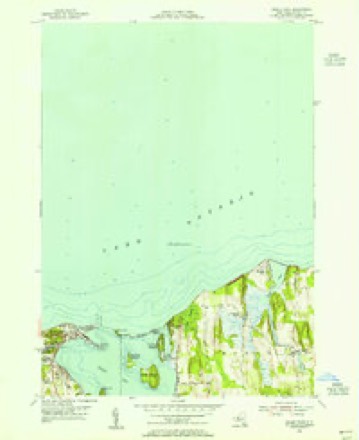
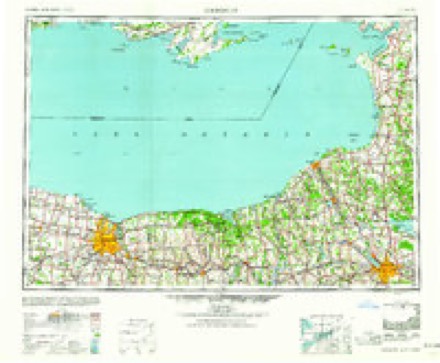
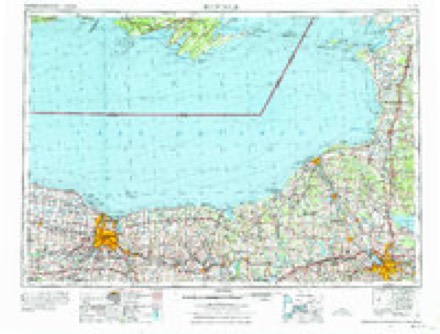
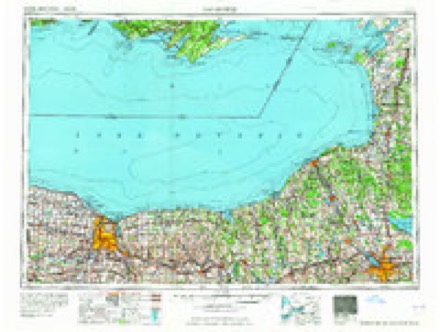
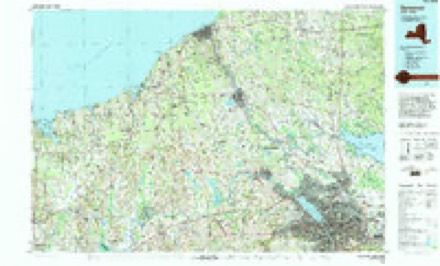
United States Geological Survey topographic sheets whose coverage includes this point. Matched by taking the coordinate the National Park Service records for this property, then testing that coordinate against the published boundary of every sheet.
Other National Register properties close
enough to walk or drive between, ordered by distance from this one. Both
positions come from the same geocoding pass that matched these properties
to their map sheets.
Listing record. National Park Service National Register of Historic Places, listed-properties dataset, current to 2026-05-22.
Map join. Address geocoded through the United States Census geocoder, then tested against the published boundary of every sheet in the USGS Historical Topographic Map Collection.
How this page is made. Listing fields come from federal records; map-sheet coverage is a labelled coordinate-to-boundary calculation, not a source-field claim.
Wildfire. Short, Karen C. 2022. Spatial wildfire occurrence data for the United States, 1992-2020 [FPA_FOD_20221014]. 6th Edition. Fort Collins, CO: Forest Service Research Data Archive. https://doi.org/10.2737/RDS-2013-0009.6 Collected with United States Government funding and usable without additional permissions or fees.
Mines and quarries. USGS Mineral Resources Data System (MRDS) https://mrdata.usgs.gov/mrds/ A work of the United States government, no copyright under 17 U.S.C. 105.
 Block