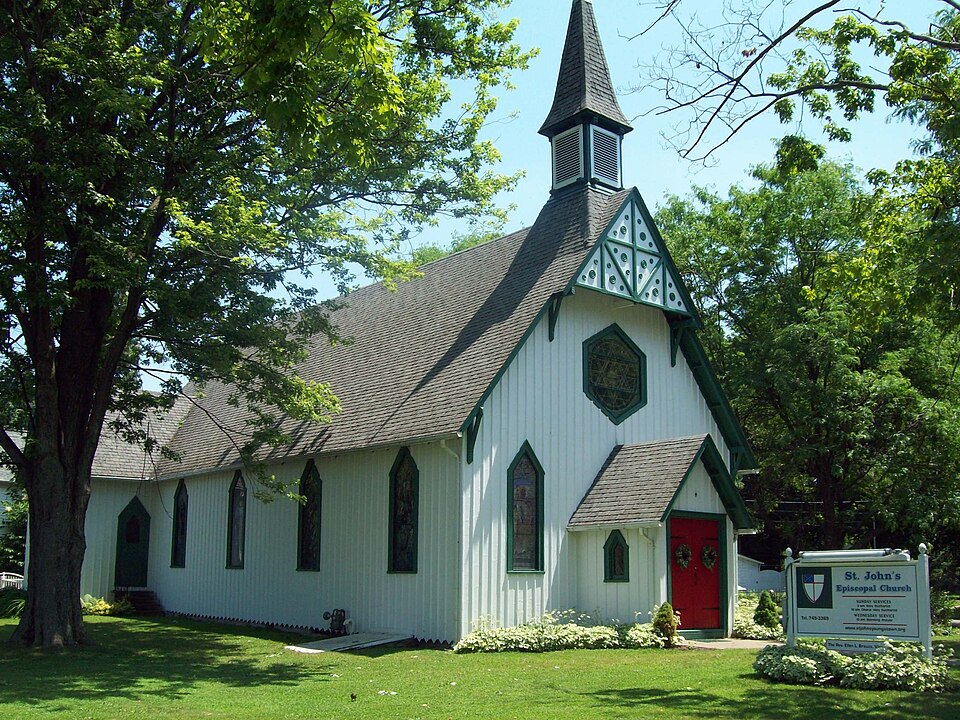
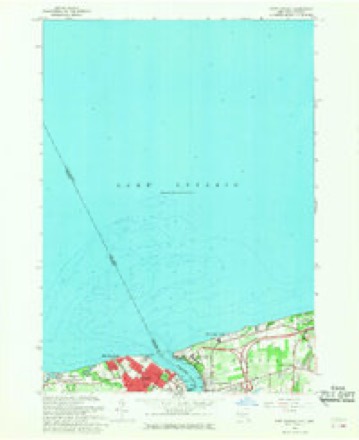
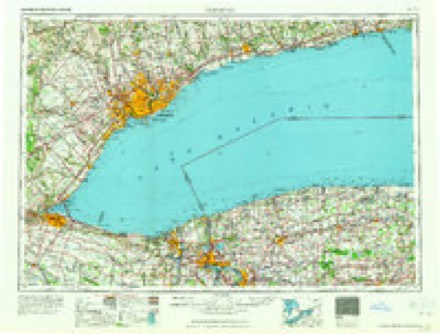
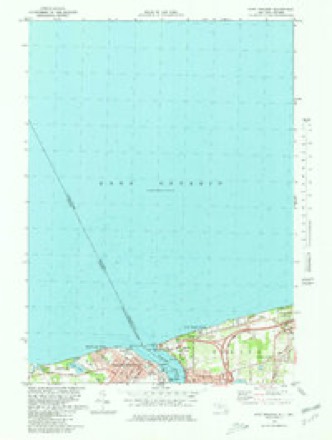
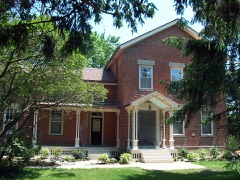
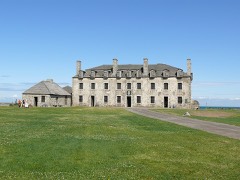
Listed on the National Register of Historic Places in 1990. 7 historic topographic surveys cover this location, the earliest from 1950.
From the record
“John's Episcopal Church is a historic Episcopal church located at Youngstown in Niagara County, New York. It is a Gothic Revival style board and batten frame church constructed in 1878.”
Wikipedia article St. John's Episcopal Church (Youngstown, New York), CC BY-SA 4.0.
One of 99 National Register listings published here for Niagara County · listed in 1990 · category: Building.
National Register reference number.90000687- the number the National Park Service assigned this property when it was listed, and the key its nomination file is catalogued under at the National Archives.
In 1816 William and John Clapsaddle came from Herkimer county, N. Y., and settled in Porter, the latter locating on lot No. 9. It is said that the journey was made with an ox team, which was the first ever driven attached to a wagon over the five miles of road between Youngstown and Four-mile creek. He built the first saw-mill and grist-mill in the town about the year 1817, and he was also the keeper of a pioneer tavern.
David Baker settled in Youngstown in the same year. After working there as carpenter for three years, he removed to that part of the town now known as Porter Center, and purchased a portion of a lot that had been articled to Gideon Curtiss, afterward receiving a deed for it from the Holland Land Company. The following year Gideon Curtiss came to Porter and took up land now comprised within the boundaries of the settlement known as Ransomville. He cut the first timber felled in that part of the town, and afterwards helped to lay out the main road through the village and the one from the ridge to the lake. Mr. Curtiss came from near Litchfield, Conn. G. W. Curtiss, a brother of Gideon, well known as Captain Gilbert W. Curtiss, came from Connecticut. He tried to make a clearing near that of his brother, but was unable to do so on account of the scarcity of provisions and money. It is related by a descendant of the captain that he had only one dollar in money, with which he went to Canada to purchase bread. After he had paid his ferriage across the river, he had only sufficient money left to buy two or three small loaves, with which he returned, and kept on with his attempts at clearing till he was obliged to stop from sheer want of necessary food, leave his land and engage to serve out a part of the time of a soldier at Fort Niagara. After a time, success so far crowned his efforts to establish a home in the wilderness, that he considered himself warranted by his circumstances in going back to Connecticut and marrying a girl lo whom he had been betrothed before first leaving his native State. The bride and groom returned in a one-horse covered wagon of the old lumbering style. When they arrived at the ridge hj was obliged to cut a road through the woods to the location of Ransomville, ahead of tlie vehicle which contained his bride and such of their meager domestic wealth as they could carry. Many times, when old age had whitened the captain's locks, he told the story of his bridal trip, and laughingly compared it to the luxurious and expensive tours of the newly wedded couples of to-day; and the contrast was not weakened by the fact that the journey of the bridegroom from Porter to Connecticut was made on foot. The captain was commander of a company under the old militia law, and from this fact originated the official title by which he was known through life. At the time the captain and Mrs. Curtis came from Connecticut they brought apple seeds, which he planted, transplanting the young trees afterward and starting an orchard, which is to be seen at the present time at the rear of the grain warehouse of his sons, the Curtiss Brothers, at Ransomville. From this primitive beginning has grown the fruit interest of the eastern portion of the town, now a source of considerable profit to the farmers there.
Regional context, not property-specific
evidence. The
federal wildfire occurrence database
lists 53 fires within 5 miles of St. John's Episcopal Church
between 2002 and 2020, burning about 30 acres in total. 4 started naturally. 3 were recorded as arson.
Distance is straight-line from the map coordinates, so a fire counted
here may appear on a neighbouring settlement's page as well.
Reported cause
Fires
Missing data/not specified/undetermined
41
Natural
4
Debris and open burning
4
Arson/incendiarism
3
Misuse of fire by a minor
1
The most recent of
them, most recent first, with the day each was reported and the service
that recorded it.
Regional context, not property-specific
evidence. The National Weather Service names
Youngstown, the town this property stands in, in 10 storm reports between 1994 and 2023: 5 thunderstorm wind, 4 flood, 1 hail.
No death or injury is recorded in these reports. Each account below is quoted exactly as the forecast office
filed it, from the NOAA Storm Events Database, and each date
opens the federal record of that event.
United States Geological Survey topographic sheets whose coverage includes this point. Matched by taking the coordinate the National Park Service records for this property, then testing that coordinate against the published boundary of every sheet.
Other National Register properties close
enough to walk or drive between, ordered by distance from this one. Both
positions come from the same geocoding pass that matched these properties
to their map sheets.
Listing record. National Park Service National Register of Historic Places, listed-properties dataset, current to 2026-05-22.
Map join. Address geocoded through the United States Census geocoder, then tested against the published boundary of every sheet in the USGS Historical Topographic Map Collection.
How this page is made. Listing fields come from federal records; map-sheet coverage is a labelled coordinate-to-boundary calculation, not a source-field claim.
Wildfire. Short, Karen C. 2022. Spatial wildfire occurrence data for the United States, 1992-2020 [FPA_FOD_20221014]. 6th Edition. Fort Collins, CO: Forest Service Research Data Archive. https://doi.org/10.2737/RDS-2013-0009.6 Collected with United States Government funding and usable without additional permissions or fees.
Storms. NOAA National Centers for Environmental Information, Storm Events Database https://www.ncei.noaa.gov/stormevents/ A work of the United States government, no copyright under 17 U.S.C. 105. Narratives are quoted verbatim from the National Weather Service report and are not edited or summarised.
 Block