Listed on the National Register of Historic Places in
1972. A historic map-sheet match is not published yet. The record needs a coordinate-quality review before it can be joined to a sheet boundary.
From the record
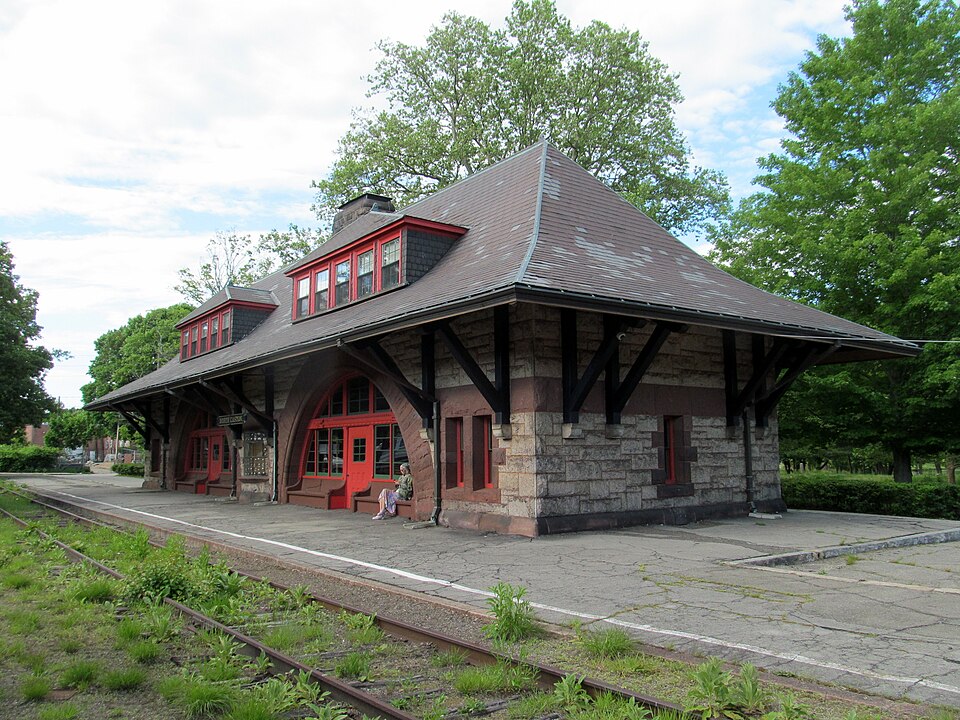
“North Easton station is a former railroad station designed by noted American architect H. It is located just off Oliver Street in North Easton, Massachusetts, and currently houses the Easton Historical Society.”
Wikipedia article North Easton station, CC BY-SA 4.0.
one of 272 National Register listings in Bristol County · listed in 1972 · category: Building · one of 8 National Historic Landmarks in Bristol County.
National Register reference number.72000125- the number the National Park Service assigned this property when it was listed, and the key its nomination file is catalogued under at the National Archives.
The population of Easton is about four thousand. At the census of 1880 it was precisely three thousand nine hundred and one. Easton Centre is twenty-four miles south of Boston, twelve north of Taunton, and twenty-seven north of Fall River. It is twentytwo miles from the sea-shore in a direct line. It is on the Old Colony Railroad, on the main line from Boston to Fall River and Newport, and has two railroad stations. It has three villages, each with a post-office. The principal village is North Easton, which contained a population of two thousand one hundred and fifty-six in 1880, considerably over half of the whole population of the town. The other villages are Easton, or the Furnace village, and South Easton. The chief industry of North Easton, the industry in fact which has built up this village, is shovel-making. Another important business here is the manufacture of hinges. There are two bootand shoe-factories, and the New England Specialty Company, which manufactures screw-drivers and a variety of similar articles. There are also twelve stores, including markets, drug-store, etc. South Easton has the cotton-thread factory of E. J. W. Morse & Co., a grist-mill, machine-shop, two shoefactories, a wheelwright-shop, and two stores. The Furnace village (post-office address, Easton) has two foundries or furnaces, two saw-mills, and two stores. In the southeast part of the town mathematical and scientific instruments are manufactured. These is also a small grist-mill in the west part, and one in the northeast part. All these industries of the town are merely alluded to here; they will be more particularly -described farther on.
North Easton village presents many points of special interest and attraction. There are several costly and other handsome dwelling-houses, among which may be mentioned those of F. L. Ames, Oliver Ames, Oakes A. Ames, Mrs. Oliver Ames, E. W. Gilmore, George W. Kennedy, and Unity Church parsonage. The residences of F. L. Ames and Oliver Ames are within a large and beautiful park, which is open to the public for driving and walking, a privilege that is highly appreciated. An immense greenhouse filled with rare and costly plants, and containing a collection of orchids hardly second to any in the United States, forms a great attraction. At one of the entrances to these grounds has been recently erected a most unique and interesting lodge-house. It is built of large, roundish, moss-covered stones taken from stone walls or from the surface of the ground and cemented together. Its two sections are connected by a massive and splendid archway which forms the entrance to the park. The walls are low, the chimneys large and of stone like the walls, and the roof is covered with red tiles.
Regional context, not property-specific
evidence. The
federal wildfire occurrence database
lists 207 fires within 5 miles of North Easton Railroad Station between
2002 and 2020, burning about 83 acres in total. 3 started naturally. 5 were recorded as arson.
Distance is straight-line from the map coordinates, so a fire counted
here may appear on a neighbouring settlement's page as well.
Reported cause
Fires
Debris and open burning
106
Missing data/not specified/undetermined
62
Misuse of fire by a minor
17
Recreation and ceremony
7
Smoking
6
Arson/incendiarism
5
Natural
3
Equipment and vehicle use
1
The most recent of
them, most recent first, with the day each was reported and the service
that recorded it.
Regional context, not property-specific
evidence. Museums hold 1,187 specimens
collected within 10 miles of North Easton Railroad Station between 1877 and
1975: 755 Animalia, 260 Plantae, 171 Fungi, 1 Protozoa. 12 distinct Species records are shown.
Collected by ?, A. A. Eaton, A. B. Seymour and others. Each is a
physical object with a catalogue
number, and each entry opens the museum's record. This is what was
collected and kept, not a survey of what lives here - nothing can be
concluded from a species being absent.
Regional context, not property-specific
evidence. The federal mineral resources record lists
5 workings within 5 miles of North Easton Railroad Station: 4 past producers, 1 producer.
1 still produces. What was taken out: Sand and Gravel, Construction, Stone, Crushed/Broken. Distance is straight-line from the
map coordinates, so a quarry counted here may appear on a neighbouring
settlement's page as well.
Regional context, not property-specific
evidence. The National Weather Service names
North Easton, the town this property stands in, in 4 storm reports between 1994 and 2023: 3 thunderstorm wind, 1 hail.
No death or injury is recorded in these reports. Each account below is quoted exactly as the forecast office
filed it, from the NOAA Storm Events Database, and each date
opens the federal record of that event.
In Easton, trees were down on Poquanticut Ave with one on a house. A tree and wires were down on Heath Rd at Prospect St. A tree was down on wires on School St.
Dime-size hail and a wind gust to 57 mph was reported by a spotter. Lightning strikes knocked out power at the high school, fire station, and town hall, and started a fire in the attic of a house.
Dime-size hail and a wind gust to 57 mph was reported by a spotter. Lightning strikes knocked out power at the high school, fire station, and town hall, and started a fire in the attic of a house.
No historic map-sheet match is published
for this property yet. That does not mean no map exists. This record needs
a coordinate-quality review before it can be joined to a sheet boundary.
Browse the county's mapped places while that work is
pending.
Named in the fire insurance atlases
Sanborn surveyors printed an index of the
town's establishments at the front of each atlas. This property is named in
one, read straight off the scanned sheet.
When this property was proposed for the
National Register, someone wrote the case for it: what the building is,
and why it matters. That document is a federal record in the public domain.
It is quoted below word for word, never summarised. The text was read off the scanned case file by machine, so the
occasional stray character is the recogniser's and the 1970s
typewriter's.
Description of the property
The North Easton Railroad Station, designed by H.H. Ríchardson, was commissioned in November, 1881. The rectangular building of rock-faced Braggsville granite is set on a low foundation of Longmeadow (red) sandstone; a broad course of the same sandstone encircles the entire building about halfway up the exterior walls. The station is covered by a bellcast hip roof. The upper slope of the roof on the west side is broken by two symmetrically placed dormers of five windows each. The lower slope of the roof creates a deep overhang on all sides of the building. This overhang is supported by large brackets contructed of heavy beams and placed in pairs. The wall posts terminate in a stone corbel.
A port-cochere or carriage porch is centered on the east facade of the station and it, too, is covered with a bellcast hip roof. Patterns of fenestration on the east and west facades of the station are quite similar. Two wide arches are placed symmetrically on each facade. These arches contain windows which are the main source of light for the station. The architect has also placed a double window outside the arches at the north and south end of each facade. These double windows are divided by vertical stone mullions. All windows not contained in arches have surrounds of red sandstone set flush with the walls. The side surrounds of these windows resemble quoining and the lintels are formed by the sandstone course noted above.
The south side of the station contains a single window in the middle of the wall. A wide, centrally located door is the only break in the opposite (north) facade. Exterior details of the station include examples of Richardson's decorative animal figures. These are characteristic of the buildings which the architect super- vised most closely.
The Old Colony Railroad Station in North Easton is the best remaining example of the small stations designed by H. H. Richardson in his distinctive American or Richardsonian Romanesque style. Professor Henry Russell Hitcheock considers Richardson's Auburndale station of 1881 "the best he ever built."_ However, that station is no longer extant. In discussing the North Easton station, he states that " to that at Auburndale,e the only other small station really comparable in quality F.L. Ames, who was Richardson's friend and patron, commissioned this station in 1881 and gave it to the Old Colony line (later the New York, New Haven and Hartford), in which members of the Ames family were principal stockholders.
The Ames family built a fortune from the profits of the Shovel Works, which Oliver Ames founded at Easton in 1803. The first shovels were made by hand and taken to market in Boston in a one-horse wagon. The Shovel Works grew steadily and in the mid-century boom brought by the discovery of gold in California and Australia and by the vast increase in railroad building became the world's largest shovel factory. Following Oliver Ames' death in 1863, the family business was carried on by his sons Oakes, Oliver Jr., and F. L. The Old Colony Station was the fourth in a series of five buildings which Richardson designed for the Ames family: the Ames Free Library (1877), Ames Memorial Hall (1879), the Ames Gate Lodge (1880), the Old Colony Station (1881), and the Ames Gardener's Cottage (1884).
Mrs. Eleanor R. Ames describes Richardson's work in North Easton as a "...
Quoted from the National Register nomination
for reference 72000125, 13 pages, held by the National Archives in Record
Group 79. See the
catalogue record.
Listed places nearby
3 within 8 miles
Other National Register properties close
enough to walk or drive between, ordered by distance from this one. Both
positions come from the same geocoding pass that matched these properties
to their map sheets.
Listing record. National Park Service National Register of Historic Places, listed-properties dataset, current to 2026-05-22.
Map join. Address geocoded through the United States Census geocoder, then tested against the published boundary of every sheet in the USGS Historical Topographic Map Collection.
How this page is made. Listing fields come from federal records; map-sheet coverage is a labelled coordinate-to-boundary calculation, not a source-field claim.
Wildfire. Short, Karen C. 2022. Spatial wildfire occurrence data for the United States, 1992-2020 [FPA_FOD_20221014]. 6th Edition. Fort Collins, CO: Forest Service Research Data Archive. https://doi.org/10.2737/RDS-2013-0009.6 Collected with United States Government funding and usable without additional permissions or fees.
Specimens. Global Biodiversity Information Facility (GBIF), https://www.gbif.org/. Only records licensed CC0 or CC BY are used. Records licensed CC BY-NC are excluded because this site carries advertising. Images are checked individually and any whose licence is non-commercial, no-derivatives or unreadable is refused.
Mines and quarries. USGS Mineral Resources Data System (MRDS) https://mrdata.usgs.gov/mrds/ A work of the United States government, no copyright under 17 U.S.C. 105.
Storms. NOAA National Centers for Environmental Information, Storm Events Database https://www.ncei.noaa.gov/stormevents/ A work of the United States government, no copyright under 17 U.S.C. 105. Narratives are quoted verbatim from the National Weather Service report and are not edited or summarised.
 Block
Block