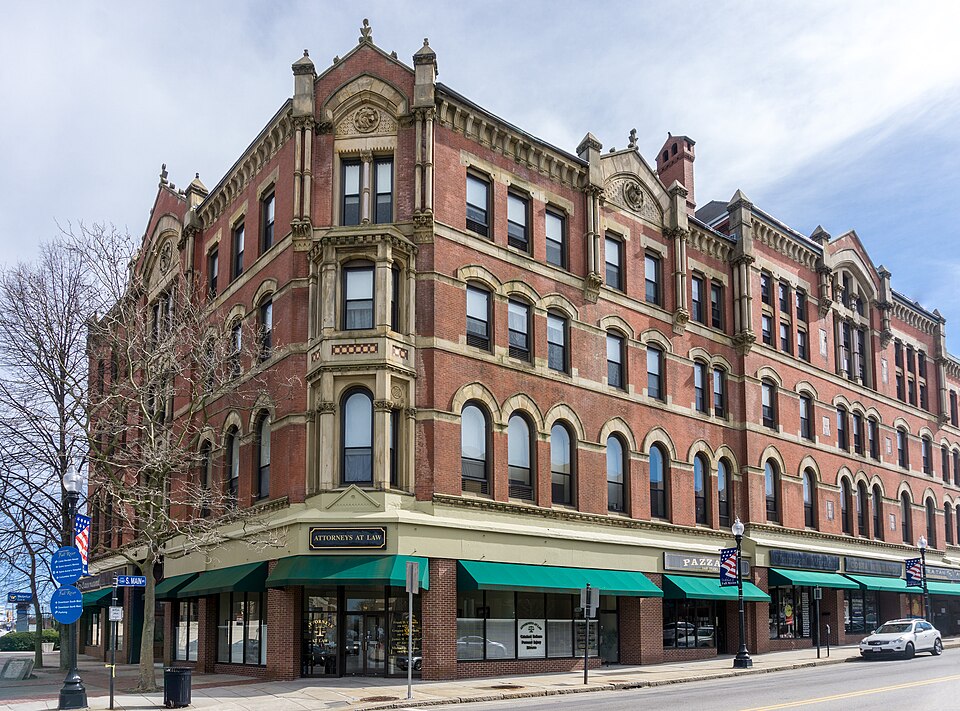
Built in 1876 in the Gothic Revival. Listed on the National Register of Historic Places in
1973. A historic map-sheet match is not published yet. The record needs a coordinate-quality review before it can be joined to a sheet boundary.
From the record
“Academy Building is a historic building in Fall River, Massachusetts. The building was constructed in 1875 as a memorial to Nathaniel Briggs Borden by his family.”
Wikipedia article Academy Building (Fall River, Massachusetts), CC BY-SA 4.0.
one of 272 National Register listings in Bristol County · listed in 1973 · category: Building · built in 1876, Gothic Revival, by Hartwell & Swasey · one of 8 National Historic Landmarks in Bristol County.
National Register reference number.73000277- the number the National Park Service assigned this property when it was listed, and the key its nomination file is catalogued under at the National Archives.
Fires near this property
27 since 2001
Regional context, not property-specific
evidence. The
federal wildfire occurrence database
lists 27 fires within 5 miles of Academy Building between
2001 and 2020, burning about 56 acres in total. None started naturally. 3 were recorded as arson.
Distance is straight-line from the map coordinates, so a fire counted
here may appear on a neighbouring settlement's page as well.
Reported cause
Fires
Missing data/not specified/undetermined
13
Debris and open burning
6
Arson/incendiarism
3
Misuse of fire by a minor
2
Recreation and ceremony
1
Power generation/transmission/distribution
1
Equipment and vehicle use
1
The most recent of
them, most recent first, with the day each was reported and the service
that recorded it.
Regional context, not property-specific
evidence. Museums hold 1,074 specimens
collected within 10 miles of Academy Building between 1844 and
1975: 594 Animalia, 369 Plantae, 78 Fungi, 29 Chromista, 4 Unrecorded. 12 distinct Species records are shown.
Collected by A E Schuyler, A. B. Hervey, A. Macrae and others. Each is a
physical object with a catalogue
number, and each entry opens the museum's record. This is what was
collected and kept, not a survey of what lives here - nothing can be
concluded from a species being absent.
Regional context, not property-specific
evidence. The federal mineral resources record lists
2 workings within 5 miles of Academy Building: 1 unknown, 1 plant.
1 still produces. What was taken out: Stone, Crushed/Broken, Sand and Gravel, Construction. Distance is straight-line from the
map coordinates, so a quarry counted here may appear on a neighbouring
settlement's page as well.
Regional context, not property-specific
evidence. The National Weather Service names
Fall River, the town this property stands in, in 24 storm reports between 1997 and 2025: 10 flood, 5 thunderstorm wind, 5 flash flood, 2 hail.
No death or injury is recorded in these reports. Each account below is quoted exactly as the forecast office
filed it, from the NOAA Storm Events Database, and each date
opens the federal record of that event.
At 1:25 PM EST, several cars were trapped in flood waters on Quequechan Street and Warren Street, near a Walmart store. The two streets were closed due to flooding.
Warren Street was flooded and impassable. A car was stuck in flood waters on Pleasant Street at the intersection with Quarry Street. Manhole covers popped off due to flooding on Globe Street.
No historic map-sheet match is published
for this property yet. That does not mean no map exists. This record needs
a coordinate-quality review before it can be joined to a sheet boundary.
Browse the county's mapped places while that work is
pending.
From the nomination file
4,053 words on record
When this property was proposed for the
National Register, someone wrote the case for it: what the building is,
and why it matters. That document is a federal record in the public domain.
It is quoted below word for word, never summarised. The text was read off the scanned case file by machine, so the
occasional stray character is the recogniser's and the 1970s
typewriter's.
Description of the property
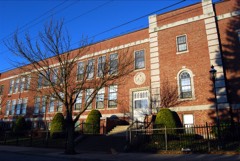
Moved - Unexposed (Check One) riginal Site The Academy Building (1876) occupies an important corner block and fronts on three streets: So. Main, So. Frontage, and Second Streets. It is four stories high, of red pressed brick, with plain and carved sandstone trim, and polished granite and encaustic tile detail. The style is High Victor- ian (or Ruskinian) Gothic, and the three facades, though composed different- ly, are unified through an abundant use of chromatic Gothic detail. The So. Main St. and So. Frontage St. facades are basically tripartite with large, shallow projecting, pedimented bays and flanking wings. The larger portion of the Second St.
facade serves as a theater wall and is simpler row of colossal pointed-arch windows with panel-brick insets and is capped with a wide panelled and corbelled brick entablature. The principal facades, on So. Main and So. Frontage Sts., have modern glass shop fronts on the street level, but retain their original fenestration of single, paired, and triple-grouped windows in the upper three stories. Decoration is colorfully and exuberantly applied. Windows are capped with pointed arches in the second story, segmental arches in the third story, and scalloped lintels in the fourth story. Sandstone courses divide the facades horizontally and connect windows at both sill and cornice levels.
On the fourth floor and in the central bays, paired stone columns with stylized Gothic pinnacles and framing roundels with finely carved grotesques, add to the Academy's decorative liveliness. Further sandstone ornamentation occurs on the So. Frontage St. facade, in the carved and tiled panels above the entrance, and in the canted corner bays projecting at either end.
18th Century 19th Century 20th Century Political "! Religion/Phi- losophy Science Sculpture Social/Human- itarian Theater Transportation Urban Planning Other (Specify) LL The Academy Building is an outstanding example of Ruskinian Gothic architecture, the most important building of this style in Fall River, and, in terms of its quality, scale, and condition, one of the finest in New England. It was completed in :1876 for Simeon Borden from designs of the Boston architects, Hartwell and Swazey. Constructed at the height of Fall River's commercial and cultural growth, it is unique in providing space and facilities for these two major forces in the city's development.
With shop-fronts and three floors of office space it offered the most desirable business location and was the finest commer- cial block in the city when completed. Today the office and retail portions of the block remain as the commercial heart of Fall River. The chief theater and opera house (the Academy of Music, from which building took its name) was located in the building and for over half a century it was the cultural center ofthe city, with the theater play- ing host to many famous performers in its day. Except for the much altered store fronts, the facades and exterior decoration of the building are in excellent condition. Inside, most original woodwork and plasterwork survives, also in good condition.
The theater is now in operation as a movie house, and is original through- out except for the seating of the parquet. There have been no major renovations at any time, and a theater the size and age of the Academy, still retaining its original stage machinery, drops, and sets, as well as its original crystal chandelier and ornate plastered and painted audience hall is a rare survival.
Quoted from the National Register nomination
for reference 73000277, 25 pages, held by the National Archives in Record
Group 79. See the
catalogue record.
Listed places nearby
6 within 8 miles
Other National Register properties close
enough to walk or drive between, ordered by distance from this one. Both
positions come from the same geocoding pass that matched these properties
to their map sheets.
Listing record. National Park Service National Register of Historic Places, listed-properties dataset, current to 2026-05-22.
Map join. Address geocoded through the United States Census geocoder, then tested against the published boundary of every sheet in the USGS Historical Topographic Map Collection.
How this page is made. Listing fields come from federal records; map-sheet coverage is a labelled coordinate-to-boundary calculation, not a source-field claim.
Wildfire. Short, Karen C. 2022. Spatial wildfire occurrence data for the United States, 1992-2020 [FPA_FOD_20221014]. 6th Edition. Fort Collins, CO: Forest Service Research Data Archive. https://doi.org/10.2737/RDS-2013-0009.6 Collected with United States Government funding and usable without additional permissions or fees.
Specimens. Global Biodiversity Information Facility (GBIF), https://www.gbif.org/. Only records licensed CC0 or CC BY are used. Records licensed CC BY-NC are excluded because this site carries advertising. Images are checked individually and any whose licence is non-commercial, no-derivatives or unreadable is refused.
Mines and quarries. USGS Mineral Resources Data System (MRDS) https://mrdata.usgs.gov/mrds/ A work of the United States government, no copyright under 17 U.S.C. 105.
Storms. NOAA National Centers for Environmental Information, Storm Events Database https://www.ncei.noaa.gov/stormevents/ A work of the United States government, no copyright under 17 U.S.C. 105. Narratives are quoted verbatim from the National Weather Service report and are not edited or summarised.
 Block
Block