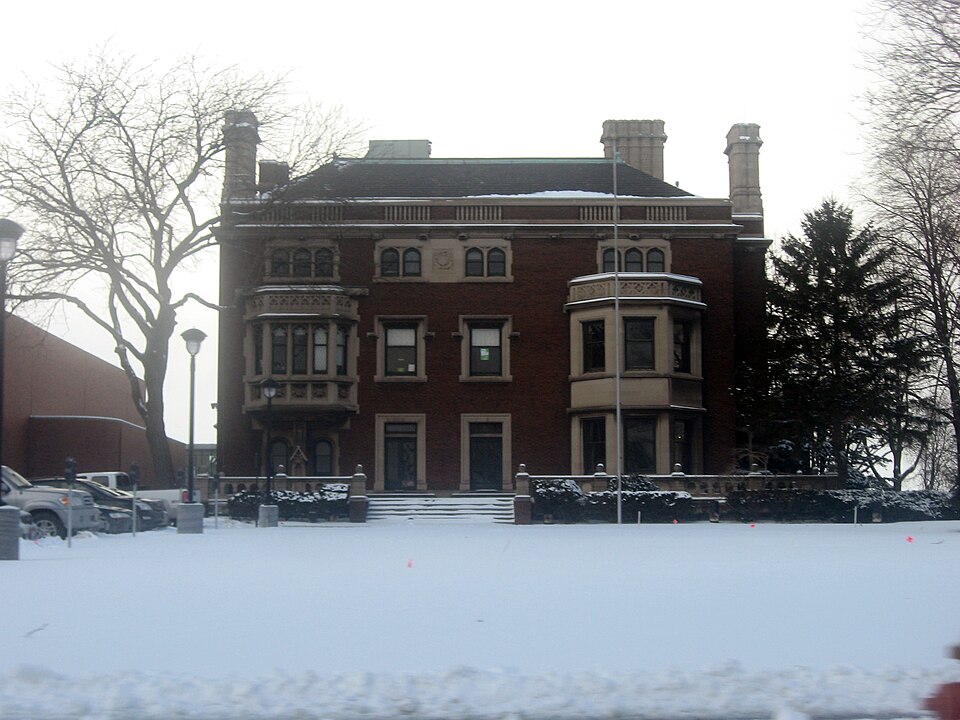
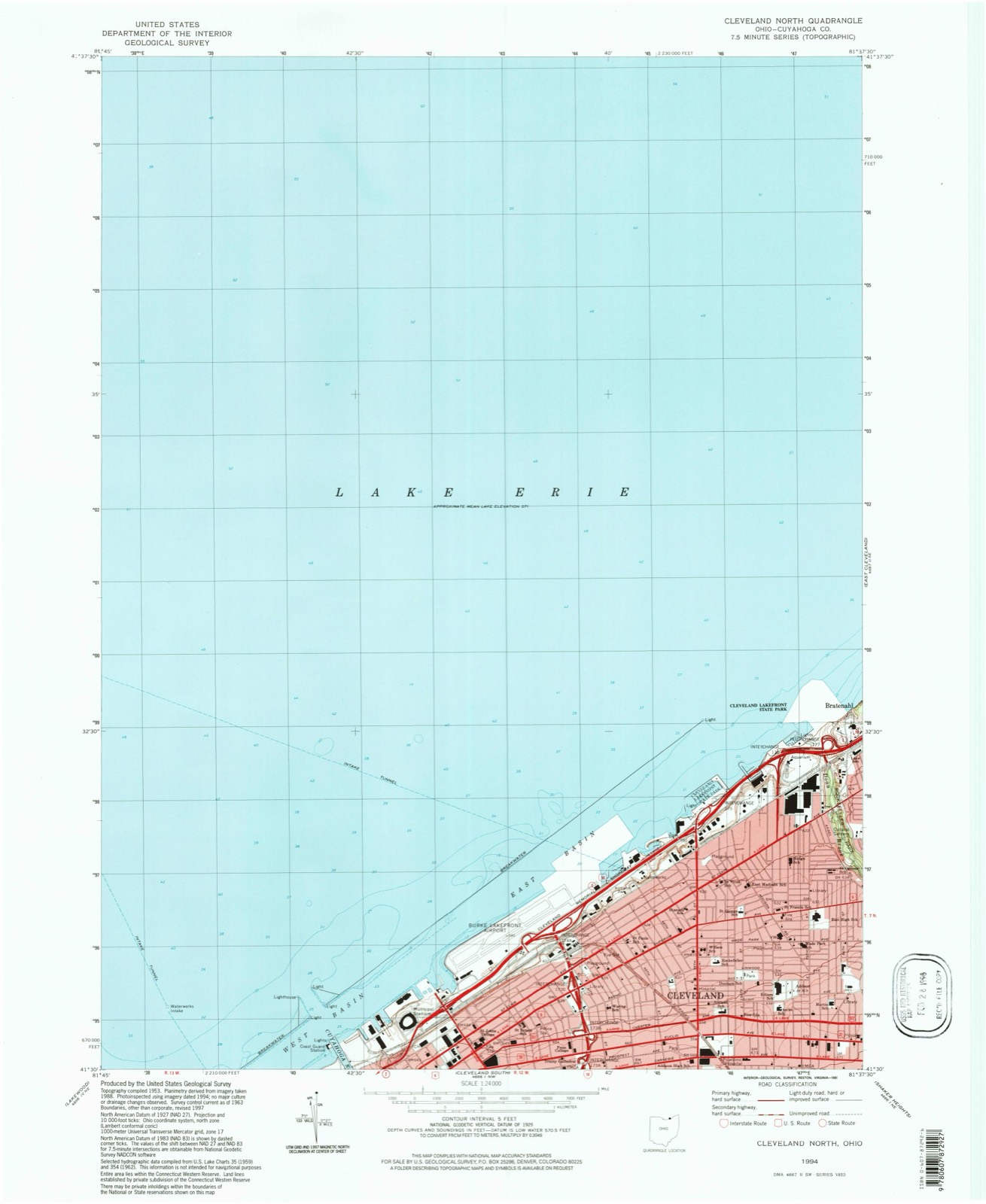
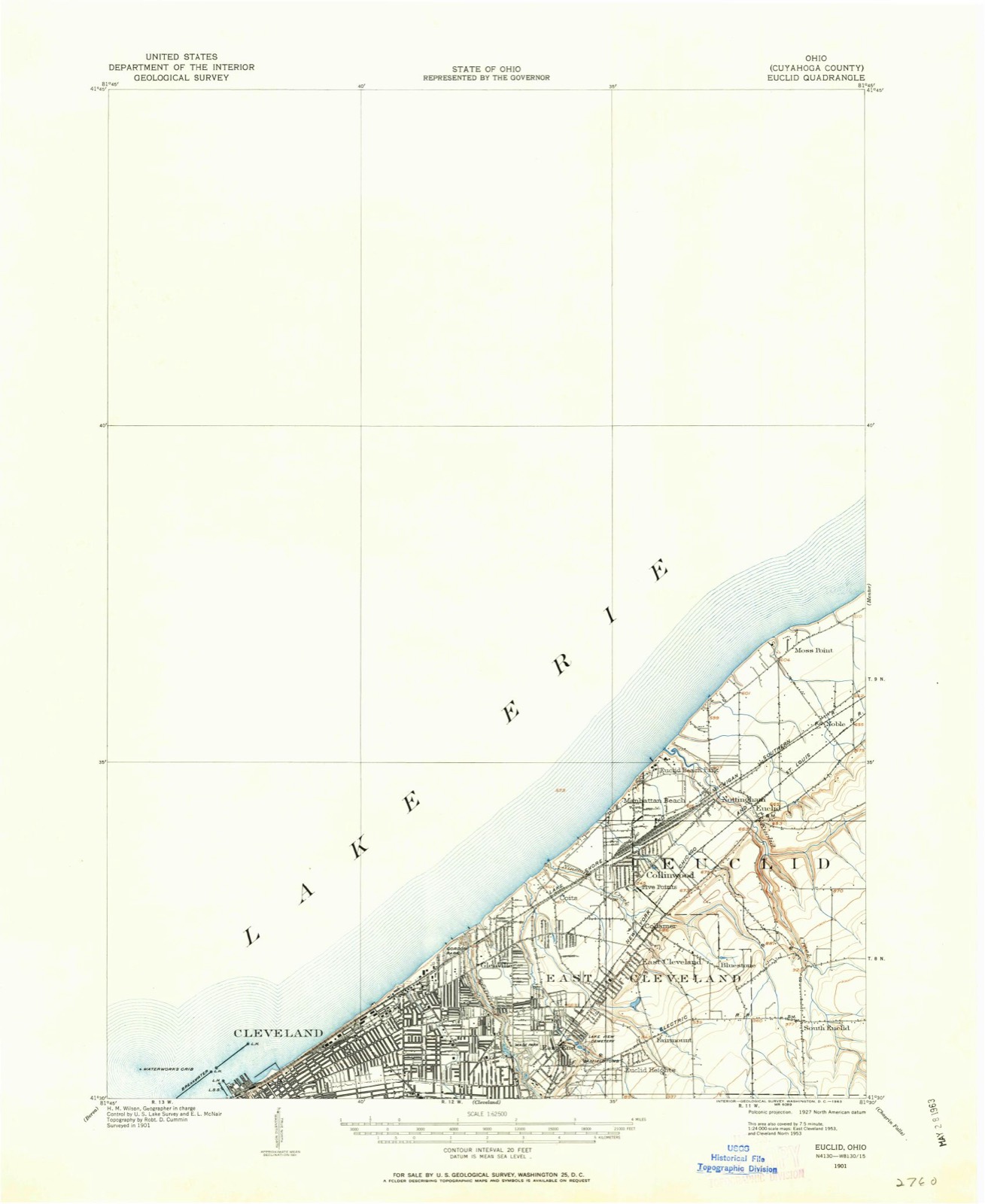
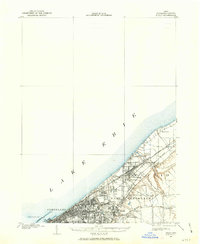
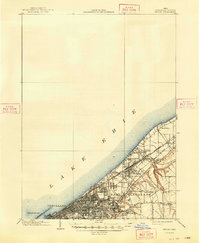
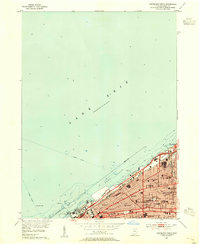
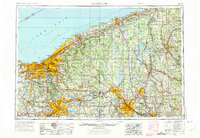
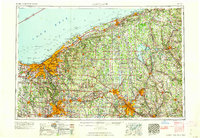
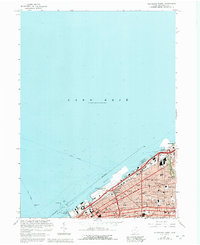
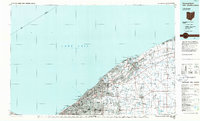
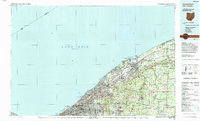
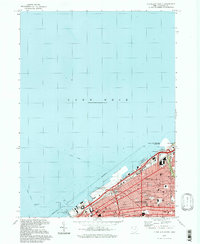
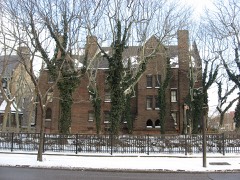
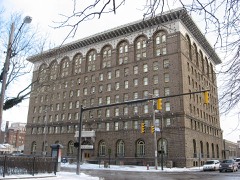
Built in 1910 (Tudor Revival architecture). Listed on the National Register of Historic Places in 1973. 9 historic topographic surveys show this location, the earliest from 1901.
From the record
One of 426 National Register listings published here for Cuyahoga County · listed in 1973 · category: Building · built in 1910, Tudor Revival architecture, by Charles F. Schweinfurth.
National Register reference number.73001421- the number the National Park Service assigned this property when it was listed, and the key its nomination file is catalogued under at the National Archives.
Then and now
1901 to 1994
The ground this property stands on, surveyed
93 years apart. Drag the handle to wipe between them. Both sheets are
United States Geological Survey originals; neither has been altered.
19011994
The ground it stands on
23,212 words
The chapter on Cleveland City in History of Cuyahoga County Ohio, published 1870 names Cleveland. This is what it says, exactly as the scans read.
At the Erie Conference M. EK. Church, in the fall of 1838, resolutions were passed dis approving any expression by the churches on the question of American slavery. This action was received with disfavor by a portion of the members of the church in Cleveland. On September 1, 1839, an organization was effected, consisting of about sixty members, who withdrew from the First Methodist Episcopal Church for that purpose. This new church stood alone until May, 1843. when it sent delegates to a convention held at Utica, New York, and there went into the organization which has ever since been known as the Wesleyan Methodist Connection of America.
John W. Allen was born in Litchfield, Connecticut, in 1802. He resided in Chenango county, New York, from 1820 to 1825, when he removed to Cleveland, where he has ever since lived. He was admitted to the bar the next year, and for several succeeding years was engaged in the active practice of his profession.
Regional context, not property-specific
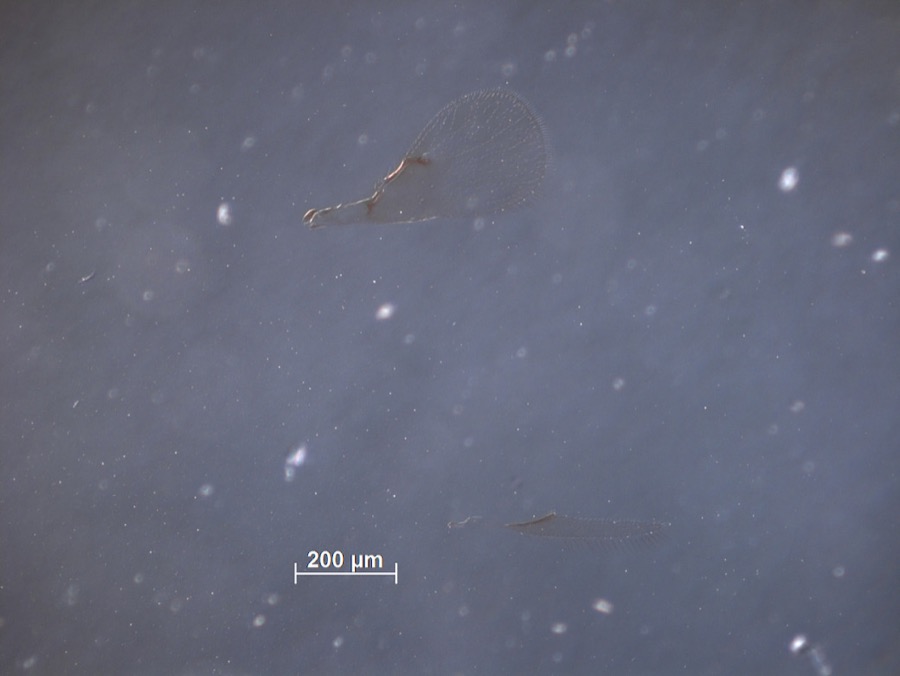
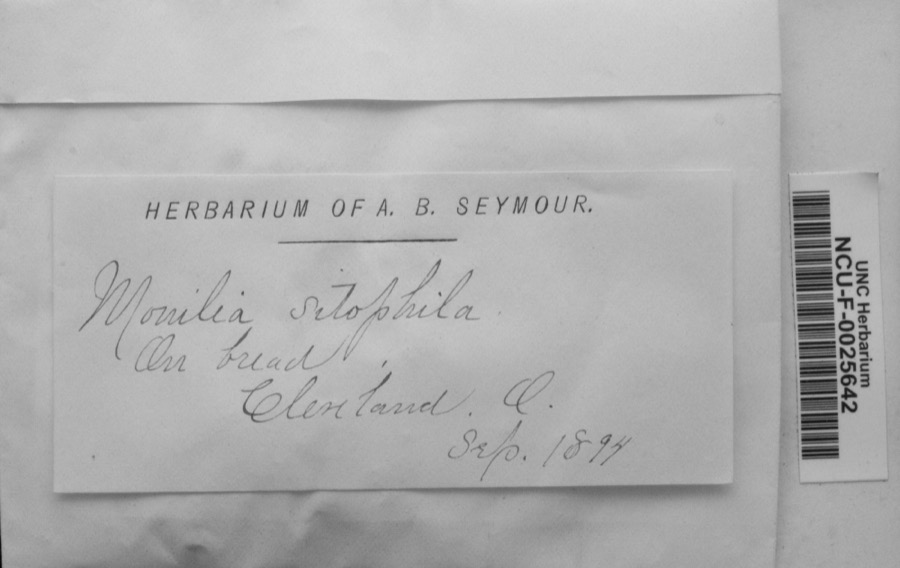
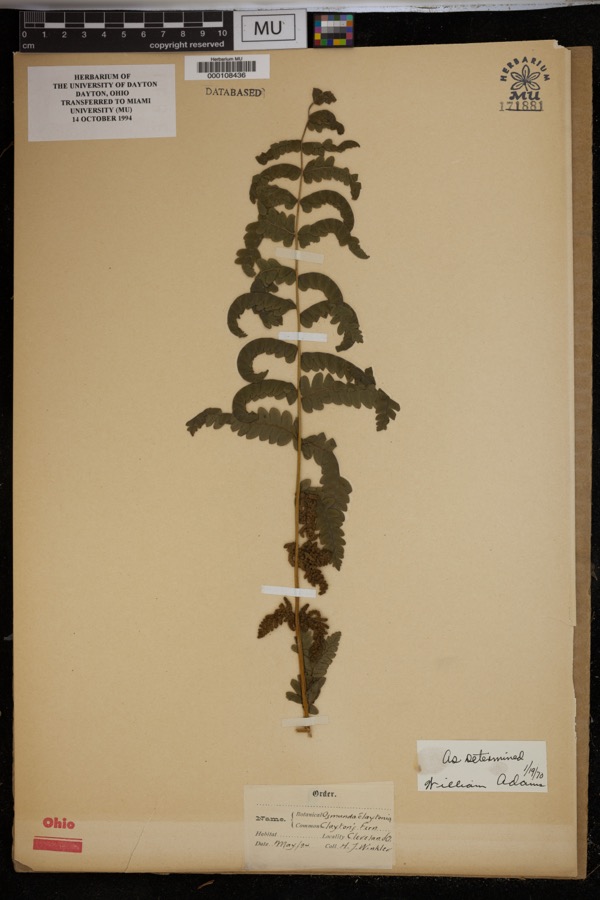
evidence. Museums hold 3,759 specimens
collected within 10 miles of University Hall, Cleveland State University between 1849 and 1975: 3,343 Animalia, 216 Fungi, 121 Plantae, 73 Protozoa, 5 Unrecorded, 1 Chromista.
12 distinct Species records are shown.
Collected by A. D. Huryn, A. D. Selby, A. G. Newhall and others. Each is a
physical object with a catalogue
number, and each entry opens the museum's record. This is what was
collected and kept, not a survey of what lives here - nothing can be
concluded from a species being absent.
Regional context, not property-specific
evidence. The federal mineral resources record lists
19 workings within 5 miles of University Hall, Cleveland State University: 10 unknowns, 6 producers, 2 past producers, 1 plant.
7 still produce. What was taken out: Iron, Zirconium, Silica, Halite. Distance is straight-line from the
map coordinates, so a quarry counted here may appear on a neighbouring
settlement's page as well.
Regional context, not property-specific
evidence. The National Weather Service names
Cleveland, the town this property stands in, in 95 storm reports between 1994 and 2025: 51 thunderstorm wind, 26 hail, 11 flash flood, 3 lightning.
The reports record 3 deaths and 6 injuries. Each account below is quoted exactly as the forecast office
filed it, from the NOAA Storm Events Database, and each date
opens the federal record of that event.
During a sailboat race on Lake Erie, two people who were not wearing life preservers, were swept overboard by high waves and drowned. A total of four boats capsized and twelve people were swept overboard.
Thunderstorm wind gusts of 35 to 40 mph blew down two large tents on the west side of Cleveland. Three people inside were injured when the tents collapsed. One person was hospitalized. A peak wind gust of 36 mph was measured at nearby Cleveland Hopkins International Airport.
During the afternoon hours of the 2nd, a severe thunderstorms moved over downtown Cleveland. This thunderstorm remained nearly stationary over the downtown area for around an hour, and dropped as much as four and a half inches of rain. Several rainfall reports of 3.0 to 4.5 inches were received from downtown Cleveland. This rain fell in less than 90 minutes. Local streets and highways throughout the downtown area quickly filled with water. Many roads, including Interstate 90 were impassable by flood waters as much as four feet deep. Many vehicles became stranded in the flood waters. Once the rain ended, the high water receded quickly. This was a very local event in Cuyahoga County as the southern part of the county remained mainly dry. In fact, Cleveland Hopkins Airport did not receive any rainfall from this thunderstorm.
Heavy thunderstorm rain caused widespread flooding of roads and low lying areas in Cleveland and surrounding suburbs. In Newburgh Heights, Interstate 77 was flooded with three to four feet of water and an elderly couple had to be rescued from their floating car. Over five inches of rain was measured in some southern and eastern sections as storms repeatedly crossed the area for several hours.
Thunderstorms dumped up to three inches of rain on downtown Cleveland during the late afternoon hours. A television station located just east of downtown recorded 2.75 inches of rain in only 48 minutes. Major street flooding occurred and dozens of cars became stuck in water up to four feet deep. Several motorists had to be rescued from their vehicles.
Broadcast media posted a photo on social media of a large tree that fell on a house on the west side of Cleveland. The time was radar estimated. The media also reported 25,000 residents within the metropolitan Cleveland area lost power. One Giant Eagle grocery store had to throw out all of their refrigerated items after losing power. Tree limbs were also reported down on Martin Luther King Boulevard.
Rainfall amounts of 2 to 3.5 inches fell over Cleveland during a span of 60-90 minutes. Citywide flooding resulted as storm water systems were overwhelmed. Many roads including I 480 were flooded and closed for a brief period.
The Big Creek in Cuyahoga County (drainage basin 35.3 square miles) cuts through parts of Brooklyn and Cleveland before draining into the Cuyahoga River. On the morning of the 7th radar estimated rainfall amounts between 1.5 and 1.75 inches over the Big Creek basin. Some roads adjacent to the creek were closed. Most notably, the Cleveland Metropark Zoo was closed as water flooded their parking lots and threatened the veterinary clinic and other buildings.
16 papers published in this town,
digitised by the Library of Congress and free to read. Every page is searchable, so a name or a street can be
looked for directly in what the town printed about itself at the time.
United States Geological Survey topographic
sheets whose coverage includes this point. Matched by taking the coordinate the National Park Service records for this property, then
testing that coordinate against the published boundary of every sheet.
When this property was proposed for the
National Register, someone wrote the case for it: what the building is,
and why it matters. That document is a federal record in the public domain.
It is quoted below word for word, never summarised. The text was read off the scanned case file by machine, so the
occasional stray character is the recogniser's and the 1970s
typewriter's.
Description of the property
large rectangular, three story building is built of dark red, waterstruck, The left bay, an oriel window containing Mrs. Mather's second floor bedroom and study, is delicately scaled with narrow leaded windows and carved lime- with larger windows, an unadorned limestone spandrel and a more boldly detailed stone terrace reached by a broad run of stairs from the lawn and two sets of ade, from the irregular spacing of the ballustrade sections above the cornice Tudor arch flanked by a pair of Tudor arch windows, contains double bronze cast bronze grillage encloses the back porch on the north end of the build- ing. Formerly, the "back porch" led to an elaborate Italian-style sunken led into a large foyer (40 x 24') paneled in English brown oak, with a library, dining room.
kitchen, pantries, billiard room, den, an office for rooms, dressing rooms, linen and sewing rooms), and on the third floor were eight bedrooms, a trophy room, and a magnificent formal ballroom 65' x 27' 1ng, mostly oak, covers most of the walls in the house and the floors are of offices of the student newspaper, the Cauldron, and the University's Department of Development with its offices of Alumni Affairs, Public Infor-- counseling, student lounges, student council offices, while the third floor has the Afro-American Cultural Center, the Board of Trustees' meeting room, CONDITION ond floor headquarters the Student Life Center which includes testing and abethan fireplace and classic marble figure sculpted by Antonio Rossi of several other offices.
On the second floor were seven suites of rooms (bedrooms,sitting feet wide, facing Euclid Ave. features two dissimilar limestone bay projections.
Head of the firm of Pickands, Mather & Co. and Public Citizen of Cleveland, Ohio, Samuel Mather was born in Cleveland, Ohio July 13, 1851. His mother Richard Mather who came to this country from near Liverpool, England; his brother, Increase, was one of the first presidents of Harvard University, His father, Samuel Livingston Mather, was a prominent lawyer and a Director Harvard, but while working there he had a serious accident which prevented the firm of Pickands, Mather & Company; was a member of the Executive Committee of American Nat'1 Red Cross, member of Presiding Bishop and Council orations of Cleveland, as well as many social organizations. He was President of Lakeside Hospital, V.P. and Trustee of Western Reserve the U.S. by the Cleveland Chamber of Commerce.
Conservation losophy Communications Engineering Architecture Theater Transportation Commerce Science Aboriginal Industry NATIONAL Religion/Phi SIGNIFICANCE Music Agriculture Education Literature Invention Military Landscape Sculpture of the Connecticut Land Company which purchased the Western Reserve lands Social/Human- and established the Cleveland Iron Mining Co.in 1852.This was the first while Increase's son Cotton became one of the founders of Yale University. of the Protestant Episcopal Church; Director of the United States Steel University; Trustee of the Cleveland Museum of Art, and Warden of Trinity Samuel Mather went into the mines of Cleveland Iron Mining before going to company to enter the iron ore industry. Urban Planning his known gifts amounted to $7,277,452.
Pre-Columbian| Political pioneer days to Metropolitan Cleveland of 193l.At the time of his death Other (Specify) of the city of Cleveland. REGISTER itarian Art from the state of Connecticut and which furnished many of the early settlers Cathedral.
Quoted from the National Register nomination
for reference 73001421, 14 pages, held by the National Archives in Record
Group 79. See the
catalogue record.
Listed places nearby
6 within 8 miles
Other National Register properties close
enough to walk or drive between, ordered by distance from this one. Both
positions come from the same geocoding pass that matched these properties
to their map sheets.
Listing record. National Park Service National Register of Historic Places, listed-properties dataset, current to 2026-05-22.
Map join. Address geocoded through the United States Census geocoder, then tested against the published boundary of every sheet in the USGS Historical Topographic Map Collection.
How this page is made. Listing fields come from federal records; map-sheet coverage is a labelled coordinate-to-boundary calculation, not a source-field claim.
Specimens. Global Biodiversity Information Facility (GBIF), https://www.gbif.org/. Only records licensed CC0 or CC BY are used. Records licensed CC BY-NC are excluded because this site carries advertising. Images are checked individually and any whose licence is non-commercial, no-derivatives or unreadable is refused.
Mines and quarries. USGS Mineral Resources Data System (MRDS) https://mrdata.usgs.gov/mrds/ A work of the United States government, no copyright under 17 U.S.C. 105.
Storms. NOAA National Centers for Environmental Information, Storm Events Database https://www.ncei.noaa.gov/stormevents/ A work of the United States government, no copyright under 17 U.S.C. 105. Narratives are quoted verbatim from the National Weather Service report and are not edited or summarised.
 Block