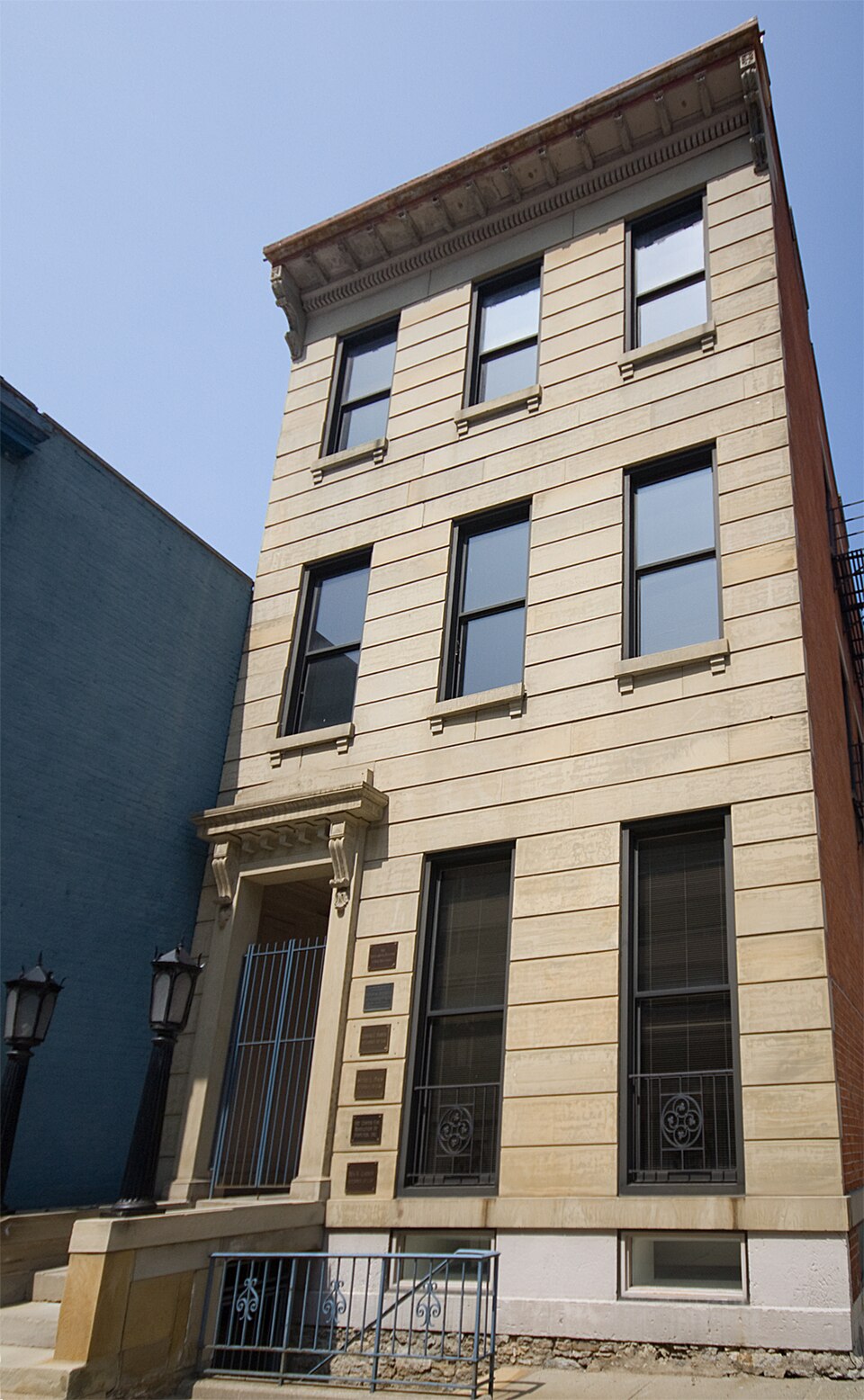
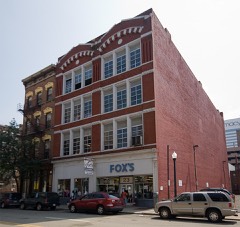
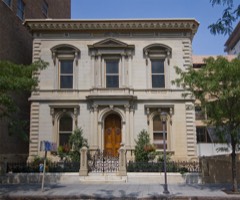
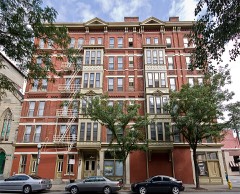
Built in 1830 in the Greek Revival architecture. Listed on the National Register of Historic Places in
1979. A historic map-sheet match is not published yet. The record needs a coordinate-quality review before it can be joined to a sheet boundary.
From the record
“Friedlander House is a historic residence in downtown Cincinnati, Ohio, United States. Erected in 1830, it features a facade three stories tall and three bays wide; although brick is employed in some of the walls, both the foundation and the walls are predominantly sandstone.”
Wikipedia article Abraham J. Friedlander House, CC BY-SA 4.0.
one of 314 National Register listings in Hamilton County · listed in 1979 · category: Building · built in 1830, Greek Revival architecture · one of 9 National Historic Landmarks in Hamilton County.
National Register reference number.79001855- the number the National Park Service assigned this property when it was listed, and the key its nomination file is catalogued under at the National Archives.
The reader looks forward to this, the first history of Cincinnati that has yet found itself in print. The writers look back across its half-century of chapters and the century of years embraced by its annals, and have, chiefest of all, to regret many unavoidable errors, both of omission and commission. The more important of these, it is hoped, will appear in our page of errata; but there are still many, doubtless, that have escaped the compilers' attention. In a few cases, discrepancies appear between their statements and those of an extract immediately following. In those instances they must assure the reader that the former rest upon an authority believed to be superior to the other in regard to the matter in hand; but time and space could not always be taken for the discussion and settlement of points concerning which there are variant reports. In all really important matters, they believe the history will be found quite trustworthy, especially when corrected from the page of errata.
Within the decade whose annals have just been passed in review, fell the birth of Cincinnati township, to which was entrusted, for almost twelve years, the government of Cincinnati village, which it of course contained. The township was created, after Columbia, by the court of general quarter sessions of the peace, which then had jurisdiction in these matters, in 1791. To the time of the erection of these townships, the whole county, which contained but a few hundred white inhabitants, was most conveniently governed as one municipality.
Regional context, not property-specific
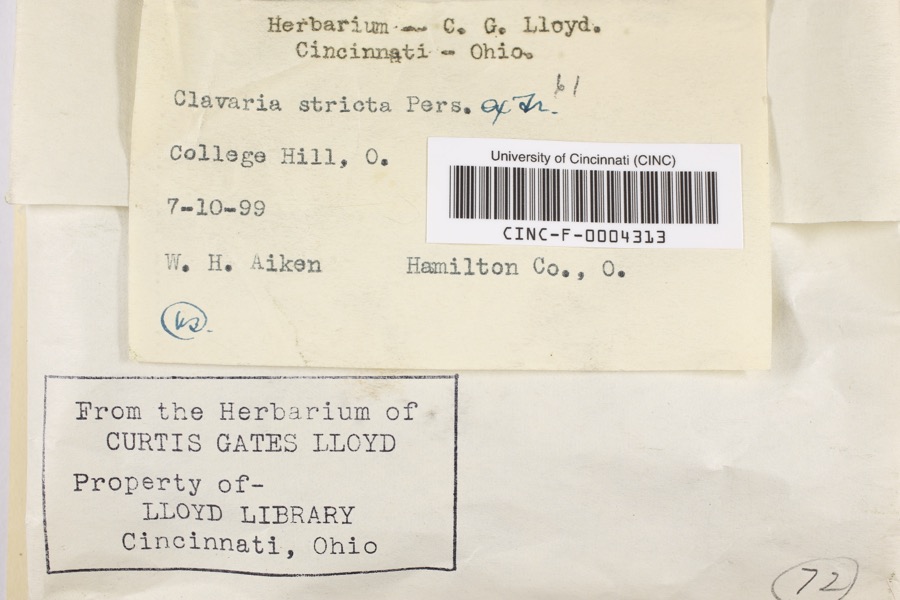
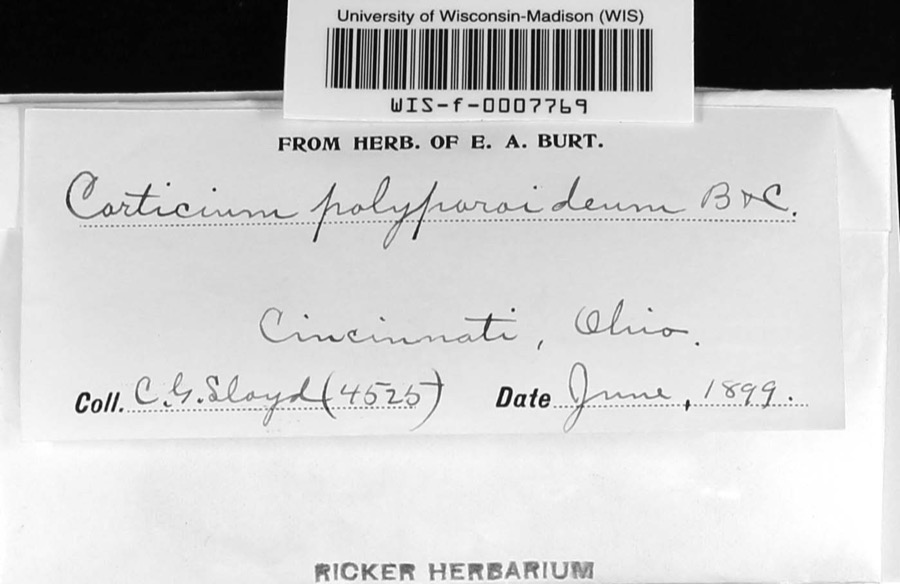
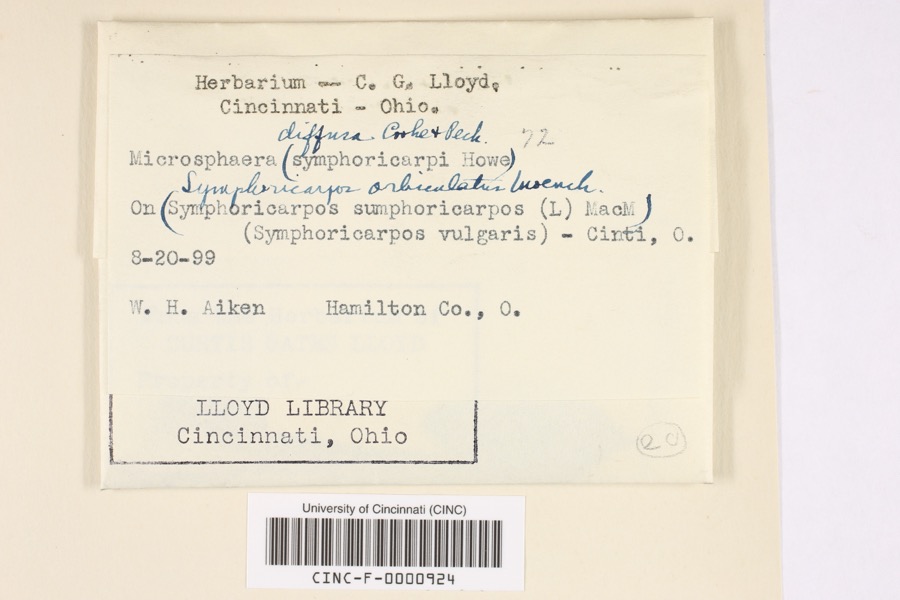
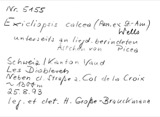
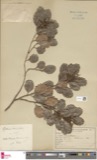
evidence. Museums hold 5,874 specimens
collected within 10 miles of Friedlander, Abraham J., House between 1819 and
1975: 2,846 Fungi, 1,719 Animalia, 960 Plantae, 298 Protozoa, 32 Unrecorded, 18 Chromista, 1 Bacteria. 12 distinct Species records are shown.
Collected by A Schwartz, A. Braun, A. F. Braun and others. Each is a
physical object with a catalogue
number, and each entry opens the museum's record. This is what was
collected and kept, not a survey of what lives here - nothing can be
concluded from a species being absent.
Regional context, not property-specific
evidence. The federal mineral resources record lists
1 working within 5 miles of Friedlander, Abraham J., House: 1 unknown.
None of them still produces. What was taken out: Tin, Lead, Antimony. Distance is straight-line from the
map coordinates, so a quarry counted here may appear on a neighbouring
settlement's page as well.
Regional context, not property-specific
evidence. The National Weather Service names
Cincinnati, the town this property stands in, in 70 storm reports between 1994 and 2025: 25 thunderstorm wind, 17 hail, 14 flash flood, 7 flood.
The reports record 1 injury. Each account below is quoted exactly as the forecast office
filed it, from the NOAA Storm Events Database, and each date
opens the federal record of that event.
Numerous roads were flooded throughout the Cincinnati area and some basements were flooded. Flooding also caused some damage at Reading High School and Whitaker Elementary School.
Lightning struck a home causing a fire in the attic, which spread toward the second floor before being extinguished. Significant fire and water damage occurred to the home.
High water was reported on several roads in the downtown Cincinnati area and the near West Side. A retaining wall collapsed onto a roadway near the intersection of State Avenue and Ernst Street and a building was flooded on Poplar Street. Also, an apartment basement flooded on Linn Street and one resident needed to be rescued.
14 papers published in this town,
digitised by the Library of Congress and free to read: 0 issues,
0 pages. Every page is searchable, so a name or a street can be
looked for directly in what the town printed about itself at the time.
No historic map-sheet match is published
for this property yet. That does not mean no map exists. This record needs
a coordinate-quality review before it can be joined to a sheet boundary.
Browse the county's mapped places while that work is
pending.
From the nomination file
3,215 words on record
When this property was proposed for the
National Register, someone wrote the case for it: what the building is,
and why it matters. That document is a federal record in the public domain.
It is quoted below word for word, never summarised. The text was read off the scanned case file by machine, so the
occasional stray character is the recogniser's and the 1970s
typewriter's.
Description of the property
The building located at 8 West Ninth Street is an excellent example of mid-nineteenth century townhouse architecture. The front block, built c. 1830-1850, is three stories in height and exhibits an asymmetrical three bay facade. This facade is dressed with a noteworthy on the facade is a classical entrance, which is approximately 3½ feet above elements are repeated near the top of the building and contribute to its overall harmony The remainder of the facade is characterized by bracketed lugsills, a Dayton limestone have long since been replaced. The first addition, built c. 1855, is two stories in height and is of stretcher bond The extent of the alterations to the exterior of this building is limited, most of it windows as practicality will allow.
CONDITION UNEXPOSED MOVEDDATE DETERIORATED wooden walls and terra cotta detail on the ceiling complement the Greek Revival doorway. from the hallway up to the third floor. A cherry newel post, scrolled moldings, and cherry and maple woodwork is located in the midsection of the building. like the windows. floor bays are taller than the upper floors.All of the windows throughout the building story staircase.A modest cherry bannister is supported by turned tiger maple spindles and balance. smooth sandstone facing that is accentuated by incised or beveled horizontal bands.Most The frontispiece is distinguished by two simple sandstone pilasters which support a which adorned the projecting arms of the stoop, are currently being restored.
moulded jambs and surrounds, some of them exhibiting protruding cornices. Many of the doors classical entablature: incised brackets, dentils and a plain cornice.A variation of these The interior of this building retains some notable detailing, particularly the three The vestibule adds to the elegance of an otherwise modestly detailed building.
Cincinnati, Ohio. and composition of the Greek Revival mode. Although many of the details are muted, it does Lafever's Beauties of Modern Architecture, first published in 1835. The architectural famous contemporary architect, through his numerous publications, of influencing local preceding the Civil War, Cincinnati was the world's leading meat packing center. Laboiteaux & Sons, wholesale dealers in liquors, set up residence. Other prosperous 1700-1799 EDUCATION ART BUILDER/ARCHITECT SIGNIFICANCE ARCHEOLOGY-HISTORIC THEATER PERIOD SCULPTURE Unknown PREHISTORIC MILITARY INDUSTRY CONSERVATION have any impact on this building.
But neither can one deny the strong possibility of a INVENTION TRANSPORTATION POLITICS/GOVERNMENT XARCHITECTURE "In any consideration of the creative modification of Greek forms in American _EXPLORATION/SETTLEMENT _COMMUNICATIONS authored five major works on Greek Revival architecture.
It can be suggested the 1850's, substantial expansion occurred, as evidenced through a significant increase in architecture one comes again and again on traces of influences from the books AGRICULTURE century period architecture and also for its association with the commercial history of of Asher Benjamin and Minard Lafever.These were used by designers and The Abraham J.Friedlander House is significant as a representative example of nineteenth Friedlander House's interior floor plan and detail are very much in accord with manufacturers of clothing moved in.Then in 1867,Lafayette La Boiteaux of Lafayette called),and it rapidly became a desirable residential haven for prosperous Cincinnatians. city's built environment.
Until the early 1820's, Seventh Street on Northern Row served as the northern boundary for most of the city's residential population.By 1824, Mssrs.
Quoted from the National Register nomination
for reference 79001855, 18 pages, held by the National Archives in Record
Group 79. See the
catalogue record.
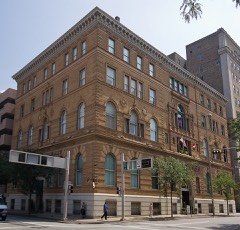
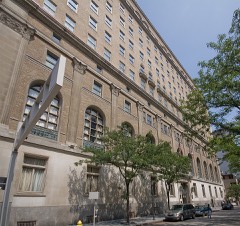
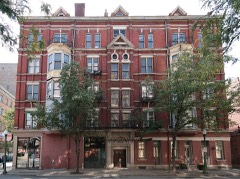
Listed places nearby
6 within 8 miles
Other National Register properties close
enough to walk or drive between, ordered by distance from this one. Both
positions come from the same geocoding pass that matched these properties
to their map sheets.
Listing record. National Park Service National Register of Historic Places, listed-properties dataset, current to 2026-05-22.
Map join. Address geocoded through the United States Census geocoder, then tested against the published boundary of every sheet in the USGS Historical Topographic Map Collection.
How this page is made. Listing fields come from federal records; map-sheet coverage is a labelled coordinate-to-boundary calculation, not a source-field claim.
Specimens. Global Biodiversity Information Facility (GBIF), https://www.gbif.org/. Only records licensed CC0 or CC BY are used. Records licensed CC BY-NC are excluded because this site carries advertising. Images are checked individually and any whose licence is non-commercial, no-derivatives or unreadable is refused.
Mines and quarries. USGS Mineral Resources Data System (MRDS) https://mrdata.usgs.gov/mrds/ A work of the United States government, no copyright under 17 U.S.C. 105.
Storms. NOAA National Centers for Environmental Information, Storm Events Database https://www.ncei.noaa.gov/stormevents/ A work of the United States government, no copyright under 17 U.S.C. 105. Narratives are quoted verbatim from the National Weather Service report and are not edited or summarised.
 Block
Block