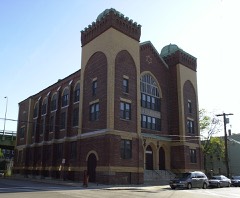
Listed on the National Register of Historic Places in
1982. A historic map-sheet match is not published yet. The record needs a coordinate-quality review before it can be joined to a sheet boundary.
From the record
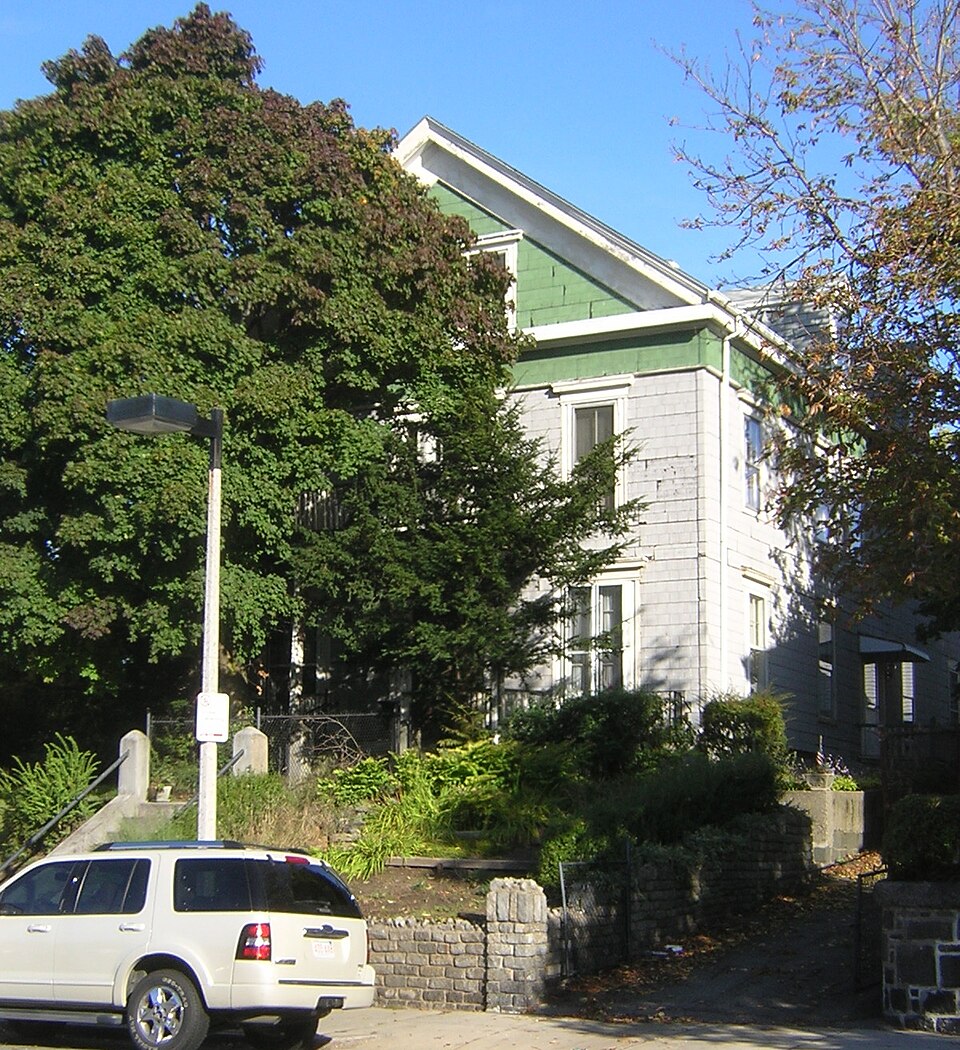
“The Donald McKay House is a privately owned historic house at 78-80 White Street in East Boston, Massachusetts. It was the residence of Donald McKay, a builder of clipper ships.”
Wikipedia article Donald McKay House, CC BY-SA 4.0.
one of 206 National Register listings in Suffolk County · listed in 1982 · category: Building · one of 5 National Historic Landmarks in Suffolk County.
National Register reference number.82004450- the number the National Park Service assigned this property when it was listed, and the key its nomination file is catalogued under at the National Archives.
What happened here
An account from the chapter on Boston city, The inset identifies its exact
source book and publication year.
IN giving some notices of manners and social life during this period, I shall speak first of usages which were characteristic of the close of the last century: most of them continued without essential modification until our city charter swept away the old landmarks, and Boston felt the im¬ pulses which mark a new epoch in her history.
Illustrations: State House and the Monument (in 1811), 64; the Monument from the corner of Temple and Derne streets, 65 ; the Monument and the Thurston House, 65; Beacon Street and the Common (in 1804-1811), heliotype, 65; Boston from Breed's Hill (in 1791), 66; the Faneuil-Phillips House,
IN giving some notices of manners and social life during this period, I shall speak first of usages which were characteristic of the close of the last century: most of them continued without essential modification until our city charter swept away the old landmarks, and Boston felt the im¬ pulses which mark a new epoch in her history. It is difficult to deal justly with ways of living which are not widely different from those that surround us. We miss the salient contrasts which lend themselves to picturesque de¬ scription, and are tempted to look for exceptional occurrences to brighten a narrative, rather than for facts which are truly symptomatic of taste and thought. Were it possible to go back four-score years, or even a century, and mingle with those then conducting the town, we should not feel among strangers. In many respects their ways were counterparts of our own. In certain directions, indeed, we might note a narrowness of range and a contraction of outlook, while envying the vigor of speech and de¬ cisiveness of action which seemed the outcome of the limitations. When Massachusetts took her place in the sisterhood of States, the gigantic up¬ heaval of the French Revolution had not taken place. The prophets whom her capital was to raise up to demand the redemption of human society, each with his panacea for its sad ailments, had put in no appearance. The tyranny of England had been broken by an heroic effort, and any further redemption which society might need would be provided by those who VOL. iv. - i.
Regional context, not property-specific
evidence. The
federal wildfire occurrence database
lists 38 fires within 5 miles of McKay, Donald, House between
2015 and 2020, burning about 19 acres in total. None started naturally. 2 were recorded as arson.
Distance is straight-line from the map coordinates, so a fire counted
here may appear on a neighbouring settlement's page as well.
Reported cause
Fires
Missing data/not specified/undetermined
16
Debris and open burning
12
Recreation and ceremony
4
Smoking
3
Arson/incendiarism
2
Misuse of fire by a minor
1
The most recent of
them, most recent first, with the day each was reported and the service
that recorded it.
Regional context, not property-specific
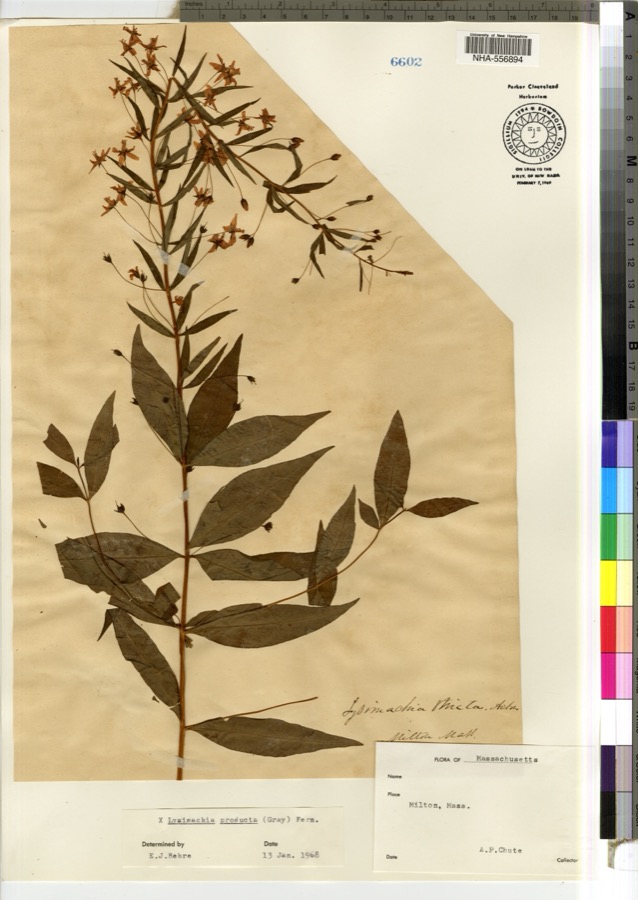
evidence. Museums hold 17,656 specimens
collected within 10 miles of McKay, Donald, House between 1810 and
1975: 8,032 Plantae, 4,189 Fungi, 3,613 Animalia, 1,290 Chromista, 229 Bacteria, 184 Protozoa, 119 Unrecorded. 12 distinct Species records are shown.
Collected by ?, A B Seymour, A C Gibson and others. Each is a
physical object with a catalogue
number, and each entry opens the museum's record. This is what was
collected and kept, not a survey of what lives here - nothing can be
concluded from a species being absent.
Regional context, not property-specific
evidence. The federal mineral resources record lists
14 workings within 5 miles of McKay, Donald, House: 9 plants, 2 past producers, 2 producers, 1 unknown.
11 still produce. What was taken out: Iron, Lead, Stone, Crushed/Broken, Gypsum-Anhydrite. Distance is straight-line from the
map coordinates, so a quarry counted here may appear on a neighbouring
settlement's page as well.
Regional context, not property-specific
evidence. The National Weather Service names
Boston, the town this property stands in, in 64 storm reports between 1994 and 2024: 37 thunderstorm wind, 9 flash flood, 7 lightning, 7 flood.
The reports record 1 death and 9 injuries. Each account below is quoted exactly as the forecast office
filed it, from the NOAA Storm Events Database, and each date
opens the federal record of that event.
A 50 year old man was struck by lightning while walking in an area known as the Sugar Bowl in South Boston. Lightning struck him in the head, passing through his back and exiting his feet. He collapsed in cardiac arrest and was revived and hospitalized for several days before dying from his injuries.
A 29 year old male and a 29 year old female were knocked unconscious when lightning struck them at Thomas Park, where the pair were watching the July 4th fireworks. They regained consciousness prior to the arrival of EMTs, but unable to feel their legs and were transported to Brigham and Women's Hospital.
In Boston, two cars were stuck in flood waters on Corey Road. Storrow Drive was closed due to flooding at the Mass Avenue and Longmeadow Bridges. Several other roadways in the city experienced significant flooding.
Numerous trees and wires and several utility poles were downed throughout Boston, including in Boston Common. Several trees were downed onto cars throughout town, though no injuries resulted. One tree was downed onto a building on Corey Road. The Automated Surface Observing System at Logan International Airport in Boston, MA (KBOS) recorded sustained wind speeds of 47 mph and wind gusts up to 68 mph.
Multiple trees and wires were downed throughout Boston, including on Barstow Street, Forrester Street, Washington Street, Houston Road, and Keith Street. Trees were downed onto cars on Forrester and Washington Streets. A portion of a chimney was blown over onto Keith Street.
The National Weather Service at Logan International Airport recorded a wind gust to 60 mph as a severe thunderstorm moved across the city of Boston. Scaffolding was blown down at government center and some large trees were blown down in Revere and Winthrop. One damaged a house in Winthrop and a tree limb and electrical wires fell onto an auto. The occupants of the auto were not injured.
At 546 PM EST, an amateur radio operator reported two trees down on Belden Street in the Upham's Corner section of Boston. Also, two trees were down on Hamlet Street including one down on three cars. A tree was down on Willis Street. A tree was down on wires on Taft Street.
At 3:26 PM EST, heavy rain caused the intersection of Lewis and Marginal Streets in East Boston to be flooded and impassable. At 3:36 PM EST a car was trapped in floodwaters at Clark and Stockton Streets in Chelsea. At 3:38 PM EST several cars were trapped in floodwaters on the McClellan Highway, Condor Street and Putnam Street in East Boston.
At 5:05 PM EST several cars on Child Street and Boynton Street were trapped in flood waters as high as the car doors. At 5:10 PM EST a car was trapped in flooding on Columbia Road at Bodwell Street, and Ceylon Street was impassable at Quincy Street due to flooding.
A tree was downed by thunderstorm winds onto a car at the intersection of Bakersfield and Stoughton Streets. Another tree was downed onto a car on Columbia Road.
8 papers published in this town,
digitised by the Library of Congress and free to read: 0 issues,
0 pages. Every page is searchable, so a name or a street can be
looked for directly in what the town printed about itself at the time.
No historic map-sheet match is published
for this property yet. That does not mean no map exists. This record needs
a coordinate-quality review before it can be joined to a sheet boundary.
Browse the county's mapped places while that work is
pending.
From the nomination file
5,418 words on record
When this property was proposed for the
National Register, someone wrote the case for it: what the building is,
and why it matters. That document is a federal record in the public domain.
It is quoted below word for word, never summarised. The text was read off the scanned case file by machine, so the
occasional stray character is the recogniser's and the 1970s
typewriter's.
Description of the property
The Greek Revival style Mckay House faces south on White Street in a residential section of East Boston. .It is a two-story plus attic, three by five bay detached frame dwelling. a shingled, ridged roof with the gable end fronting on the street in a manner typical of this style. The gable has a full entablature with the bold, wide profile also typical of Greek Revival design. On the front facade a central entrance porch with two posts supports a second story balcony (of later date) with a plain balustrade. This projects around a center window flanked by side- The Tateral windows flanking the entrance on the first floor are wider than those directly above them which are of slightly more elongated proportions. A pair of windows is Tocated in the gable end.
Al1 windows on the front and on the east elevation are 2 over 2 double-hung sash as are most of the other windows on the house. Koulded window enframements are all the same on the original portion of the house. The moulding pattern is repeated in the enframement for the center entrance door. Two vertical members, each resembling a pilaster, are capped by a pronounced lintel showing its design derivation from the frieze and cornice of Greek temples. The enframement design may have been taken from one of the builder's handbooks available in 1844. Anarchitectural handbook may have been the source for the flat-roofed porch which McKay added along the west side of his house. inirteen columns, allegedly in nonor of che thirteer cold.
nies, support an entablature composed of a fasciated architrave, a plain frieze and a project- ing, moulded cornice. The columns are square with a recessed panel in each plane.
/Architect unknown Statement of Significance (in one paragraph) The significance of the house at 78-80 White Street lies primarily in its association with Donald McKay, a nineteenth century shipbuilder who was a major intluence on the deve oprent of international maritime design and engineering. McKay was also the dominant personatit tributing to the growtn of East Boston which was a major tactor in the economic proscerity of the city as a whole. His White Street house represents a fine and unusual example c" NET- ek Revival architecture in the East Boston neighbohood of Boston.
Thus s*e cKay ouse meets criteria B and Cof the National Registerof Historic Places in that associated with the life of a person significant in the past; and it embodies the disti-ctive characteristics of a type, period, or method of construction. Mçkay, a Canadian by birth, moved to East Boston in 1843. Then thirty-four years oid, "cKay had completed his apprenticeship and had joined a shipbuilding partnership in Newour po-ts Massachusetts. Through the auspicies of Enoch Train, a wealthy Boston merchant, oened his own shipyard on. Border Street between White and Eutaw Streets. (All vestiges o" t s vard have been obliterated by later 20th century development.) Until 1850, he designed pacet vessels, the dominant sailing ship type preceding the clipper.
With the launching o- tre "Staghound" in 1850, Mckay began his career of building clipper ships. In all, thireyslipper ships were designed and built by Mokay in his Border Street shipyard. Most notable was the "Flying Cloud", built in 1851, which is internationally famous or making the passage from New York to San Francisco, around the tip of South America, in only 8i days.
Quoted from the National Register nomination
for reference 82004450, 22 pages, held by the National Archives in Record
Group 79. See the
catalogue record.
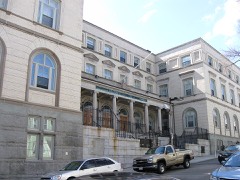
Listed places nearby
6 within 8 miles
Other National Register properties close
enough to walk or drive between, ordered by distance from this one. Both
positions come from the same geocoding pass that matched these properties
to their map sheets.
Listing record. National Park Service National Register of Historic Places, listed-properties dataset, current to 2026-05-22.
Map join. Address geocoded through the United States Census geocoder, then tested against the published boundary of every sheet in the USGS Historical Topographic Map Collection.
How this page is made. Listing fields come from federal records; map-sheet coverage is a labelled coordinate-to-boundary calculation, not a source-field claim.
Wildfire. Short, Karen C. 2022. Spatial wildfire occurrence data for the United States, 1992-2020 [FPA_FOD_20221014]. 6th Edition. Fort Collins, CO: Forest Service Research Data Archive. https://doi.org/10.2737/RDS-2013-0009.6 Collected with United States Government funding and usable without additional permissions or fees.
Specimens. Global Biodiversity Information Facility (GBIF), https://www.gbif.org/. Only records licensed CC0 or CC BY are used. Records licensed CC BY-NC are excluded because this site carries advertising. Images are checked individually and any whose licence is non-commercial, no-derivatives or unreadable is refused.
Mines and quarries. USGS Mineral Resources Data System (MRDS) https://mrdata.usgs.gov/mrds/ A work of the United States government, no copyright under 17 U.S.C. 105.
Storms. NOAA National Centers for Environmental Information, Storm Events Database https://www.ncei.noaa.gov/stormevents/ A work of the United States government, no copyright under 17 U.S.C. 105. Narratives are quoted verbatim from the National Weather Service report and are not edited or summarised.
 Block
Block