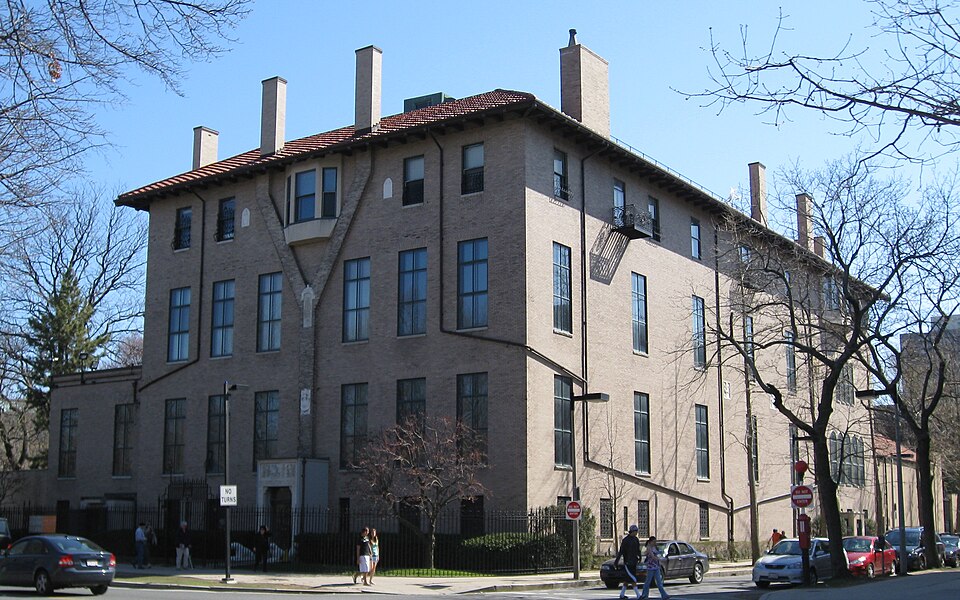
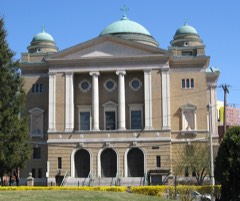
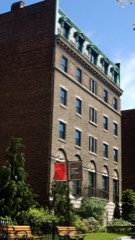
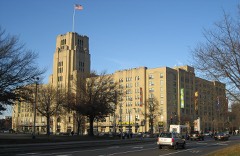
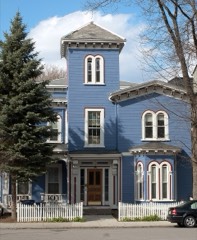
Built in 1903. Listed on the National Register of Historic Places in
1983. A historic map-sheet match is not published yet. The record needs a coordinate-quality review before it can be joined to a sheet boundary.
From the record
“The Isabella Stewart Gardner Museum is an art museum in Boston, Massachusetts, which houses significant examples of European, Asian, and American art. Its collection includes paintings, sculpture, tapestries, and decorative arts.”
Wikipedia article Isabella Stewart Gardner Museum, CC BY-SA 4.0.
one of 206 National Register listings in Suffolk County · listed in 1983 · category: Building · built in 1903, by Willard Thomas Sears · one of 5 National Historic Landmarks in Suffolk County.
National Register reference number.83000603- the number the National Park Service assigned this property when it was listed, and the key its nomination file is catalogued under at the National Archives.
What happened here
An account from the chapter on Boston city, The inset identifies its exact
source book and publication year.
IN giving some notices of manners and social life during this period, I shall speak first of usages which were characteristic of the close of the last century: most of them continued without essential modification until our city charter swept away the old landmarks, and Boston felt the im¬ pulses which mark a new epoch in her history.
Illustrations: State House and the Monument (in 1811), 64; the Monument from the corner of Temple and Derne streets, 65 ; the Monument and the Thurston House, 65; Beacon Street and the Common (in 1804-1811), heliotype, 65; Boston from Breed's Hill (in 1791), 66; the Faneuil-Phillips House,
IN giving some notices of manners and social life during this period, I shall speak first of usages which were characteristic of the close of the last century: most of them continued without essential modification until our city charter swept away the old landmarks, and Boston felt the im¬ pulses which mark a new epoch in her history. It is difficult to deal justly with ways of living which are not widely different from those that surround us. We miss the salient contrasts which lend themselves to picturesque de¬ scription, and are tempted to look for exceptional occurrences to brighten a narrative, rather than for facts which are truly symptomatic of taste and thought. Were it possible to go back four-score years, or even a century, and mingle with those then conducting the town, we should not feel among strangers. In many respects their ways were counterparts of our own. In certain directions, indeed, we might note a narrowness of range and a contraction of outlook, while envying the vigor of speech and de¬ cisiveness of action which seemed the outcome of the limitations. When Massachusetts took her place in the sisterhood of States, the gigantic up¬ heaval of the French Revolution had not taken place. The prophets whom her capital was to raise up to demand the redemption of human society, each with his panacea for its sad ailments, had put in no appearance. The tyranny of England had been broken by an heroic effort, and any further redemption which society might need would be provided by those who VOL. iv. - i.
Regional context, not property-specific
evidence. The
federal wildfire occurrence database
lists 32 fires within 5 miles of Gardner, Isabella Stewart, Museum between
2015 and 2020, burning about 31 acres in total. None started naturally. 2 were recorded as arson.
Distance is straight-line from the map coordinates, so a fire counted
here may appear on a neighbouring settlement's page as well.
Reported cause
Fires
Missing data/not specified/undetermined
16
Recreation and ceremony
9
Smoking
4
Arson/incendiarism
2
Equipment and vehicle use
1
The most recent of
them, most recent first, with the day each was reported and the service
that recorded it.
Regional context, not property-specific
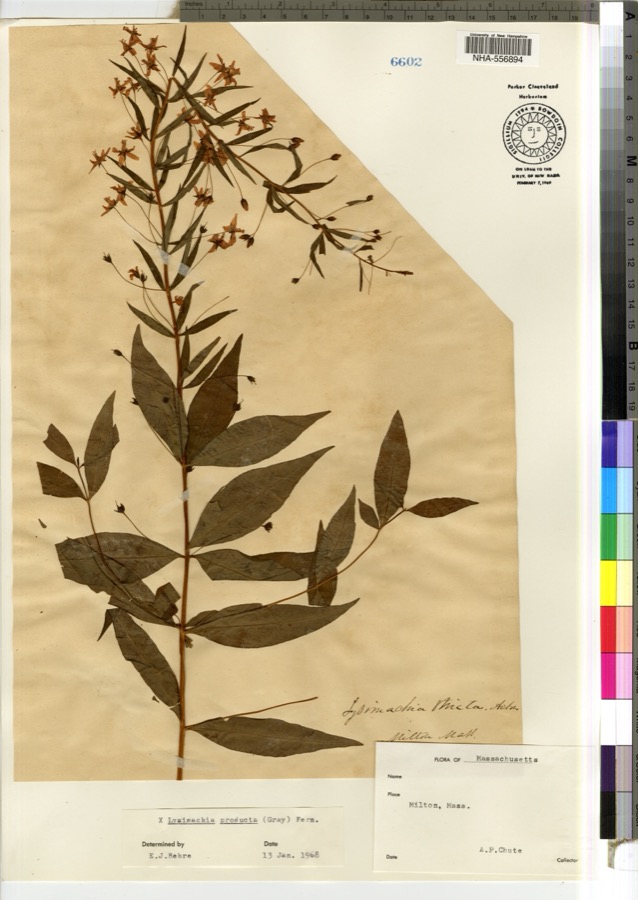
evidence. Museums hold 15,784 specimens
collected within 10 miles of Gardner, Isabella Stewart, Museum between 1810 and
1975: 6,821 Plantae, 4,247 Fungi, 3,555 Animalia, 654 Chromista, 210 Protozoa, 208 Bacteria, 89 Unrecorded. 12 distinct Species records are shown.
Collected by (MARSDEN, H W), ?, A B Seymour and others. Each is a
physical object with a catalogue
number, and each entry opens the museum's record. This is what was
collected and kept, not a survey of what lives here - nothing can be
concluded from a species being absent.
Regional context, not property-specific
evidence. The federal mineral resources record lists
9 workings within 5 miles of Gardner, Isabella Stewart, Museum: 7 plants, 2 past producers.
7 still produce. What was taken out: Iron, Lead, Gypsum-Anhydrite, Sand and Gravel, Construction. Distance is straight-line from the
map coordinates, so a quarry counted here may appear on a neighbouring
settlement's page as well.
Regional context, not property-specific
evidence. The National Weather Service names
Boston, the town this property stands in, in 64 storm reports between 1994 and 2024: 37 thunderstorm wind, 9 flash flood, 7 lightning, 7 flood.
The reports record 1 death and 9 injuries. Each account below is quoted exactly as the forecast office
filed it, from the NOAA Storm Events Database, and each date
opens the federal record of that event.
A 50 year old man was struck by lightning while walking in an area known as the Sugar Bowl in South Boston. Lightning struck him in the head, passing through his back and exiting his feet. He collapsed in cardiac arrest and was revived and hospitalized for several days before dying from his injuries.
A 29 year old male and a 29 year old female were knocked unconscious when lightning struck them at Thomas Park, where the pair were watching the July 4th fireworks. They regained consciousness prior to the arrival of EMTs, but unable to feel their legs and were transported to Brigham and Women's Hospital.
In Boston, two cars were stuck in flood waters on Corey Road. Storrow Drive was closed due to flooding at the Mass Avenue and Longmeadow Bridges. Several other roadways in the city experienced significant flooding.
Numerous trees and wires and several utility poles were downed throughout Boston, including in Boston Common. Several trees were downed onto cars throughout town, though no injuries resulted. One tree was downed onto a building on Corey Road. The Automated Surface Observing System at Logan International Airport in Boston, MA (KBOS) recorded sustained wind speeds of 47 mph and wind gusts up to 68 mph.
Multiple trees and wires were downed throughout Boston, including on Barstow Street, Forrester Street, Washington Street, Houston Road, and Keith Street. Trees were downed onto cars on Forrester and Washington Streets. A portion of a chimney was blown over onto Keith Street.
The National Weather Service at Logan International Airport recorded a wind gust to 60 mph as a severe thunderstorm moved across the city of Boston. Scaffolding was blown down at government center and some large trees were blown down in Revere and Winthrop. One damaged a house in Winthrop and a tree limb and electrical wires fell onto an auto. The occupants of the auto were not injured.
At 546 PM EST, an amateur radio operator reported two trees down on Belden Street in the Upham's Corner section of Boston. Also, two trees were down on Hamlet Street including one down on three cars. A tree was down on Willis Street. A tree was down on wires on Taft Street.
At 3:26 PM EST, heavy rain caused the intersection of Lewis and Marginal Streets in East Boston to be flooded and impassable. At 3:36 PM EST a car was trapped in floodwaters at Clark and Stockton Streets in Chelsea. At 3:38 PM EST several cars were trapped in floodwaters on the McClellan Highway, Condor Street and Putnam Street in East Boston.
At 5:05 PM EST several cars on Child Street and Boynton Street were trapped in flood waters as high as the car doors. At 5:10 PM EST a car was trapped in flooding on Columbia Road at Bodwell Street, and Ceylon Street was impassable at Quincy Street due to flooding.
A tree was downed by thunderstorm winds onto a car at the intersection of Bakersfield and Stoughton Streets. Another tree was downed onto a car on Columbia Road.
8 papers published in this town,
digitised by the Library of Congress and free to read: 0 issues,
0 pages. Every page is searchable, so a name or a street can be
looked for directly in what the town printed about itself at the time.
No historic map-sheet match is published
for this property yet. That does not mean no map exists. This record needs
a coordinate-quality review before it can be joined to a sheet boundary.
Browse the county's mapped places while that work is
pending.
From the nomination file
2,959 words on record
When this property was proposed for the
National Register, someone wrote the case for it: what the building is,
and why it matters. That document is a federal record in the public domain.
It is quoted below word for word, never summarised. The text was read off the scanned case file by machine, so the
occasional stray character is the recogniser's and the 1970s
typewriter's.
Description of the property
The Isabella Stewart Gardner Museum faces north on the Fenway, across this roadway from the Muddy River section of Frederic Law O1msted's "Emerald Necklace" park system. It is in the Fenway neighborhood of Boston which dates from the first decade of thetwentieth century and consistslargely of attached apartment buildings plus many of the city's cultural and medical institutions including The Museum of Fine Arts, SymphonyHall, andvariouscolleges,art and music schools, and hospitals. The Gardner Museum property consists of almost an entire block. The Museum Building proper occupies the northern portion, and the walls of the building and gardens enclose the entire property. A coach house (now apartment) faces south, mid- block, set into the inner garden wall.
It looks toward an outer rear garden and modern greenhouses. Behind the greenhouses at the southeast corner of the property is the Museum staff parking lot. It abuts a privately owned early-twentienth-century apartment building at the southwest corner of the block, which is not part of this nomination. The Gardner Museum, constructed 1900-1902, is a large but unpretentious building on the exterior, inward toward gardens and a central courtyard. The four- story masonry building is an Italian in form with buff-colored brick walls and a red-tiled hip roof surroumounted by a gabled glass skylight. The front is a narrow side of the basic rectangle, six bays across. At the east side it is extended by a two bay wide, two-story, tlat rooted wing.
A two-story, gable-rooted ottice annex, extending back along the west facade, is the building's only addition (con- structed 1933). Several tall chimneys add to the lively skyline. . Structurally, the granite foundation is built on wood pilings, and the first floor is reinforced by steel beams and brick vaulting. The front (north) elevation is symmetrical and fairly stark.
/Architect Willard T. Sears Statement of Significance (in one paragraph) The Isabella Stewart Gardner Museum (originally called Fenway Court) possesses integrity of location, design, setting, materials, workmanship, and association. chief significance is two-fold: association with a woman who contributed greatly to the cultural and civic life of Boston during her lifetime, and early representation of an American residence dually designed to house a substantial museum collection. It meets criteria A, B, and C of the National Register. Isabella Stewart was born in New York City in 1840, and married vohn : Garaner ot Boston shortly before her 20th birthday. Mrs. Gardner contributed greatly to the cultural and civic life of Boston during her lifetime.
She awarded prizes to citizens Tomag torises nd eonerene ioe seti aie efein erenudt itine and fenasten She sponsored refugees. She entertained such international figures as Sarah Bernhardt, Pablo Casals, Lady Gregory, William Butler Yeats, and John Singer Sargent. Her greatest contribution, however, was her museum, built on Boston's Fenway at the turn of the century. Built after her husband's death, as a home for herself and setting for her works of art, it is significant as such and is reminiscent of an Italian palazzo design, incorporating the collection of architectural and sculptural fragments brought home by Mrs. Gardner from her several trips abroad.
The Gardner Museum preceded, by a few years, other notable house/public gallery efforts including New York's Frick (1913-14) and Gloucester's Beauport (1907). Mrs. Gardner's museum also was the first of several cultural and educational institutions to choose as 1ts site the reclaimed Fens area in Boston, much of which was converted in the 1880's by Frederick Law Olmsted from mudflats into parkland. The collection itself issmall and unusual in its quality and diversity.
Quoted from the National Register nomination
for reference 83000603, 19 pages, held by the National Archives in Record
Group 79. See the
catalogue record.
Listed places nearby
6 within 8 miles
Other National Register properties close
enough to walk or drive between, ordered by distance from this one. Both
positions come from the same geocoding pass that matched these properties
to their map sheets.
Listing record. National Park Service National Register of Historic Places, listed-properties dataset, current to 2026-05-22.
Map join. Address geocoded through the United States Census geocoder, then tested against the published boundary of every sheet in the USGS Historical Topographic Map Collection.
How this page is made. Listing fields come from federal records; map-sheet coverage is a labelled coordinate-to-boundary calculation, not a source-field claim.
Wildfire. Short, Karen C. 2022. Spatial wildfire occurrence data for the United States, 1992-2020 [FPA_FOD_20221014]. 6th Edition. Fort Collins, CO: Forest Service Research Data Archive. https://doi.org/10.2737/RDS-2013-0009.6 Collected with United States Government funding and usable without additional permissions or fees.
Specimens. Global Biodiversity Information Facility (GBIF), https://www.gbif.org/. Only records licensed CC0 or CC BY are used. Records licensed CC BY-NC are excluded because this site carries advertising. Images are checked individually and any whose licence is non-commercial, no-derivatives or unreadable is refused.
Mines and quarries. USGS Mineral Resources Data System (MRDS) https://mrdata.usgs.gov/mrds/ A work of the United States government, no copyright under 17 U.S.C. 105.
Storms. NOAA National Centers for Environmental Information, Storm Events Database https://www.ncei.noaa.gov/stormevents/ A work of the United States government, no copyright under 17 U.S.C. 105. Narratives are quoted verbatim from the National Weather Service report and are not edited or summarised.
 Block
Block