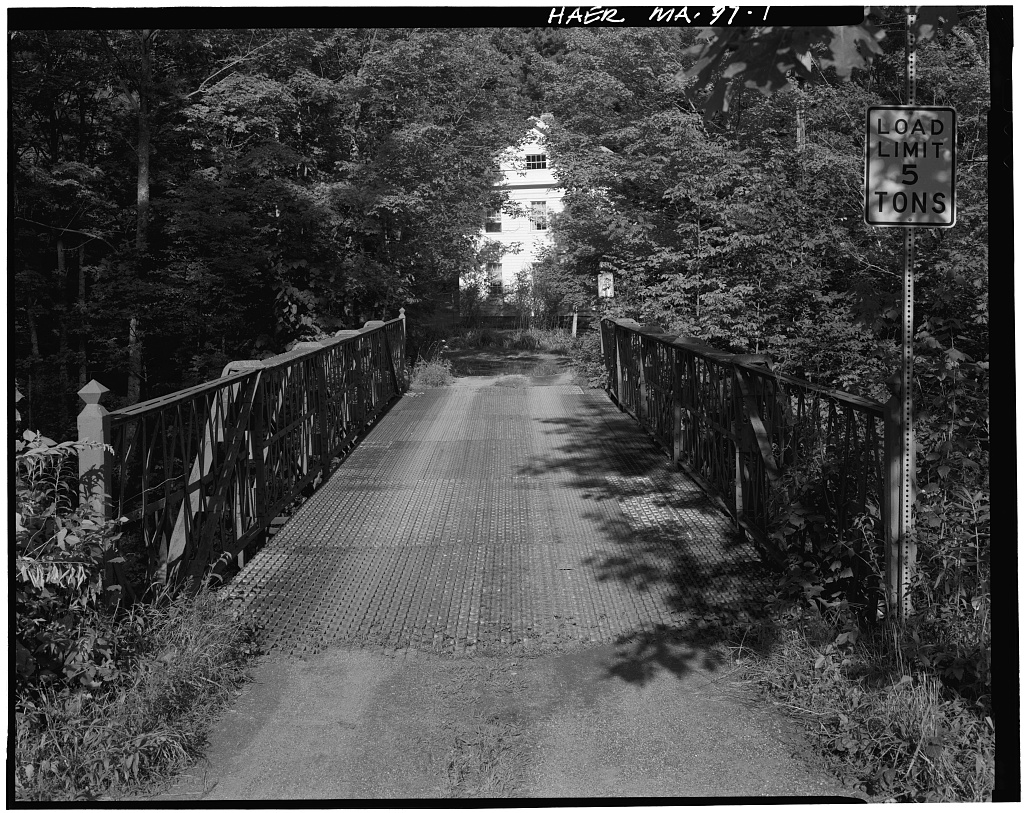
Documentation of the North Chester Village Bridge is part of the Massachusetts Historic Bridge Recording Project, conducted during the summer of under the co-sponsorship of HABS/HAER and the Massachusetts Department of Public Works, in cooperation with the Massachusetts Historical Commission. Patrick Harshbarger, HAER Historian, August NORTH CHESTER VILLAGE BRIDGE # (SMITH ROAD BRIDGE) HAER No. MA-97 (page 2) Description The North Chester Village Bridge spans the Middle Branch of the Westfield River on Smith Road in the town of Chester, which lies in the Berkshire Mountains of Western Massachusetts. The half-dozen dwellings, farmhouses and summer homes that make up the village of North Chester, cluster near the southwestern approach to the bridge.
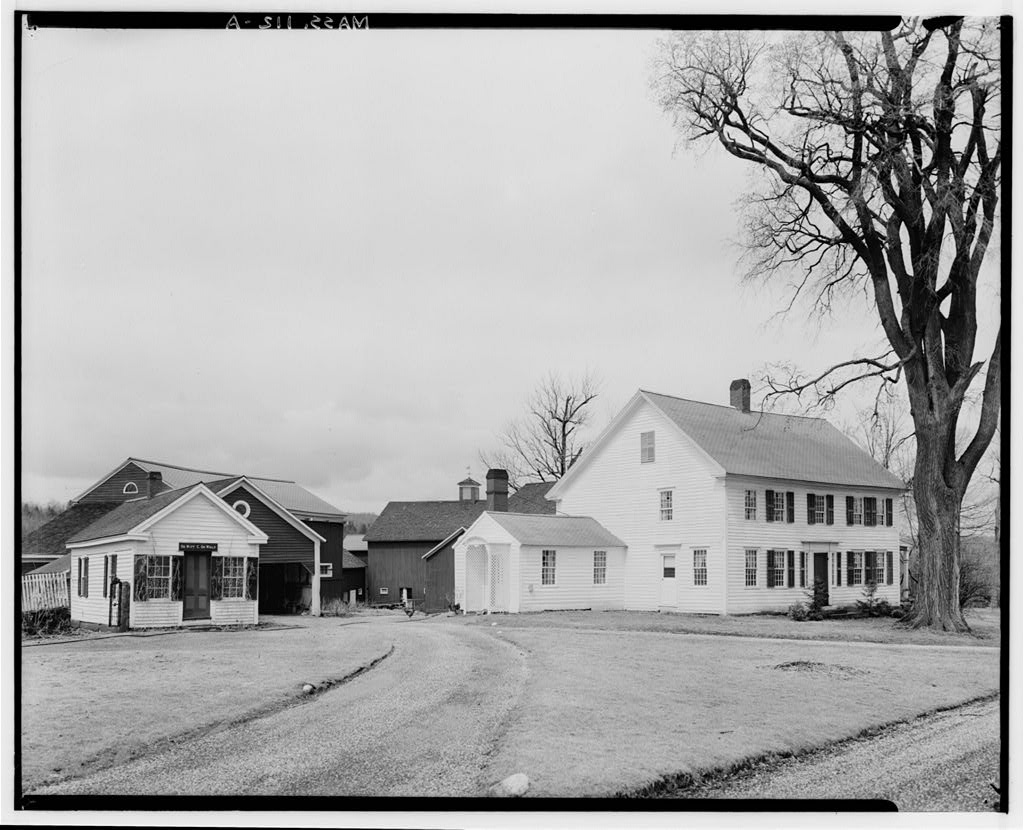
A beautifully-restored Greek- Revival farmhouse, probably dating from the middle of the nineteenth century, sits back from the bridge's eastern end. The bridge passes over the rock- strewn bed of the southerly-flowing river at a height of approximately 40 feet. The North Chester Village Bridge is a single-span, five-panel, Pratt pony truss, measuring long (center to center), wide, and deep.(See Figure 1.) The lower chord is comprised of two 3" angles, riveted to paired 6" wrought-iron battens. The upper chord consists of two wrought- Iron, 3" angles, joined by a riveted, 10" cover plate. A splice plate is riveted to the upper chord at the center of the bridge. The verticals are comprised of two 3" angles, joined by battens.
The inclined endposts are also 3" angles The main diagonals in the second, third, and fourth panels consist of paired Vhn-diameter rods with turnbuckles. The counters in the second and fourth panels are paired %"-diameter rods. One of the most interesting features of the North Village Bridge is its combination of riveted and pinned joints. The joints where the inclined end post and lower chord meet are riveted. All of the lower chord joints, where the verticals, diagonals and counters meet, are pinned. At the upper chord, pins join the diagonals and counters to gusset plates, which in turn rivet to the verticals and chord.
The three sway braces on either side of the truss consist of single angles riveted to the upper chord, and two separate angles extending horizontally from the floor beams. The floor beams are rolled I-beams, and the lower lateral bracing is made of angles. The stringers are steel I-beams and the bridge roadway is open-grid steel decking. The lattice-work guardrails extend beyond the endposts and are one of the bridge's most distinctive features. They are high and end with decorative fenceposts capped by diamond-shaped finials. Plaques that read Hawkins Iron Works, Springfield, MA, are bolted to each fencepost. North Chester Village Bridge The Town of Chester sits along an important historical route following the course of the Westfield River across the Berkshire Mountains.
Eighteenth- century pioneers mapped its path, and in the the Boston & Albany Railroad laid the first tracks through the pass and west to the Hudson River. By the Chester had grown from a relatively isolated rural town and stagestop into a village that boasted a roundhouse for the railroad engines that pushed the trains over the Berkshires. Granite quarries and paper mills also thrived in the steep valley and sent their goods back down the railroad to Springfield. Despite industrial growth along the Westfield River Valley, parts of the NORTH CHESTER VILLAGE BRIDGE (SMITH ROAD BRIDGE) HAER No. MA-97 (page 3) town of Chester remained rural. A large mountain ridge separated the main town from the village of North Chester to the northeast.
North Chester sat in the narrower valley of the Middle Branch of the Westfield River and consisted of a handful of homes and a gristmill. Chester's citizens made decisions to build and repair bridges in the way typical of New England towns. In March, the selectmen called a town meeting to elect new officers, approve town budgets, and discuss public works projects. Invariably, an agenda item was "to see what action the town will take in regards roads and bridges." Floods and harsh winters regularly took their toll on wooden bridges that crossed the steep and fast-running rivers of Western Massachusetts. Often the citizens could not afford to pay for all of the needed bridge repairs.
Town meetings could turn into political battles when the interests of one portion of the community turned against the other. Thus, it can be imagined that the small bridge at the village of North Chester, which carried farmers from the far northeastern portions of town to the gristmill, did not rank high on the priority list of bridges in the town. In the town bought its first two iron bridges to span the main branch of the Westfield River in downtown Chester. In the selectmen surveyed the remaining twelve timber bridges to ascertain which should be given priority. They diplomatically reported that after careful inspection of all the bridges, they were satisfied each would need thorough repairs sometime in the near future to make them safe.
Over the course of the next thirty years, the town's officials replaced Chester's wooden bridges with iron ones.1 In the town voted to replace the North Chester Village Bridge. The Annual Report noted that the timber from an old bridge was sold for $4 to a local man named Bemes. This is the first mention of the North Chester Village Bridge in the town records, and it is not known how long a wooden bridge had spanned the river at that site. Tthe selectmen awarded the bridge contract for to a local bridge builder, the Hawkins Iron Works of Springfield, Massachusetts. As was typical with these contracts, the bridge manufacturer assumed responsibility for erecting the iron superstructure, while the town hired a local contractor to prepare the stonework and lay the floor timbers.
The bridge's impressive height above the level of the river called for a massive stone abutment to be built on the western side of the bridge, and a smaller abutment to rest on a large outcropping of bedrock to the east. The town looked to a local mason, Edson H. Fiske, to build the new abutments. It is not unlikely that Fiske bought the stone from the local granite quarries. The cost of the abutments was well over three times the cost of the iron truss itself.2 R.F.Hawkins Iron Works The bridge manufacturer, Hawkins Iron Works, built numerous bridges throughout New England and Upstate New York. At least twenty Hawkins bridges, dating from to are known to exist in Massachusetts alone. NORTH CHESTER VILLAGE BRIDGE (SMITH ROAD BRIDGE) HAER No.
MA-97 (page 4) England Railroad between Waterbury, Connecticut, and Fishkill, New York. In addition, the company advertised as a maker of plate girders, roofs, turn- tables, steam boilers, tanks, building fronts, blacksmith forgings, and other types of cast iron and brass. The Hawkins Iron Works built the roof of the grand Boston & Albany station in Springfield.3 The bread-and-butter of the Hawkins Iron Works were the numerous bridges the company built for the New England railroads. The relationship with the railways stretched back to the The Hawkins Iron Works was the successor of the firm of Stone & Harris founded in Amasa Stone, was the brother-in-law of William Howe, patentee of the Howe Truss, the first combination wood-and-iron bridge to be widely used by the railroads.
Stone & Harris received the franchise rights to Howe's truss and soon built a successful reputation upon their contracts with the Boston & Albany Railroad. Richard Fenner Hawkins joined Stone & Harris in at the age of 16, as an office boy. His story, if not one of "from rags to riches," was at least one of from the modestly well-off to the fabulously wealthy. Born in Lowell, Massachusetts, Hawkins' father, Alpheus Hawkins, moved to Springfield in as the first superintendent of transportation for the Western Railway, later to become the Boston & Albany Railroad, In Alpheus Hawkins died, leaving his teenage son to provide for the family; and Richard Hawkins found employment with the bridge builders who were most certainly business acquaintances, if not friends, of his father.
By Hawkins had worked his way into a partnership in the firm. When Amasa Stone sold his shares in the company, the iron works became known as Harris & Hawkins. In Hawkins assumed full control of the Springfield company, thereafter renaming it the Hawkins Iron Works. By the firm employed some 150 men. Advertisements boasted that the iron works "embraced all the latest improved machinery and tools known to the iron-working trade, [and] afforded the most ample conveniences for the construction of the largest wrought-iron structures." The iron works occupied a large lot on Liberty Street near the mainline of the Boston & Albany Railroad in downtown Springfield.
An engraving from the shows the layout of the manufactory.4(See Figure 2.) Hawkins built numerous types of bridges, not only the Howe Truss, but other truss types, such as the Pratt and Warren. Two large Hawkins railroad bridges, the 1500-foot Massachusetts Central Railroad Bridge at Northampton and the Boston & Albany Bridge at Springfield, can still be found spanning the Connecticut River. Although Hawkins himself had no schooling in civil or structural engineering, other than what he learned at the iron works and by experience, he did hire Thompson as his chief engineer. It is unknown what kind of background and training Thompson had, but apparently Hawkins relied heavily upon his chief engineer, who received top billing in the firm's advertisements.
Still, Hawkins paid close attention to the fabrication and design of his bridges, and it was said that he visited every construction site personally. Among the many projects undertaken by Hawkins, the North Chester Village Bridge, completed in would have been one of the smallest. The records of the company do not survive and it is impossible to tell how many highway NORTH CHESTER VILLAGE BRIDGE (SMITH ROAD BRIDGE) HAER No. MA-97 (page 5) bridges they built. The North Chester Village Bridge Is the second oldest of at least twenty known surviving Hawkins Iron Works highway bridges in the state of Massachusetts. It is the only one of these bridges that Is a Pratt pony truss, with the unusual pinned and riveted connections.6 Rivets vs.
Pins During the last half of the nineteenth century, American bridge engineers debated the relative merits of pinned and riveted connections. In the early years, pins were generally preferred for the main field connections because they were faster and less expensive than rivets, which required a forge on-site. Rivets were generally used for shop connections. As better field equipment came into use, field rivets became more common. The change from pinned to riveted connections eventually took place because of economics, and to achieve greater truss stiffness.
By the twentieth century, field- riveting had become a commonplace technique, supplanting pinned joints in many bridge types.7 With its combination of pinned and riveted connections, the North Chester Village Bridge is well within the mainstream of this transitional period in engineering technology. Conclusion Since the North Chester Village Bridge has served the small community well, only being closed occasionally for repairs to its deck. In the town removed the wood deck and stringers and replaced them with steel I-beam stringers and an open steel deck. The bridge has been designated National Register eligible by the Massachusetts Department of Public Works. NORTH CHESTER VILLAGE BRIDGE (SMITH ROAD BRIDGE) HAER No.
MA-97 (page 6) O K H N 0> < 2 - > CC \- UJ 5 o UJ o to CO < D > Q: o H LJ o OJ o Q LT C\J CD UJ O < -J -J > < ^ UJ h- CC UJ. m X hr- o. (/) X UJ X o k o 21 to NORTH CHESTER VILLAGE BRIDGE (SMITH ROAD BRIDGE) HAER No. MA-97 (page 7) n 4J 4-) 0) to Bo W ct) S O - 00 -O -H r-i 4> - T4 *0 01 bO 4-) C cO <H 1-4 U V (X to W 3 to O 4-> to O 3 M O n) CO VI C co n-f ct 3* W C CO ' fH f* C 1-1 Pi CM [4 NORTH CHESTER VILLAGE BRIDGE (SMITH ROAD BRIDGE) HAER No. MA-97 (page 8) ENDNOTES 1. Town of Chester, Reports of the Town of Chester. and Collection of the Chester Public Library, Chester, Massachusetts. 2. Town of Chester, Reports of the Town of Chester. 3. The Massachusetts Historic Bridge Recording Project documented three other Hawkins Iron Works Bridges: Marion Street Bridge in Natick (HAER No.
MA- Weston Road Bridge in Wellesley (HAER No. MA-118), and Kingsbury Street Bridge in Wellesley (HAER No. MA-117). A fourth bridge, the Shelburne Falls Bridge in Shelburne/Buckland (HAER No. MA-96), was built by a subsidiary of the Hawkins Iron Works, the Vermont Construction Company. 4. An inspection of the former site of the iron works showed that none of the buildings have survived. 5. Hawkins also played the role of a leading businessman in Springfield. He supported public improvements and served as water commissioner. For personal and business reasons he turned down both the Republican and Democratic nomination for mayor a number of times. When he passed away in the newspaper obituaries clearly made the impression that Hawkins was a well-loved and congenial man. 6.
Roper, "Massachusetts Historic Bridge Inventory," May 16, File Massachusetts Department of Public Works, Boston. 7. Gregory J. Galer, "The Boston Bridge Works and the Evolution of Truss Building Technology," thesis (Brown University, pp. J.A.L. Waddell, The Designing of Ordinary Iron Highway Bridges (New York: John Wiley & Sons, pp. and William Smith, Massachusetts Historical Commission, editorial comments. NORTH CHESTER VILLAGE BRIDGE (SMITH ROAD BRIDGE) HAER No. MA-97 (page 9)
Advertisements for Hawkins Iron Works," Springfield Citv Directory. back covers. "Bridge Massachusetts Department of Public Works Bridge Section files, Boston, Massachusetts. Clippings filed under Hawkins," in the vertical file at the Springfield Public Library, Springfield, Massachusetts. "Death of Hawkins: A Pioneer Bridge Builder," obituary, in The Springfield Daily Republican. March 6, Drew, Bernard. Spanning Berkshire Waterways: A Personal Excursion into the History of Metal Truss Highway Bridge Construction in Western New England. Great Barrington, Massachusetts: Attic Revivals Press, pp. Drew, Bernard. "Stone Arch Bridges," Stone Walls, vol. 5, Spring pp. Galer, Gregory J. "The Boston Bridge Works and the Evolution of Truss Building Technology," Senior Thesis.
Providence, Rhode Island: Brown University, pp. King, Moses, ed. Hawkins Iron Works," King's Handbook of Springfield. Massachusetts. Springfield, Massachusetts: James D. Gill, Publisher, pp. Libardi, Carl. "The Granite Quarries and the Stone Sheds," Stone Walls, vol. 13, Winter p. 3. Oppenheimer, Grace. "The Boston and Albany Railroad in Chester," Stone Walls, vol. 12, Fall pp. Hawkins Iron Works," Commerce. Manufactures and Resources of Spring- field1 Mass.: A Historical. Statistical and Descriptive Review. Springfield, Massachusetts: National Publishing Company, pp. 53- 55. Hawkins Iron Works," Inland Massachusetts Illustrated. Springfield, Massachusetts: Elstner Publishing Company, pp. Hawkins Iron Works," Springfield. Supplement to the Springfield Daily News. June 26, p. 58.
NORTH CHESTER VILLAGE BRIDGE (SMITH ROAD BRIDGE) HAER No. MA-97 (page 10) "Richard Fenner Hawkins," The Leading Citizens of Hampden County. Massachusetts. Boston: Biographical Review Publishing Co., pp. Town of Chester, Massachusetts. Reports of the Town of Chester. and Collection of the Chester Public Library, Chester, Massachusetts. Waddell, J.A.L. The Designing of Ordinary Iron Highway Bridges. New York: John Wiley & Sons, Waddell, J.A.L. Bridge Engineering. New York: John Wiley & Sons,
 Block
Block