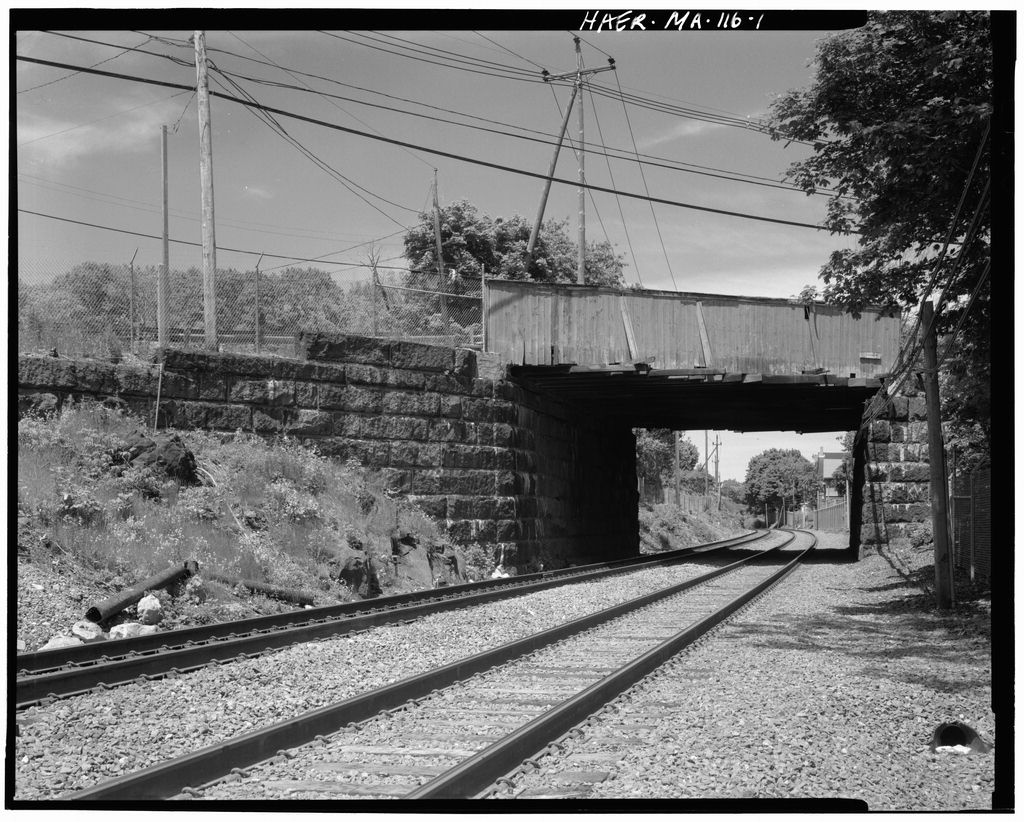
Documentation of the Essex Street Bridge is part of the Massachusetts Historic Bridge Recording Project, conducted during the summer of under the co-sponsorship of HABS/HAER and the Massachusetts Department of Public Works, in cooperation with the Massachusetts Historical Commission, Patrick Harshbarger, HAER Historian, August BOSTON & MAINE RAILROAD: ESSEX STREET BRIDGE (EASTERN DIVISION BRIDGE NO. 22) HAER No. MA-116 (page 2) Description The Essex Street Bridge, designated by the Boston & Maine Railroad as Eastern Division Bridge No, 22, is located in a residential section of the seaside community of Swampscott.
The single-span bridge is approximately 43 feet long and 50 feet wide, and carries Essex Street across the main line of the Boston & Maine Railroad's Eastern Division, now part of the Massachusetts Bay Transportation Authority (MBTA) commuter rail, nearly 17 feet below. The Essex Street approaches parallel the railroad, rising at a grade of nearly 6 percent, and then make sharp turns to cross the bridge. The bridge is an example of a modified Howe pony truss. A Howe truss can be identified by wooden chords and diagonals, and wrought-iron verticals. An unusual feature of the Essex Street Bridge is that due to the pronounced 45 degree skew, the center portion of the bridge is not supported by the trusses, but rests on stringers that run from abutment to abutment.
The flanking triangular-shaped sections created by the skew are the only portions of the bridge carried by the trusses. The trusses are encased by a thin board housing with a shingled shed roof. According to a set of plans in the files of the Massachusetts Department of Public Works, the upper chord is a timber, and the bottom chord is a 38' timber. The end diagonals are timbers, and the other two diagonals of the middle panels are timbers. The three verticals are steel rods ranging from 1%" to 1%" in diameter. Mortised wood joints and steel bolts form the bridges connections.
The depth of the trusses measures approximately The timber stringers hang directly below the lower chord and extend beyond it, the free end of each stringer being supported by means of a steel rod hung from the upper chord. The roadway of the bridge is asphalt covering two layers of wooden decking. On the north side of the bridge is a wood deck sidewalk raised about 3" above the level of the roadway with a timber curb. The abutments are made of coursed, ashlar granite. To the outside of each truss are three sway braces, added in to increase the lateral stability of the trusses. The braces consist of wood timbers with V*" steel rod reinforcers. They extend outward at an angle of approximately 30 degrees from the top chord.2 The Boston & Maine Railroad's Timber Bridges In J.
Parker Snow, an engineer with the Boston & Maine Railroad, reported to his colleagues in the Boston Society of Civil Engineers, "The building of [wooden] bridges is a live business on the Boston & Maine Railroad, although the impression seems to be prevalent in many quarters that such construction is obsolete and out of fashion." The Essex Street Bridge is a reminder to bridge historians that iron and steel did not replace timber overnight. In out of bridges owned by the Boston & Maine Railroad were wooden structures, and more than half of the replacement bridges being built by the railroad were made of wood.3 Snow outlined the reasons that the Boston & Maine preferred timber to BOSTON & MAINE RAILROAD: ESSEX STREET BRIDGE (EASTERN DIVISION BRIDGE NO. 22) HAER No.
MA-116 (page 3) iron for its shorter spans. Although the loads for new wooden bridges were somewhat lighter than iron bridges, wooden bridges were easier to inspect and to strengthen when they showed signs of strain. The railroads' master carpenters demonstrated a high level of skill, and after years of experience could often build wooden bridges to almost the exact size called for by the engineers' scientific analysis of loads and strength of materials. Furthermore, short wooden spans were less costly to build than iron spans. Snow calculated that only for spans greater than 120 feet did an iron bridge cost approximately the same as a wooden bridge. In addition, the railroads' construction crews could build wooden bridges in half the time it took to build an iron bridge.
For spans less than 30 feet long, the Boston & Maine preferred to use plain stringer bridges. For spans between 30 and 60 feet in length, the railroad built a modified, Howe pony truss. For bridges between 60 and 120 feet, the railroad recommended Town lattice trusses built of spruce. Snow commented that for overhead highway bridges, such as the Essex Street Bridge, the modified Howe truss was used exclusively.4 Essex Street Bridge The Essex Street Bridge crossed the Boston & Maine Railroad's mainline between Boston and Salem, Massachusetts.
The right-of-way was one of the oldest in the country, chartered to the Eastern Railroad Company in The company completed a single track between the two cities in August In May the Town of (Swampscott had not yet been incorporated) gave the railway the right to close Essex Street. The street ran across a slight rise at this point, and the railroad probably needed to cut through the hill to maintain a reasonable grade.5 It is not known when the Eastern Railroad built the first bridge at Essex Street. It is known that in the Eastern Railroad expanded the line to two tracks, and in doubled the line again to four tracks. Either of these events might have necessitated the building of a bridge.
Plans drawn by railroad engineers in show an older bridge, somewhat narrower than the current structure.6 In the Eastern Railroad leased the Boston and Salem line to the Boston & Maine Railroad, and in the two companies merged. In the engineers of the Boston & Maine decided to replace the Essex Street Bridge with the current pony truss. Apparently, the engineers designed the bridge to carry pedestrian, vehicular and streetcar traffic. A set of plans from shows a proposed relocation of the tracks of the Eastern Massachusetts Street Railway Company from the southern side to the center of the bridge. It is not known when the streetcar tracks were removed.7 The repair record of the Essex Street Bridge shows that its timber stringers wore out at a rate of about once every twenty years.
In the railroad added sway bracing to the bridge.8 In the repairmen replaced the bridge's deck and used special templates to give each stringer a y4-inch crown to improve drainage. In the Massachusetts Department of Public Works strengthened the bridge for asphalt surfacing by inserting new stringers BOSTON & MAINE RAILROAD: ESSEX STREET BRIDGE (EASTERN DIVISION BRIDGE NO. 22) HAER No, MA-116 (page 4) between those already existing.9 Over these years of repair, the bridge had a number of different owners. In the New York, New Haven & Hartford Railroad bought the Boston & Maine. In the early the line merged with the Conrail system, and after some negotiations, maintenance of the highway crossings was transferred to the Massachusetts Department of Public Works.
The Essex Street Bridge is a relatively rare survivor of wood and iron bridge technology in the twentieth century, and is one of the oldest surviving timber pony truss bridges in the stated0 BOSTON & MAINE RAILROAD: ESSEX STREET BRIDGE (EASTERN DIVISION BRIDGE NO. 22) HAER No. MA-116 (page 5) J .Timber top chord 7' 'x 9". a FIGURE 1: Line diagram of the Essex Street Bridge. ("Bridge Bridge Section files.) FIGURE 2: Plan of the Essex Street Bridge. ("Bridge Bridge Section files.) BOSTON & MAINE RAILROAD: ESSEX STREET BRIDGE (EASTERN DIVISION BRIDGE NO. 22) HAER No. MA-116 (page 6) ENDNOTES 1. Boston & Maine Railroad, "Eastern Division: Bridge No. original plans, File Boston & Maine cabinets, Bridge Section, Massachusetts Department of Public Works, Boston. 2.
Boston & Maine Railroad, "Eastern Division: Bridge No. 22, repairs," File Boston & Maine cabinets, Bridge Section, Massachusetts Department of Public Works, Boston. 3. J. Parker Snow, "Wooden Bridge Construction on the Boston & Maine Railroad," Journal of the Association of Engineering Societies. July p. 31. 4. Ibid., pp. 5. Interstate Commerce Commission, "Interstate Commerce Commission Valuation Notes, Boston & Maine Railroad Historical Society Collection, Mogan Library, University of Lowell, Lowell, Massachusetts. 6. Boston & Maine Railroad, plans for "Eastern Division: Bridge No. and Interstate Commerce Commission, "Valuation Notes, 7. Ibid. 8.
Snow noted in his report to the Boston Society of Civil Engineers that all Howe pony trusses should be stayed against side motion by sway bracing. Why the braces were not an original feature of this bridge is unknown. 9. Plans for "Eastern Division: Bridge No. and 10. Francis Bradlee, The Boston and Maine Railroad: A History of the Main Road, with its Tributary Lines (Salem, Massachusetts: Essex Institute, pp. and Plans for "Eastern Division: Bridge No. and BOSTON & MAINE RAILROAD: ESSEX STREET BRIDGE (EASTERN DIVISION BRIDGE NO. 22) HAER No. MA-116 (page 7)
Boston & Maine Railroad. Plans for "Eastern Division: Bridge No. and Located in File Boston & Maine cabinets, Bridge Section, Massachusetts Department of Public Works, Boston. Bradlee, Francis The Boston and Maine Railroad: A History of the Main Road. With its Tributary Lines. Salem, Massachusetts: Essex Institute, pp. "Bridge Massachusetts Department of Public Works, Bridge Section files, Boston. Interstate Commerce Commission. "Interstate Commerce Commission Valuation Notes, Located in the Boston & Maine Railroad Historical Society Collection, Mogan Library, University of Lowell, Lowell, Massachusetts. Snow, J. Parker. "Wooden Bridge Construction on the Boston & Maine Railroad," Journal of the Association of Engineering Societies. July pp. 31- 43. Waddell, J.A.L.
The Designing of Ordinary Iron Highway Bridges. New York: John Wiley & Sons,
 Block
Block