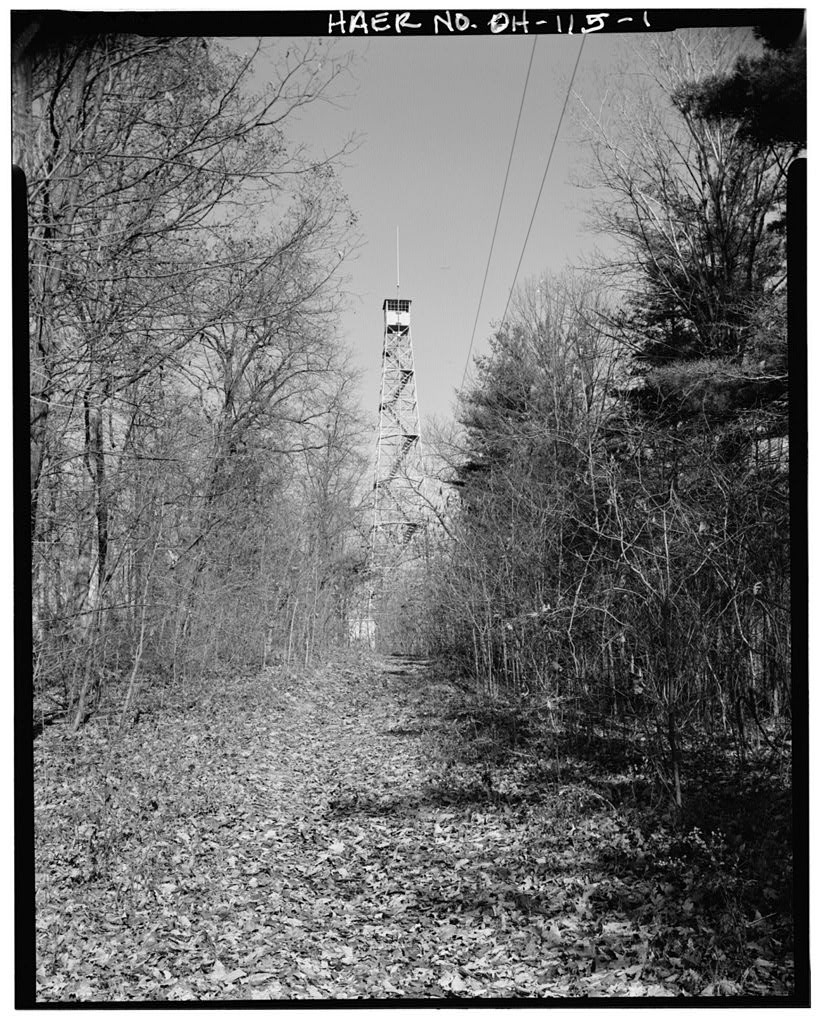
The Shawnee Tower is an unusually well-preserved example of a type of structure that played a vital role in fire prevention efforts in national forests from the up to the The tower was constructed in by enrollees in the Civilian Conservation Corps an emergency relief program that operated from to The Shawnee Tower and its story is typical of CCC operations, but unique to the Wayne National Forest. The lookout tower is highly significant as the only surviving representative of four similar structures built in the Wayne National Forest from The tower's story serves as a reminder of the tremendous efforts of federal relief programs during the Depression years and its presence allows an interpretation of the CCC in the Wayne National Forest.
Description : The Shawnee Tower is located approximately 2 miles south of New Straitsville in a densely wooded portion of the Wayne National Forest. The tower sits on a ridge approximately above sea level and north of the junction of Township Road 22 and Township Road It is approached by a dirt access road from the east and is sited with the face of the tower slightly off of true north. The forest consists of mainly deciduous trees intermingled with coniferous trees. The base of the tower is constructed of four concrete piers anchored to the ground. Each of the four steel legs of the tower are bolted to the concrete piers. Steel struts are also anchored to the piers for lateral supports.
An open wooden staircase and railing extends up through the center of the tower with a small metal landing at each level. The landings are protected on three sides by chain-link mesh. The tower stands 9" tall and tapers towards the top. A square cab is located at the top. The cab is constructed of wood frame with paired 3x3 windows on all four walls. The exterior walls are covered with metal siding. The cab has a wood plank floor with a 3' hatch opening in the floor. The ceiling is plywood attached to the wooden rafters and covered with a metal roof. Shawnee Tower HAERNo. OH-1I5 (Page 2) History: Constructed in the Shawnee Tower was one of several projects completed by the Civilian Conservation Corps in the Wayne National Forest during the mid- to late~1930s.
The lookout tower served as a fire observation platform, occupied during the leaf-on and leaf-off periods from the late until the early Initiated for emergency relief aid, the Civilian Conservation Corps came into existence in and grew to be the most popular New Deal program devised by Franklin D. Roosevelt. Between and the CCC employed approximately three million young men between the ages of 17 and 25. Selection policy, determined by an Advisory Council, limited enrollment primarily to single men whose families were on public relief rolls, and who were willing to allot $22 to $25 of their monthly $30 wage to their dependents.
Averaging over camps, the relief program employed anywhere from to workers assigned to projects administered by the Department of the Interior or the Department of Agriculture operating on a six month enrollment cycle. Individual work camps, situated on public land throughout most states and territories of the United States, contained facilities built and run by the Army. Projects completed by the CCC varied from fire fighting, tree planting, laying telephone wire, and the construction of roads, trails, out buildings, cabins, lookout towers, and camping grounds. Many of these programs also employed local foremen and technical specialists.
One of the primary objectives of the reforestation, resulted in the planting of over 570 million young trees by giving the conservation core the nickname "Roosevelt's Tree Army." Of the projects completed by the over 75 percent were under the jurisdiction of the Department of Agriculture and 50 percent of these were for the Forest Service. The National Forest Service located Ohio within the North-Central Region. This region composed of eight states, contained roughly two percent of national forest land. In the total enrollment quota of CCC employees for the North-Central Region amounted to over men. This number allotted workers to Ohio. At the peak of CCC activity in there were a total of 167 camps operating in the region with nine camps located in Ohio. Shawnee Tower HAERNo.
OH-115 (Page 3) In the North-Central Region, CCC programs focused on four primary areas: forest culture, transportation improvements, recreation, and fire protection. Reforestation and timber stand improvements occupied most of the projects accomplished in the Region; however, employees were also utilized for flood cleanup in both Illinois and Ohio. Individual camps consisting in approximately enrollees were established in specific areas according to project planning. In a forestry camp, corps members could be working in small groups under an enrollee leader clearing dead wood, planting trees, digging out rocks, building trails, or occasionally fighting fires.
Larger groups could be organized with expert technicians clearing firebreaks, building small dams, bridges, telephone lines, or look out towers. The Department of Agriculture delegated authority over the camps to its individual bureaus. These individual bureaus were in charge of directing, planning, and advising CCC projects. The Forest Service, Soil Conservation Service, Biological Survey, Agricultural Engineering, National Agricultural Research Center, Plant Industry, and Entomology and Plant Quarantine each drew up plans and specifications for specific work projects and supervised the actual ground work. Some bureaus with no direct camps assigned to them served as technical advisors to other bureaus that actually directed the field work.
Placed in the service of fire protection, the lookout towers were built frequently by the In the most active year, enrollees erected 611 towers across the United States. This number trailed off in following years, with 362 towers in 241 in and 181 in Less than 200 towers a year were constructed after this date. In Ohio, there were relatively few lookout towers erected each year. In the CCC constructed two towers in Ohio, including the Shawnee Tower. Only one tower was constructed each year in both and No towers were constructed in but two additional structures were put in place in Shawnee Tower was built by Camp Nelson, CCC camp Co. located in Nelsonville, Ohio.
According to a annual report, the CCC had established Camp Nelson along with 30 other camps in Ohio, The Department of Agriculture administered 26 of the 31 camps. Camp Nelson was one of only two camps located on National Forest lands. Typical of early CCC camps, the administration of Camp Nelson fell to the Army. In an Infantry reserve officer, 1 st Lieut. William L. Walker, Shawnee Tower HAERNo. OH-115 (Page 4) commanded the camp with 2 nd Lieut. Willard P. Sheridan as adjutant. The Army ran the day to day operations of the camp, while the management of projects fell to the camp superintendent, James P. Seward, a forest service employee.
A camp newspaper called The Nelsonian gave glimpses of the daily life in Camp Nelson and provides accounts of the importance of the CCC to the Forest Service. Through cursory descriptions of projects, the paper allows an overview of the types of projects conducted in the Wayne National Forest by the Among other things, the paper details work being done on two towers around Nelsonville, and through repetitive mention of the Shawnee Tower, the editors of The Nelsonian imply the importance of the tower as a constant part of CCC activities. In April The Nelsonian mentions work on a "new Fire Tower" being erected on state route about four miles from Nelsonville.
Known as Snake Tower, the project resulted in a 110 foot tower "located on one of the highest points in Hocking Valley." Accordingly, a watchman could "locate fires for miles around." A small detachment from Camp Nelson, including one foreman, one Leader, and thirteen enrollee laborers, completed the tower in May The camp assigned Jack Rake as foreman over the project, assisted by Oliver Linebeck, a Junior Assistant Technician, and enrollee Leader Ned Keney. The group of enrollees consisted of both new recruits and older veterans. By this time, the Shawnee Tower had already been completed.
In addition to the tower, the Shawnee Project consisted of several improvements made to the small site south of New Straitsville during and These site improvements consisted of a cabin, a detached garage and a separate latrine, all of log construction. By April CCC crews had completed landscaping improvements around the tower and associated buildings. Under the supervision of Mr. B. D. Ferris, the "boys of Camp Nelson" seeded the "yard around the cabin" and planted shrubbery, considered a "wonderful improvement." In early spring, work crews came back to the site to erect rail fences near the tower.
Of interest, the editor of The Nelsonian comments that he "won't say whether it will meet the approval of the 'old tune' rail fence makers," but in his opinion the improvements at the site were "really pretty." The CCC did not send boys to erect towers without any experience. Enrollees received educational training at each camp prior to performing projects in the field. The educational program at Camp Nelson had two Shawnee Tower HAERNo. OH-I15 (Page 5) components, Job Training provided by the Technical Service and Educational Classes administered by an Education Advisor. In Arch Knowlton served as educational advisor to the camp. During the week of April 18 to 23, camp classes reached a high mark with 81 enroilees attending 276 man hours of instruction.
Due to the rigorous planned schedule of the camp, instructors held job training classes in the morning before the work day and educational classes in the evening after dinner. In extracurricular instruction amounted to at least one class per week as a compulsory requirement. During the spring of the District Headquarters formulated plans for a new educational building to house a library, reading room, photography dark room, office, and classrooms. Inspecting officers considered the new building one of the best facilities in Ohio, and the expanded educational program contributed to the Superior rating received by the camp in Enroilees participated in classes covering journalism, photography, wood working, bookkeeping, spelling, arithmetic, as well as several other subjects.
After May when the camp purchased a large, modern movie projector, instructors offered a class in "Motion Picture." Job Training classes covered areas such as auto mechanics and fire fighting, as well as the needed skills to complete rudimentary jobs at hand. This educational program was second to the work program conducted by the camp. It has already been shown that construction had an active role in projects, at least in In The Nelsonian reported that "outside fire protection, tree planting [was] the most important project" operated by the camp. During the year, camp leaders stressed the "quantity and quality of this work." During the spring, the camp organized five crews of 25 men planting trees in the vicinities of Nelsonville, Longstreter, Doanville, Shawnee, and Old Straitsville.
According to the numbers and variety of trees planted, the spring planting program was an enormous project. The planting season lasted from March 18 to May 1 and entailed the planting of just under a million trees. Enroilees planted a diverse variety of trees including pitch pine, short leaf pine, black locust, Virginia pine, white pine, black walnut, tulip popular, chestnut oak, and red oak. Even though other projects received more attention and publicity, tree planting emerged as a massive undertaking. Indeed, the amount of trees planted required each enrollee to plant at least 280 trees every working day of the project. Shawnee Tower HAERNo.
OH-115 (Page 6) The Shawnee Tower became a significant component of daily life for the With the use of short-wave radios, inventive forms of fire fighting were established. The CCC began the first use of short-wave radios for fire fighting during the spring fire season of During the last week of April, watchman "Andy" Anderson spotted a fire from the Shawnee Tower. Anderson's call for a fire crew transmitted by portable short-wave radio was picked up by A. Osborn, a radio operator on a surveying crew. The surveying crew quickly responded to the call and extinguished the fire. This became standard procedure, and during the day the towerman at the Shawnee fire tower contacted field crews directly and notified them by radio of the location of fires to be suppressed.
The use of radios, which began as an instrument of fire suppression, became a way for the tower to maintain constant contact with the crews working throughout the forest. With the spring fire season starting on March 20, CCC enrollees of Camp Nelson, as in previous seasons, began to fill fire fighting positions. By mid April, crews from the camp had already suppressed three fires. Both Forest Service employees and CCC enrollees manned the Shawnee Tower. Forest Guard Everett Carroll and enrollees George Healey and Robert Crombie provided a watchful eye over the forest during fire season; their diligence exemplified by the fact that lookouts at the Shawnee Tower spotted all fires suppressed by Co. during the season.
Each of them, as a "towerman" had the duty to "locate fires and then notify the camp dispatcher who in turn determine[d] the numbers of men to dispatch to a fire." The editors of The Nelsonian listed the chief causes of forest fires fought by Co. crews as smokers, brush burning, and railroad locomotives. Due to the amount of work performed and as an expression of gratitude, the Forest Service thanked "enrollees of Camp for their hearty cooperation in the fire suppression program" in effect over the spring of Through the educational program and work experience, enrollees had the opportunity to improve their position and attain occupational training.
Success did not come to every member of CCC camps as evidenced by the high incidents of enrollees leaving the camps before the end of their enrollment. The story of one enrollee, however, shows the possibilities the CCC offered and gives a glimpse of how the CCC developed leadership within its own ranks. Shawnee Tower HAERNo. OH-115 (Page 7) Enrollee Edward Bober came to Camp Nelson from Caldwell, Ohio, in July at the age of 18. A self motivated young man, Bober earned his first rating after five months. Indeed, his superiors quickly recognized his "effort and initiative" and placed him on a "rapid rise to success." Bober became active in work and extracurricular activities, serving as Editor-in-Chief of The Nelsonian and rising to the positions of Assistant Leader and then Leader.
In May he led a crew of 27 enrollees in pond development work. In establishing an objective, the experimental crew tried to "construct a dam as cheaply as possible to prove that heavy machinery [was] not always needed." Camp supervisors viewed the work by Bober's crew as a trial to investigate the possibilities of developing methods by which several other ponds could be constructed during the summer. With the success of projects in the field, Bober continued to rise through the ranks of the Promoted again in he became Clerk of the Technical Service Office.
Filling this position for eight months, Bober's enrollment ended on March 27, Due to the success of his service and the continued need of quality supervisors, the Forest Service hired Bober as a Squad Foremen and he continued to work for Co. Besides regular work as a foreman on forestry projects, by the Spring of he taught both typing and surveying for the educational program. While success did not come easy to the young men of the there are numerous success stories. Edward Bober is one of the many success stories. His hard work and dedication were rewarded as he was promoted through the ranks of the The activities of the while short- lived, provided valuable skills and opportunity for young men across the country.
With the elimination of the CCC program in Forest Service activities were curtailed to a minimum and the use of the Shawnee fire tower changed dramatically. As most of the young CCC men were now serving in the Second World War, staff rangers in the forest were reduced to a minimum. While the use of fire towers remained a vital aspect of the daily forest activities, the method of fire suppression varied from the CCC to the Forest Service. A publication that addressed career opportunities contained a narrative on the Forest Service use of fire towers. Lookouts watched for smoke at distances of up to five miles. When seen, the spotter trained a sighting instrument on the smoke. The sighting instrument sat in the Shawnee Tower HAERNo.
OH-115 (Page 8) middle of a circle with numbers along the edge representing the direction from the tower. After the direction had been ascertained, personnel phoned the number into the district office using a telephone system. In the Wayne National Forest, an extensive telephone system utilized chestnut tree poles said to be "crooked, but durable." This was possible as CCC crews erected over 29 miles of telephone poles in alone. The established Forest Service system required two towers to pinpoint a fire, with lookouts from both towers calling in coordinates. Typically, the district office of the Forest Service had a large map showing the towers circled by direction numbers. A dispatcher pinpointed the fire by triangulation and sent a single "smoke chaser" to the area.
The forest service personnel dispatched to the fire evaluated the incident and either took care of the problem, as in a camp fire or single tree struck by lightning, or came back to the central office to organize the needed response. The book pointed out that practical experience for forest ranger service could be gained in the CCC since corps members often filled these spotter rolls. The Shawnee Tower operated as a lookout tower from to the mid- when the advent of aerial technology made the need for lookout towers obsolete. The fire tower had been inactive since the and had been left to deteriorate.
The tower was listed on the National Historic Lookout Register in In after the tower was determined to be eligible for the National Register of Historic Places, the Forest Service stabilized the structure and completed numerous repairs. The repairs included the four concrete piers, replacement of the first flight of stairs, replacement of all wooden stairs and landings, replacement of the wooden cab floor and ceiling, installation of intermediate stair railings for safety, installation of chain-link fencing around each stair landing and on the top stair railing for safety, installation of a safety grab bar at the cab entry, sandblasting and repainting the tower, and repair of ail bullet holes.
The radio relay communication equipment located in the cab of the tower has been removed now that the tower is open to the public. This equipment is located in a secured concrete building below ground approximately 80' south of the tower and is concealed by additional vegetation. Shawnee Tower HAERNo. OH-115 (Page 9)
 Block
Block