 Block
Block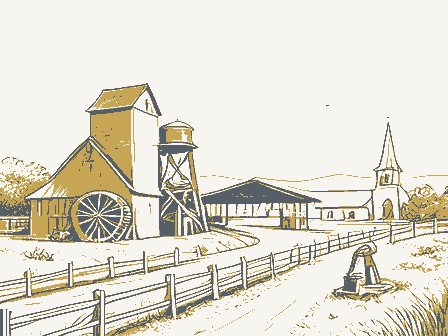
Perry Township
The complete chapter on this township from History of Franklin County [Ohio]:, published in 1858. 637 words, covering 1 settlement.
Contents
1 sectionThe section headings the book prints inside this chapter. Each one jumps to where it begins.
The modern record here
1 settlementWhat the federal record holds for each settlement inside this township: wildfires and storm reports since the 1950s, mineral workings, and museum specimens collected nearby. These are counted within a few miles of each settlement, so neighbours share them and the columns are deliberately not added up. Every row links to the settlement's own page, where each figure is broken out.
| Settlement | Fires | Storm reports | Mines and quarries | Specimens |
|---|---|---|---|---|
| Worthington Hills | - | - | - | 3,240 |
Settlements in this township
1 placeEvery populated place the Geographic Names Information System records inside this township's Census boundary. 0 of the 1 are named in the chapter; the rest were founded later or were never more than a post office.
The chapter
637 wordsReproduced complete and unedited. The text is machine-read from a scan of the 1858 printing, so expect the errors a machine makes reading a century-old page: misspelled names, dropped words, stray characters. Nothing has been corrected, because correcting a proper name invents one. The headings below are the book's own.
Perry Township
Perry Township is composed of two fractional original surveyed townships, bounding on the Scioto, range nineteen. It is ten miles in length, north and south, and from one to three miles in width, varying with the meanders of the river. It was originally a part of Liberty Township ; afterward a part of Washington ; then a part of it was attached to Norwich ; and in 1820, it was set off and organized by its present name and boundaries. There is no village nor post office in this township. Part of the township receive their mail matter at the Dublin post office ; part at Worthington, and part at Columbus. Some years since, Mr. Simon Shattuck, who lives near the middle of the township, having disposed of part of his farm in small lots, it brought some half dozen families in close proximity, and the place has since generally been known as " Shattucksburg," though it was never laid out nor intended for a town.
About the years 1813 and '14, Thomas Backus (fjither of the Lite Elijah Backus) erected mills on the Scioto, which for some years bore his name ; then for many years known as McCoy's mills, and more hitterly as Matere's mills, and Marble Cliff mills. Between forty and fifty years, these mills have been a constant benefit to the neighborhood, and reasonably productive to the proprietors. Not f^ir below the mills, in a cliff of rocks, Avere the noted rattlesnake dens, which were a terror to the neighborhood, and particularly to the mill boys ; and about which many large " snake stories " have been related. These dens were openings in the rocky cliff; one was large enough to admit a person to walk into the cavern, which has never been fully explored. The snakes have of late years entirely disappeared.
In the north part of this township are the Kosciusko lands. In 1800, a patent was issued by the United States Government to Thaddeus Kosciusko for 500 acres of land in this township, on account of his services in the Ptevolutionary War. lie attempted to transfer these lands by an assignment on the back of the patent, like the assignment of a note or bond. They were afterward claimed by a distant heir. After the conclusion of peace in America, Kosciusko returned to Poland, his native country, which, not long after, became involved in war with Russia. Kosciusko was appointed com- mander in chief of the Polish army, which was defeated, and he was severely wounded, and carried captive to St. Petersburg ; but was finally released, and he returned to France, where he lived in retirement until he died, in October, 1817. General Harrison, in delivering his eulogy in Congress, on the arrival of the news of his death, when speaking of his defeat and fall, uses the following beautiful and highly complimental couplet :
There are in this township four churches : The Union Church, owned by the German Reform and the Episcopalians, near the farm of Mr. John Legg, a painted frame, erected about the year 1852 ; a Methodist stone church, on the Medary farm, erected about the year 1847 ; a Methodist brick church, on the form of Mr. Jacob Wright, erected about the year 1844 ; and a neat wdiite painted frame Methodist Church, near 'Squire Brown's, erected in 1849 - ground donated by Mr. Dennis Fares. They also have a town or township house, on the farm of Mr. Joseph Henderson, near the center of the township, erected about the year 1854, in which to hold elections and transact township business.
twelve school districts, and an aggregate of 520 youth between the ages of five and tw-enty-one years. In 1857, it contained, according to the returns, an aggregate of 496 such youth.
Provenance
Text from History of Franklin County [Ohio]:, by Martin, William T., 1788-1866. [from Old Catalog], published 1858 and in the public domain in the United States. Digitised by the Internet Archive. The settlements listed against this township are matched by point-in-polygon test of each Geographic Names Information System coordinate against the Census Bureau's county subdivision boundary, not by name.