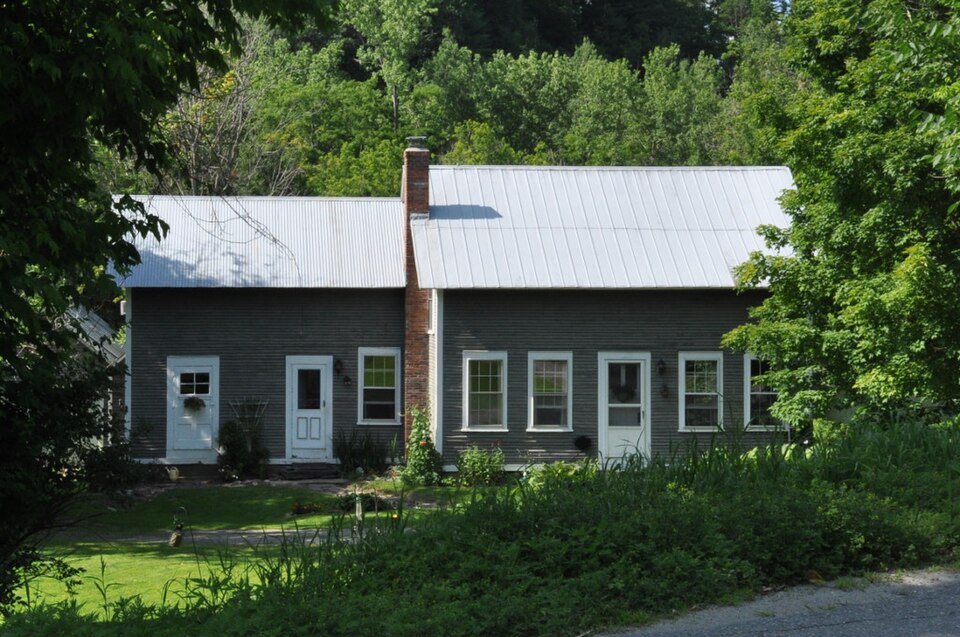
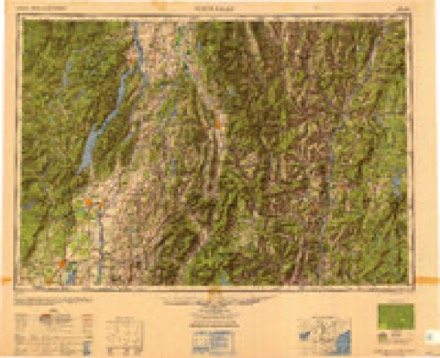
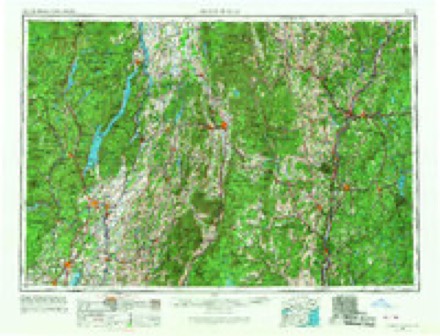
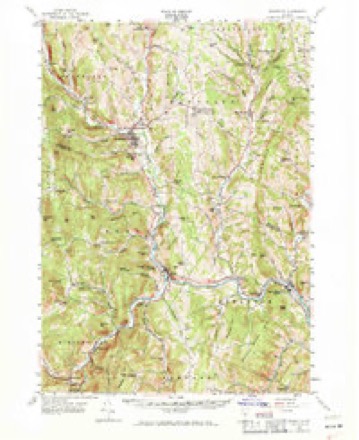
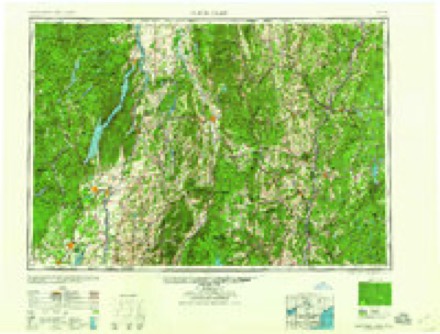
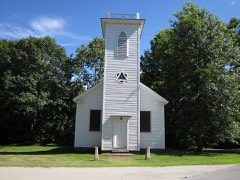
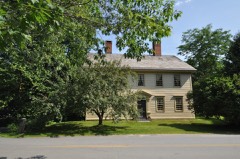
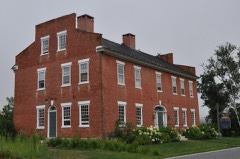
Listed on the National Register of Historic Places in 1983. 10 historic topographic surveys cover this location, the earliest from 1919.
From the record
“The Royalton Mill Complex is a three-building residential site in what is now a rural setting of Royalton, Vermont. The two houses and barn are historically associated with a mill, whose breached dams and remnant foundations lie just to the north.”
Wikipedia article Royalton Mill Complex, CC BY-SA 4.0.
One of 139 National Register listings published here for Windsor County · listed in 1983 · category: Building.
National Register reference number.83003232- the number the National Park Service assigned this property when it was listed, and the key its nomination file is catalogued under at the National Archives.
The ground it stands on
12,192 words
The chapter on Royalton Town in History of Windsor County, Vermont, published 1891 names South Royalton. This is what it says, exactly as the scans read.
With the earliest settlement, almost, in the town there sprung up a trading center, where was kept a store and a shop, and a post-office when the latter was established in the State generally, and this locality, this pretty though quiet little hamlet, has always been known by the name of the village of Royalton. This is the old historic center of "the town, although the later creation, known as South Royalton, has taken away much of the business enterprise and prosperity that naturally belonged to the older town. Here was the trading center of the town one hundred years ago, and here it should be to-day, but circumstances have ordered to the contrary. The business and other institutions of Royalton village of the present time may be briefly summed up in a single store, a hotel, a public school, the Royalton Academy, one or two shops, two churches, and from twenty-five to thirty dwellings within the village proper.
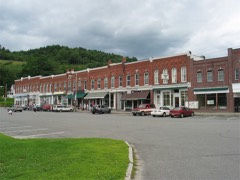
The first bank in Royalton, Vt , was chartered by the General Assembly of said State November 30, 1853, under the name of "The Bank of Royalton," with a capital of $100,000, divided into 2,000 shares of fifty dollars each. Chester Baxter, William Skinner, Stoddard B. Colby, Solon Danforth, Daniel L. Lyman, William W. White, Russell Hyde, E. B. Chase, and Philander D. Bradford were named in the char ter as commissioners to receive subscriptions for the capital stock of the bank, and the stock was subscribed in February, 1854. The bank was organized March 10, 1854, by the election of William Skinner, Daniel L. Lyman, Solon Danforth, George Lyman, E. D. Briggs, Perley C. Jones, and Ziba Sprague as its first board of directors. On March 24, 1854, William Skinner was elected president, and Newton Kellogg, of Rutland, cashier, and the first bills of the bank were issued June 7, 1854. Newton Kellogg resigned the office of cashier October 2, 1854, and Lucius L. Tilden, then cashier of the White River Bank at Bethel, Vt., was elected his successor. January 9, 1855, the same board of directors was reelected, excepting George Lyman, who was succeeded by Chester Baxter. January 8, 1856, the same board was re elected, except the election of Hiram Moore in place of Chester Baxter. Perley C. Jones resigned the office of director September 23, 1856, and Aaron N. King was appointed by the other directors to succeed him. January 13, 1857, the board was still further changed by the election of Dudley C. Denison in place of E. D. Briggs. L. L. Tilden resigned the office of cashier March 3, 1857, and William H. Baxter of Barton, Vt., was elected in his stead, but Mr Tilden continued by request of the directors to assist in the bank till April 1st following. During the autumn of 1857 the bank suffered large losses by insolvent debtors, and the last of October it suspended the re demption of its circulating notes in Boston and at its counter. January 12, 1858, Hiram Moore, Daniel L. Lyman, Ziba Sprague, Aaron N. King, Perley C. Jones, Asa W. Kenney, and William H. Baxter were elected directors, and Perley C. Jones was elected president, which office he continued to hold by re-election till January 9, 1866. The new board of directors without delay made great efforts to collect money enough on the overdue notes to the bank to enable it to resume business, which had been almost wholly suspended from November ist. Failing to raise money in this way, they borrowed it on their private note, and the bank was thus enabled to resume business and the redemption of its circulation February 24, 1858. Hiram Moore, one of the directors, died May 29, 1858. January 11, 1859, the directors of the previous year were re-elected, except that Silas H. Clark succeeded William H. Baxter, and George W. Bradstreet took the place of Hiram Moore deceased. Mr. Clark soon after resigned. August 2, 1859, William H. Baxter resigned the office of cashier to take effect on the 9th inst., and Asa W. Kenney was elected cashier, which office he continued to hold till " The National Bank of Royalton," which succeeded this bank, was closed in 1882. November 18, 1859, in consequence of losses sustained by the bank in 1857, its capital was reduced by an act of the Legislature to $50,000. January 10, i860, the number of directors was reduced by a vote of the stockholders to five, and Perley C. Jones, Aaron N. King, Ziba Sprague, Asa W. Kenney and R. H. Hyde were elected, but Mr. Hyde soon resigned. January 8, 1861, the same board of directors was re elected, except R. H. Hyde was succeeded by Chester Downer, and this board continued in office by re-election till January 9, 1866. At the last mentioned date Chester Downer, Asa W Kenney, Dudley C. Denison, Crosby Miller and Phineas D. Pierce were elected directors, and continued to be re-elected directors till the close of the National Bank in 1882. Chester Downer was elected president of the bank January 30, 1866, and was continued in that office by annual re-election till January 17, 1879, when he was succeeded by Crosby Miller, who was reelected to said office as long as the bank continued. The Comptroller of the Currency claimed that New England had received under the United States law for establishing national banks more than her proportionate share of circulating notes, and would not grant leave for the conversion of this bank into a national bank, until the directors had executed a paper waiving all claim on behalf of the bank for circulating notes, which they did. On the i6th day of September, 1867. the bank was converted under the laws of the United States into " The National Bank of Royalton," No 1673, and its capital was increased March 7, 1868, $50,000, making its whole capital $100,000. After this the directors learned that by buying the notes in circulation of national banks which had failed or gone into liquidation, and surrendering them to the Comptroller at Washington, they could obtain from him circulating notes to an equal amount for their own bank, and this they did, paying par and three or four per cent, premium for the broken bank notes until they had obtained in this way $90,000, being their full quota of circulation. On the night of April 26, 1870, the bank vault was blown open by burglars, and the walls of tlie banking house were badly damaged by the explosion, but they did not succeed in breaking the safe in the vault, and they carried off only about $5 of nickels then lying in the vault. In consequence of the damaged condition of the vault and building the bank was removed May 14, 1870, to South Royalton, about two miles distant. During the summer and autumn of 1871 the vault and banking house were repaired, and the bank was moved back to its old quarters October 23, 1871. Phineas D. Pierce was elected vice-president of the bank January 12, 1875. ar'd was annually re-elected till the close of the bank. Lyman A. Peck, a resident of Royalton, on the 8th day of October, 1877, broke into the banking house for the purpose of stealing money from the drawer of tbe counter, while the cashier was at dinner, but the money was safely locked in the vault so that he obtained none, but was tried and sentenced to the State prison for five years for his luckless exploit. On the night of October 17, 1881, burglars again entered the bank and drilled through the outer brick wall of the vault to the heavy granite wall, and with powder or some other explosive, blew out a few brick and broke the windows, but obtained no money. January 10, 1882, the stockholders voted to close the bank. In less than six months thereafter all liabilities were paid, and the stock at par was paid back to the stockholders. Afterwards they were paid $21,200 on the capital of $100,000, it being twenty one and one-fifth per cent, more than par. SoutJi Royalton, the junior of the two villages of the town, yet con- siderably the larger, was brought into existence by the building of the Vermont Central Railroad ; and its stores and other buildings, except dwellings, were of the character usually found in localities having a mushroom growth ; that is, of frame and not substantial or enduring ; neither were they attractive, especially after exposure to the storms of a few years. But, young though the village may have been, it has had its own fire record, and the old unsightly structures " passed away." In their stead there has been built a substantial two-story brick row ; plain, yet convenient buildings, and a credit to the town. They front on the park, as also does the large and attractive hotel, the property of Charles H. Woodward ; but the hotel and the stores are on opposite sides of the park, and on the other side, the park being in form a parallelogram, is the depot, and opposite to it some fine dwellings and one of the village churches.
Regional context, not property-specific
evidence. The
federal wildfire occurrence database
lists 4 fires within 5 miles of Royalton Mill Complex
between 2013 and 2020, burning about 6 acres in total. None started naturally. None was recorded as arson.
Distance is straight-line from the map coordinates, so a fire counted
here may appear on a neighbouring settlement's page as well.
Reported cause
Fires
Debris and open burning
2
Equipment and vehicle use
2
The most recent of
them, most recent first, with the day each was reported and the service
that recorded it.
Regional context, not property-specific
evidence. The federal mineral resources record lists
1 working within 5 miles of Royalton Mill Complex: 1 past producer.
None of them still produces. What was taken out: Marble, Dimension. Distance is straight-line from the
map coordinates, so a quarry counted here may appear on a neighbouring
settlement's page as well.
Regional context, not property-specific
evidence. The National Weather Service names
South Royalton, the town this property stands in, in 3 storm reports between 2012 and 2016: 2 thunderstorm wind, 1 hail.
No death or injury is recorded in these reports. Each account below is quoted exactly as the forecast office
filed it, from the NOAA Storm Events Database, and each date
opens the federal record of that event.
United States Geological Survey topographic sheets whose coverage includes this point. Matched by taking the coordinate the National Park Service records for this property, then testing that coordinate against the published boundary of every sheet.
Other National Register properties close
enough to walk or drive between, ordered by distance from this one. Both
positions come from the same geocoding pass that matched these properties
to their map sheets.
Listing record. National Park Service National Register of Historic Places, listed-properties dataset, current to 2026-05-22.
Map join. Address geocoded through the United States Census geocoder, then tested against the published boundary of every sheet in the USGS Historical Topographic Map Collection.
How this page is made. Listing fields come from federal records; map-sheet coverage is a labelled coordinate-to-boundary calculation, not a source-field claim.
Wildfire. Short, Karen C. 2022. Spatial wildfire occurrence data for the United States, 1992-2020 [FPA_FOD_20221014]. 6th Edition. Fort Collins, CO: Forest Service Research Data Archive. https://doi.org/10.2737/RDS-2013-0009.6 Collected with United States Government funding and usable without additional permissions or fees.
Mines and quarries. USGS Mineral Resources Data System (MRDS) https://mrdata.usgs.gov/mrds/ A work of the United States government, no copyright under 17 U.S.C. 105.
Storms. NOAA National Centers for Environmental Information, Storm Events Database https://www.ncei.noaa.gov/stormevents/ A work of the United States government, no copyright under 17 U.S.C. 105. Narratives are quoted verbatim from the National Weather Service report and are not edited or summarised.
 Block