 Block
Roberts, Indiana
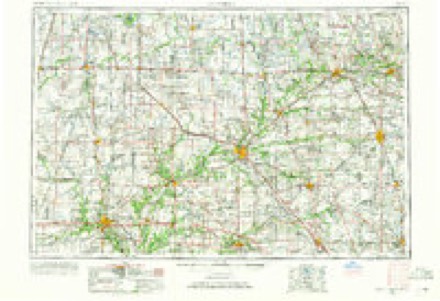
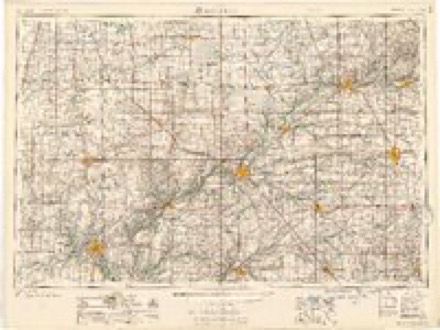
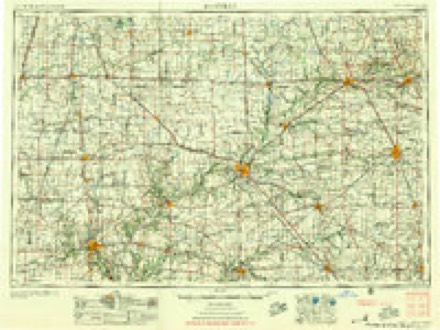
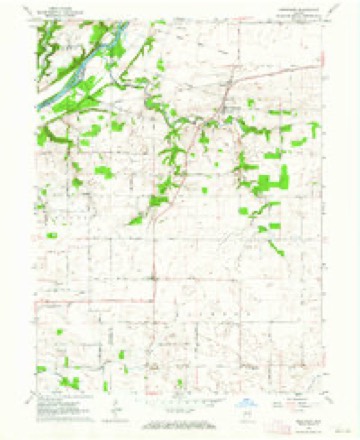
8 topographic sheets cover this place, the earliest surveyed in 1953 and the latest in 1987. It stands in Davis Township. It lies in ZIP code area 47918. The Survey maps it on the Westpoint quadrangle.
Topographic sheets covering this place
6 surveys from 8 printed sheetsMatched by testing this settlement's coordinate against the published boundary of every sheet in the United States Geological Survey's historical collection. Each opens the scanned sheet at the Survey.
- 1953 USGS Danville quadrangle1:250000, 3 printings
- 1955 USGS Danville quadrangle1:250000
- 1956 USGS Danville quadrangle1:250000
- 1962 USGS Westpoint quadrangle1:24000
- 1984 USGS Danville quadrangle1:100000
- 1987 USGS Danville quadrangle1:100000
In the county-history sources
10,200 words on this townshipHistory of Fountain County : Together with Historic Notes on the Wabash Valley, Gleaned from Early Authors, Old Maps and Manuscripts, published 1881 names this settlement in its chapter on Davis Township. These are the passages that mention it, exactly as the scans read.
Subscription schools were secured as soon as a sufficient number of people had arrived to maintain them. They were held first in vacant cabins and different parts of the township. It is impossible to mention the first school nor the first teacher, but information is to the effect that two or more were perhaps nearly simultaneously begun. One of the earliest, and the most important at that period, was that in the Shawnee settlement. The house stood in the little grove just behind Salem church, and was a long, hewed-log cabin, built by Andrew Eound on a five-acre lot lie owned. When he was leaving, the people united and purchased the house and piece of ground for public use. Here were held singing, spelling and common schools, and religious exercises ; and for many years this was the chief place of popular gathering. School was commenced most probably in 1829. The Kev. James Kinkennon, a New Light preacher, taught the three first winters, and Cuitis Carmain succeeded two winters and one summer. One of the later ones, perhaps the last, was Sanford Calvert. A school was kc]>t at John Pierce's, another in the Dntton neighborhood, over in Tippecanoe, and among these three and the Attica school existed an exciting rivalry in the old-fashioned spelling-school, an institution too much neglected nowadays. Carmain trained liis scholars for the contest. Some were permitted to concentrate their whole study on the elementary spellingbook until it was mastered ; while extended tasks were allotted others, that they might perfect themselves in sections of the work. A challenge came from Attica. The " master," " nothing loth," accepted it, and selecting five of his best spellers, went down to the village at the time set. It was an hour of grave interest, and palpitating anxiety, naively and courteously concealed with mirth, sport, and cordial greetings. The moment arrived ; the school stood up in waiting. The words were given out in distinct voice, and spelled and pronounced as clearly, and with confident promptness. Round and round they passed, and one by one the contestants went down. Carmain's confidence in his well-drilled pupils was not unfounded. The ranks of their opponents grew thin, and at last melted out of sight before the perfect discipline and preparation which these encounters stimulated. Tiie Shawnee scholars triumphed on the first trial. The ulterior result was the real triumph. The absorbing interest created by love of victory was momentary, but the value acquired was permanent. In these respects the pioneers had very limited advantages, and apologies by these venerable people for lack of early opportunities are not seldom made. What can be the occasion for apology when illiteracy is actually on the increase, and putting to shame privileges unexampled in the history of the race, we are at a loss to know. In 1837, or later, a capacious brick school-house was built on the corner west of Salem Church, and was used fifteen or twenty years. The foundation proving defective it was torn down, and the frame building now standing there and used for a tenant house was erected. Schools were discontinued here wlien tlie district was divided. Josepli Poole was one of tlie first teacliers in tlie brick house. This would seat eighty or ninety scholars,' and liad a fireplace in each end. When subscription schools were kept there was a term of throe months in winter, and each scholar paid §1.50 and two cords of wood. Singing and spelling schools furnished fuel for their own use, and eliurch-goers had to provide "preaching wood." Tiie old frame school-house standing in Trustum Beverly's yard, once ' called Shawnee, was built some forty years ago. Joseph Poole tauglit first in this. Its low ceiling was not a little in the way of Moyer's high-crowned hat and the rod he wielded. As early as 1833 William - ; i Puwell taught near Maysville, and afterward iu other cabins in dii^'erent pai'ts of the township. He was a surve\'or, and often liad to close - 1 his school a week at a time to go to lay out a road. The first school taught in the northwest part of the township was by E. L. Wheeler. This man is living near Onarga, Iroquois county, Illinois. Tiie earliest school-house built from the public fund is deserving of description. Uncle Jesse Marvin having learned that the school commissioner held money to the credit of the township, took the initial step in the matter, and caused the township to be laid off into five districts. Three trustees were elected, himself among the nunibei', and a clerk and a treasurer. Tiie fund drawn amounted nearly to §300. Tiie building of the house was awarded to Mr. Marvin. It was situated near the center of Sec. 32, and was about 18x24: feet square. It was constructed of hewed logs, with straightened edges meeting within an inch, and daubed without chinking. The ceiling was 7i feet high; two windows of 8x10 glass were on each side, and one was in the end. The stove occupied the center of the room, and the teacher's desk the south . end. In the north end was the door, and pegs for hats, bonnets, shawls, and dinner-pails. On either side were ranged a long desk and bench, the former made fast to tiie wall with brackets. The- slanting lid or cover which had to be raised when putting books in or taking them out, were sawed in two, so that not more than a fourth of the scliool should be interrupted and incommoded when a single scholar had occasion to get into the desk. William Chizum and Jefferson Parrish were the earliest teachers. This house has been twice moved : the first time into the Brown neighborhood, where it was many j-ears used as well for a polling place as a school-house, and the second time to where it now stands, on AVilliam Duncan's place. Jasper Roberts is the present trustee. The township is divided into si.x districts, and has 239 scholars. Schools are maintained six months of the year. Tiie buildings arc valued at §3,000, and the furniture and apparatus, much worn, at §400. Twelve hundred dollars are annually paid to teachers, whoso
Passage source: History of Fountain County : Together with Historic Notes on the Wabash Valley, Gleaned from Early Authors, Old Maps and Manuscripts, published 1881.
Archibald Roberts (deceased), Attica, was born in Hardee county, Virginia, March 13, 1800. His mother was Mary Bosely. His father, Archibald, served as a soldier nearly throughout the revolution. Mr. Roberts began life as a laborer, and worked ten years for |S per month. The first year of this period he was in Virginia, the remainder on the Scioto bottoms not far from Chillicothe. In 1828 he came to Davis township and entered two eighties, and about 1830 married Anna Taylor, by whom was born to him one child, George. His wife died ; and October 24, 1839, he married Miss Piiebe Alenduff. She bore six children : William H., Frederick M., Mary (deceased), Joseph H., Jasper, and Charles A. Three of Mr. Roberts' sons were in the army. George was a member of the 76th 111. Vols, three years; William enlisted in the 86th Ind., but got sick and after about six months was discharged for disability. He served on the Bragg-Buell race. Frederick served out two enlistments. (See his biography.) Mr. Roberts died greatly respected. May 23, 1867, having provided an ample inheritance for his family, leaving to them 500 acres of real estate, including 140 acres of woodland. He also gave a farm to each, George, wluiam, and Frederick. The former has 175 acres where he lives, near Milford, Iroquois county, Illinois. Mrs. Roberts has been in the communion of the Methodist Episcopal church since 1857. She was born January 22, 1820, and was the daughter of Frederick and Nancy (Meredith) Alenduff. Her grandfather Meredith was a soldier of seven years and six months' service in the revolution ; he fought at the Cowpens, and Guilford Court House, and was wounded in the last battle. He ran away from home at the age of fourteen and went into the army.
Passage source: History of Fountain County : Together with Historic Notes on the Wabash Valley, Gleaned from Early Authors, Old Maps and Manuscripts, published 1881.
Frederick M. Roberts, fanner, Attica, son of Archibald Roberts, was born in Davis township, August 3, 1812. His mother, Phebe, was the daughter of Frederick Alenduft". Both his parents arrived here in 1828? He was married January 2, 1870, to Miss Maggie Duncan. She died June 10, 1871, and he married Josephine Stanley February 10, 1874. She was the daughter of Martin and Melinda (Bartlett) Stanley, and was born November 20, 1854. They have two children : Walter, born November 14, 1875, and Mary EdiUiJ^te^TOT- 30, 1878. Mr. Roberts enlisted July 6, 1863, in Co. ^^I^Flixi. Vo]^^., for six months, and served eight. The regiment" rendczvrfused and~^vv:as organized at La Fayette. It went to Fort Dearboi;n; Michigan ; thence ^to Detroit, and from there by the " Morning Star*"' steamer to Cleveland,, and the rest of the way by rail to Cincinnati and Camp Dick Robin-\^ son, where it was brigaded with three other regiments. From this > point the march was begun for Greenville, Tennessee. Here he spent the winter of 1863-4, scouting and marching, and was in two skirmishes. In that at "Walker's Ford a soldier of Co. F was killed Two from his company and five from his regiment were taken prison, ers during the winter service. He was mustered out at La Fayetto March 1, 186i. His second enlistment was February 10, 1805, in Co. F, 150th Ind. Vols. Tiie regiment was organized at Camp Carrlneton, Indianapolis, and served in the Shenandoah Valley. The raou were mustered out at Stevenson Station, and disbanded and paid ofl'at Indianapolis, August 5, 1865. His captain in the 116th was Abrani Claypool, and Col. Kice commanded the regiment. Capt. Boswcll and Col. Taylor, of La Fayette, were his officers in the 15Uth. This Inst regiment marched from Harper's Ferry to Winchester, and was at Charleston, Virginia, when Lee surrendered. Mrs. Roberts is a member of the Methodist Episcopal church, and he owns a well-cultivated farm of 226 acres, and is a republican.
Passage source: History of Fountain County : Together with Historic Notes on the Wabash Valley, Gleaned from Early Authors, Old Maps and Manuscripts, published 1881.
Machine-read from a century-old scan, so expect the errors a machine makes: misspelled names, dropped words, stray characters.
Read the whole chapter on Davis Township - it names this place 1 more 1 time.
Mines and quarries near this place
1 within 5 milesRegional context, not property-specific evidence. The federal mineral resources record lists 1 working within 5 miles of Roberts: 1 past producer. None of them still produces. What was taken out: Clay. Distance is straight-line from the map coordinates, so a quarry counted here may appear on a neighbouring settlement's page as well.
| Where | Site | Commodity | Status | Recorded |
|---|---|---|---|---|
| Rostone Pit | Clay | Past Producer |
Nearest settlements
The eight closest, with where each one stands in the county. Distances are straight-line, computed from the Geographic Names Information System coordinates.
| Map | Place | Distance | Sheets |
|---|---|---|---|
| Vine | 2.3 miles | 9 | |
| Maysville Crossing | 2.6 miles | 9 | |
| Riverside | 3.4 miles | 9 | |
| Attica | 7.9 miles | 9 | |
| Newtown | 8.1 miles | 9 | |
| Rob Roy | 9.3 miles | 9 | |
| Mellott | 10.7 miles | 9 | |
| Aylesworth | 10.8 miles | 9 |
Elsewhere
Matched on this settlement's Geographic Names Information System number rather than its name, so it cannot be a different place of the same name in another state.
| Wikipedia article on Roberts | An encyclopaedic summary. Its text is share-alike, so it is linked here rather than copied. |
| Wikidata item Q18390788 | The structured record the population and elevation above come from. Public domain (CC0). |
Provenance
This settlement is recorded in the Geographic Names Information System as feature 442149. The sheet list is computed by point-in-boundary test against the United States Geological Survey's historical topographic inventory. Both are works of the United States government and carry no copyright under 17 U.S.C. 105.
Mines and quarries. USGS Mineral Resources Data System (MRDS) https://mrdata.usgs.gov/mrds/ A work of the United States government, no copyright under 17 U.S.C. 105.