Major Bibliographical References Previous documentation on file (NPS) Primary location of additional data - preliminary determination of individual listing (36 CFR 67) - State Historic Preservation Office has been requested. - Other State agency - previously listed in the National Register - Federal agency - previously determined eligible by the National Register - Local government - designated a National Historic Landmark - University - recorded by Historic American Buildings Survey - Other - recorded by Historic American Engineering Record Property is: 1849-1942 history. Architect/Builder Bibliography African-American Name of repository: A owned by a religious institution or used for religious Period of Significance Cultural Affiliation C Property embodies the distinctive characteristics of a National Register listing) purposes. 10.
Geographical Data UTM References (Place additional UTM references on a continuation sheet) 1 17 367290 4252340 Catlettsburg, KY - Ohio-W.Va. - See continuation sheet. Verbal Boundary Description (Describe the boundaries of the property on a continuation sheet.) See Attached Boundary Justification (Explain why the boundaries were selected on a continuation sheet.) 11. Form Prepared By name/title_Maura Johnson, revised by Marcelle Wilson, Research Historian and Donna M. DeBlasio, Director organization_Wilson & DeBlasio: Youngstown State University Center for HP date_11/14/00; rev. 3/23/01 street & number Johnson: 2-489 SR 281; Wilson & DeBlasio: Dept.
of History, One University Plaza telephone_Johnson: 471-248-0773; Wilson & DeBlasio: 330-742-3158 city or town_Johnson: Deshler, Wilson & DeBlasio: Youngstown state_OH zip code Johnson: 43516; Wilson & DeBlasio 44555 Additional Documentation Submit the following items with the completed form: Continuation Sheets A USGS map (7.5 or 15 minute series) indicating the property's location. Representative black and white photographs of the property.
Additional items (Check with the SHPO or FPO for any additional items) Property Owner (Complete this item at the request of the SHPO or FPO.) name_Trustees Burlington Cemetery street & number 154 Township Road 1022 _telephone city or town Burlington Paperwork Reduction Act Statement: This information is being collected for applications to the National Register of Historic Places to nominate properties for listing or determine eligibility for listing, to list properties, and to amend existing listings. Response to this request is required to obtain a benefit in accordance with the National Historic Preservation Act, as amended (16 U.S.C. 470 et seq.). Administrative Services Division, National Park Service, P.0.Box 37127,Washington, DC 20013-7127; and the Office of Management and Budget, Paperwork Reductions Project (1024-0018), Washington, DC 20503.
Lawrence County, OH Photographs Maps Burlington 37 Cemetery Zone Easting Northing Acreage of Property Less than 1 acre gathering and maintaining data, and completing and reviewing the form. Direct comments regarding this burden estimate or any aspect of this form to the Chief, OMB No. 1024-0018 United States Department of the Interior National Park Service NATIONAL REGISTER OF HISTORIC PLACES CONTINUATION SHEET Burlington 37 Cemetery Lawrence County, OH backgrounds and countries. It is also a history which includes shameful examples of masters freed their slaves because of conscience, religious and/or moral beliefs, or (in their will), at the time of their death. One man who bequeathed freedom to his slaves was Virginia slave owner, James Twyman in 1848.
Twyman's will left directions for thirty-seven of his slaves to be freed and provided thirty-two of them with one of the free states of the Union, and their location therein, or elsewhere if they should desire it, and to the purchase of a home or homes for them, together with provisions and clothing for one year for Provisions were made for five of the "thirty-seven" Twyman slaves to remain in Virginia, through West Virginia to Ohio, where they purchased land through their spokesman Thomas Walker Fry, former foreman for Twyman's plantation. By the 1870s, the original 640 acres of land were divided among the former Twyman slaves and the Burlington 37 Cemetery is located there. Many of the freed slaves and their ground. [Photograph 6] middle of a residential neighborhood (the Del Meade Subdivision, platted in 1925).
The vacant alley at the east end of the site, deeded to cemetery trustees around 1985. A recently excavated and filled. Homes are located immediately to the south and east of the cemetery, and small, newer homes to the west of it, across Center Street. The older homes in the neighborhood are small, single story wood frame structures that appear to J. Earl Pratt. The Promised Land. (New York: Vantage Press, 1964.) 35. 2 Ibid., 18. Description (8-86) descendants are interred in this graveyard, and thus explains the name of the burial located.1 NPS Form 10-900-a America's history is rich, complex, broad, and encompasses people from all them, and all necessary tools to work the land on which they may be cemetery covers approximately .89 acres of slightly undulating land; this includes a human exploitation; slavery is just one of those events.
During the era of slavery, some ...the sum of ten thousand dollars to be applied...[to their removal]...to The Burlington 37 Cemetery [Photograph 1] is located on an irregular-shaped lot in the rectangular area (approximately 15,221 square feet) that was added in the 1920s, and a NPS Form 10-900-a OMB No. 1024-0018 United States Department of the Interior National Park Service NATIONAL REGISTER OF HISTORIC PLACES CONTINUATION SHEET Burlington 37 Cemetery Lawrence County, OH date from the 1920s. Newer, post-1960 homes are of a similar scale and many are pre- tabricated units. In the absence of demonstrated historic associations or quality of craftsmanship or design, and because the physical integrity of the area has been compromised, it is determined that none of these structures appear to meet the criteria for listing in the National Register of Historic Places. left of the larger gate.
installed and dedicated to the freed African-Americans of the Twyman plantation in 1994. [Photograph 2] The tablet is incised with "Promised Land" and an image of two covered wagons, pulled by oxen and led by a man. Beneath the image are listed the surnames of the freed slaves to whom the cemetery is dedicated. There is a flagpole inside the drive [Photograph 3] runs roughly east-west through the center of the cemetery; just Several century/yucca plants are also scattered throughout the grounds in no apparent These improvements were initiated by the local pastor, H. R. Ray.
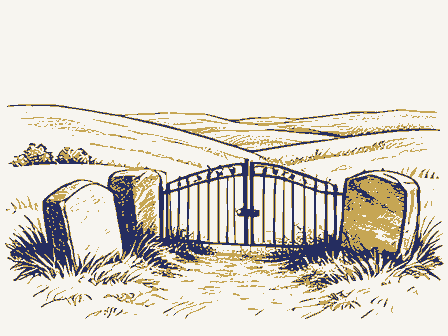
Although a well manicured lawn is maintained today, the earlier, natural appearance of the cemetery was not atypical of its time and type.According to Vennie Dees-Moore, former assistant folklorist at the Smithsonian's Office of Folklore Programs, "it is not unusual to find an 3 A popular Victorian planting, the spiky bush was commonly used in African-American cemeteries grandson of Susan Twyman Gordon, one of the freed Twyman slaves who moved to Ohio in 1849. (8-86) pattern.3 with wild, overgrown vegetation and an unkempt appearance.He recalls tearing down a inside the entrance, the road curves slightly south of a high spot where some of the older Section 7 Page 2 painted wooden sign that reads "Burlington Cemetery 37." Double-hinged doors allow to keep spirits from roaming about; the significance of the plants is unknown. passage of cars through this gate.
A pedestrian gate with hinged door is located to the Immediately inside the cemetery gates (to the left) is a large stone monument which was gate on the right. The flagpole and fencing were installed around 1985. An unpaved *Owen Pleasant served as trustee for the Burlington Cemetery 37 for many years. He is the headstones are located.There are two large deciduous trees near the center of the site. NPS Form 10-900-a OMB No. 1024-0018 United States Department of the Interior National Park Service NATIONAL REGISTER OF HISTORIC PLACES CONTINUATION SHEET Burlington 37 Cemetery Lawrence County, OH not be disturbed." The current trustees dismiss this belief and established a regular program of maintenance for the cemetery grounds. There are approximately 250 grave sites in the cemetery. At least twenty-five members of the original Burlington 37 are believed to be interred here.
There is no written record of the earliest burials, which probably date to the 1850s. Similarly, no headstones are monuments belonging to the Toms family.® Along with several other older monuments, The last of the original "37" to be interred was Susan Twyman Gordon, who died in 1942 and whose gravesite was recently re-dedicated with a flat stone marker. [Photograph 6] descendant of the Burlington 37, born during the journey from Virginia to Ohio. Although there is no apparent landscape design, the graves are laid out in a traditional east-west axis, with headstones facing east so that the souls beneath them "will arise on folk/homemade concrete markers. [Photograph 9] Concrete markers [Photograph 7] are the most prevalent in this cemetery and range from simple, hand-inscribed markers graves are continually being added.
Recent burials have been made in the low-lying areas along the south side and near Center Street, at the northwest corner of the American Cemeteries, (Detroit: Visible Ink Press, 1996), p. 43. -The record of internment has been passed orally through the generations; a written record has been maintained since ca. 1990. (8-86) cemetery. Because it is an active cemetery (approximately thirty-five plots are still available), new taking place.This does not necessarily signify neglect, but is done so that the dead will Ibid., p. 20. Section 7 Page 3 identifiable from that period. The oldest known markers in the cemetery are stone these are located on the highest spot in the cemetery, near the center of the original lot. that last day facing the rising sun." The graves are placed in rows, for the most part, with families loosely grouped.
The historic headstones fall into three general categories: [Photograph 8] to larger, geometric monuments. [Photograph 10] NPS Form 10-900-a OMB No. 1024-0018 United States Department of the Interior National Park Service NATIONAL REGISTER OF HISTORIC PLACES CONTINUATION SHEET Burlington 37 Cemetery Lawrence County, OH Statement of Significance From their first arrival in the state, Ohio's black citizens played an essential role in the nineteenth century emancipation/antislavery movement, and the communities they Places under Criterion A for its association with this aspect of Ohio's social history.® The and common ownership and ends in 1942, the year when the last of the original 37 was purchased and commonly held by the Burlington 37, as previously mentioned, a relocated to Ohio in 1849.
A prominent Black settlement in Ohio, Burlington was an important and active stop on the Underground Railroad. Reserved for the thirty-two freed Twyman slaves and their descendants, the cemetery stands as the only place or structure having direct physical and historical associations with this group. For this reason, the property is also nominated under Criterion Consideration D. Historical Background and Significance Burlington is located on the northern banks of the Ohio River, in the state's southernmost township.
The area was first settled by Revolutionary War veteran William Davidson in 1798,who was followed by James Davidson and George Koons in 1801 and Samuel Ankrim in 1807.Named for James Lawrence, a naval officer in Tripoli and War of 1812, to whom is attributed the cry "Don't give up the ship," Lawrence County was organized in county seat, in addition to building a post office, courthouse, and jail. In 1851, the county seat was moved from Burlington to Ironton, the business and distribution center of the nearby Hanging Rock iron district.° DeBlasio and Marcelle Wilson, for the Ohio Historic Preservation Office, 2001. Inc., 1925.) 374. Vexler, Robert I., State Editor. Chronology & Documentary Handbook of the State of Ohio. (New York: Oceana Publications, Inc., 1978.) 10. (8-86) interred.
Section 8 Page Much of the information on the Underground Railroad is taken from the Multiple Property Documentation on Historical and Architectural Resources of the Underground Railroad in Ohio by Donna M. established were several of many destinations for free African-Americans and runaway slaves. The Burlington 37 Cemetery is nominated to the National Register of Historic period of significance has been determined to begin in 1849, the date of initial purchase community of slaves manumitted by slave-owner James Twyman of Virginia and 1816. In 1817, Edward Tapper laid out the town of Burlington, which became the first 9 Galbreath, Charles B. History of Ohio: Volume I. (Chicago: The American Historical Society, NPS Form 10-900-a OMB No.
1024-0018 United States Department of the Interior National Park Service NATIONAL REGISTER OF HISTORIC PLACES CONTINUATION SHEET Section 8 Page 2 Burlington 37 Cemetery Lawrence County, OH of the region and one of the largest tributaries of the Mississippi, this great waterway followed Ohio's eastern and southern borders for more than 400 miles. Called La Bell pathway to the West."® The river was the region's first and most important means of transportation and, until canals and railroads opened the markets of the East, it was the key to trade and economic growth there. The Ohio River formed the southernmost boundary of the Western free states of Indiana and Illinois. It often served as a gateway state's future in antislavery activities.
The Northwest Ordinance, established in 1787, set guidelines for settlement of the new territories and guaranteed freedom of religion and the territory was open to settlement, people from New England settled in small clusters in the northern and eastern parts of Ohio. The Society of Friends or Quakers, known for their abolitionist sentiments, moved to the southern, southwestern, central, and eastern parts of the state, while "Covenanters and antislavery Southerners and some Negroes" moved to the area as well."Other groups of people settling Ohio also brought Ohio), Scottish Covenanters, and the Wesleyan Methodists. Scottish and Scots-Irish Morgan Counties, Ohio, where they were known to be ardent supporters of runaway Railroad.
Ohio's native inhabitants, the Ottawa Indians under Chief Kinjeino in the northwest part of the state likewise were willing to aid fugitive slaves on their way to freedom in Canada. Ohio was, in addition to being the home of whites with antislavery beliefs, also home to large settlements of free Blacks and African-American communities in Jackson and Brown Counties, the New Guinea settlement in Belmont County, Pike County, Cincinnati, in Hamilton County, and Poke Patch in Lawrence, Ohio, whose number of African-Americans also resided in Ripley, Ohio where the 1989) 61. & Russell, 1967. 114-115. (8-86) 10 Knepper, George W. Ohio and Its People, (Kent, Ohio: The Kent State University Press, Burlington's early growth was closely associated with the Ohio River.
The dominant river slaves, added to the state's reputation as an active participant in the Underground community inhabitants aided other African-Americans fleeing from bondage. A large Riviere by the French, the Ohio River was, "for a thousand miles an open and inviting to liberation for runaway slaves traveling north into the free states and/or Canada. Ohio had a diverse population which came from many places and set the tone for the "Siebert, Wilbur H. The Underground Railroad From Slavery to Freedom. New York: Russell NPS Form 10-900-a OMB No.
1024-0018 United States Department of the Interior National Park Service NATIONAL REGISTER OF HISTORIC PLACES CONTINUATION SHEET Section 8 Page 3 Burlington 37 Cemetery Lawrence County, OH various colleges and universities which promoted abolitionist ideals, such as Congregationalist Oberlin College, Presbyterian Western Reserve College, Presbyterian Lane Seminary, African Methodist Episcopal Wilberforce, and Geneva College in Northwood, Logan County, Franklin College in New Athens, Harrison County, and it is easy to understand why "there was no break in the business of the Road from the Rankin, but suffered hard times when admission of African-American students in 1831 Ohio's physical location made ita popular state to travel to or through for many runaway bordered Kentucky with about one hundred and sixty miles of river frontage; and Virginia almost any point." Major terminal stations on Lake Erie in Ohio included Sandusky, Cleveland, Toledo, Ashtabula Harbor, Painesville, Huron, Lorain, and Conneaut, which paths, and routes which fugitive slaves took on their way to freedom, and "Ashtabula Harbor, Cleveland and Sandusky, each seems to have been the terminus for four or five lines of Road, while perhaps only two or three lines ended at Toledo and Painesville, and one each at Huron, Lorain and Conneaut." Charles L.
Blockson notes in the Hippocrene Guide to the Underground Railroad that at least five main routes existed in Ohio and fugitive slaves traveled them often to safety and freedom. Slaves also escaped by being put on either the Columbus and Cincinnati Railroad or the Cleveland and Western Railroad and escaped through Alliance, Ohio into Cleveland. Completion of railway lines to the Great Lakes areas occurred by 1850 and Underground Railroad 12 Ibid. 30-35. Story of the Underground Railroad and the Growth of the Abolition Movement. (New York: Harper & Brothers, 1941.) 72-73. Blockson. Charles L. Hippocrene Guide to the Underground Railroad, (New York: Hippocrene Books, 1994.) 261. 1 Knepper, George W. Ohio and Its People. (Kent, Ohio: The Kent State University Press, 1989.), 192. 15 Siebert, The Underground Railroad, 114-115. (8-86) split the college community and the town.14 16 Ibid. 146.
with perhaps two hundred and twenty-five miles or more, and crossings were made at Black section of the town was known as "Little Africa"or"Africa Hill."12 Add to this the slaves. Wilbur Seibert, author of The Underground Railroad, notes of Ohio's locale, "It conductors and employees utilized these, calling them surface lines.1 Blockson notes 13 Ibid. The Underground Railroad. 40, 115. Buckmaster, Henrietta. Let My People Go: The 18 Ibid. 78. NPS Form 10-900-a OMB No. 1024-0018 United States Department of the Interior National Park Service NATIONAL REGISTER OF HISTORIC PLACES CONTINUATION SHEET Burlington 37 Cemetery Lawrence County, OH While not every runaway slave followed these five trails, Siebert identifies many other routes taken by escaping slaves.
The southern part of the state, according to Siebert's entry into the state were numerous, in areas such as Moscow, Red Oak, and Rome, to name a few.? for states connected to large bodies of water and rivers. Slaves utilized steamships, riverboats, canals, and other forms of water transportation to make their way to major seaport cities located along rivers, lakes, and streams. Some ended up in New York, Pennsylvania, Boston, Cincinnati, and other areas. From big cities, members of the of their journey into Canada.2 Slaves fleeing states like Virginia, Kentucky, Arkansas, and Tennessee would travel on the Ohio River, the Mississippi and Missouri Rivers, and receive aid and guidance from members of the Underground Railroad along their way to freedom.
One benefit to escaping by way of the Ohio River was that it periodically froze in winter and allowed slaves to run across it without worry of finding water transport to Ohio. One noted slave who fled over the frozen Ohio River, was "Eliza," made reference to in Harriet Beecher Stowe's novel, Uncle Tom's Cabin. She returned several times to 19 Blockson,, Hippocrene Guide, 253. 2 Quarles, Benjamin. Black Abolitionists. (New York: Oxford University Press, 1969.) 145. 21 Seibert, The Underground Railroad, 78. 2 Ibid., 78. *Haskins, James. Get On Board: The Story of the Underground Railroad. (New York: Scholastic Books, Inc., 1993.) 16-17: Mabee, Carlton. Black Freedom: The Nonviolent Abolitionists from 1830 Through the Civil War. (London: The MacMillian Company, 1970.) 275. (8-86) help lead her children, who remained in slavery in the South, to freedom in Canada.24 1996.) 12-13.
Section 8 Page 4 that "A number of escaped slaves were delivered by schooners at the foot of Superior map in his The Underground Railroad: From Slavery to Freedom, indicates that points of " Seibert, The Underground Railroad, 105; Blockson, Hippocrene Guide, 265. Sprague, Stuart Seely, Editor. His Promised Land: Autobiography of John Parker. (New York: W. W. Norton & Company, Underground Railroad then put runaways on wagons, ships, and/or trains for the last leg notes that, "There were probably more surface lines in Ohio than any other state."21 NPS Form 10-900-a OMB No. 1024-0018 United States Department of the Interior National Park Service NATIONAL REGISTER OF HISTORIC PLACES CONTINUATION SHEET Burlington 37 Cemetery Lawrence County, OH THE UNDERGROUND RAILROAD IN OHIO and spans the decades until slavery was outlawed in the United States with adoption of the 13' amendment in 1865.
Earliest accounts testify that in 1812 a slave was freed from his captor "by Colonel James Kilbourne," a Worthington, Ohio official. The slave 1816 to 1830," while Eliakim H. Moore of Athens, (treasurer of Ohio University) and Dr. as being active in the early 1820s in Ohio. through localized efforts, which operated in secrecy as well as in the open. Larry Gara, fugitives who encountered it on their way North to freedom.? Much of the romanticism of the Underground Railroad and the various myths and legends which have become publication, Uncle Tom's Cabin, which was "directed to the heart and conscience of the on their journeys north to freedom. of the fugitive him/herself, "The relatively few slaves who did escape were primarily significant amounts toward aiding and protecting fleeing slaves.? Frequently, when 25 Siebert, Wilbur. The Underground Railroad. 38. 26 Ibid.
38 (8-86) indisputable."28 The"road,"where it existed, might form along the routes runaways took 27 Gara, The Liberty Line, 9.
When studying the Underground Railroad and its effectiveness, one must not lose sight County resident, Job Mullin states, "The most active time to my knowledge was from Underground Railroad can be found from residents and participants in Ohio.Warren entrenched in Americana over time can be traced, initially, to Harriet Beecher Stowe's Section 8 Page 5 was later "sent north aboard one of the government wagons engaged at the time in Thomas Cowgill, Kennard, Champaign County resident, date the Underground Railroad The Underground Railroad is generally believed to be an informal operation, largely author of The Liberty Line, notes that "The grand minority who existed in every nation" and its "impact in molding opinion [in favor of antislavery sentiment] was dependent on their own resources," and free Blacks and African-Americans contributed 28lbid. 133. NPS Form 10-900-a OMB No.
1024-0018 United States Department of the Interior National Park Service NATIONAL REGISTER OF HISTORIC PLACES CONTINUATION SHEET Burlington 37 Cemetery Lawrence County, OH and often the lines in rural areas generally were places for fugitives to hide, seek nourishment, and clothing. Some stops on the northward Underground Railroad were thirty miles apart and runaway slaves rode concealed in wagons, which could cover the distance in a night's journey.3 In rural areas, those who were sympathetic to the plight of African-Americans were usually White, while urban areas, such as Philadelphia, population, with large areas of White settlement as well as large towns and communities of Northerners who were not abolitionists or did not hold antislavery sentiments. Some, for African-Americans, slave or free.
There were various elements that were present in Ohio, as well as other states, which slave hunters, and prosecution for violation of federal and state laws. According to Wilbur H. Siebert, author of The Underground Railroad From Slavery To Freedom, Ohio was an instrumental participant in the activity of aiding fugitive slaves to freedom. Siebert states, The conditions that determined the number and distribution of stations with which we are forced to be content. It is safe to assert that in Ohio the conditions favorable to the development of a large number of stations, and the dissemination of these throughout the state, existed in a measure and combination not reproduced in the case of any other state. Underground Railroad lying all about them, who knew that slave catchers lived not a 3°John Hope Franklin, and Alfred A. Moss, From Slavery To Freedom: A History of African- Americans.
(New York: McGraw-Hill, 1997) 185; Gara., The Liberty Line. 94. 31 Carlton Mabee, Black Freedom: The Nonviolent Abolitionists from 1830 Through the Civil War, (London: The MacMillian Company, 1970), 274-275. 32 Gara, The Liberty Line., 6, 62, 64. (8-86) slaves traveled the line, they"often did so after having already completed the most 33 Siebert, The Underground Railroad, 114. It seemed only common sense to oppose slavery,"To the men who saw the rails of the Section 8 Page 6 neighborhoods, houses or "stations" on the Underground Railroad could be spaced Boston, and New York City had both Black and White Underground Railroad employees.
African-American churches often organized and operated vigilance committees and made some of its citizens willing to risk condemnation by their neighbors, violence from twelve to fifteen miles apart, the approximate distance a runaway could walk in a night. of proffered rewards for runaway slaves. The North was not always a land of freedom throughout this region are clearly discernible even in the incomplete data NPS Form 10-900-a OMB No.
1024-0018 United States Department of the Interior National Park Service NATIONAL REGISTER OF HISTORIC PLACES CONTINUATION SHEET Section 8 Page 7 Burlington 37 Cemetery Lawrence County, OH intensity," making devoted Underground Railroad conductors and employees even more determined to succeed despite the various dangers and obstacles put before them." Violence was not limited to New York, Boston, or Philadelphia, "The Ohio mobs were to prove as bloody and tenacious" as those found in larger cities.
Such activity was driven by fear, hatred, and competition for jobs, but its primary target was the African- Americans, abolitionists, and Underground Railroad workers, those noble people who aided fugitive slaves.3 While this might be true, it ignores the fact that some areas in Ohio held antislavery beliefs; one such place was the Western Reserve where "if the majority of the Western Reserves' inhabitants were not reformers they were at least more tolerant," than other area of the state. The fact that William Lloyd Garrison made large crowds in Youngstown, Oberlin and thirteen other towns in the Reserve. directly through the North, so that all a slave had to do was contact a member and he or she would be automatically directed from that point on.
Such was not the case, and opposed by most southerners, and a violation of federal and state laws, secrecy and 34 Buckmaster, Let My People Go, 66. which was originally known as "New Connecticut" because it was part of the eastern state's colonial land 38 National Historic Landmark Nomination, Wilson Bruce Evans House by Donna M. DeBlasio, Martin's Press, 1998), 366-367. (8-86) 1996. believe that it was a fully operational system, widely linked from locations in the South freeing slaves, the job would not be an easy one, for not all of Ohio's citizens supported abolitionism. Similarly, the harsh reality was,"In Ohio[,] Negro-hatred burned with fierce operated successfully inits aid of runaway slaves to freedom, many people mistakenly because the activities Underground Railroad employees conducted were illegal, claims, became home to many settlers from New England and western New York.
39 Mayer, Henry.,All on Fire: William Lloyd Garrison and the Abolition of Slavery (New York: St. is another indication of the area's strong antislavery sentiments. Garrison lectured to Although the Underground Railroad did have some semblance of organization and result of abolitionist activity and abolitionists (those actively engaged in working for the 37 Ohio's Western Reserve makes up most of the northeastern section of the state. This land, day's journey away, [and] action was [only]...natural."34 Even to Ohioans who favored 36 Ibid. 66. OMB No. 1024-0018 United States Department of the Interior National Park Service NATIONAL REGISTER OF HISTORIC PLACES CONTINUATION SHEET Burlington 37 Cemetery difficult.
The ultimate goal of emancipation of African-Americans was not furthered by the Underground Railroad because it caused people to "hide from tyranny, instead of Slavery, not to help a few former slaves, and even those most interested in fugitive aid Underground Railroad is necessary for an accurate portrayal of Northerners' various positions on the subject, many people, when faced with the opportunity to aid a fugitive, slave's arrival and preparations were made in advance. There is no doubt that the Underground Railroad did exist in various forms in the North, but in spite of this fact, "most of the runaways did not know of it. Even Negroes who had lived in the northern slaves, lest they attempt to flee. Leadership in the Underground Railroad was achieved through personal actions and "individual performance and examples, not by election or appointment."43 In other words, the Underground.
Underground operations relied heavily upon secretiveness and coded other important information. While this was true in some areas, some operators of The Underground Railroad is one of the remarkable examples of both African-Americans * Gara, The Liberty Line, 18, 76, 4, 73. 42 Ibid. 58-59. 43 Breyfogle, William. Make Free: The Story of the Underground Railroad. (New York: J.B. Lippincott Company, 1958.) 173-174. (8-86) Lawrence County, OH states were [often] unaware of whatever underground railroad may have existed."42 Underground Railroad activity conducted their work openly, as mentioned previously.
NPS Form 10-900-a usually made a clear distinction between the two activities."4° While this distinction steps in need of food and directions, although occasionally word was sent ahead of the Southern slave owners took special care to keep such information away from their that would further enrage southern slave owners and make their [abolitionists'] task more defying it." "Some of the most uncompromising opponents of slavery considered such activity useless or even immoral." The abolitionist objective was to make America a safe between abolitionists, people holding antislavery sentiments, and workers in the family to hear a knock at their door in the middle of the night and find a fugitive on their people who did the most work and sacrifices to aid runaway slaves earned their titles in and Whites united in a single cause and cooperating together, in some instances, to aid NPS Form 10-900-a OMB No.
1024-0018 United States Department of the Interior National Park Service NATIONAL REGISTER OF HISTORIC PLACES CONTINUATION SHEET Burlington 37 Cemetery Lawrence County, OH those in need. Fugitives,"... were aided in their flight by members of their own race and slave and free, has been under-emphasized and largely ignored.4 This claim has merit, owing to the fact that most histories, until recently, were largely written by White abolitionists, White Underground Railroad workers, and White historians. Such errors Marion Gleason McDougall in Fugitives Slaves: 1619-1865, occurred in 1838 when Robert Purvis was named its "President."46 Each state had its own members, and men in the Reverend John Rankin of Ripley, and George W. S.
Lucas of Salem were well known conductors who kept the lines running smoothly.* While there have been countless anonymous participants in the daily, weekly, and yearly activities of the Underground Railroad, some men and women have reached a kind of destination of freedom. James Fairfield, a White Virginia abolitionist who is renowned for his countless trips into the South to lead slaves north to freedom. For more than twelve years he spent his time aiding African-Americans and gave his life to the cause in 1860 efforts to lead slaves into freedom. Tubman is credited with rescuing over * Merton L. Dillon, The Abolitionists: The Growth of a Dissenting Minority, (New York: W.W. Norton and Company, 1974) 134. Freedom: A History of African-Americans. (New York: McGraw-Hill, 1997.) 115-120 46 McDougall, Marion Gleason. Fugitive Slaves: 1619-1865.
(Boston: Ginn & Company, 1891.) 47 Buckmaster, Let My People Go, 78. 48 Seibert, The Underground Railroad, 32, 70, 78. (8-86) of the roles the fugitive actually played in this "historic drama." While in operation for when he was found dead, apparently in an insurrection in Tennessee.9 Harriet Tubman, 49 Buckmaster, Let My People Go, 192-199. Ohio such as Levi Coffin of Cincinnati,(who gave early service to the cause in North Carolina and Indiana; he was first called the"President"of the UGRR by a Southerner7) Section 8 Page 9 others, claim that the role of White antislavery and Underground Railroad workers has been overemphasized over time while the role and story of African-Americans, both contributions to the story of the abolition and antislavery movements, and a magnification 45 Gara, The Liberty Line, 18, 62. Franklin, John Hope and Alfred A. Moss.
From Slavery To by sympathetic White persons willing to defy a law they rejected as unjust.** Revisionist an escaped slave from Maryland, is known as the "Moses of her people" for her tireless NPS Form 10-900-a OMB No. 1024-0018 United States Department of the Interior National Park Service NATIONAL REGISTER OF HISTORIC PLACES CONTINUATION SHEET Section 8 Page 10 Burlington 37 Cemetery three hundred African-Americans from the shackles of slaver before the Civil War.
to have been a conductor on the Underground Railroad in Washington, D.C Ohio's abolitionist-minded citizens were instrumental in ensuring the success of the early years, John Sloane of Ravenna, David Hudson (founder) of Hudson, and Owen Brown(father of John Brown) set the tone for the state by aiding fugitive slaves from slave hunters and were "among the first of those known to have harbored slaves in the freeing his family who still resided in slavery in the South. Later, Parker married and moved to Ripley, Ohio, a well-known abolitionist community with an African-American aided hundreds of runaways north by boat across the Ohio River. Josiah Henson, Ohio resident and former slave, is known to have rescued more than 200 slaves from fugitive slave, was Cincinnati resident Harriet Beecher Stowe.
Stowe, her husband Calvin, and her brother-in-law aided fugitive slaves and their experiences were the Ohio politicians involved in the Underground Railroad included Joshua R. Giddings, Congressman from Jefferson in Ashtabula County, House member Quaker Richard Mott, Ohio Governor William Bebb, refused Kentucky's demand to extradite fifteen people for their aid of a runaway slave from that state. Bebb, in an interesting 51 Siebert, The Underground Railroad, 37. W. W. Norton & Company, 1996.) 8 53 Buckmaster, Let My People Go, 76-77. 54 Siebert, The Underground Railroad, 105; Buckmaster, Let My People Go, 220-224. (8-86) 55-65. the Northern public's outrage over the institution of Southern slavery. Lawrence County, OH 55 Ibid. 105, 92.
Frederick Douglass, an African-American slave from Maryland, escaped from slavery hen went on to lecture, write, and advocate for the immediate end of slavery. He i Underground Railroad in that state and conveying their passengers to safety. In the eastern part" of the state." Former slave, John P. Parker first resided in Cincinnati after purchasing his freedom from his Mobile, Alabama master. There he aided a barber in section known as "Little Africa," and home of the Ripley Abolitionist Society with 300 52 Sprague, Stuart Seely, Editor. His Promised Land: Autobiography of John Parker. (New York: members. Parker frequently traveled to the slave states of Kentucky and Virginia and Kentucky to freedom in Canada. Another famous Ohioan who aided the cause of the 5°Earl Conrad, Harriet Tubman, (Washington, D.C.: The Associated Publishers, Inc., 1990) 35-36, NPS Form 10-900-a OMB No.
1024-0018 United States Department of the Interior National Park Service NATIONAL REGISTER OF HISTORIC PLACES CONTINUATION SHEET Section 8 Page 11 Burlington 37 Cemetery Lawrence County, OH many politicians of the era found it akin to political "suicide" to be labeled an abolitionist of abolitionist. The Liberty Party, Free Soil Party and the Republicans all held antislavery advocates who supported the "free soil" ideology, and would not be too odious to Southerners. While this strategy might have worked in the North, Southern politicians made no such distinctions and labeled all such antislavery politicians with the opprobrious epithet "abolitionist." To many Northerners as well as Southerners, the term abolitionist denoted a small, extremist, vocal minority.
Famous Ohioans who provided aid to runaways include Reverend John Rankin of Ripley, and Levi Coffin of Cincinnati, who was a conductor on the Underground Railroad and collected money from friends and businessmen to aid fugitives in the way of providing food, clothing, and railroad and ship tickets for slaves. Religious participants of the Underground Railroad system included James Gilliland of Red Oak, William Dickey of Fayette and or Ross County, Russellville native Jesse Lockhart, Robert B. Dobbins of Sardinia, Hugh S. Fullerton of Chillicothe, and Greenfield resident Samuel Crothers. These men were the spiritual leaders of antislavery Presbyterian into the vicinity of any one of them were likely to receive the needed help" on their Jr., of Marietta, aided slaves crossing the Ohio River, using owl calls to indicate that all was safe for the runaways. I.
Newton Pierce was active in Alliance, as was Judge Butler, Ohio, 471. 57 Larry Gara, "Who Was An Abolitionist?" in The Antislavery Vanguard: New Essays on the Abolitionists. Martin Duberman, ed., (New Jersey: Princeton University Press, 1965.) 46-50. 58 Siebert, The Underground Railroad, 32, 78 (8-86) statement, said that Ohio laws "did not recognize property in man." While the role of A politician could hold antislavery views but worked vigorously to avoid the designation 56 McDougall, Fugitive Slaves, 41. Error found in McDougall, who lists 1848 Ohio Governor as Bell, but George W.
Knepper states in Ohio and Its People that Ohio's 1848 governor was William Bebb of politicians in the Underground Railroad is disputed by some historians, it is true that Such a "moderate" stance, they felt, would appease abolitionists, attract anti-slavery congregations, which were tireless opponents to slavery, and "fugitives finding their way journey north.9 Military men such as Colonel John Stone of Beipre, and David Putnam, 59 Ibid. 32. While Presbyterians took no position on slavery, there were antislavery Presbyterian sects, including the Associate, Reformed, Associate Reformed and New Light Presbyterian Churches. OMB No. 1024-0018 United States Department of the Interior National Park Service NATIONAL REGISTER OF HISTORIC PLACES CONTINUATION SHEET Section 8 Page 12 Burlington 37 Cemetery Lawrence County, OH business and secrecy employed for its success.
Ingenious ways were developed throughout the history of the Underground Railroad in which to forward slaves to northern destinations and avoid detection freedom had its risks as well as its rewards of knowing that one was "doing the Lord's work." Risks were seen in the fact that some slave catchers often disguised themselves as being sympathetic to the plight of runaways in order to were poorly made and easily detected. A few African-Americans also attempted Whether Black or White, such informers were held in contempt by those willing to some people to return runaways, The offering of rewards for fugitives brought unpredictable results. Often they would stimulate the Yankee's zeal to prove that he was not amenable to bribes and drive a man with no Abolition sentiments to the aid of the fugitives.
At other times, $500 or $1000 would make a greater appeal than a man's humanity.® Some unscrupulous Blacks also posed as fugitives in order to gain sympathy, money, established to help runaways in need. Such impostors went so far as to collect money to South. Such fakers not only misused the trust and sympathy of Northern abolitionists but also drained antislavery societies' coffers, already low on funds, and supplies 62 Buckmaster, Let My People Go, 112. Quarles, Black Abolitionists, 161. (8-86) 63 Buckmaster, Let My People Go, 67. 60 Ibid. 47-60.
NPS Form 10-900-a Thomas Lee of the Western Reserve.® Early in the history of the state, "It has been said Underground Railroad is very long and often incomplete due to the illegal nature of the purchase freedom for their non-existent relatives supposedly still in bondage in the that theHopkins, Salsbury, Snediger, Dickey, and Kirkpatrick families, of Southern Ohio, forwarded more than 1,000 fugitives to Canada before 1817," showing the state's early attempt to infiltrate the Underground system in the North. Often such attempts to find out such information for rewards offered by Southern slave owners. 61 Ibid. 87. NPS Form 10-900-a OMB No.
1024-0018 United States Department of the Interior National Park Service NATIONAL REGISTER OF HISTORIC PLACES CONTINUATION SHEET Burlington 37 Cemetery Lawrence County, OH Underground Railroad participants established other ways to aid slave movement throughout Ohio, using the latest transportation technology, in the form of steam railroads, as well as less technical devices. In Clinton County, Ohio, Quaker Abram hunters. Meigs County farmer, Horace Holt, clandestinely hauled slaves in his wagon as he traveled back and forth to southern Ohio selling reeds. Businessman James W.
slaves in wagons and on trains, disguises were often employed, as escapes from thus achieved freedom, while Ellen and William Craft of Georgia disguised themselves either pass themselves off as Whites or darken their skin with burnt cork to alter their appearance and lessen the possibility of recognition from slave hunters and pursuing masters. Routes and stations of the Underground Railroad in Ohio and the Western Reserve, "dotted [the landscape] over with communities where [runaway] Negroes learned the meaning of Yankee In the southern part of the state, the station at 64 Quarles, Black Abolitionists, 160-161. 65 Siebert, The Underground Railroad, 59-63. 68 Siebert, The Underground Railroad, 31. (8-86) sympathetic. and newspapers warning the public to be aware of such trickery and often published hide eight to nine runaway slaves.
A book binder in Troy, Ohio, owned a grand wagon Sandusky" in an effort to get them to freedom.5 In addition to devising ways to hide 69 Ibid. 70. 67 Siebert, The Underground Railroad, 30-50. Gara.Liberty Line. 48-49. Section 8 Page 13 descriptions of African-American impostors who had successfully preyed on the with large, concealed drawers in which he transported slaves, out of sight of slave masters grew and southerners increased their attempts to recover their lost property. Some disguises were fairly simple, men dressed in women's clothing and vice versa, but Cincinnati was used frequently.® Gallipolis was as significant as Cincinnati because of (Philadelphia: Porter & Coates, 1872.) 67-75; 380-400. Douglass, Life and Times, 196-205.
Allen purchased a specially designed wagon, nicknamed the Liberator, in which he could Torrence and his friends in Northwood, Ohio shipped "grain, feathers, and fugitives to camouflage their "passengers." Underground agents, in cooperation with him, shipped hunters. Frederick Douglass, during his escape from Maryland, posed as a sailor and intended to aid those truly in need.4Advertisements appeared in abolitionist journals NPS Form 10-900-a OMB No. 1024-0018 United States Department of the Interior National Park Service NATIONAL REGISTER OF HISTORIC PLACES CONTINUATION SHEET Section 8 Page 14 Burlington 37 Cemetery Lawrence County, OH its location on the Kanawha River corridor. In Poland, Ohio, Dr. Jared P.
Kirtland's home Springboro, Mount Pleasant, and Salem, Ohio, were known to be part of the Underground Railroad system.?In Massillon in northeastern Ohio, fugitives followed tow board ships for Canada." Jefferson, Ohio lawyer and Congressman Joshua Giddings, used his law office as a station to assist fleeing slaves. In Cherry Valley, Ohio, the King & Brothers' Cabinet Shop, as well as other places, was used to hide weapons for John Brown's Harpers Ferry raid in 1859. Owen Brown, father of abolitionist John Brown, lived in Hudson, Ohio. In his barn, located on Hill Road, there reportedly was a secret niche in the floor. Brown hid slaves there until it was safe to send them to the next station. Reverend Daniel Alexander Payne, former bishop of the African Methodist Episcopal Church and the first president of Wilberforce College - the first college owned he preached.
Wilberforce, Ohio is the location of Maxwell House and Howell Place, two stops on the Underground Railroad. Xenia, Ohio was an extremely active area for the road, and has seven homes which were stations for such activity. Westerville, Ohio was the residence of the Reverend William Hanby. Aided by his friends and eldest son Benjamin, Hanby hid fugitives in his barn behind his home. Colonel William Hubbard was a fervent tunnel dug which traveled from the base of his barn to the shore of Lake Erie.
Although some historians debate this fact, it certainly adds to the mystery of the Railroad's history It is believed that Lundy was the first person to propose that abolitionists support their store was established, named the Mount Pleasant Free Produce Company, and opened slave labor."The Quakers were adherents of this policy as were others and the idea of a free labor store soon spread to other is also the author of The Genius Books, 1994.) 255-266. (8-86) 70 Ibid. 104,93. its doors in 1848,uniting the community in a collective"boycott of all goods produced by paths which led to Cleveland, and an Underground Railroad station where slaves could and operated by African-Americans - often hid fugitives in the various churches in which abolitionist and conductor on the Underground Railroad. It is believed that he had a cause by not buying any items produced by slave labor.
To further that goal, a free labor was a station to aid fugitives in the 1820s and 1830s, while a large Quaker presence in 71Ibid.142. NPS Form 10-900-a OMB No. 1024-0018 United States Department of the Interior National Park Service NATIONAL REGISTER OF HISTORIC PLACES CONTINUATION SHEET Section 8 Page 15 Burlington 37 Cemetery Lawrence County, OH set the stage for the state's future antislavery activities. In 1817, Charles Osborn, a Quaker in Mount Pleasant initiated publication of America's first newspaper advocating the abolition of slavery. This paper, The Philanthropist, was the first of many ways in to this newspaper prior to publishing his own, and formed the first antislavery society in Ohio in 1816.The Union Humane Society, formed at St.
Clairsville, helped like minded Historically, Ohio's laws and court systems have not always supported runaway slaves "Slavery was weakened by people seeing the fleeing slave and [the various attempts] to recapture him."7s In the early 1800s, Ohio established laws which provided for the capture and return of runaways. In the 1840s and 1850s, men were prosecuted for aiding and abetting runaway slaves in Ohio. This led to the proposal of a "Defense in the legal battles and fees incurred while violating the Fugitive Slave Law. The Fugitive Slave Law of 1850, which forced Northerners to aid slave hunters, had the opposite effect for many people who had not previously aided runaway slaves. The new law outraged many Northerners who saw it as offensive.
Joshua Giddings and many other Northerners denounced the law as "unconstitutional and an act of piracy." After the passage of the law, residents of Muskingum County's African-American community Ohio History, Volume 83: Autumn, 1974. (Columbus, Ohio, Ohio Historical Society, 1974. 220-255.) 75 Quarles, Black Abolitionists, 143-145. 76 Siebert, The Underground Railroad, 102-105. " Dillon, Merton L. The Abolitionists: The Growth of a Dissenting Minority. (New York: W.W. Norton & Company, 1974.) 188. 18 Quarles, Black Abolitionists, 202, 209. (8-86) 246-250. which some Ohioans began to show their aversion to the institution. Lundy contributed neighbors articulate their ideas concerning the enslavement of human beings. swayed some Ohioans to support abolitionists.
Not only in Ohio, but all over the North, League of Freedom" which would aid people, slave or Underground Railroad participant, resolved to fight the law by extending aid to any runaway arrested in their area under the Fugitive Slave Act of 1850. At a state-wide meeting in January, 1851, a group of African- and those "morally guided" people who aided them. Federal law, in the form of the Fugitive Slave Act of 1793, "offended the popular sense of fair play" and may have Americans in Columbus, Ohio, condemned the new law, calling it "an outrage upon 74 Burke, James L. and Donald E. Bensch, "Mount Pleasant and The Early Quakers of Ohio," in NPS Form 10-900-a OMB No.
1024-0018 United States Department of the Interior National Park Service NATIONAL REGISTER OF HISTORIC PLACES CONTINUATION SHEET Burlington 37 Cemetery Lawrence County, OH impede the hated fugitive slave laws, but these were largely ineffective in breaking the slave system entrenched in the South.? Some famous legal cases did occur in Ohio during the era of the Underground Railroad. The 1846 case of former slave Jerry Finney of Columbus, Ohio, foreshadows the later and more famous Dred Scott decision. Finney, who believed he was free because "he had been brought to Ohio by or with the consent of his owner and had thereby become a Peace in Franklin County, engineered Finney's arrest and denied his request for a fair trial. Finney was returned to Kentucky; in the meantime, Henderson was questioned as to why Finney did not get a fair trial.
The JP replied that "the Columbus magistrates were citizens of Columbus were outraged. A party pursued the kidnappers as far as raised $500to match $500 from the governor of Ohio, Mordecai Bartley, to bring the kidnappers to trial. Two of the kidnappers, Jacob Armitage and Alexander C. Forbes protected agents of slave owners retrieving fugitive slaves. The Ohio lawyers argued that because Finney was brought to a free state with the consent of his owner, he was a free man. Forbes was then indicted by the Grand Jury of Franklin County and the other kidnappers, including Henderson and Armitage, were also indicted as aiders and abettors of Forbes. Henderson was found guilty and the other defendants were acquitted, on the basis of their being unfamiliar with law and facts of Finney's freedom.
Henderson appealed to the Ohio Supreme Court and his sentenced was reversed on the release and he returned to Ohio a free man.' 19 Siebert, The Underground Railroad 245-246 3 Alfred E. Lee. History of the City of Columbus Capital of Ohio. (New York and Chicago: Munsell, 1892). 509-601. 81 Ibid. 82 Ibid (8-86) Cincinnati, but they were too late.A public meeting condemning the actions of basis that he had acted in good faith.As for Finney, the people of Columbus paid for his free man,"was arrested as a fugitive slave.William Henderson, the Justice of the Section 8 Page 16 'a set of damned abolitionists.'*® As word of Finney's capture spread, many of the The speakers expressed their determination to rescue Finney. The citizens of Columbus were charged with violating Ohio law in seizing and abducting Finney.
The two men Henderson and his allies took place at the Town Street Methodist Episcopal Church. were arrested by the state of Kentucky, but were released because Kentucky law NPS Form 10-900-a OMB No. 1024-0018 United States Department of the Interior National Park Service NATIONAL REGISTER OF HISTORIC PLACES CONTINUATION SHEET Section 8 Page 17 Burlington 37 Cemetery The famed Oberlin-Wellington Rescue Case is one that is often referred to where citizens in Ohio, without the use of violence, freed a re-captured fugitive and set him free. This action led to an intense, long drawn out trial of the "rescuers" from Oberlin in Federal Court in Cleveland for violation of the Fugitive Slave Act of 1850. Many citizens were arrested for violation of the law, but were eventually freed.83 There are other Ohio was found guilty of aiding nine fugitives in their efforts to gain freedom.
In 1854 attorney Rush Sloane, Sandusky, Ohio, also was found guilty when he aided seven fugitives. Emancipation by Manumission but they were not always available to all slaves. Self-purchase was often a way for an industrious slave to legally become free. The slave would work at additional jobs, save their own freedom, and some unscrupulous masters took their slaves' money and otherwise thou wilt be constantly liable to be arrested, and may never again have such a feelings of guilt or fear; this was especially true after slave revolts, like Nat Turner's Rebellion in1831. Others left orders in their wills that their slaves were free upon their death. One other recourse left to slaves, and it was successful occasionally, was legal 83 Siebert, Underground Railroad, 335-337. 84 Ibid. 102-104. 85 Quarles, Benjamin, Black Abolitionists, 59. 86 Gara, The Liberty Line, 70-71.
(8-86) Lawrence County, OH and reliance upon slave labor by many people. This change enabled some masters to Changing economic and agrarian conditions in the Upper South reduced the need for his or her money, and pay his or her master the agreed amount. This was done more their position as slave laborers for their masters. There were other ways out of slavery, examples of legal proceedings in Ohio. In 1842 John Van Zandt of Hamilton County, their freedom, saying "It is desirable to obtain thy liberty in a legal way, if possible, for "dispose"of their unnecessary slaves, thus all slaves were not forced to escape to end commonly than many might suspect. Not all masters allowed their slaves to purchase good opportunity to escape from bondage."6 Some masters freed their slaves out of NPS Form 10-900-a OMB No.
1024-0018 United States Department of the Interior National Park Service NATIONAL REGISTER OF HISTORIC PLACES CONTINUATION SHEET Burlington 37 Cemetery Lawrence County, OH action. A slave, with the aid of abolitionists, could sue in court for his or her freedom. There are cases where this was successful, but when faced with court costs, a White judge and legal system, the odds were not in the slave's favor. The Dred Scott case in 1857-1858 illustrates this point perfectly established settlements and communities throughout the state. Slave owner John Means of South Carolina, for example, came with his slaves to Lawrence County in 1819. Means was an early leader in the Hanging Rock iron industry, establishing the Union Furnace, a charcoal fired cold blast furnace, in 1826.
According to Wilbur Siebert, and Mount Vernon furnaces - may have been used as stations on the Underground Railroad, with Black workers and White owners participating in those efforts side by In 1818, in what was probably the largest migration of this type, about nine hundred former slaves of Samuel Gist, an Englishman with plantations in Virginia, were settled under the terms of Gist's will on some 2,300 acres at two sites in Brown County. But as was the case with the Tour nundred ex-slaves of Virginian John Randolph who were settled on farmlands to the northwest of Mercer County, the Gist slaves had little capital other than land, and no control over that under the provisions of their paternalistic master's will. Both groups of ex-slaves were soon estates and local land speculators. ®® While this is true, most African-Americans successfully settled in Ohio.
Many were remote towns of Lawrence County, where they formed the nucleus of a strong, self- 87 Siebert, 94-96. * Gerber, David A. Black Ohio and the Color Line: 1860-1915. (Urbana: University of Illinois Press, 1976.) 18. (8-86) masters. A significant number of freed slaves settled on land purchased for them by "paternalistic" the furnaces in the region - specifically, the Mount Savage, Monroe, Buckhorn, Olive, 89 Ibid., 18-19. Section 8 Page 18 side.* Drought by masters in "smaller numbers, often in parties of small families, and were more cheated out of considerable portions of land by agents of their masters' As a result of emancipation or escape, many free black migrants from the South sought OMB No.
1024-0018 United States Department of the Interior National Park Service NATIONAL REGISTER OF HISTORIC PLACES CONTINUATION SHEET Section 8 Page 19 Burlington 37 Cemetery Lawrence County, OH reliant black community. The best known of these groups and the only one to maintain a physical presence in Burlington, was the Burlington 37. The Burlington 37 This group of thirty-two freed slaves of Virginia plantation owner James Twyman made their way to Ohio in 1849: slaves of James Twyman started on the long trip to Ohio. An account was paid by the executors on October 25,1849 for transporting slaves to Virginia, to Huntington West Virginia, after crossing the Blue Ridge at one of the gaps through that beautiful range of mountains.
Their final destination was what is now Burlington, Ohio, which is about four miles down the Ohio River from the center of Huntington, West Virginia....lt is just about exactly four hundred miles from the James Twyman Burlington is located on a rich half-mile of bottom land, extending from the Ohio River to the high, abrupt hills that rise to the north, 400 feet above the level of the town. In this houses on it." Until more homes were built, the group lived together in the large house. None of the homes of the original thirty-two settlers are known to remain. * History of Lawrence County, 206. * John G. Wilson, "Old Times: The Exodus of the 37 Blacks from Virginia to Burlington in 1849," Ironton Register, 5 March 1896. (8-86) NPS Form 10-900-a Traveling by wagon, the group, plantation in Madison County, Virginia, to Burlington, Ohio.91 Ohio.
And a deed to the slaves was filed in Ohio on October 31, 1849.90 90Pratt, J. Earl. The Promised Land,(New York: Vantage Press, 1964), 18. 91 Ibid., 18-19. 94 Pratt, 18-25. probably followed approximately what is now Route 60 from Lexington, vicinity, and just east of Burlington, the newly freed Twyman slaves settled on a farm It is believed to have been August or September 1849 that the freed purchased for them from Isaac and Jane Frampton. The farm was approximately 640 acres of hill and bottom-land, with one large frame house and several small tenant NPS Form 10-900-a OMB No.
1024-0018 United States Department of the Interior National Park Service NATIONAL REGISTER OF HISTORIC PLACES CONTINUATION SHEET Section 8 Page 20 Burlington 37 Cemetery Lawrence County, OH Statement of Significance references - as the Fry Lands, so named for Thomas Walker Fry, past foreman for made the trip): Simeon, Violet, Abraham, Ambrose, Charlotte, Barbara, Horace, Susan, Short John, Maria, Jane, Beck, Henry, Elizabeth, Mary Ann, Ellen, Lucy Ann, Persilla, Eleanor, Edmund Daniel, Cilla (daughter of Jane), Alexander (son of Beck), Nancy, Julia, William (son of Nancy), Charles, William, Lewis, Washington, Lawrence, Albert, Yellow John, Bob, Noah, and Winney. Soon after arriving in Ohio, these freed slaves In the 1850 census records for Lawrence County, most of the male members of the employment.
Over time, these new settlers built farms and churches, and became an elsewhere along Ohio's southern border, Burlington seems to have largely transcended that struggle prior to the Civil War. The need for farm labor in southern Ohio remained unusually high well into the late 1860s, and since rural African-American migrants could number of land-holding black families in the area, most originally from Virginia. Several 95 Coats, Wilma Stricklen, comp. 1850 Census, Lawrence County, Ohio. (Evansville, IN: Evansville Bindery.) n.d.: 229. 96 Gerber, 31. (8-86) James Twyman and (apparent) group spokesman. The remaining owners were listed in adopted surnames: Toms, James, Smith, Twyman, Thomas, and Wilson.
goods store, or patent medicine and cigar factories offered additional opportunities for provide such skills "they had an opportunity to blend into a familiar agrarian way of life." Some of these migrants were able to purchase farms, and by the 1850s there were a more large Black families-including the Smith, Polley, and Justice families-also arrived the deed of transfer only by their given or Christian names (not all of those listed in fact principal occupation, although jobs along the waterfront and in the local stave mill, dry In spite of the oppressive racial prejudice and discrimination suffered by blacks around this time. NPS Form 10-900-a OMB No.
1024-0018 United States Department of the Interior National Park Service NATIONAL REGISTER OF HISTORIC PLACES CONTINUATION SHEET Burlington 37 Cemetery Lawrence County, OH To provide a sense of social cohesion and an avenue for political action, churches were established early in the black settlements of southern Lawrence County. The area's first manumitted slaves from Virginia, two miles north of Burlington. By 1819, two more Baptist churches were established at Big Rock and Blackfork, in even more remote Missionary Baptist Association in 1821 (the name was changed to the Providence Regular Missionary Baptist Association in 1833), and the black settlements they served soon became well recognized stations on the Underground Railroad route from Burlington to Poke Patch in Lawrence County.
Providing access into Ohio's densely wooded interior, the Muskingum, Hocking, Scioto, Little Miami, and Great Miami rivers flowed into the Ohio River from the north, and "were from the south included the Licking, Big Sandy, and Kanawha rivers. People living in states as far away as North Carolina could travel along these rivers to the Ohio River and points north. For runaway slaves, the rivers "became channels of escape into free near or opposite the mouths of rivers and creeks. Located on the Ohio River, opposite the mouth of present day West Virginia's Big Creek and Four Pole Creek purportedly allowedfugitives to cross the Ohio River on foot. Further east, along the river in Ohio, were Quaker Bottom,102 Proctorville, and Red Hill.1 According to Siebert, these were active stations on the 9 Siebert, 98. * Knepper, 7 College Book Co., 1951.) 134. 101 Siebert, The Underground Railroad. 83.
(8-86) The Underground Railroad in Burlington locations. Together, these three congregations founded the Providence Anti-Slavery 97 National Register of Historic Places, 1978. 100 Siebert, Wilbur H. The Mysteries of Ohio's Underground Railroad. (Columbus, Ohio: Long's 102 Quaker Bottom was established around 1807. of central importance to the settlement and development of early Ohio."99Tributaries Section 8 Page 21 black church, the Macedonia Missionary Baptist Church, was established in 1813 by surprisingly, many of the most active stations were along Ohio's southern border at sites Sandy River, Burlington was an important first stop for runaways. Just a few miles east near Huntington, West Virginia, a sand bar between Twelve Pole 103 Red Hill was a free black or African-American settlement. NPS Form 10-900-a OMB No.
1024-0018 United States Department of the Interior National Park Service NATIONAL REGISTER OF HISTORIC PLACES CONTINUATION SHEET Burlington 37 Cemetery Lawrence County, OH Underground Railroad. Between these communities, and under the close scrutiny of border patrols and slave catchers, operated a complex network of aid for runaways. The principal conductors in the Burlington area were African-Americans James Dicher and Gabe Johnson. Together they operated over a sixty-five mile distance along the river, from Portsmouth to Proctorville. Johnson recounts: At Burlington, Philip Lynch (colored) and Reverend Mr. Beaman - a white Stephen Wilson - belonging to the Methodist church, and Dr. Cornelius Hall- others, who would give us bread and keep the secret; but we had to be pretty cautious for there were lots of Democrats there...
The work went on down to the war, and as the war came on there were more[people who] helped us, especially after the Fugitive Slave Law. 104 From Proctorville, the runaways were brought to Burlington, where they were either directed into the hills to Mount Vernon and Olive Furnace, or to Getaway or Macedonia. From any of those points, the next stop was the Stewart settlement, a community settled by free African-Americans in the 1820s, which was commonly known as Poke Patch. active routes from Ironton and Burlington."106 From there, a number of routes to the involvement in the operations of the Underground Railroad.
Still, Wilber Siebert notes, it must be remembered that escapes were continually taking place along the entire frontier between the two sections of the Union, the drift of travel being constantly towards those points where the homes of abolitionists or where negro [sic] settlements indicated initial stations on lines running north to freedom. 107 104 Siebert, MSS, Box 108 105 Siebert, Mysteries of Ohio's. 98. 106 Ibid., 103. 10Ibid., The Underground Railroad. 119. (8-86) north and northeast were accessible for fugitive slaves. Presbyterian - were strong into it. We had sympathizers, too, like the Nixons and Section 8 Page 22 Only anecdotal information suggests that any member of the Burlington 37 had direct More than 200 runaways were reportedly aided in Poke Patch, "a busy junction of two NPS Form 10-900-a OMB No.
1024-0018 United States Department of the Interior National Park Service NATIONAL REGISTER OF HISTORIC PLACES CONTINUATION SHEET Section 8 Page 23 The Burlington 37 Cemetery Lawrence County, OH In 1870, the 640 acre Fry Lands were split into smaller tracts and divided among the surviving members of the group. By 1887, many of those tracts had been sold. A county atlas from that year shows an intact cluster of long, narrow, ten to twenty acre lots along cemetery is located on those remnant properties. The date of the first internment in the Burlington 37 Cemetery is not precisely known, but current trustees believe it was in the 1850s, when the Fry Lands were still commonly held. Although there is no extant documentation, the area was apparently reserved for burial of the freed slaves and descendants of the Twyman slaves since their initial settlement in Burlington, Ohio.
At least twenty-five of the original thirty-two settlers are believed to buried there, along with over 200 of their descendants. In the absence of headstones or markers, the oldest burial sites are impossible to precisely locate. It may ground are all that mark the other graves. known as the Rowsey farm in the 1920s - was sold to Harry and Cecile Irons, who dedicated it as the Del Meade Subdivision. With some adjustments and additions to its Aside from the cemetery, none of the Fry Lands are known to remain in possession of 108 Pratt, 29. 1964. (8-86) 109 Lawrence County Historical Book Committee, 3. 1990. southernmost tip of a free state. boundaries, the cemetery remains intact within that subdivision.
Burlington stands as a prime example of a prominent African-American settlement at the the river-front still in the possession of the Toms and Fry families.The Burlington 37 with direct physical and historical association with this group. descendants of the Burlington 37. The cemetery stands as the only place or structure be significant to note that the slave cemetery on the original Twyman plantation in Soon after World War I, the large prosperous farms of Lawrence County's river valley Virginia contains only one stone monument;common fieldstonesembedded in the NPS Form 10-900-a OMB No. 1024-0018 United States Department of the Interior National Park Service NATIONAL REGISTER OF HISTORIC PLACES CONTINUATION SHEET Section 9 Page 1 Burlington 37 Cemetery Lawrence County, OH An Atlas of Lawrence County, Ohio. Philadelphia: D.J. Lake & Co., 1887. Buley, R. Carlyle.
The Old Northwest: Pioneer Period, 1815-1840. Bloomington: Indiana University Press, 1951. Hippocrene Books, 1994. the Growth of the Abolition Movement. New York: Harper & Brothers, 1941. Lippincott Company, 1958. Burke, James L. and Donald E. Bensch, "Mount Pleasant and The Early Quakers of Ohio," in Ohio History, Volume 83: Autumn, 1974. Columbus, Ohio, Ohio Historical Society, 1974. 220-255. Campbell, Perry, Tom Clutters and Julian Barnett. Lawrence County, Ohio Cemeteries. Chaddock, Robert E. Ohio Before 1850: A Study of the Early Influence of Pennsylvania 1860." M.A. Thesis, Miami University, 1936. Coats, Wilma Stricklen, comp. 1850 Census, Lawrence County, Ohio. Evansville, IN: Evansville Bindery. Conrad, Earl. Harriet Tubman. Washington, D.C.: The Associated Publishers, Inc., Dillon, Merton L. The Abolitionists: The Growth of a Dissenting Minority. New York: W.W.
Norton & Company, 1974. (8-86) BIBLIOGRAPHY and Southern Populations in Ohio. New York: Longmans, Green & Co.,1908. Breyfogle, William. Make Free: The Story of the Underground Railroad. New York: J.B. Blockson, Charles L. Hippocrene Guide to the Underground Railroad. New York: Buckmaster, Henrietta. Let My People Go: The Story of the Underground Railroad and vol. I. By NACP - Ohio, 2000. Churchman, Keith David. "The Social and Economic Status of the Negro in Ohio in 1990. OMB No. 1024-0018 United States Department of the Interior National Park Service NATIONAL REGISTER OF HISTORIC PLACES CONTINUATION SHEET Section 9 Page 2 Burlington 37 Cemetery Lawrence County, OH Douglass, Frederick. The Life and Times of Frederick Douglass. New York: NTC Fess, Simeon D., ed. Ohio: A Four-Volume Reference Library on the History of a Great Franklin, John Hope and Alfred A. Moss.
From Slavery To Freedom: A History of African-Americans. New York: McGraw-Hill, 1997. Society, Inc., 1925. Gara, Larry. "Who Was An Abolitionist?" in The Antislavery Vanguard: New Essays on Illinois Press, 1976. Scholastic Books, Inc., 1993. and Co., 1882. November 13, 1902 - March 30, 1905. 1896. Howe, Henry. Historical Collection of Ohio. Norwalk, Ohio: The Laning Printing Co., Historical Hand-Atlas of Lawrence County, Ohio. Chicago and Toledo. H. H. Hardest Publishing Group, 1998. Ironton Register, "Lawrence County, Ohio: Its History from the Time of Its Organization." Gerber,David A.Black Ohio and the Color Line:1860-1915.Urbana:University of NPS Form 10-900-a Haskins, James. Get On Board: The Story of the Underground Railroad. New York: University of Kentucky Press: 1967. Ironton Register, September 22,1870; March 5, 1896. (8-86) State. Chicago" The Lewis Publishing Co., 1937.
Gara, Larry. The Liberty Line: The Legend of the Underground Railroad. Lexington, NPS Form 10-900-a OMB No. 1024-0018 United States Department of the Interior National Park Service NATIONAL REGISTER OF HISTORIC PLACES CONTINUATION SHEET Section 9 Page 3 Burlington 37 Cemetery Lawrence County, OH Lawrence County Auditor's Office records. Lawrence County Deed Book 12, page 137. Lawrence County Historical Book Committee, ed. History of Lawrence County, Ohio Waynesville, North Carolina: Walsworth Publishing, 1990. Munsell, 1892. Mabee, Carlton. Black Freedom: The Nonviolent Abolitionists from 1830 Through the Civil War. London: The MacMillian Company, 1970. Mayer, Henry. All on Fire: William Lloyd Garrison and the Abolition of Slavery. New York: St. Martin's Press, 1998. Mayer, Richard E., ed. Ethnicity and the American Cemetery.
Bowling Green, Ohio: Bowling Green State University Popular Press, 1993. McDougall, Marion Gleason. Fugitive Slaves: 1619-1865. Boston: Ginn & Company, Multiple Property Documentation on Historical and Architectural Resources of the Underground Railroad in Ohio by Donna M. DeBlasio and Marcelle R. Wilson, for the Ohio Historic Preservation Office, 2001. National Historic Landmark Nomination, Wilson Bruce Evans House by Donna M. DeBlasio, 1996. National Register Nomination, Putnam Historic District, August, 1975. NRHP, 1978. Osofsky, Gilbert, ed. Puttin' On Ole Massa: The Slave Narratives of Henry Bibb, 1891. (8-86) 1989. Knepper, George W. Ohio and Its People. Kent, Ohio: The Kent State University Press, Lee, Alfred E. History of the City of Columbus Capital of Ohio. New York and Chicago: NPS Form 10-900-a OMB No.
1024-0018 United States Department of the Interior National Park Service NATIONAL REGISTER OF HISTORIC PLACES CONTINUATION SHEET Section 9 Page 4 Burlington 37 Cemetery Lawrence County, OH William Wells Brown, and Solomon Northrop. New York: Harper & Row, 1969 Pratt, J. Earl. The Promised Land. New York: Vantage Press, 1964. Quarles, Benjamin. Black Abolitionists. New York: Oxford University Press, 1969. Siebert, Wilbur H. The Mysteries of Ohio's Underground Railroad. Columbus, Ohio: Long's College Book Co., 1951. Columbus: 1740 - 1860. MSS 108, 116. Siebert, Wilbur H. The Underground Railroad From Slavery to Freedom. New York: Russell & Russell, 1967. Sprague, Stuart Seely, Editor. His Promised Land: Autobiography of John Parker. New York: W. W. Norton & Company, 1996. Still, William. The Underground Rail Road: A Record Of Facts, Authentic Narratives, Letters, &c.
Philadelphia: Porter & Coates, 1871. Vexler, Robert I., State Editor. Chronology and Documentary Handbook of the State of Ohio. New York: Oceana Publications, Inc., 1978. Vlach, John Michael. By the Work of Their Hands: Studies in Afro-American Folklife. Ann Arbor: University of Michigan Research Press, 1991. Wilson, John G. "Old Times: The Exodus of the 37 Blacks from Virginia to Burlington in 1849", Ironton Register, 5 March 1896. African-American Cemeteries. Detroit: Visible Ink Press, 1996. (8-86) 1982. Wilhelm, Hubert G.H. The Origin and Distribution of Settlement Groups in Ohio, 1850. Wright, Roberta Hughes and Wilbur B.Hughes Ill.Lay Down Body: Living History in Siebert, Wilbur H. "Collection of Papers." Ohio Historical Society, Archives Library. NPS Form 10-900-a OMB No.
1024-0018 United States Department of the Interior National Park Service NATIONAL REGISTER OF HISTORIC PLACES CONTINUATION SHEET Section 11 Page 1 Burlington 37 Cemetery Lawrence County, OH Verbal Boundary Description Parcel #06-158-1505, north of Block C in the Del Meade Subdivision Boundary Justification The nominated property includes the parcel historically associated with the cemetery, as well as two twentieth century parcels that were added to include earlier, apparently unrecorded burial sites. (8-86) NPS Form 10-900-a OMB No.
1024-0018 United States Department of the Interior National Park Service NATIONAL REGISTER OF HISTORIC PLACES CONTINUATION SHEET Burlington 37 Cemetery Lawrence County, OH 23 September 1999 Photos taken by: Maura Johnson View: From Center Street, looking into cemetery from outside perimeter fence at northwest corner View: From southwest corner of cemetery, looking east-northeast. Note unpaved road in center field. View: Headstone of William "Traveler" Smith, and his wife, Mary. The youngest of the Burlington 37, Traveler was born in 1849 en route to Ohio. View: Stone monuments dedicated to the Toms family and dating from the View: Original concrete headstones of Susan Twyman Gordon, the last of the 37 Twyman slaves (d. 1942), and her husband Isiah Richard Gordon. A flush marker was later re-dedicated to the couple. View: Example of a simple, 1930s-vintage concrete marker.
View: Looking west-northwest, showing example of a hand-lettered concrete marker (foreground). Mary Payne died in 1950. View: Looking west-northwest across the cemetery from rear, showing the range of monument types. Note the two century plants in center field. (8-86) 1890s. geometric markings. PHOTOGRAPHS View: Looking east through main gate.On the left is the stone monument dedicated in 1994. Section Photographs Page 1 Photos taken: Example of large concrete headstones with incised View: NPS Form 10-900-a OMB No. 1024-0018 United States Department of the Interior National Park Service NATIONAL REGISTER OF HISTORIC PLACES CONTINUATION SHEET Burlington 37 Cemetery Lawrence County, OH Appendix | Ohio's Underground Railroad Trails from Mysteries of Ohio's Underground Railroads by Wilbur H. Siebert.
Columbus, Ohio: Long's College Books, 1951 Sectionalism, 1861, showing slave and free states and territories from A Brief Atlas for History and the Humanities by John A. Maxwell. Acton, MD: Tapestry Press, Ltd., 1993, 1995. Distribution of African-Americans in Ohio in 1850 from The Origins and Distribution of Settlement Groups: Ohio, 1850 by Hubert G. H Wilhelm. Athens, Ohio: Ohio University, 1982. Map IV Burlington 37 Cemetery map photo key (8-86) Maps Section Appendix Page 1 Map 1 Map Ill NPS Form 10-900-a OMB No. 1024-0018 United States Department of the Interior National Park Service NATIONAL REGISTER OF HISTORIC PLACES CONTINUATION SHEET Section Appendix Page Map 1 Burlington 37 Cemetery Lawrence County, OH From The Mysterles of Ohio's Underground Rallroads Reprinted 1993, with permission, by Arthur W.
McGraw Wilbur H.Siebert Trails (8-86) Underground Copyright 1951 by Long's College Book Co. - Columbus, Ohlo OMB No. 1024-0018 National Park Service NATIONAL REGISTER OF HISTORIC PLACES CONTINUATION SHEET Lawrence County, OH Atlantic Ocean Pacific Ocean SECTIONALISM, 1860 Free stater NEW MEXICO (8-86) IOWA Section Appendix Page Map 2 Burlington 37 Cemetery BRITISH NORTH AMERICA NPS Form 10-900-a United States Department of the Interior Gulf ot Mexico New York Siave stated Open to slavery by the Dred Main cotton growing areas OREGON ILLINOIS OHIO CALIFORNIA NPS Form 10-900-a OMB No. 1024-0018 United States Department of the Interior National Park Service NATIONAL REGISTER OF HISTORIC PLACES CONTINUATION SHEET Section Appendix Page Map 3 ONE DOT = 50 PEOPLE 1850 (8-86) MILES DISTRIBUTION OF BLACKS Lawrence County, OH Burlington 37 Cemetery NPS Form 10-900-a OMB No.
1024-0018 United States Department of the Interior National Park Service NATIONAL REGISTER OF HISTORIC PLACES CONTINUATION SHEET Burlington 37 Cemetery Lawrence County, OH Photo Key 'ENTER STREET (8-86) North FIFTH AVENUE Section Maps Page 4 N.82 BURLINGTON #37 CEMETERY FA -4 LAWRENCE CO., OH FAYETTE TOWNSHIP CEMETERIES VITAL STATISTICS ADKINS, Alice ADKINS, Marion E. BLACK, James BOGGS, Adaline BOGGS, Bertie Ellen BOGGS, Emest M. BOGGS, Rev. W. BOTTS, Matilda BOTTS, Oscar Arnold Pvt. US ARMY WWI BRISCO, Lisa D. BROWN, A.L. BRYANT, Harry G. BRYANT, Zena H. CARTER, Elizabeth CARTER, Tom CORNUTE, Mary Price EDMONS, John FERGUSON, Rosa Reynolds FERGUSON, Sim GAYHEART, Rissie Jane GORDON, Isiah Richard GORDON, J.R. GORDON, Sarah GORDON, Susan Twyman HALL, Charles H. HARRIS, Honshell E. Son /o. John & Fannie HIGGINS, Elvin HIGGINS, Harrison HIGGINS, Myrtle HOFFMAN, George W. HOWARD, Julia A.
HOWARD, Lawrence HOWARD, Minnie HOWARD, Sallie Ann JACKSON, Manfred Pfc. 803 Pioneer Inf. JACKSON, Leonard A. Sgt. 36 Depot Co. WWI JUSTICE, James Carlos KILGORE, Walker LAYNE, Edith A. 1944 1949 1941 1846 1929 1958 1964 1969 1864 1945 1970 1923 1946 1916 1899 1856 1961 1853 1912 1898 1874 1876 1934 1940 1978 1971 1844 1889 1855 1870 1963 1888 8-25-1893 1968 1887 1892 1972 1883 2-25-1979 1841 1880 1881 1875 1921 1852 10-10-1854 12-13-1891 7-22-1877 1952 3-1865 5-18-1924 PAGE 2-1-1865 3-11-1879 3-1-1910 5-1-1879 5-1-1861 9-15-1942 11-17-1927 4-14-1908 FA-4 HARRIS, Maggie HOWARD, Henry HENRY, Mary No Dates DIED LAWRENCE, Charles M. HIGGINS, Olive HOWARD, William HOWARD JUSTICE, Lottie Twyman 1951 BURLINGTON #37 CEMETERY FA-4 LAWRENCE CO., OH FAYETTE TOWNSHIP CEMETERIES FA -4 PAGE 3 VITAL STATISTICS ( LEFTWICH, Georgia LEFTWICH, John A. MAYO, Clyde Pvt. QM Corps MAYO, Eugene R. Cpl.
365 Inf. 97 Div : WWI McCREARY, Willie Pvt. US ARMY WWI MENEERE, Alice MOORE, Samuel B. MORRIS, Arch N. MORRIS, Edward MORRIS, Emmett MORRIS, Maggie MORRIS, - - - -- ( Mother) MULLEN, Ezra Elwood MULLEN, Florence PERRY, Jennie PERRY, Solomon PLEASANT, Iona Gordon PLEASANT, Owen Sr. REAVES, Mary L. ROBERTS, Alezander ROBERTS, Lot ROBINSON, Rufus ROBINSON, Tom ROGERS, Ella Vinson ROGERS, W:W. SIMMONS, Hester SIMPSON, Cassie SMITH, Kate R. SMITH, William Traveler SMITH, William B. SMOOT, Emma SNOW, Charles R. STURGEON, Evelyn TODD, Lettie Vinson TOMS, D. W.
Shedd TOMS, Howard TOMS, Mable Aged 47yrs TWYMAN, Horace TWYMAN, Susan 1950 1957 1949 1900 1930 1956 1897 1849 1968 1977 1963 1951 2-26-1928 1959 1867 1844 1921 1944 1955 1975 1865 1853 1859 1894 8-22-1890 1855 1899 1884 1931 1932 1889 1880 1876 8-6-1946 1912 6-6-1961 1887 1885 6-22-1890 6-26-1896 1972 1856 2-28-1891 12-9-1888 1868 1882 1861 1-28-1938 1886 5-21-1952 1-20-1877 3-20-1869 7-12-1875 5-17-1945 10-5-1869 1881 5-31-1870 12-6-1942 3-17-1896 12-11-1878 8-10-1941 3-1934 3-12-1890 8-7-1864 8-13-1877 1-8-1888 SMITH, Mary K. DIED PAYNE, Mary 1-5-1948 TOMS, Priscilla VINSON, Anna VINSON, Cora M. REAVES, George M. TOMS , Myrta T. VINSON, Charles 1-8-1857 TOMS , Katie TOMS, William H. 1939 BURLINGTON #37 CEMETERY FA-4 LAWRENCE CO., OH FAYETTE TOWNSHIP CEMETERIES VITAL STATISTICS INSON, George W VINSON, John Pfc. 317 Engrs 92 Div WWI WRIGHT, Frank W. WRIGHT, May G WRIGHT, Oliver P.
WRIGHT, Ruth C. TOTAL LISTINGS: 104 Campbelt, Perry; Clutters, Tom; and Barnett, By NACP - Ohio (2000). 1941 1859 1986 1925 1973 1864 1867 1889 10-12-1945 1882 8-31-1895 FA-4 PAGE DIED Lawrence County Ohio Cemeteries. Julian. SOURCE: Vol. I. UNITED STATES DEPARTMENT OF THE INTERIOR NATIONAL PARK SERVICE NATIONAL REGISTER OF HISTORIC PLACES EVALUATION/RETURN SHEET Underground Railroad in Ohio MPS ATE OF 45TH DAY REASONS FOR REVIEW: OTHER : | PROGRAM UNAPPROVED: COMMENT WAIVER: N ABSTRACT/ SUMMARY COMMENTS : RECOM.
/CRITERIA DATE REJECT PROPERTY RETURN TELEPHONE 8/14/01 MULTIPLE ACCEPT DISCIPLINE 10/18/01 REVIEWER PDIL: Burlington 37 Cemetery DATE RECEIVED: NAME : DATE OF WEEKLY LIST: DATE OF 16TH DAY: LANDSCAPE: N DOCUMENTATION see attached comments Y/N see attached SLR Y/N 9/29/01 PERIOD: LESS THAN 5O YEARS: BURLINGTON 37 CEMETERY LAWRENCE CO., OHIO - PHOTO NO.I BURLINGTON 37 CEMETERY LAWRENCE CO, OHIO PHOTO NO. Z BURLINGTON 37 CEMETERY LAWRENCE CO., OHIO PHOTO NO. 3 MARY K 1849 -1931 1856-1934 SMITH TRAVELER HIS WIFE WILLIAM PRISCILLA DUC. 22.1890. ASED LAWRENCE CO., OMIO PHOTO NO. 1942 1944 PHOTO NO. 6 BURLINGTON 37 CEMETERY LAWRENCE CO., OMIO BURLINGTON 37 CEMETERY LAWRENCE CO, OMIO PHOTO NO. 7 BURLINGTON 37 CEMETERY PHOTO No.8 LAWRENCE CO, OMIO BURLINGTON 37 CEMETERY LAWRENCE CO., OHIO PHOTO NO. 9 BURLINGTON 37 CEMETERY LAWRENCE CO., OHIO PHOTO NO. 10 CATLETTSBURG, KY.-OHIO-W. VA.
CATLETTSBURG QUADRANGLE UNITED STATES DEPARTMENT OF THE INTERIOR RIVER ROAD CLASSIFICATION GEOLOGICAL SURVEY OHIO
 Block
Block