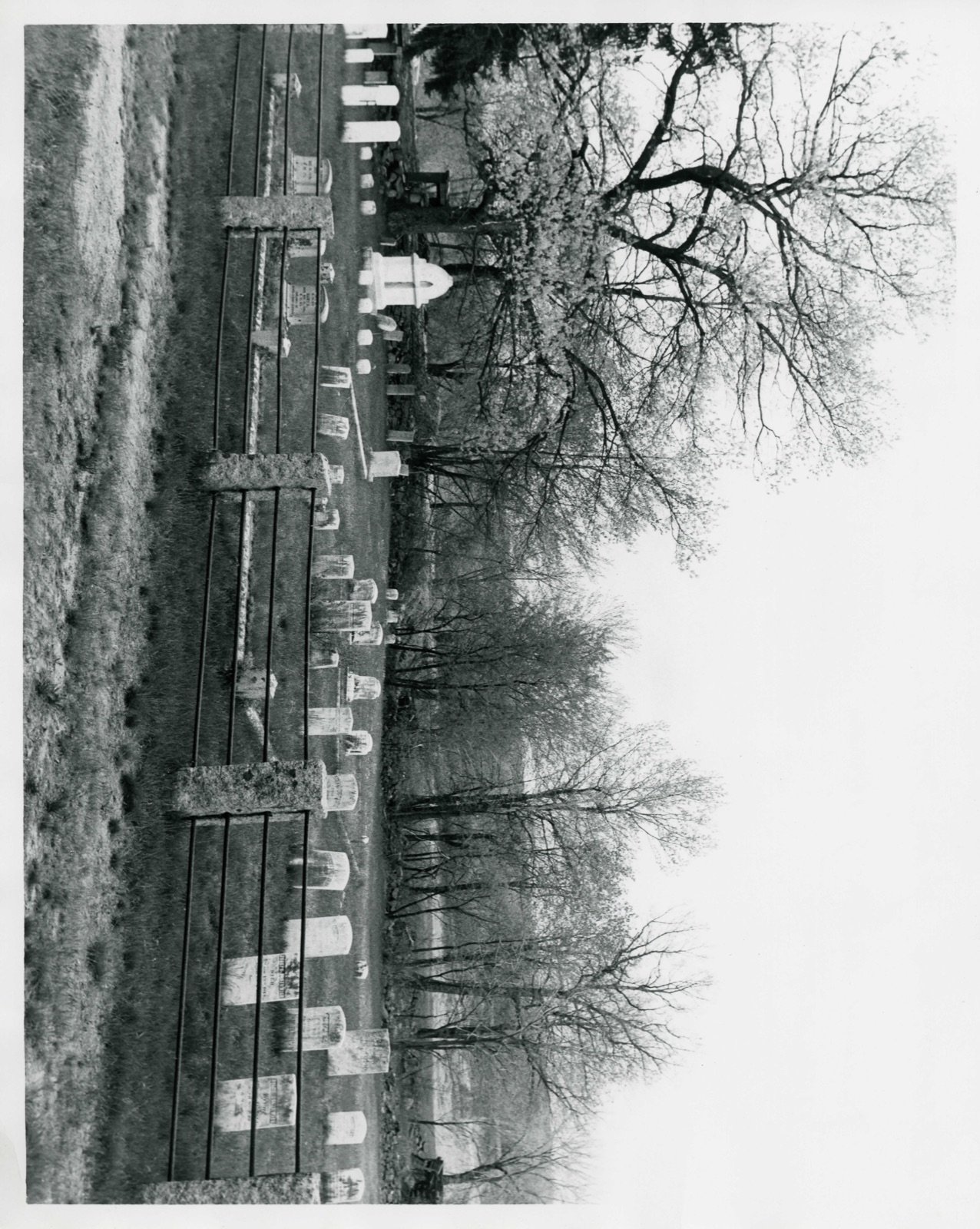
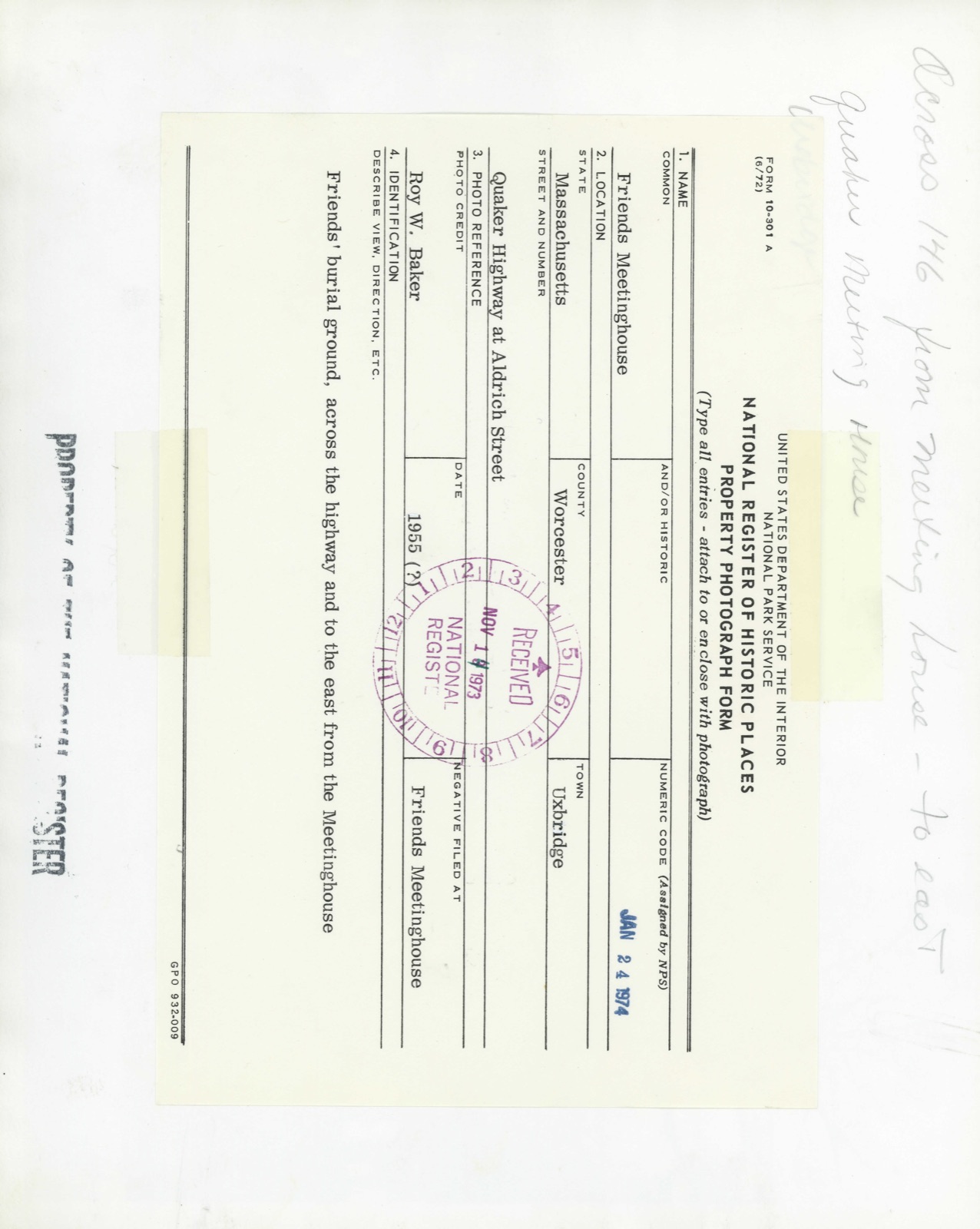
Photographs from the nomination case file, National Park Service records.
Friends Meetinghouse
Listed on the National Register of Historic Places in
1974. A historic map-sheet match is not published yet. The record needs a coordinate-quality review before it can be joined to a sheet boundary.
From the record
“The first physician in Uxbridge, to whom I have occasion to refer, was a Dr. Wood, who occupied a house standing formerly upon the old cellar situated near the road, northerly from the spot where the boat house formerly stood.”
Address Delivered at the Unitarian Church, in Uxbridge, Mass., in 1864 : with Further Statements, Not Made a Part of the Address, But Included in the Notes (1881). Machine-read text.
one of 500 National Register listings in Worcester County · listed in 1974 · category: Building · one of 1 National Historic Landmarks in Worcester County.
National Register reference number.74000395- the number the National Park Service assigned this property when it was listed, and the key its nomination file is catalogued under at the National Archives.
In the winter of 1863-4, Mr. Chapin was invited to deliver a lecture in Uxbridge, in the course given for the benefit of the First Congregational Church. He selected the early history of the town, in which he took great interest, for his subject, and collected so much valuable material in relating it, that some of the publicspirited citizens felt it to be very desirable that the information thus obtained should be preserved in a permanent form, and requested him, some four years since, to give them his manuscript for publication. He consented, but wished to render it more valuable by the addition of various details equally worthy of record, which would have made his lecture too long for delivery, and others that have since come to his knowledge. His illness and subsequent death prevented him from preparing the work for the press ; and in the spring of 1879 it was intrusted to me, and was immediately entered upon as a sacred trust. The address as originally delivered, the notes which Judge Chapin was engaged in preparing, and the title page he had written, are now presented to those specially interested in the matters here spoken of.
Those who read this address will please remember that it is not a history of the town of Uxbridge they are reading, but memorabilia, and if its history should ever be written, I have no doubt the writer will duly appreciate the labor here expended. Much later information than that here given, and naturally finding a place in a history of the town, is, for obvious reasons, omitted. I recommend that with this address, the address of Judge Alphonso Taft, given at the Taft gathering in Uxbridge, August 12th, 1874, be also read.
Regional context, not property-specific
evidence. The
federal wildfire occurrence database
lists 72 fires within 5 miles of Friends Meetinghouse between
2002 and 2020, burning about 58 acres in total. None started naturally. 4 were recorded as arson.
Distance is straight-line from the map coordinates, so a fire counted
here may appear on a neighbouring settlement's page as well.
Reported cause
Fires
Debris and open burning
24
Missing data/not specified/undetermined
20
Smoking
10
Recreation and ceremony
8
Arson/incendiarism
4
Railroad operations and maintenance
4
Other causes
1
Equipment and vehicle use
1
The most recent of
them, most recent first, with the day each was reported and the service
that recorded it.
Regional context, not property-specific
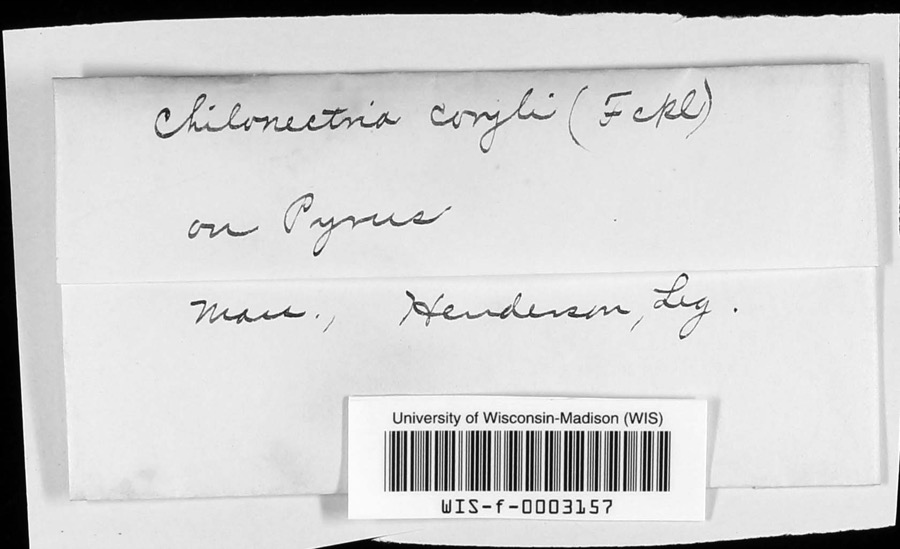
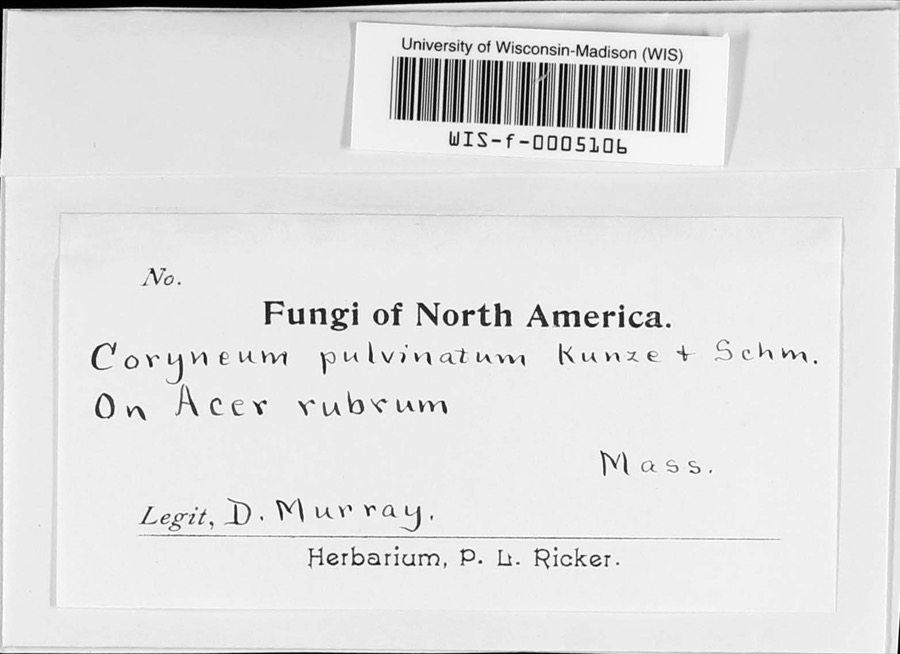
evidence. Museums hold 363 specimens
collected within 10 miles of Friends Meetinghouse between 1844 and
1974: 188 Plantae, 131 Animalia, 30 Fungi, 9 Protozoa, 3 Unrecorded, 2 Chromista. 12 distinct Species records are shown.
Collected by A. B. Seymour, A. R. Hodgdon; F. L. Steele, A. R. Hodgdon; F. L. Steele and others. Each is a
physical object with a catalogue
number, and each entry opens the museum's record. This is what was
collected and kept, not a survey of what lives here - nothing can be
concluded from a species being absent.
Regional context, not property-specific
evidence. The federal mineral resources record lists
10 workings within 5 miles of Friends Meetinghouse: 7 past producers, 2 producers, 1 prospect.
2 still produce. What was taken out: Sand and Gravel, Construction, Lead, Zinc. Distance is straight-line from the
map coordinates, so a quarry counted here may appear on a neighbouring
settlement's page as well.
Regional context, not property-specific
evidence. The National Weather Service names
Uxbridge, the town this property stands in, in 6 storm reports between 1996 and 2021: 4 thunderstorm wind, 2 hail.
No death or injury is recorded in these reports. Each account below is quoted exactly as the forecast office
filed it, from the NOAA Storm Events Database, and each date
opens the federal record of that event.
No historic map-sheet match is published
for this property yet. That does not mean no map exists. This record needs
a coordinate-quality review before it can be joined to a sheet boundary.
Browse the county's mapped places while that work is
pending.
From the nomination file
1,924 words on record
When this property was proposed for the
National Register, someone wrote the case for it: what the building is,
and why it matters. That document is a federal record in the public domain.
It is quoted below word for word, never summarised. The text was read off the scanned case file by machine, so the
occasional stray character is the recogniser's and the 1970s
typewriter's.
Description of the property
Ruins [] Moved - Unexposed (Check One) XOriginal Site The Friends' Meetinghouse in Uxbridge is situated on a wooded knoll which overlooks the Quaker Highway (Route 146) and the Meetinghouse burial ground. It was erected between 1770 and 1776 on land purchased from Moses Farnum, an elder and first minister of the Meeting. The structure is rectangular in plan, three bays wide by two bays deep, and two stories high. The wall fabric is brick, laid in common bond. Chimney flues are incorporated into the east and west gable ends of the gently-sloped ridge roof. The two story entrance vestibule was added to an otherwise austere main (south) facade during the first quarter of the nineteenth century.
At this time the 1771 entrance, which consisted of a double leaf door, was removed and bricked over. It was replaced by two single doors which flanked the original door frame. The original interior stair was removed to the vestibule addition, providing access to the second floor gallery. The interior of the Meetinghouse was probably renovated at the time the vestibule was added. A moveable interior partition was inserted, running north- south, which divided the first floor into two unequal spaces. Panels were suspended by a system similar to that which operates sash windows. When in place they created two separate meeting spaces; when raised they did not interfere with the large, single, interior first floor space.
A fireplace was added at this time to the east wall, opposite the original fireplace in the west wall, to heat the second space created by the partition. The seating arrangement, dating from the nineteenth century and typical of Quaker meetinghouses of the period, consists of two banks of benches which face each other.
The Friends' Meetinghouse (1770-1776) in Uxbridge is of architectural and local historical significance. It is of architectural significance as an unusual example of the use of brick as wall fabric in an eighteenth century New England meetinghouse. Because the form of Quaker meetinghouses traditionally bore a greater relation to domestic rather than ecclesiastical architecture, and because several of the houses in Uxbridge at that time - including the Moses Farnum House - were built of brick, one can explain the use of brick in this instance. The Uxbridge Meetinghouse is also a good example of the typology of eighteenth century Quaker meetinghouses in New England.
The interior moveable partition and the installation of two separate entrances to the spaces created by that partition are indicative of the nineteenth century custom of separating the female and male elements of a Meeting at certain times. The austere interior and exterior finishes reflect the striving for simplicity which was a part of Quaker life. The Friends' Meetinghouse is of local significance in the history of the development of the town. The Quaker faith was introduced to Uxbridge by Friends from Smithfield, Rhode Island. As Uxbridge is close to the border, the settlement served as a bridge between the liberal Quakers of one state, and the severe Congregationalism of the other.
The woolen mills for which Uxbridge is known were founded by members of the Uxbridge Meeting, and have contributed greatly to the town's economic growth. The Meetinghouse was restored in 1954 and 1955 to its present state with funds raised from the town and from neighboring Meetings. AL151 <6) (21131 RECEiVED NOV 1 41973 NATIONAL REGISTER 16 10.
Quoted from the National Register nomination
for reference 74000395, 10 pages, held by the National Archives in Record
Group 79. See the
catalogue record.
Listed places nearby
6 within 8 miles
Other National Register properties close
enough to walk or drive between, ordered by distance from this one. Both
positions come from the same geocoding pass that matched these properties
to their map sheets.
Listing record. National Park Service National Register of Historic Places, listed-properties dataset, current to 2026-05-22.
Map join. Address geocoded through the United States Census geocoder, then tested against the published boundary of every sheet in the USGS Historical Topographic Map Collection.
How this page is made. Listing fields come from federal records; map-sheet coverage is a labelled coordinate-to-boundary calculation, not a source-field claim.
Wildfire. Short, Karen C. 2022. Spatial wildfire occurrence data for the United States, 1992-2020 [FPA_FOD_20221014]. 6th Edition. Fort Collins, CO: Forest Service Research Data Archive. https://doi.org/10.2737/RDS-2013-0009.6 Collected with United States Government funding and usable without additional permissions or fees.
Specimens. Global Biodiversity Information Facility (GBIF), https://www.gbif.org/. Only records licensed CC0 or CC BY are used. Records licensed CC BY-NC are excluded because this site carries advertising. Images are checked individually and any whose licence is non-commercial, no-derivatives or unreadable is refused.
Mines and quarries. USGS Mineral Resources Data System (MRDS) https://mrdata.usgs.gov/mrds/ A work of the United States government, no copyright under 17 U.S.C. 105.
Storms. NOAA National Centers for Environmental Information, Storm Events Database https://www.ncei.noaa.gov/stormevents/ A work of the United States government, no copyright under 17 U.S.C. 105. Narratives are quoted verbatim from the National Weather Service report and are not edited or summarised.
 Block
Block