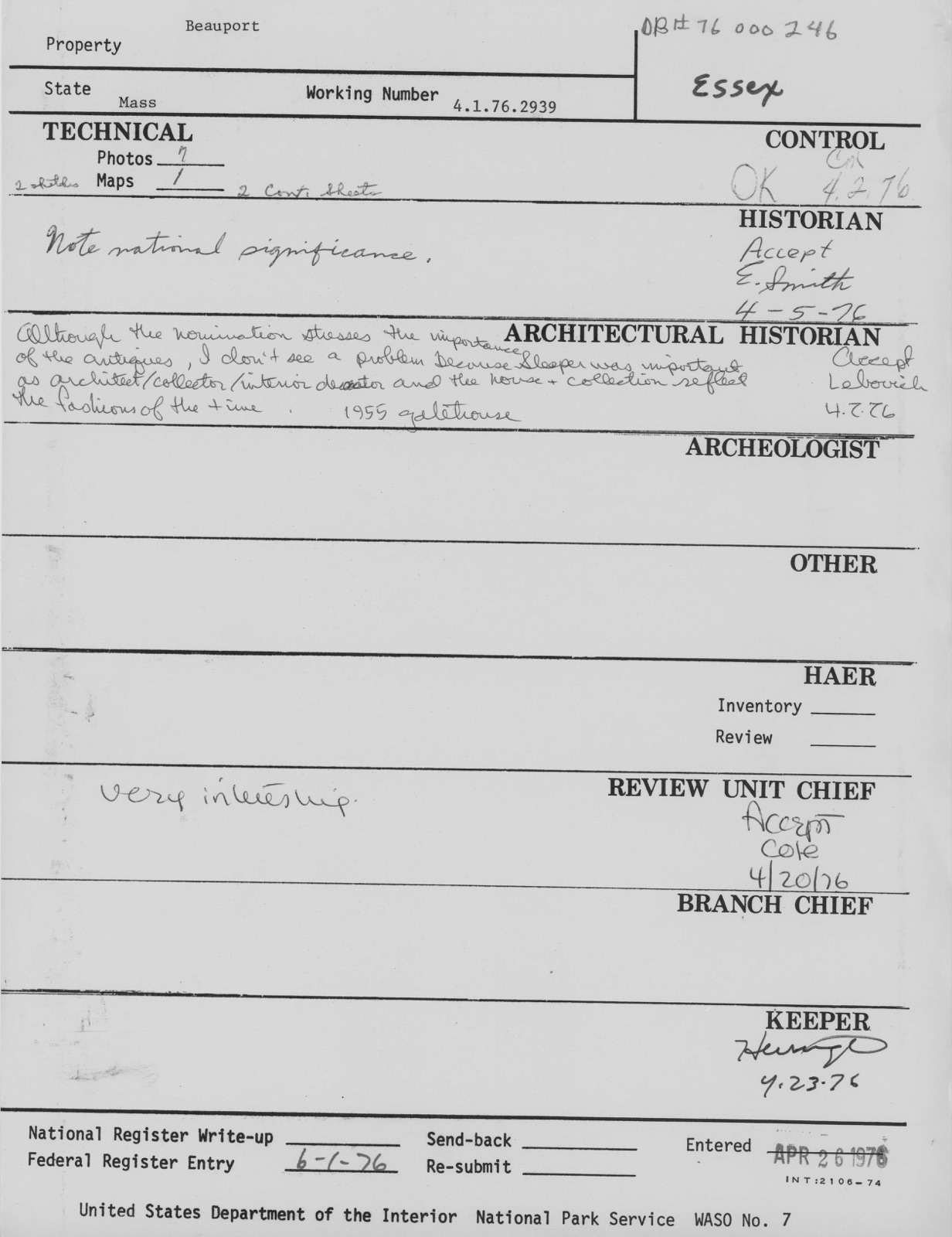
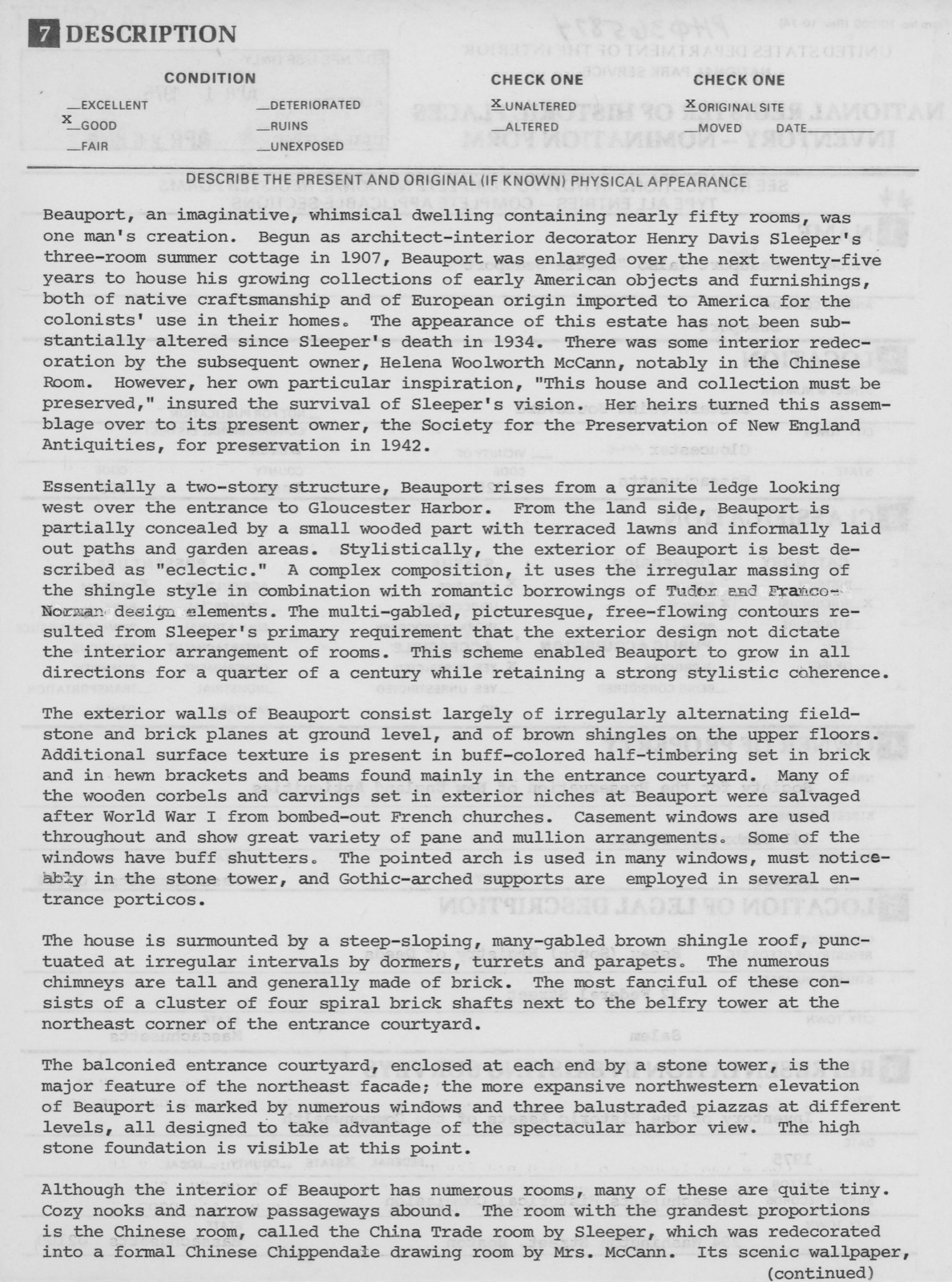
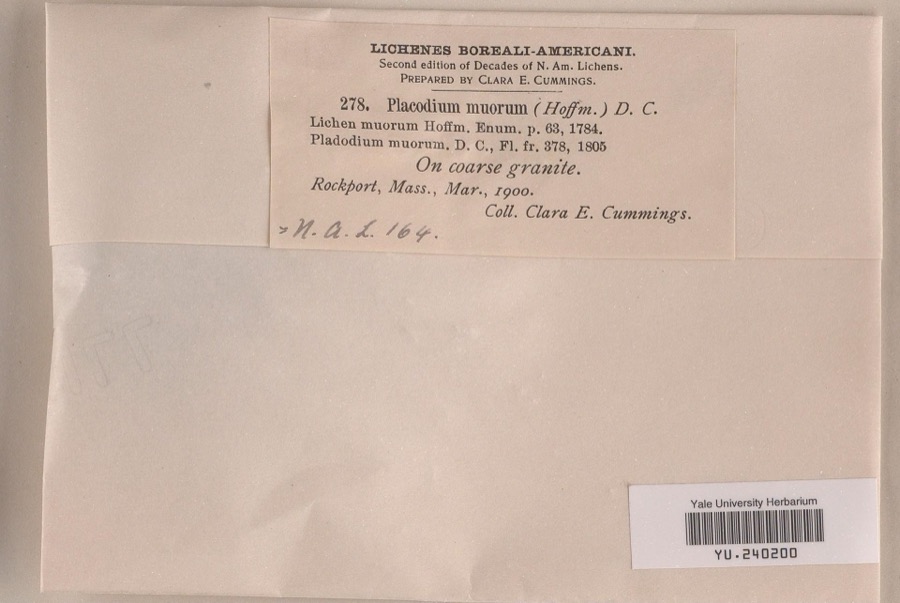
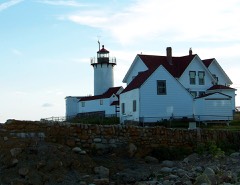
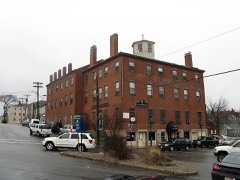
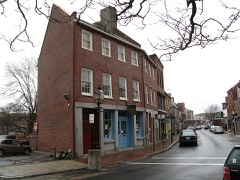
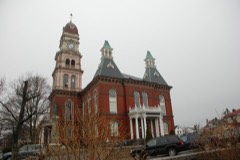
Photographs from the nomination case file, National Park Service records.
Beauport
Listed on the National Register of Historic Places in
1976. A historic map-sheet match is not published yet. The record needs a coordinate-quality review before it can be joined to a sheet boundary.
From the record
one of 350 National Register listings in Essex County · listed in 1976 · category: Building · one of 2 National Historic Landmarks in Essex County.
National Register reference number.76000246- the number the National Park Service assigned this property when it was listed, and the key its nomination file is catalogued under at the National Archives.
Fires near this property
21 since 2015
Regional context, not property-specific
evidence. The
federal wildfire occurrence database
lists 21 fires within 5 miles of Beauport between
2015 and 2020, burning about 19 acres in total. None started naturally. 4 were recorded as arson.
Distance is straight-line from the map coordinates, so a fire counted
here may appear on a neighbouring settlement's page as well.
Reported cause
Fires
Recreation and ceremony
9
Arson/incendiarism
4
Debris and open burning
3
Smoking
3
Misuse of fire by a minor
1
Equipment and vehicle use
1
The most recent of
them, most recent first, with the day each was reported and the service
that recorded it.
Regional context, not property-specific
evidence. Museums hold 5,138 specimens
collected within 10 miles of Beauport between 1817 and
1975: 2,128 Animalia, 1,319 Plantae, 1,018 Fungi, 318 Chromista, 244 Unrecorded, 91 Protozoa, 20 Bacteria. 12 distinct Species records are shown.
Collected by A H HIGGINSON, A Perlmutter, A. A. Eaton and others. Each is a
physical object with a catalogue
number, and each entry opens the museum's record. This is what was
collected and kept, not a survey of what lives here - nothing can be
concluded from a species being absent.
Regional context, not property-specific
evidence. The federal mineral resources record lists
4 workings within 5 miles of Beauport: 4 past producers.
None of them still produces. What was taken out: Sand and Gravel, Construction. Distance is straight-line from the
map coordinates, so a quarry counted here may appear on a neighbouring
settlement's page as well.
Regional context, not property-specific
evidence. The National Weather Service names
Gloucester, the town this property stands in, in 10 storm reports between 1997 and 2020: 6 thunderstorm wind, 2 lightning, 1 heavy rain, 1 flood.
No death or injury is recorded in these reports. Each account below is quoted exactly as the forecast office
filed it, from the NOAA Storm Events Database, and each date
opens the federal record of that event.
No historic map-sheet match is published
for this property yet. That does not mean no map exists. This record needs
a coordinate-quality review before it can be joined to a sheet boundary.
Browse the county's mapped places while that work is
pending.
From the nomination file
6,714 words on record
When this property was proposed for the
National Register, someone wrote the case for it: what the building is,
and why it matters. That document is a federal record in the public domain.
It is quoted below word for word, never summarised. The text was read off the scanned case file by machine, so the
occasional stray character is the recogniser's and the 1970s
typewriter's.
Description of the property
Beauport, an imaginative, whimsical dwelling containing nearly fifty rooms, was one man's creation. Begun as architect-interior decorator Henry Davis Sleeper's three-room summer cottage in 1907, Beauport was enlarged over the next twenty-five years to house his growing collections of early American objects and furnishings, both of native craftsmanship and of European origin imported to America for the colonists' use in their homes. The appearance of this estate has not been sub- stantially altered since Sleeper's death in 1934. There was some interior redec- oration by the subsequent owner, Helena Woolworth McCann, notably in the Chinese Room. However, her own particular inspiration, "This house and collection must be preserved," insured the survival of Sleeper's vision.
Her heirs turned this assem- blage over to its present owner, the Society for the Preservation of New England Antiquities, for preservation in 1942. Essentially a two-story structure, Beauport rises from a granite ledge looking west over the entrance to Gloucester Harbor. From the land side, Beauport is partially concealed by a small wooded part with terraced lawns and informally laid out paths and garden areas. Stylistically, the exterior of Beauport is best de- scribed as "eclectic." A complex composition, it uses the irregular massing of the shingle style in combination with romantic borrowings of Tudor and Erancos Norman deeign elements.
The multi-gabled, picturesque, free-flowing contours re- sulted from Sleeper's primary requirement that the exterior design not dictate the interior arrangement of rooms. This scheme enabled Beauport to grow in all directions for a quarter of a century while retaining a strong stylistic coherence. The exterior walls of Beauport consist largely of irregularly alternating field- stone and brick planes at ground level, and of brown shingles on the upper floors.
Beauport comprises an important early collection of American and European antiques housed within a unique architectural setting. Created over the first three decades of the 20th century, the property represents one of the earliest attempts in America to rescue architectural fragments and install them in new surroundings. It played a key role in the establishment of the Henry Francis du Pont Winterthur Museum and of the American Wing of the Metropolitan Museum. Owner-architect Henry Davis Sleeper has been recognized as a genius of American interior design and his influence on taste is felt even today. Beauport became his design showcase and Sleeper enjoyed using it as a summer center for his rather Bohemian social set, which included nu- merous celebrated personages.
At the outbreak of war in France in 1914, Sleeper and his Eastern Point neighbor and friend, A. Piatt Andrew, organized, then staffed and supplied the American Field Service, an ambulance corps working behind French front lines. For this work Sleeper was awarded the ribbon of the Legion of Honor by the French government. Early in 1907 Sleeper purchased land and began to erect a small cottage on foundations blasted out of a ledge overlooking Gloucester Harbor. At first he called the place "Little Beauport," for the harbor itself had been termed "le Beau Port" by Samuel de Champlain when he charted it in 1606. Later that summer Sleeper acquired wood- work, windows and furniture from the about-to-be demolished Choate House, built in 1728 by William Cogswell in the nearby village of Essex.
These materials were moved to Gloucester and installed in the new cottage, creating Cogswell Hall, the Central Hall and the Green Dining Room from the paneling. Thus began the imaginative scheme Construction on Beauport continued apace and by 1909 the house had 26 rooms.
Quoted from the National Register nomination
for reference 76000246, 29 pages, held by the National Archives in Record
Group 79. See the
catalogue record.
Listed places nearby
6 within 8 miles
Other National Register properties close
enough to walk or drive between, ordered by distance from this one. Both
positions come from the same geocoding pass that matched these properties
to their map sheets.
Listing record. National Park Service National Register of Historic Places, listed-properties dataset, current to 2026-05-22.
Map join. Address geocoded through the United States Census geocoder, then tested against the published boundary of every sheet in the USGS Historical Topographic Map Collection.
How this page is made. Listing fields come from federal records; map-sheet coverage is a labelled coordinate-to-boundary calculation, not a source-field claim.
Wildfire. Short, Karen C. 2022. Spatial wildfire occurrence data for the United States, 1992-2020 [FPA_FOD_20221014]. 6th Edition. Fort Collins, CO: Forest Service Research Data Archive. https://doi.org/10.2737/RDS-2013-0009.6 Collected with United States Government funding and usable without additional permissions or fees.
Specimens. Global Biodiversity Information Facility (GBIF), https://www.gbif.org/. Only records licensed CC0 or CC BY are used. Records licensed CC BY-NC are excluded because this site carries advertising. Images are checked individually and any whose licence is non-commercial, no-derivatives or unreadable is refused.
Mines and quarries. USGS Mineral Resources Data System (MRDS) https://mrdata.usgs.gov/mrds/ A work of the United States government, no copyright under 17 U.S.C. 105.
Storms. NOAA National Centers for Environmental Information, Storm Events Database https://www.ncei.noaa.gov/stormevents/ A work of the United States government, no copyright under 17 U.S.C. 105. Narratives are quoted verbatim from the National Weather Service report and are not edited or summarised.
 Block
Block