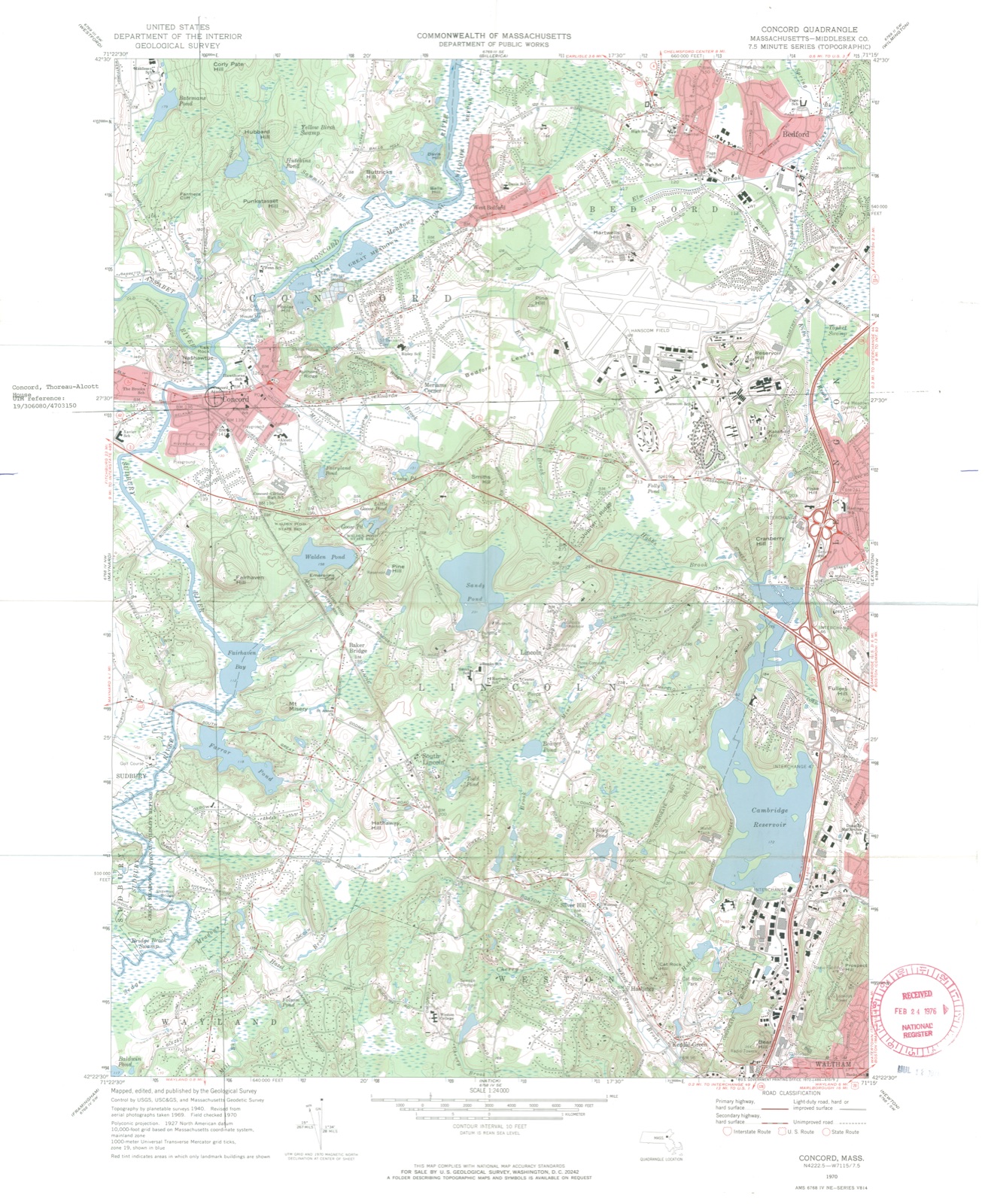
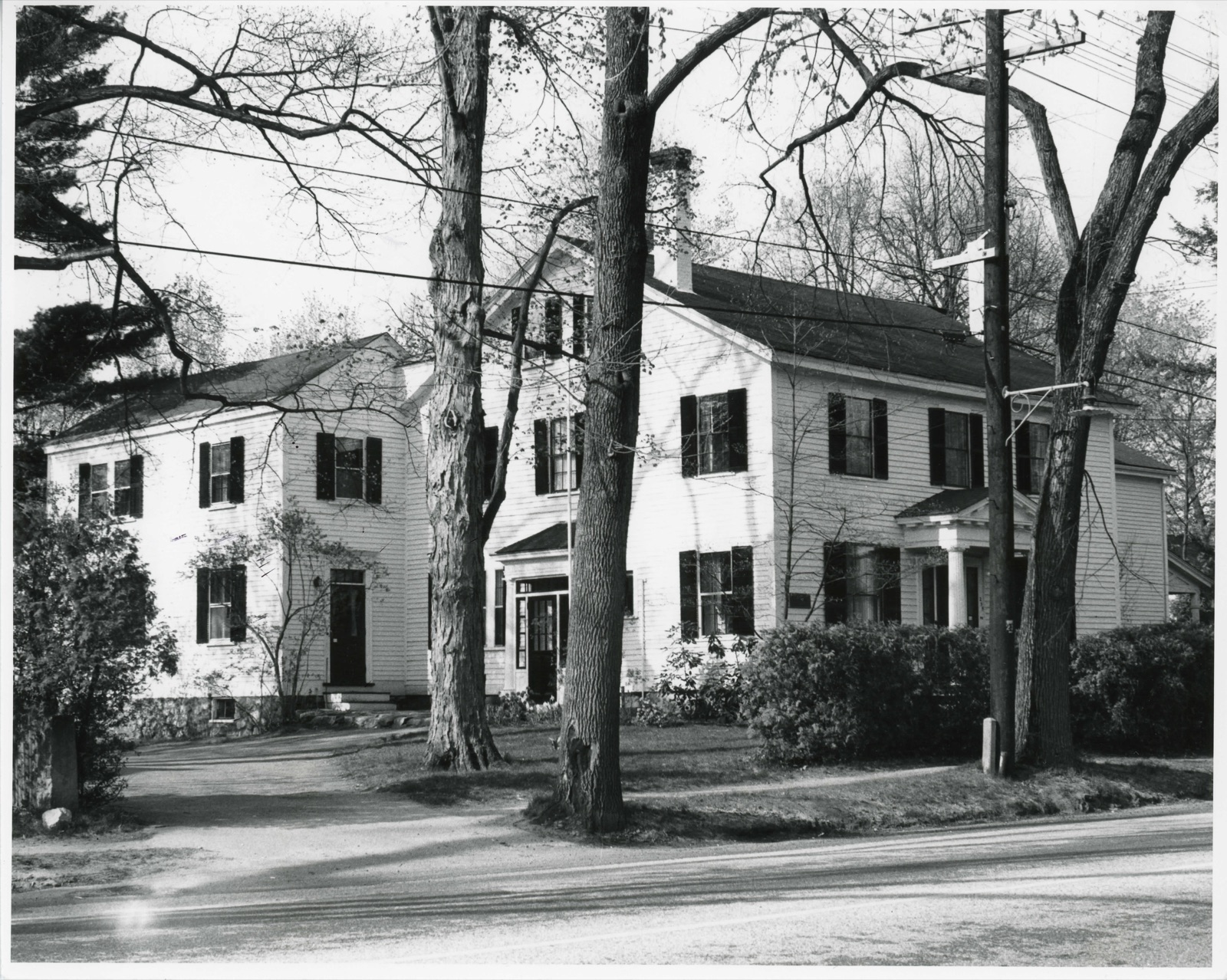
Photographs from the nomination case file, National Park Service records.
Thoreau-Alcott House
Listed on the National Register of Historic Places in
1976. A historic map-sheet match is not published yet. The record needs a coordinate-quality review before it can be joined to a sheet boundary.
From the record
“About the 21st of Feb., says Gookin in the manuscript before quoted, " there befel another great trouble to the Christian Indians of Nashobah, who sojourned in Concord. The Council had by several orders empowered a committee, who, with consent of the selectmen of Concord, settled those Indians at that town, under the government and tuition of Mr.”
A History of the Town of Concord, Middlesex County, Massachusetts : from Its Earliest Settlement to 1832; and of the Adjoining Towns, Bedford, Acton, Lincoln, and Carlisle; Containing Various Notices of County and State History Not Before Published. (1835). Machine-read text.
one of 1100 National Register listings in Middlesex County · listed in 1976 · category: Building · one of 3 National Historic Landmarks in Middlesex County.
National Register reference number.76000247- the number the National Park Service assigned this property when it was listed, and the key its nomination file is catalogued under at the National Archives.
What happened here
An account from the chapter on Concord town, The inset identifies its exact
source book and publication year.
Philip's War. - State of the Country. - Garrison Houses. - Expedition to Brookfield. - Proceedings of Government} and of the Town. - Lancaster burnt. - Christian Indians in Concord. - Feelings towards the Indians. - Abraham and Isaac Shepherd killed. - Groton burnt. - People remove to Concord. - Proceedings of Government.
The author of the following History, having had occasion several years since to consult some of the earlier town records in Concord, discovered many important facts and documents which were wholly unknown to the public, and very imperfectly to the inhabitants of the town itself; and it occurred to him that a series of communications in a periodical work, embracing them, would be interesting and valuable, and he immediately began to collect materials for this purpose. But, in the progress of his investigation, the quantity of interesting matter increased so much, that it was thought best it should be published in some other form than that originally intended. The result of his inquiries appears in the following volume. It has been compiled at such intervals of time as could be conveniently abstracted from the almost constant engagements of business.
Those only, who have been engaged in similar works, can be aware of the great labor required to collect the materials for a volume like this, and arrange them for the press. And the difficulty and labor have been much increased in this instance by the imperfections of the town and church records. The first volume of the records of the town, containing its proceedings prior to 1696, about sixty years after its first settlement, is lost ; and likewise the proceedings of the church prior to 1738, more than one hundred years after its organization. There is however in the clerk's office an old volume, containing an imperfect record of several grants of land, and a few unconnected proceedings of the town ; with an incomplete list of marriages, births, and deaths, prior to 1696. This renders the early history of the town, less perfect than it would have been, had the records been preserved, though from other sources much important information has been obtained. The early records and documents in the offices of the Secretary of the Commonwealth and of the county of Middlesex, and the private papers of individuals, and various other scattered fragments of traditionary, manuscript, and printed history have, with great labor and no little expense, been consulted, which, though they do not furnish a complete history, have been found interesting and important, and in some respects supply the place of town records. Traditions, however, are often contradictory, tending to embarrass rather than to elucidate. They should be depended upon only as leading the investigator towards the truth, which, on further inquiry and comparison of different traditions with records, may be discovered. I have seldom been willing to state a fact positively, unless verified in this way. A tradition has prevailed in Concord, that the early records of the town were burnt ; and this is said to have taken place when part of the first settlers removed to Connecticut. If this were true, it could not apply to the town records from 1650 to 1696, nor to any part of the church records prior to 1738. This tradition is undoubtedly incorrect. The town records were destroyed in some other way, and, if burnt, it must have occurred subsequently to 1696. The loss of the church records was probably occasioned by the difficulty in the church detailed in the following History.
Regional context, not property-specific
evidence. The
federal wildfire occurrence database
lists 41 fires within 5 miles of Thoreau-Alcott House between
1992 and 2020, burning about 24 acres in total. 1 started naturally. 1 was recorded as arson.
Distance is straight-line from the map coordinates, so a fire counted
here may appear on a neighbouring settlement's page as well.
Reported cause
Fires
Debris and open burning
19
Missing data/not specified/undetermined
10
Railroad operations and maintenance
4
Power generation/transmission/distribution
3
Arson/incendiarism
1
Equipment and vehicle use
1
Other causes
1
Natural
1
Recreation and ceremony
1
The most recent of
them, most recent first, with the day each was reported and the service
that recorded it.
Regional context, not property-specific
evidence. Museums hold 718 specimens
collected within 10 miles of Thoreau-Alcott House between 1898 and
1975: 379 Animalia, 184 Plantae, 146 Fungi, 4 Chromista, 4 Protozoa, 1 Unrecorded. 12 distinct Species records are shown.
Collected by A. B. Seymour, A. B. Seymour & M. D. Feigley, A. E. Feldman and others. Each is a
physical object with a catalogue
number, and each entry opens the museum's record. This is what was
collected and kept, not a survey of what lives here - nothing can be
concluded from a species being absent.
Regional context, not property-specific
evidence. The federal mineral resources record lists
11 workings within 5 miles of Thoreau-Alcott House: 8 past producers, 2 producers, 1 occurrence.
2 still produce. What was taken out: Sand and Gravel, Construction, Copper. Distance is straight-line from the
map coordinates, so a quarry counted here may appear on a neighbouring
settlement's page as well.
Regional context, not property-specific
evidence. The National Weather Service names
Concord, the town this property stands in, in 36 storm reports between 1997 and 2024: 26 thunderstorm wind, 4 flood, 3 lightning, 1 hail.
The reports record 12 injuries. Each account below is quoted exactly as the forecast office
filed it, from the NOAA Storm Events Database, and each date
opens the federal record of that event.
A tornado developed within an area of showers and thunderstorms moving through southern New England. This tornado touched down near the Cambridge Turnpike and headed northeast. Most of the damage was concentrated in an area beginning near the intersection of Lexington Road and Alcott Road and continuing up to the neighborhood of Alcott and Independence Roads. Numerous trees were uprooted or had the tops sheared off. These subsequently blocked roads, damaged homes, and downed power lines, cutting off power to the neighborhood. In addition, utility poles were downed either from the wind or from the downed power lines. Thirty-nine houses in this area were damaged to some degree. Only one house suffered significant structural damage. The tornado continued for a short distance beyond this neighborhood before lifting. The historical home of Louisa May Alcott and her family was right next to the tornado path but was not damaged.
Trees, wires, and poles were downed throughout Concord, closing several roads, including: Elm Street, Crescent Street, MacArthur Road, and Ornac Road near Route 2.
Sudbury Road in Concord was flooded at Heath's Bridge. The Cambridge Turnpike was also flooded. In Framingham, the intersection of Routes 126 and 9 was flooded. A car was stranded in flood waters on Bent Road in Sudbury.
No historic map-sheet match is published
for this property yet. That does not mean no map exists. This record needs
a coordinate-quality review before it can be joined to a sheet boundary.
Browse the county's mapped places while that work is
pending.
From the nomination file
2,896 words on record
When this property was proposed for the
National Register, someone wrote the case for it: what the building is,
and why it matters. That document is a federal record in the public domain.
It is quoted below word for word, never summarised. The text was read off the scanned case file by machine, so the
occasional stray character is the recogniser's and the 1970s
typewriter's.
Description of the property
The Thoreau-Alcott House, set back 20 feet from Main Street, is situated facing north on a 3/4 acre plot. It is in a residential area but is set off from the surrounding houses by large trees, and is protected from the street by a six foot hemlock hedge. The oldest part of the house was built c. 1820 by Josiah Davis, a prominent Concord builder. This section consisted of a three bay by three bay, almost square two story clapboard structure, with two inside chimneys and four rooms on each floor. The cellar, which has not been altered, was unfinished with a foundation of giant fieldstones. The front rooms were used as reception rooms, and a kitchen, with a separate doorway, was located to the rear on the east side of the house.
Each of the eight rooms had a fireplace, five of which are still in working condition. The house was altered in 1849 when the Thoreaus acquired the property. John Thoreau and his son Henry David completely renovated and refurbished the structure, adding long side lights at the entrance and a pedimented portico supported by Doric columns over the front door; building an elegant mahogany railing for the main staircase; and constructing a two story wing to the south, with an attached shed to accomodate their pensil factory. A door on the north elevation of this wing led directly outside, and an outside staircase on the east side led upstairs. The south wing was built with a fieldstone foundation and had a finished basement.
Further alterations occurred when the house was sold in 1877 to Anna Alcott Pratt. In order to accomodate Mrs.
BUILDER/ARCHITECT Josiah Davis The Thoreau-Alcott House is an extremely significant house in Concord, a town which abounds in significant buildings, structuxes and sites. This house, which has been very little altered since the late nineteenth century, was the home of Henry David Thoreau during his most productive years, and was closely associated with Louisa May Alcott during the period in her life when she had finally achieved recognition and financial success. John Thoreau moved his family into the house in 1849, when his pencil-making business was successful enough for him to afford a large house. This house gave the family four bedrooms, a large kitchen, two parlours and a reception room, and was certainly the grandest they had lived in.
Henry David Thoreau, 32 years old when they moved, took over the attic on the third floor. He set up his cot and simple furnishings on the east side, built bookshelves along the low walls and set aside areas for his collections of arrowheads, birds eggs and wild flowers. The south wing, added when the Thoreaus moved in, was built to house the family pencil business. Both Henry David and his sister Sophia worked in the 'factory' and were the only business employees who were allowed to complete the manufacturing process and package the pencils. The pencils, which were completed with a secret process in the privacy of the second floor of the wing, were the best on the market, and sold for 25 cents each in Boston.
Artists and draftsmen considered these pen- cils to be the finest available, and paid the exorbitant price, so the demand was great enough to, keep the Thoreau family very comfortably. Over the years, however, other manufacturers started making inroads on the Thoreau monopoly and business declined.
Quoted from the National Register nomination
for reference 76000247, 11 pages, held by the National Archives in Record
Group 79. See the
catalogue record.
Listed places nearby
6 within 8 miles
Other National Register properties close
enough to walk or drive between, ordered by distance from this one. Both
positions come from the same geocoding pass that matched these properties
to their map sheets.
Listing record. National Park Service National Register of Historic Places, listed-properties dataset, current to 2026-05-22.
Map join. Address geocoded through the United States Census geocoder, then tested against the published boundary of every sheet in the USGS Historical Topographic Map Collection.
How this page is made. Listing fields come from federal records; map-sheet coverage is a labelled coordinate-to-boundary calculation, not a source-field claim.
Wildfire. Short, Karen C. 2022. Spatial wildfire occurrence data for the United States, 1992-2020 [FPA_FOD_20221014]. 6th Edition. Fort Collins, CO: Forest Service Research Data Archive. https://doi.org/10.2737/RDS-2013-0009.6 Collected with United States Government funding and usable without additional permissions or fees.
Specimens. Global Biodiversity Information Facility (GBIF), https://www.gbif.org/. Only records licensed CC0 or CC BY are used. Records licensed CC BY-NC are excluded because this site carries advertising. Images are checked individually and any whose licence is non-commercial, no-derivatives or unreadable is refused.
Mines and quarries. USGS Mineral Resources Data System (MRDS) https://mrdata.usgs.gov/mrds/ A work of the United States government, no copyright under 17 U.S.C. 105.
Storms. NOAA National Centers for Environmental Information, Storm Events Database https://www.ncei.noaa.gov/stormevents/ A work of the United States government, no copyright under 17 U.S.C. 105. Narratives are quoted verbatim from the National Weather Service report and are not edited or summarised.
 Block
Block