Listed on the National Register of Historic Places in
1976. A historic map-sheet match is not published yet. The record needs a coordinate-quality review before it can be joined to a sheet boundary.
From the record
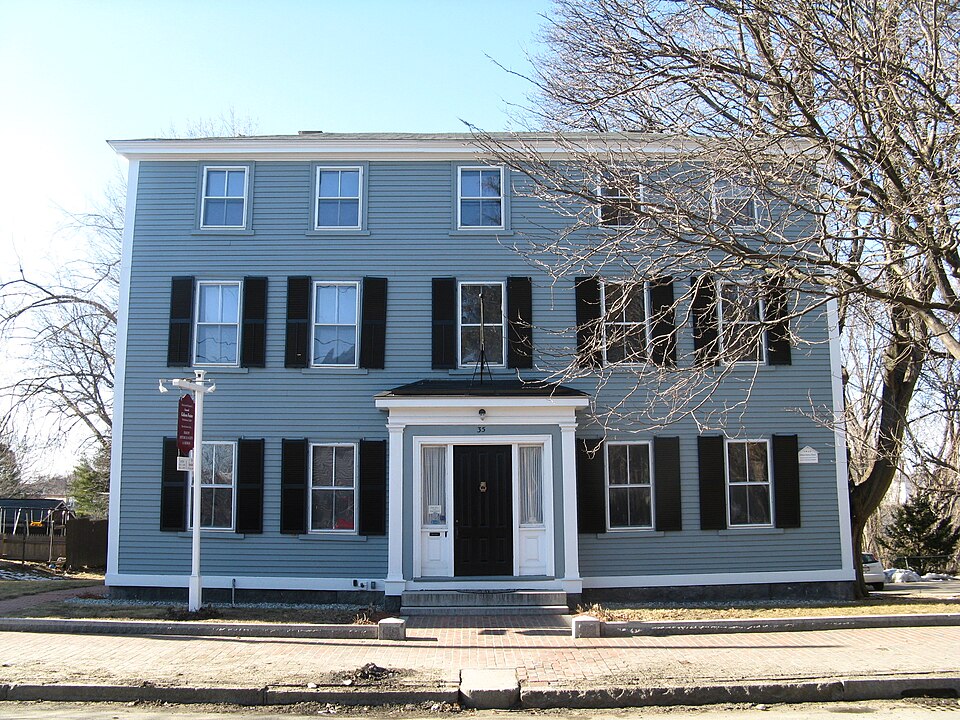
“Gideon Foster House is a historic house in Peabody, Massachusetts. The two story Federal style wood-frame house was built in the early 1800s at a location on Main Street.”
Wikipedia article Gen. Gideon Foster House, CC BY-SA 4.0.
one of 350 National Register listings in Essex County · listed in 1976 · category: Building · one of 2 National Historic Landmarks in Essex County.
National Register reference number.76000287- the number the National Park Service assigned this property when it was listed, and the key its nomination file is catalogued under at the National Archives.
Mattresses and Feathers Renovated. Goods Called For and Returned Promptly. No. 15 Walnut Street, Peabody, Mass. - Cleanliness not only is essential to health, but it also preserves and renders more endurable every kin i of fabric and cloth. This fact is equally true whether applied to garments or the carpets, bedding and similar household goods. Few people realize how much longer these materials could be made to last if cleaned more regularly and carefully. The Peabody Laundry and Steam Carpet Cleaning Works has now for nine years demonstrated its ability to handle every class ol work in these lines in the most modern and satisfactory style. The laundry business was established in 1883, and the entire enterprise has been under Mr. Charles A. Sanger's efficient management since 1884. Large and thoroughly equipped premises are occupied. A 12 horse-power engine and 30 horsepower boiler furnishes steam power, and the machinery throughout is of the latest and best type. The steam carpet beating department occupies a separate building. The^laundry work in all lines is guaranteed to be on a par with the best anywhere in this country, while the prompt service and low prices are points worth noting carefully. Of late years the services of the Steam Carpet Beating Works have been increasing steadily in popularity. The prices are as low as those afforded by any other kind of service, while in efficiency and thorough care the advantages of the Steam Beating Works are greatly superior to all others. They call for and deliver goods on request in Peabody, Salem and Danvers, taking in charge not only ingrains, tapestries, brussels, axminsters, wiltons, etc., but also fine rugs and laces, mat^tresses, feathers, and any household paraphernalia needing careful and thorough cleaning. An examination of the facilities and rates of these well conducted works will convince anyone of the superior advantages offered by them.
Flowers possess a perennial cliarm for all cultivated people, and it is one of the triumphs of modern skill that we are now enabled to obtain them in abundance at any season of the year. Among the floral establishments of Peabody and vicinity that of Mr. J. M. Ward has long held a prominent and esteemed position. The business was established by Mr. Ward in 1875 and has made steady progress under his management from the start. Four large green-houses are now utilized for the cultivation of the varied floral stock of this house, the space of 4,000 square feet being devoted entirely to this purpose. Every variety of favorite flowers, including choice roses, carnations, lilies, pansies, etc., etc., are kept constantly on hand. Cut flowers and bouquets are sold at unexcelled prices. Special attention is given to funeral and memorial designs. A fine variety of palms, ferns, selaginellas and all kinds of potted plants are ready for use at any time. The immense variety and beauty of Mr. Ward's siock. as well as his uniformly liberal prices, make it a matter both of pleasure and economy to make use of his large facilities in these lines. Mr. Ward is a native of England and one of Peabody's most substantial and esteemed business men.
Regional context, not property-specific
evidence. The
federal wildfire occurrence database
lists 82 fires within 5 miles of Foster, Gen. Gideon, House between
2003 and 2020, burning about 278 acres in total. 1 started naturally. 4 were recorded as arson.
Distance is straight-line from the map coordinates, so a fire counted
here may appear on a neighbouring settlement's page as well.
Reported cause
Fires
Recreation and ceremony
28
Smoking
13
Equipment and vehicle use
9
Debris and open burning
7
Misuse of fire by a minor
6
Missing data/not specified/undetermined
6
Arson/incendiarism
4
Fireworks
4
Power generation/transmission/distribution
2
Natural
1
Railroad operations and maintenance
1
Other causes
1
The most recent of
them, most recent first, with the day each was reported and the service
that recorded it.
Regional context, not property-specific
evidence. Museums hold 9,915 specimens
collected within 10 miles of Foster, Gen. Gideon, House between 1800 and
1975: 4,113 Plantae, 3,129 Animalia, 1,074 Fungi, 922 Chromista, 439 Unrecorded, 189 Bacteria, 49 Protozoa. 12 distinct Species records are shown.
Collected by A B. Proper, A H HIGGINSON, A. A. Eaton and others. Each is a
physical object with a catalogue
number, and each entry opens the museum's record. This is what was
collected and kept, not a survey of what lives here - nothing can be
concluded from a species being absent.
Regional context, not property-specific
evidence. The federal mineral resources record lists
13 workings within 5 miles of Foster, Gen. Gideon, House: 5 plants, 3 producers, 3 past producers, 1 unknown.
8 still produce. What was taken out: Stone, Crushed/Broken, Zirconium, Iron, Sand and Gravel, Construction. Distance is straight-line from the
map coordinates, so a quarry counted here may appear on a neighbouring
settlement's page as well.
Regional context, not property-specific
evidence. The National Weather Service names
Peabody, the town this property stands in, in 47 storm reports between 1993 and 2025: 22 thunderstorm wind, 11 hail, 6 flood, 4 lightning.
The reports record 1 injury. Each account below is quoted exactly as the forecast office
filed it, from the NOAA Storm Events Database, and each date
opens the federal record of that event.
In Lynn, Alley and Commercial streets experienced significant flooding. A car was stranded on Chatham Street. In Peabody, a car was stranded near Foster and Spring Streets. Shaws Lane and Oak Streets were flooded.
Several cars were stranded due to flooding on Canal Street in Salem, as well as at Salem State College. Urban flooding was more severe in Peabody, where Fountain Street was flooded and voluntary evacuations took place. Several streets near the center of Peabody were also closed due to flooding.
At 10:33 AM EST, Quail Road in South Peabody was closed due to flooding. At 10:52 AM EST, Lynnfield Street was closed due to flooding. At 11:07 AM EST, a car was reported trapped in floodwaters on Lynnfield Street. At 11:14 AM a car was trapped in floodwaters on Lake Street near U.S. Route 1; Lake Street was reported closed soon after. At 11:33 AM EST, a house on Batchelder Avenue was reported to have 4 feet of water in the basement.
Trees and wires were downed on Winona and Corey Drives, and Lake, Forest, Baldwin, Wheatland, and Lowell Streets. So many trees were downed on Lowell Street that the street was closed.
Trees and wires were downed on several streets in Lynn and Peabody, including on Greenwood Road in Peabody and on Herschel Street in Lynn. One of the trees on Herschel Street landed on a car.
In Peabody, a tree was down on a truck on Norfolk Avenue. A tree was down on power lines at both Lynnfield Street and Columbia Blvd. A tree was down on Bartlett Street.
Two trees down in Salem Willows Park. Numerous dime-size hail stones fell at approximately 1845 EST in West Peabody with one or two stones just under the size of a quarter as measured by the son of a NWS meteorologist. Rainfall in Peabody was 1.68 inches.
No historic map-sheet match is published
for this property yet. That does not mean no map exists. This record needs
a coordinate-quality review before it can be joined to a sheet boundary.
Browse the county's mapped places while that work is
pending.
From the nomination file
3,018 words on record
When this property was proposed for the
National Register, someone wrote the case for it: what the building is,
and why it matters. That document is a federal record in the public domain.
It is quoted below word for word, never summarised. The text was read off the scanned case file by machine, so the
occasional stray character is the recogniser's and the 1970s
typewriter's.
Description of the property
The General Gideon Foster House is located on Washington Street near the center of Peabody- Moved to its present site in 1854, it stands not far from its ori- ginal location on nearby Main Street. The General Gideon Foster House (c.1810) is a three-story Federal style house which remains virtually unaltered since the time of its construction. Although on a less sophisticated scale, the house recalls the dignified MoIntire houses built by merchants in nearby Salem. The five-bay facade has shuttered windows with two over two sash. The central entrance has a shallow enclosed porch with sidelights on either side of the door. Side elevations of the main section have two windows on each level. The house is covered with clapboards painted white and is topped with a hip roof.
A rear ell extends to the west and is three bays deep. A side entrance on the south elevation of the ell has a bracketed overhang of the mid-nineteenth century. On the interior of the house is a central hall and stairway. There is also a rear stairway which leads to the ell. The plan is typical of the Federal period. There are three fireplaces and mantels in the house, the one in the library being of the McIntire type. The house also features McIntire-inspired wood cornices. In the front the house opens directly onto a brick sidewalk and to the rear the lot is terraced.
Statement of significance
/ARCHITECT The General Gideon Foster House is significant as the home of a Revolutionary war hero and as an important Federal period building in central Peabody. The house was originally built on Main Street between Littles Lane and Park Street, later the site of the Sutton Estate. The land for the house was sold on August 9, 1808 by William W. Little to John Saunders, a merchant. Around 1810 Saunders built his house on the four-acre lot. In 1815 the house was bought by General Gideon Foster who had earlier achieved fame in the Revolutionary War. Foster had commanded a company of Minutemen from Peabody at the Battle of Lexington, and he had also served in Colonel Mansfield's regiment in the siege of Boston. At the Battle of Bunker Hill, Foster's company supplied ammunition.
For his continuing contributions to the patriots' cause, he was pro- moted to Colonel in 1792, Brigadier General in 1796, and in 1801 he was elected Major General by the State Legislature. General Gideon Foster was born in Peabody in 1749 and throughout his life played an active role in town life. He was one of the most influential citizens in the town and held a number of public offices such as town clerk and Representative to the General Court. He operated bark, grist and chocolate mills in Peabody and the machinery of his mills was of his own planning and construction. Foster died at nearly 97 years of age and he was buried with high military and civic honors with a eulogy delivered by the Honorable Daniel P. King, a State Senator and Congressman from Peabody.
In 1831 the house on Main Street was sold to Eben Sutton, a prominent wool manufac- turer.
Quoted from the National Register nomination
for reference 76000287, 13 pages, held by the National Archives in Record
Group 79. See the
catalogue record.
Listed places nearby
6 within 8 miles
Other National Register properties close
enough to walk or drive between, ordered by distance from this one. Both
positions come from the same geocoding pass that matched these properties
to their map sheets.
Listing record. National Park Service National Register of Historic Places, listed-properties dataset, current to 2026-05-22.
Map join. Address geocoded through the United States Census geocoder, then tested against the published boundary of every sheet in the USGS Historical Topographic Map Collection.
How this page is made. Listing fields come from federal records; map-sheet coverage is a labelled coordinate-to-boundary calculation, not a source-field claim.
Wildfire. Short, Karen C. 2022. Spatial wildfire occurrence data for the United States, 1992-2020 [FPA_FOD_20221014]. 6th Edition. Fort Collins, CO: Forest Service Research Data Archive. https://doi.org/10.2737/RDS-2013-0009.6 Collected with United States Government funding and usable without additional permissions or fees.
Specimens. Global Biodiversity Information Facility (GBIF), https://www.gbif.org/. Only records licensed CC0 or CC BY are used. Records licensed CC BY-NC are excluded because this site carries advertising. Images are checked individually and any whose licence is non-commercial, no-derivatives or unreadable is refused.
Mines and quarries. USGS Mineral Resources Data System (MRDS) https://mrdata.usgs.gov/mrds/ A work of the United States government, no copyright under 17 U.S.C. 105.
Storms. NOAA National Centers for Environmental Information, Storm Events Database https://www.ncei.noaa.gov/stormevents/ A work of the United States government, no copyright under 17 U.S.C. 105. Narratives are quoted verbatim from the National Weather Service report and are not edited or summarised.
 Block
Block