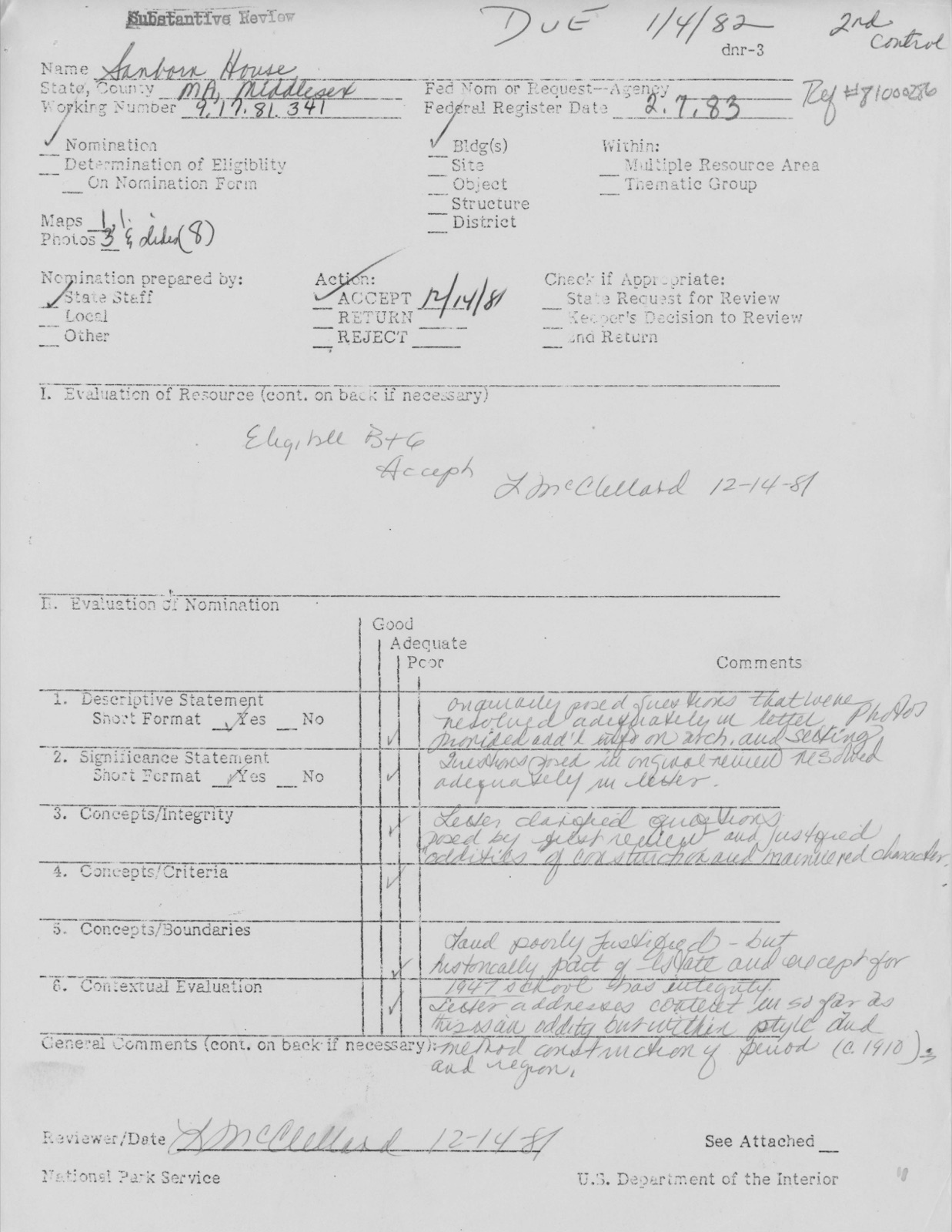
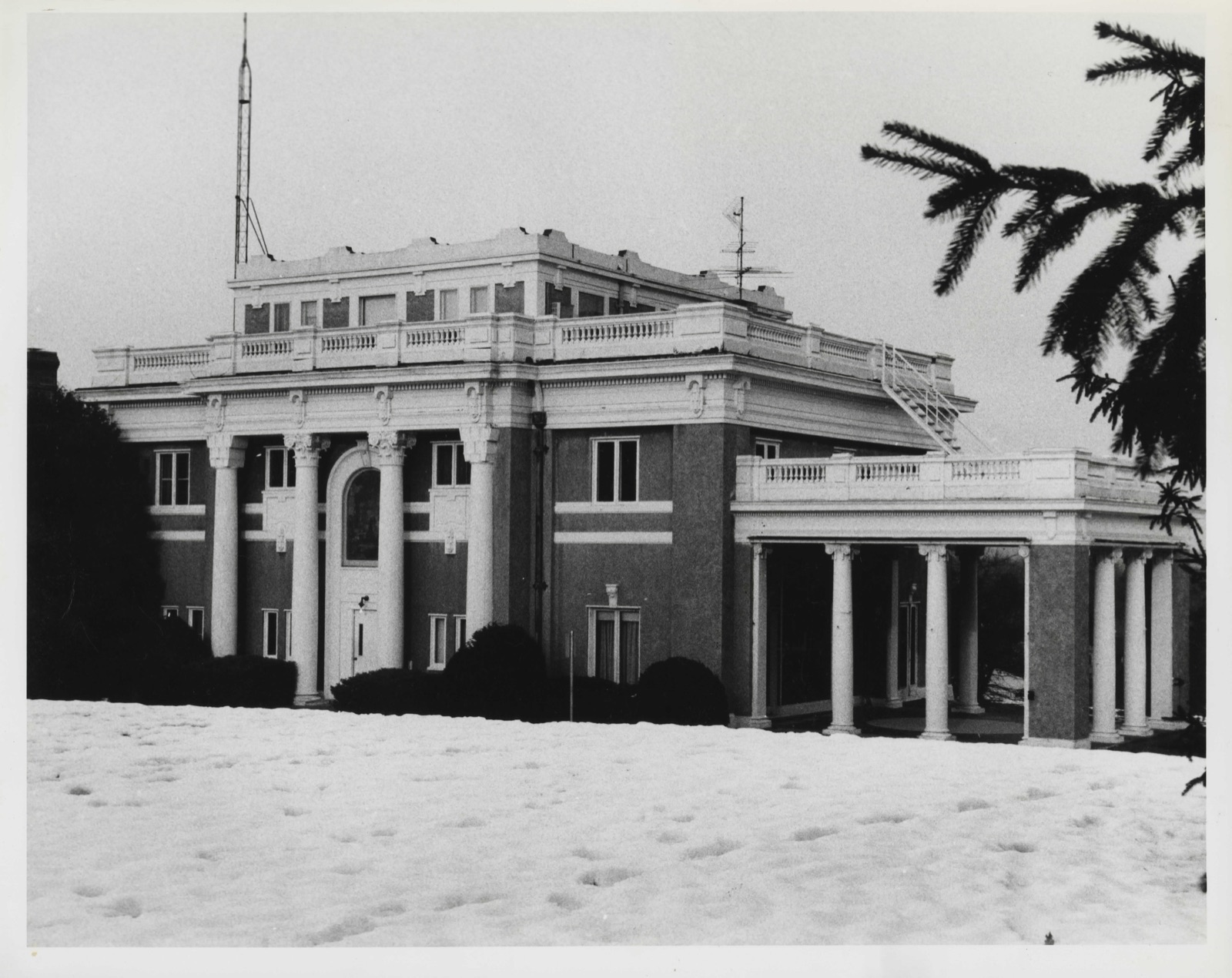
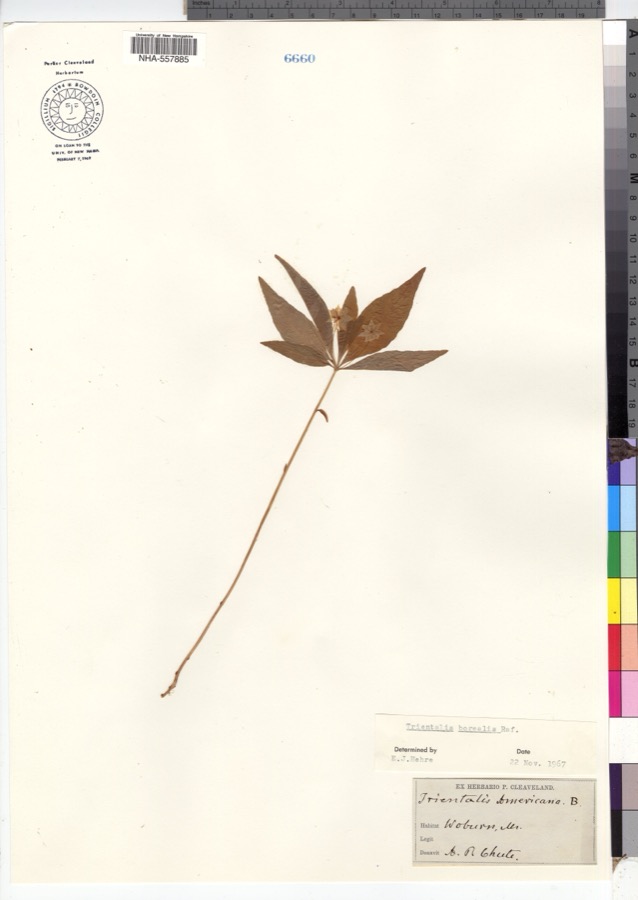
Photographs from the nomination case file, National Park Service records.
Sanborn House
Listed on the National Register of Historic Places in
1981. A historic map-sheet match is not published yet. The record needs a coordinate-quality review before it can be joined to a sheet boundary.
From the record
“Tlie pulpit for the first six months was occupied by different clergjmen. Bichard Metcalf, the present pastor, was called, and on June 14, ISGG, was duly installed.”
History of Middlesex County, Massachusetts (1880). Machine-read text.
one of 1100 National Register listings in Middlesex County · listed in 1981 · category: Building · one of 3 National Historic Landmarks in Middlesex County.
National Register reference number.81000286- the number the National Park Service assigned this property when it was listed, and the key its nomination file is catalogued under at the National Archives.
HE town of Winchester is in the easterly section of Middlesex County, eight miles northwest of Boston by the Boston and Lowell Railroad, whicii here sends off branches to Woburn and Stoneham. Its form is triangular, and it is bounded on the north and northwest by Woburn, on the east by Stoneham and Medford, on the south by Medford and Arlington, and southwest by Lexington.
December 3, 1849, the committee reported favorably upon the plan, their report was accepted, and a committee chosen to draft a petition to the legislature. December 7, 1849, the committee reported the draft of a petition, which was accepted, and another committee chosen to obtain signers thereto. Samuel S. Richardson, Oliver R. Clark, and John A. Bolles were chosen a committee to take the necessary stejis to secure a town charter, and they employed Hon. Albert H. Nelson, of Woburn, as tiieir counsel. December 24, 1849, a committee, of which Hon. F. O. Prince was chairman, Avas chosen to select a name for the town and insert tlie same in the petition, which had received one hundred and seventy-six names. A great deal of difficulty was experienced in settling upon the name to be given to the new cliild, but finally it was decided to christen it Winchester, in lionor of Colonel William P. Winchester, a wellknown and public-spirited citizen of Boston, who thus became its godfather. The petition was presented to the legislature, January 19, 1850, and referred to the committee on towns. While it was pending in the committee, remonstrances were ])resented and referred to said committee from Luke Wyman and ciglity-nine others, of West Cambridge (now Arlington), and the selectmen and one hundred and three others, of Medford. At a townmeeting, held inWoburn, February 7, 1850, it was " Voted, That tlie town is willing that the prayer of tlie petition should be granted on just and equitable terms, to be agreed upon by a committee from each part of the town."
Regional context, not property-specific
evidence. The
federal wildfire occurrence database
lists 71 fires within 5 miles of Sanborn House between
2015 and 2020, burning about 100 acres in total. None started naturally. 28 were recorded as arson.
Distance is straight-line from the map coordinates, so a fire counted
here may appear on a neighbouring settlement's page as well.
Reported cause
Fires
Arson/incendiarism
28
Missing data/not specified/undetermined
16
Debris and open burning
12
Recreation and ceremony
10
Smoking
2
Misuse of fire by a minor
2
Equipment and vehicle use
1
The most recent of
them, most recent first, with the day each was reported and the service
that recorded it.
Regional context, not property-specific
evidence. Museums hold 1,740 specimens
collected within 10 miles of Sanborn House between 1898 and
1975: 711 Animalia, 549 Plantae, 416 Fungi, 29 Protozoa, 17 Bacteria, 9 Unrecorded, 9 Chromista. 12 distinct Species records are shown.
Collected by ?, A B Seymour, A B. Proper and others. Each is a
physical object with a catalogue
number, and each entry opens the museum's record. This is what was
collected and kept, not a survey of what lives here - nothing can be
concluded from a species being absent.
Regional context, not property-specific
evidence. The federal mineral resources record lists
13 workings within 5 miles of Sanborn House: 7 past producers, 3 producers, 3 plants.
6 still produce. What was taken out: Sand and Gravel, Construction, Peat, Clay, Iron. Distance is straight-line from the
map coordinates, so a quarry counted here may appear on a neighbouring
settlement's page as well.
Regional context, not property-specific
evidence. The National Weather Service names
Winchester, the town this property stands in, in 5 storm reports between 1995 and 1999: 4 flash flood, 1 thunderstorm wind.
No death or injury is recorded in these reports. Each account below is quoted exactly as the forecast office
filed it, from the NOAA Storm Events Database, and each date
opens the federal record of that event.
No historic map-sheet match is published
for this property yet. That does not mean no map exists. This record needs
a coordinate-quality review before it can be joined to a sheet boundary.
Browse the county's mapped places while that work is
pending.
From the nomination file
3,618 words on record
When this property was proposed for the
National Register, someone wrote the case for it: what the building is,
and why it matters. That document is a federal record in the public domain.
It is quoted below word for word, never summarised. The text was read off the scanned case file by machine, so the
occasional stray character is the recogniser's and the 1970s
typewriter's.
Description of the property
The Sanborn House, designed in 1907 in a Mannerist interpretation of the Beaux Arts style, occupies a hillside site overlooking the town center. An original carriage house stands behind the main house to the northwest. The main house consists of a two story central block with a raised attic story and shallowly projecting frontispiece. A one story verandah projects from the south side while a one and one half story service wing is attached to the north. It is stuccoed, with heavily scaled detail executed in white painted wood.
The ornament of the central block consists of two string courses beneath the second story windows, a dentiled entablature and a balustrade; that of the attic includes a plain entablature and a solid parapet; the porch has a plain entablature and a balustrade; the service wing has a dentiled frieze running through the second story windows and a solid parapet. The Mannerist influence can be seen in the antifixae-like elements which decorate the entablature, the use of keystones over rectangular openings and the misplaced frieze of the service wing. The five bay facade is symmetrically organized around the frontispiece which is supported by two composite columns and two capped columns.
It includes a center entry with a tall round arched stained glass window above which is framed by a molded architrave. This is flanked by narrow paired windows at the first story and double windows with panels beneath them at the second story. The south outer bay has double windows at both stories while the north bay has paired windows at the first story and a double window at the second. Secondary entries are located on the south elevation and in the service wing.
/Architect unknown Statement of Significance (in one paragraph) The Sanborn House (Aigremont) possesses integrity of location, design, setting, materials and workmanship and is significant both for its associations with the Sanborn family and for the quality of its architectural design. It was built between 1906-07 for Oren Cheney Sanborn, the son of James S. Sanborn, a founder of the Chase and Sanborn Co. in Boston. Although its architect is presently unknown, it stands as a locally unique intrepretation of the Beaux-Arts style and as one of the few houses in the Boston area to exhibit mannerist characteristics. The house meets criteria B & C of the National Register of Historic Places.
Oren Sanborn, born in Maine in 1865, came to Winchester in 1901 at a time when the town was developing rapidly for the residence of Boston businessmen. Prospering as a member of his father's tea and coffee importing firm, Sanborn became one of the four wealthiest men in Winchester. He acquired two parcels of land to make up the nine-acre hillside tract with its magnificent view over Winchester Center to the Middlesex Fells. Although the architect is not known, Sanborn's house, which reportedly cost $250,000 to construct, is by far the most impressive in the area. In 1921 Sanborn was forced to sell the property. He had fallen upon hard times, and was living in Providence at the time. The new owner was a Bostonian, J.
Edward Downes, founder of Downes Lumber Company, which was located in Boston. The condition of the house grounds at the time of the sale required major repair work, and the Downes family of seven moved in around 1924. From 1925 until 1947, the house became a lively residence once again, housing another family prominent in Winchester society.
Quoted from the National Register nomination
for reference 81000286, 25 pages, held by the National Archives in Record
Group 79. See the
catalogue record.
Listed places nearby
6 within 8 miles
Other National Register properties close
enough to walk or drive between, ordered by distance from this one. Both
positions come from the same geocoding pass that matched these properties
to their map sheets.
Listing record. National Park Service National Register of Historic Places, listed-properties dataset, current to 2026-05-22.
Map join. Address geocoded through the United States Census geocoder, then tested against the published boundary of every sheet in the USGS Historical Topographic Map Collection.
How this page is made. Listing fields come from federal records; map-sheet coverage is a labelled coordinate-to-boundary calculation, not a source-field claim.
Wildfire. Short, Karen C. 2022. Spatial wildfire occurrence data for the United States, 1992-2020 [FPA_FOD_20221014]. 6th Edition. Fort Collins, CO: Forest Service Research Data Archive. https://doi.org/10.2737/RDS-2013-0009.6 Collected with United States Government funding and usable without additional permissions or fees.
Specimens. Global Biodiversity Information Facility (GBIF), https://www.gbif.org/. Only records licensed CC0 or CC BY are used. Records licensed CC BY-NC are excluded because this site carries advertising. Images are checked individually and any whose licence is non-commercial, no-derivatives or unreadable is refused.
Mines and quarries. USGS Mineral Resources Data System (MRDS) https://mrdata.usgs.gov/mrds/ A work of the United States government, no copyright under 17 U.S.C. 105.
Storms. NOAA National Centers for Environmental Information, Storm Events Database https://www.ncei.noaa.gov/stormevents/ A work of the United States government, no copyright under 17 U.S.C. 105. Narratives are quoted verbatim from the National Weather Service report and are not edited or summarised.
 Block
Block