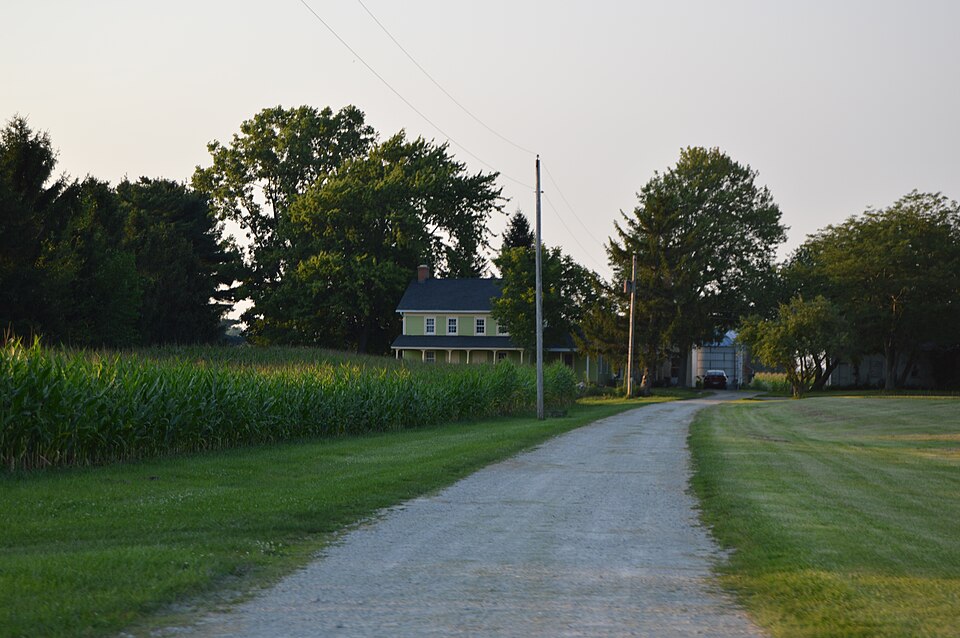
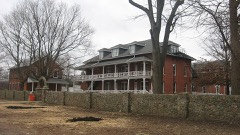
Built in 1852. Listed on the National Register of Historic Places in
1984. A historic map-sheet match is not published yet. The record needs a coordinate-quality review before it can be joined to a sheet boundary.
From the record
one of 21 National Register listings in Wood County · listed in 1984 · category: Building · built in 1852 · one of 1 National Historic Landmarks in Wood County.
National Register reference number.84003812- the number the National Park Service assigned this property when it was listed, and the key its nomination file is catalogued under at the National Archives.
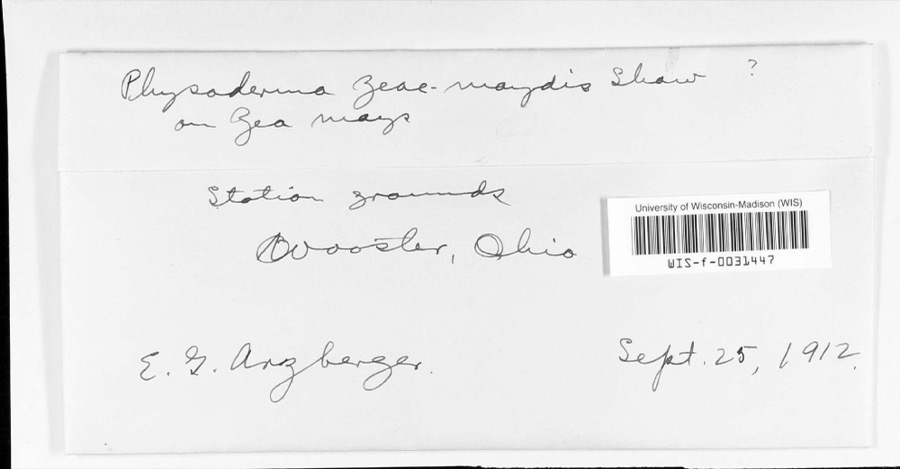
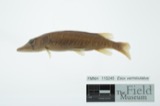
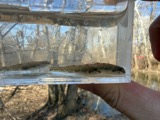
Specimens collected near this property
12 of 619 shown
Regional context, not property-specific
evidence. Museums hold 619 specimens
collected within 10 miles of Graham, William, House between 1894 and
1975: 613 Animalia, 5 Fungi, 1 Plantae. 12 distinct Species records are shown.
Collected by Allen, J. M., B. BURGER, Baumgartner, L. and others. Each is a
physical object with a catalogue
number, and each entry opens the museum's record. This is what was
collected and kept, not a survey of what lives here - nothing can be
concluded from a species being absent.
Regional context, not property-specific
evidence. The federal mineral resources record lists
1 working within 5 miles of Graham, William, House: 1 producer.
All of them still produce. What was taken out: Stone, Crushed/Broken. Distance is straight-line from the
map coordinates, so a quarry counted here may appear on a neighbouring
settlement's page as well.
Regional context, not property-specific
evidence. The National Weather Service names
Wayne, the town this property stands in, in 9 storm reports between 1996 and 2013: 4 thunderstorm wind, 3 hail, 1 flash flood, 1 lightning.
No death or injury is recorded in these reports. Each account below is quoted exactly as the forecast office
filed it, from the NOAA Storm Events Database, and each date
opens the federal record of that event.
A trained spotter reported thunderstorm winds caused damage to a fence, a camper to be moved several feet, a shed was blown to the next street, and 2 basketball hoops were bent in half.
No historic map-sheet match is published
for this property yet. That does not mean no map exists. This record needs
a coordinate-quality review before it can be joined to a sheet boundary.
Browse the county's mapped places while that work is
pending.
From the nomination file
2,728 words on record
When this property was proposed for the
National Register, someone wrote the case for it: what the building is,
and why it matters. That document is a federal record in the public domain.
It is quoted below word for word, never summarised. The text was read off the scanned case file by machine, so the
occasional stray character is the recogniser's and the 1970s
typewriter's.
Description of the property
The William Graham house was built in 1852 by Henry Tyson. The house is located at the end of a long drive on the north side of the Jerry City Road, 3.4 miles east of Jerry house sits atop a small natural mound, a remnant of a prehistoric beach ridge, which The configuration of the house, except for later additions to the east end, is essentially According to Henry Glassie, the noted folklorist and student of Germanic folk house-types, exterior of their houses while retaining the old-world/traditional interior they found more functional to their simple life style. The house is a rectangular wood framed structure with a gabled roof and situated on a foundation came from the immediate area.
The form is symmetrical with balanced and and two doors, with the doors located in the center and the windows located to the out- two interior chimneys, one remains the other being temporarily removed due to a deter- iorating support member. Across the entire first story front is a porch, a part of the each of the posts was removed during the late 1800's. The entire structure, including the porch, is covered by the original clapboard siding, presently painted yellow witn a white trim and is anchored by the original square/rectangular headed nails, and on covered by contemporary asphalt shingles and retains its original dimensions, moldings and frieze board.
is a simple plank attached to the wall at chair back height, and on the second floor an on each floor, and located at the center point of each gable-end wall was a fireplace. Only two fire places exist presently. These are on the west end of the house and are not the originals.
(in one paragraph) The William Graham house is significant because: it is a well preserved nineteenth example of the several houses attributed to Henry Tyson, a Pennsylvania German Mennonite who came to Wood County in 1847; and finally, a building of this particular style of architecture in Wood County in 1852 represents the westward spread of a unique folk trait, associated with the Pennsylvania Germans, into Northwest Ohio. These facts establish the house as an important artifact for furthering the study of a particular pattern of folk culture and its contribution to the larger cultural patterns of nineteenth century Wood County and Northwest Ohio.
folk culture patterns as a sunthesis of "Georgian (stylistic elements) with earlier, folk features - old Rhineland peasant interiors stuffed into stylish eighteenth form is seen as a result of the beginning of an English dominated popular culture Influencing the existing Germanic cultural patterns, reflecting a synthesis of styles The primary elements of the style are; a two room deep with, internal gable-end chimney, low pitched root, door and window arrangement that tries to appear symmetrical, the absence of a central hall and stairs with boxed in stairway curled into a corner instead, a three or tour room plan, and frequently two front doors, all of which are Columbianan County, Ohio.
He was born in the area of Germantown, Pennsylvania and had to a Cornelius Tyson who came to the Germantown area in 1683, participating in orig- between family, building houses and operating a sawmill located approximately one-half the congregation of a small Mennonite religious community that existed for only a relatively short time, but which has been documented in published works based on infor- Graham to build this house in 1852.
Quoted from the National Register nomination
for reference 84003812, 13 pages, held by the National Archives in Record
Group 79. See the
catalogue record.
Listed places nearby
1 within 8 miles
Other National Register properties close
enough to walk or drive between, ordered by distance from this one. Both
positions come from the same geocoding pass that matched these properties
to their map sheets.
Listing record. National Park Service National Register of Historic Places, listed-properties dataset, current to 2026-05-22.
Map join. Address geocoded through the United States Census geocoder, then tested against the published boundary of every sheet in the USGS Historical Topographic Map Collection.
How this page is made. Listing fields come from federal records; map-sheet coverage is a labelled coordinate-to-boundary calculation, not a source-field claim.
Specimens. Global Biodiversity Information Facility (GBIF), https://www.gbif.org/. Only records licensed CC0 or CC BY are used. Records licensed CC BY-NC are excluded because this site carries advertising. Images are checked individually and any whose licence is non-commercial, no-derivatives or unreadable is refused.
Mines and quarries. USGS Mineral Resources Data System (MRDS) https://mrdata.usgs.gov/mrds/ A work of the United States government, no copyright under 17 U.S.C. 105.
Storms. NOAA National Centers for Environmental Information, Storm Events Database https://www.ncei.noaa.gov/stormevents/ A work of the United States government, no copyright under 17 U.S.C. 105. Narratives are quoted verbatim from the National Weather Service report and are not edited or summarised.
 Block
Block