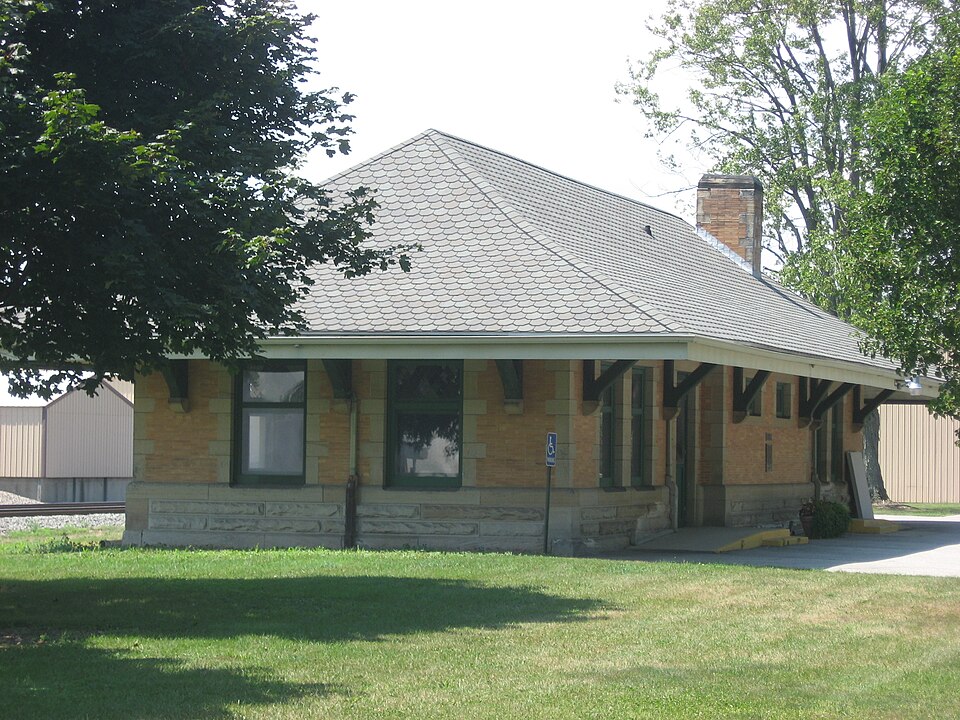
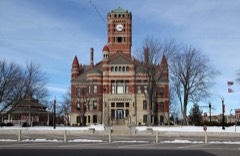
Listed on the National Register of Historic Places in
1989. A historic map-sheet match is not published yet. The record needs a coordinate-quality review before it can be joined to a sheet boundary.
From the record
“Of the early settlers of the township, jio one is more worthv of the post of honor than John Stubbs, not only because of his early residence, but because of his prominence and usefulness in the young community. He was a man of marked intelligence and strong humanitarian principles, one of the few who willingly yielded personal interest and made financial sacrifices for the sake of principle.”
The County of Williams : a History of Williams County, Ohio, from the Earliest Days, with Special Chapters on Various Subjects, Including Each of the Different Townships ; Also a Biographical Department (1905). Machine-read text.
one of 4 National Register listings in Williams County · listed in 1989 · category: Building.
National Register reference number.89001014- the number the National Park Service assigned this property when it was listed, and the key its nomination file is catalogued under at the National Archives.
Of the early settlers of the township, jio one is more worthv of the post of honor than John Stubbs, not only because of his early residence, but because of his prominence and usefulness in the young community. He was a man of marked intelligence and strong humanitarian principles, one of the few who willingly yielded personal interest and made financial sacrifices for the sake of principle. He was born in Orange county, New York, August 12, 1784. His father, William Stubbs, who was of Welsh descent, was a soldier in the Revolutionary' War and assisted in the capture of the desperate and infamous tory, Claudius Smith, near Goshen, Orange county, New York, where he was afterwards hanged. In early life, John Stubbs removed to Tompkins county. New York. He was captain of a company of state militia during the war of 1812. In 1832 he sold his farm in Tompkins county and entered nearly 1,000 acres of land in what afterwards became Springfield township, Williams county, Ohio, and came with his family, together with his sons-in-law, Jonathan B. Taylor and Harmon Doolittle, and their families, all settling in Springfield township, the following spring. Mr. Stubbs located on Tiffin River (Bean Creek), about three miles south of the present site of Stryker, built a cabin and commenced clearing. Here he remained but a year, when he removed to another tract of land in the same township, two and a half miles west of Stryker, and built another cabin. This farm of 130 acres he soon afterwards sold to Dr. Kibbey, who contemplated building a saw-mill and surveyed a portion of the land for town lots, calling the new place Williamsport ; but becoming badly involved and unable to execute his intentions, the land reverted to Mr. Stubbs, who, in the meantime, had returned to his former place where he had begun a home, and where himself and family resided until 1861, when Mr. and Mrs. Stubbs went to live with their son, John H. Stubbs, with whom they remained until death called them. Mr. Stubbs died, January 26, 1864, and was followed by Mrs. Stubbs in 1871. Mr. Stubbs was for eighteen years justice of the peace in Tompkins county, New York, and after coming to Ohio filled continuously for many years some of the township offices, being also at one time one of the commissioners of Williams county. He was a member of no church, but was for more than half a century a prominent and leading member of the Masonic fraternity, having advanced as far in the order as was then possible in this country. He was for many years Worshipful Master of Hiram Lodge, in Tompkins county, New York, and after coming west helped to organize new lodges over northwestern Ohio. He believed Masonry to be the best organization ever instituted by man, and constantly practiced, through a long and useful life, the tenets of the order. Ever seeking to ameliorate the condition of humanity he dispensed charities with a loving heart and a bounteous hand.
John H. Stubbs came to Williams county, in 1833, and was identified with its growth from that early period. His parents located in Springfield township on a farm, where he remained at work, and which he acquired by deed of gift from his father in 1845. In company with two brothers-in-law, he built the first saw-mill in Springfield township, on Tiffin River, which he had charge of for several years. He was peculiarly fitted for pioneer life, and, being a sure marksman, the wild turkeys and deer with which the country abounded, suffered at his hands. He was of an eminently social nature, and, with his violin, was an indispensable figure at all the primitive gatherings of that day. He served to cheer and enliven the hearts of the widely-separated neighbors and inspire courage for renewed efforts. Mr. Stubbs was a charter member of Stryker Lodge, No. 61 1, I. O. O. F., and in politics was a Republican. He was born November 26,. 1820, in Springfield, Tompkins county, New York. For more than forty years he was an extensive, close and careful reader and investigator, especially of metaphysical subjects. He did his own thinking and would not allow creed-makers to forge fetters for his mind. He believed that all material things were formed in obedience to certain immutable laws ; that both law and matter are eternal and indestructible ; that the word "create" is a misnomer and should be stricken from every language. He believed that there is a certain something called "energy," also eternal and indestructible, which overcomes resistance and does work ; that this energy is always the same, no matter under what circumstances it may be manifested. He firmly believed that what men called "mind," "intelligence" or "soul," is only a manifestation of energy. He believed in. the entity of the individual mind ; that all mental improvement is but accumulated thought or energy, and that it must go on forever. To him, the only evidence of a future existence is in the manifestation of spirits, and while he repudiated creeds, one and all, as the inventions of men, he was yet no materialist. He would not bow the knee in superstitious reverence of the Past, simply because it is the Past, but worshiped toward the Dawn. He believed in a religion of love, rather than in a religion of duty; that the whole of religion, pure and undefiled, is to deal justly, love mercy, and to endeavor to make fellow creatures happy. Mr. Stubbs departed this life at his home near Stryker, September 10, 1882.
Regional context, not property-specific
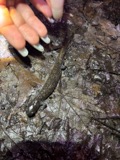
evidence. Museums hold 129 specimens
collected within 10 miles of Stryker Depot between 1890 and
1974: 128 Animalia, 1 Fungi. 12 distinct Species records are shown.
Collected by Adler, K. K., C.H. Kennedy, CLARENCE CLARK and others. Each is a
physical object with a catalogue
number, and each entry opens the museum's record. This is what was
collected and kept, not a survey of what lives here - nothing can be
concluded from a species being absent.
Regional context, not property-specific
evidence. The National Weather Service names
Stryker, the town this property stands in, in 4 storm reports between 2002 and 2024: 3 thunderstorm wind, 1 lightning.
No death or injury is recorded in these reports. Each account below is quoted exactly as the forecast office
filed it, from the NOAA Storm Events Database, and each date
opens the federal record of that event.
No historic map-sheet match is published
for this property yet. That does not mean no map exists. This record needs
a coordinate-quality review before it can be joined to a sheet boundary.
Browse the county's mapped places while that work is
pending.
From the nomination file
4,135 words on record
When this property was proposed for the
National Register, someone wrote the case for it: what the building is,
and why it matters. That document is a federal record in the public domain.
It is quoted below word for word, never summarised. The text was read off the scanned case file by machine, so the
occasional stray character is the recogniser's and the 1970s
typewriter's.
Statement of significance
Architect/Builder and C. Under A for transportation, representing the importance of rail transportation to example of the standardized "country"or small town railroad stations constructed by many The Lake Shore and Michigan Southern Railroad, which built the Stryker Depot in 1900, to 1900 Architecture town. Transportation Architectural Significance unknown Significant Person population, commerce and corresponding passenger service supported the larger facility.
replace an earlier frame structure destroyed by fire, apparently predicted continued The building is constructed of sandstone and brick and contains both large and small Cultural Affiliation visual evidence of the high hopes which both the railroad and local citizens had for their Significant Dates of two well preserved brick and stone depots remaining along the Lake Shore and Michigan Areas of Significance (enter categories from instructions) small communities at the turn-of-the-century and under C, the Depot is significant as one See continuation sheet Period of Significance State significance of property, and justify criteria, criteria considerations, and areas and periods of significance noted above.
station [2].The town later languished.However, the Stryker Depot remains as important railroads in the nineteenth and early twentieth centuries.[1] Applicable National Register Criteria Southern Railroad's famous "Air Line Route."The depot is also significant as an excellent towns"along the route and thus the recipient ofa substantial brick and stone railroad The depot's72'x 26'dimensions place itin a"class one or two"category of standardized adapted to the needs of the railroad. *locally waiting rooms, a separate baggage area and combination ticket and operators office [3].
Quoted from the National Register nomination
for reference 89001014, 36 pages, held by the National Archives in Record
Group 79. See the
catalogue record.
Listed places nearby
1 within 8 miles
Other National Register properties close
enough to walk or drive between, ordered by distance from this one. Both
positions come from the same geocoding pass that matched these properties
to their map sheets.
Listing record. National Park Service National Register of Historic Places, listed-properties dataset, current to 2026-05-22.
Map join. Address geocoded through the United States Census geocoder, then tested against the published boundary of every sheet in the USGS Historical Topographic Map Collection.
How this page is made. Listing fields come from federal records; map-sheet coverage is a labelled coordinate-to-boundary calculation, not a source-field claim.
Specimens. Global Biodiversity Information Facility (GBIF), https://www.gbif.org/. Only records licensed CC0 or CC BY are used. Records licensed CC BY-NC are excluded because this site carries advertising. Images are checked individually and any whose licence is non-commercial, no-derivatives or unreadable is refused.
Storms. NOAA National Centers for Environmental Information, Storm Events Database https://www.ncei.noaa.gov/stormevents/ A work of the United States government, no copyright under 17 U.S.C. 105. Narratives are quoted verbatim from the National Weather Service report and are not edited or summarised.
 Block
Block