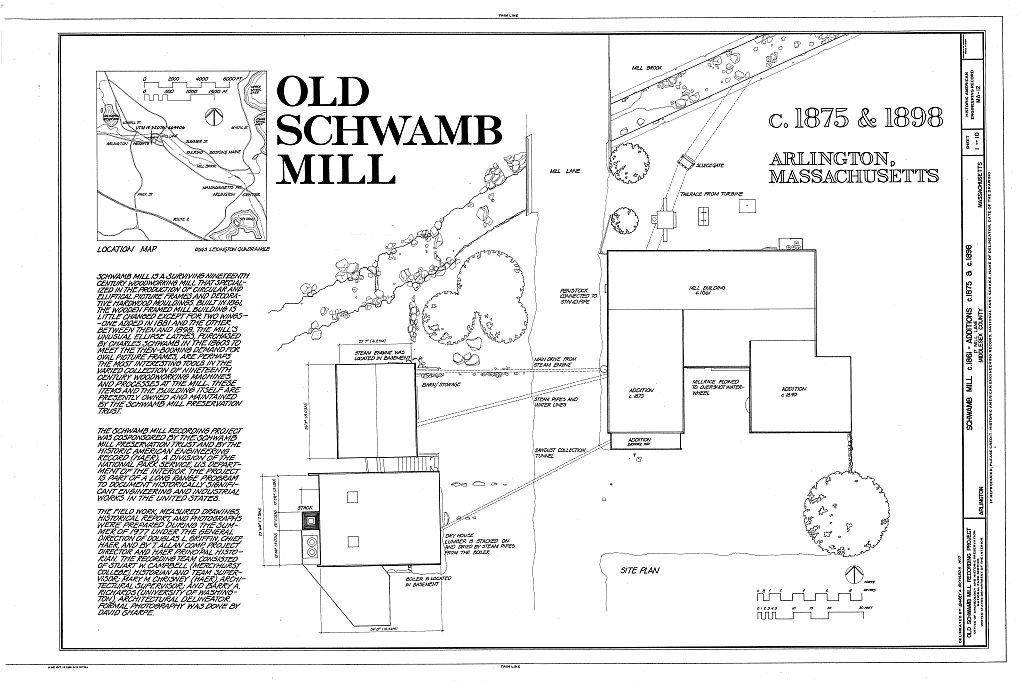
Schwamb Mill, 17 Mill Lane, Arlington, Middlesex County, MA. Surveyed as HAER MASS,9-ARL,4-, with 1 photograph, 1 measured drawing and a 5,611-word written history.
From the record
“This example of a 19th-century woodworking mill includes operational equipment and evi- dence for four power systems.”
Written record, HAER MASS,9-ARL,4- survey. Machine-read text.
surveyed by the federal HAER program as HAER MASS,9-ARL,4- · the record runs 5611 words · one of 333 surveyed structures published for this county.
1 photograph and 1 measured drawing from the federal survey record, Library of Congress.
Significance
49 words
Source document
Quoted word for word from HAER MASS,9-ARL,4-.
Not written, edited or summarised by this site.
This example of a 19th-century woodworking mill includes operational equipment and evi- dence for four power systems. Circular and elliptical picture frames are manufacturered here as they have been since the Schwamb brothers bought the mill in Of special interest are five lathes on which elliptical frames are turned.
Written history
5425 words
The headings the report itself prints. Each one jumps to where it begins.
Source document
Quoted word for word from HAER MASS,9-ARL,4-.
Not written, edited or summarised by this site.
Stuart Campbell , Flip Animation; Richard K. Anderson, It is understood that access to this material rests on the condition that should any of it be used in any form or by any means, the author of such material and the Historic American Engineering Record of the Heritage Conservation and Recreation Service at all times be given proper credit. Schwamb Mill HAER MA-12 (Page ) Schwamb Mill in an important site, a surviving nineteenth cen- tury woodworking mill that specialized in the production of circular and elliptical picture frames and decorative mouldings. Through machines and processes existed here as they had in the mid and late nineteenth century.
The wooden-framed mill building, built in is little changed except for two wings, one added by and the other between then and [1] The principal reason for such a unique survival is that while Schwamb's business was succesful enough to keep going, it never "boomed" to the extent that major expansion or technological change was called for. Circular and elliptical picture frames enjoyed great popularity for only a few years during the third quarter of the century. After that, the mill struggled along, riding small waves of increasing or decreasing demands for its high quality, hardwood pro- ducts. Elmer Schwamb, great grandson of founder Charles, finally closed the business after his father's death. Among his reasons were rising costs and the difficulty of securing good woodworkers.
Unfortunately, few manuscript records exist to trace the business history of Schwamb Mill. But from what data sources are available, three eras of operation emerge: and Founding and Prosperity, On June 30, German immigrant woodworkers Charles and Frederick Schwamb purchased an almost new mill in Arlington, Massachusetts from Henry Woodbridge. Presumably, they made their purchase with the full intent to manufacture circular and elliptical picture frames. For these items "there had grown up an active demand ... probably on account of the extraordinary call for pictures of soldiers." [2] These two men were members of a family from "Rhine Hesse" [3] whose sons immigrated to the United States at various dates during the second quarter of the nineteenth century.
The Schwamb brothers either learned woodworking in Germany or mastered the trade upon arrival. FLIP ANIMATION showing mechanical operating principles of Schwamb Mill elliptical picture frame lathes. To view animation, riffle report pages, starting with back page. See p. 23 for description of lathe parts and operation shown in these views. Schwamb Mill HAER MA-12 (Page 3 ) For example, Charles Schwamb, who arrived in Che Boston area during the mid-1840s, appeared in Che census as a propertyless "wood Curner." [4] . .. The two brothers raised enough capital to acquire the new Woodbridge Mill, built in on a site where mills had stood for generations. [5] Woodbridge and "Smith and Hill," his immediate predecessors, ground spices.
[6] Woodbridge presumably did poorer business than he had hoped and decided to sell. The Schwambs were no doubt delighted to acquire the recently constructed mill complete with a water wheel ten feet across the buckets and eighteen feet in diameter. [7] For fifteen years, Charles Schwamb' s employees "curned out". thousands of "oval frames" each week. [8] The mill concentrated "exclusively" [9] on the frames which found "a ready sale in Boston and elsewhere." Mr. Schwamb needed more than thirty hands Co meet demand. Frederick Schwamb decided to leave the business in He moved to Chicago. Charles operated the business alone until when his son Carl became his partner. Physical evidence suggests the prosperity of this period.
By the partners had added two thirty-five horsepower boilers and a Cwency-five horsepower steam engine to supplement the water wheel "as occasion required." Also, Chey added a wing, 20 feet by 20 feet, to Che souchwesc front of the main mill building. Several pieces of equipment were also apparently acquired during the early years. Items in the mill which date between and include: a wood lathe of 19-inches swing and 9-foot gap; a treadle wood lathe with a 10-inch swing and a 3-foot gap; and foot powered scroll saw made by W. F. & J. Barnes Company; a wood laChe with 24- inch swing and 6-foot gap; a belt-driven horizontal boring machine; and a belt-driven circular saw.
Schwarab Hill HAER MA-12 (Page -^ ) Transition, "About the use of oval frames went out of style." Apparently, the demand for circular and elliptical frames collapsed so quickly that the business suffered, and "for a short time" it "turned out the mill work for the piano case business conducted by (Charles' nehpew) William P. Schwamb." This business must have been wel- come because nine hands constituted the "greatest number of hands em- ployed at any one time" during the census period. There is no evidence that Schwamb Mill courted failure in the three decades following the end of the popularity of oval frames. Busi- ness was simply slower.
In fact, a wing feet by feet) was added to the southeast side of the mill between and How- ever, it is symbolic that this wing was added not for picture-frame production, but to serve an increasing emphasis on hardwood moulding. Within the addition, mouldings up to 12 feet long were sanded, stored and readied for shipment. The production of mouldings, in fact, dominated Schwamb business for the rest of the firm's life. Circular and elliptical frames were a specialty which few firms could match, but one for which there would always be less demand than-in Charles Schwamb's early, "very prosper- ous," days. # However, Schwamb Mill as a moulding mill was less unique. There- fore, increased competition presumably explain why "the business ...
had dwindled to small proportions" by the first decade of the twentieth century. There was apparently little change in the volume of business from the days after the fashion for ovals died. For example, during and early the weekly payroll fluctuated be- tween sixty and ninety dollars. Therefore, employment had, if any- thing, declined from the nine hands employed in - Equipment added during this phase indicates that the business sur- vived even if it did not thrive.
A double spindle edge moulding machine; a hand planer; and a belt-driven jig were apparently added by The Schwamb Mill paid the American Wood Working Machine Schwamb Mill HAER MA-12 (Page 5 ) Company for a band saw on 15 February In the water wheel was replaced by a nine inch Hercules water turbine made by the Holyoke Manufacturing Company. This small turbine sold for in "Moulding Mill and Picture Frame Man*ftry," On 14 May Carl Schwamb leased the mill to his sons Clinton and Louis. The latter acted as president while Clinton served as treasurer. However, Clinton apparently provided the major force for change. For example, in the mill was incorporated as Clinton Schwamb and Company.
Both brothers, however, resolved to "restore the business to the same position it held in the trade while managed by their grandfather." Unfortunately, we lack details about the "hard work and honest dealings" which accounted for the business' renewed vigor. However, a bundle of loose account pages survive for the They document that the Schwamb Mill was busier during the 'twenties than it had been in Payroll, for example, increased three or four times. The accounts are incomplete and include gaps within the covered years. However, they give some idea of the scope of business activity at the mature Schwamb mill. These accounts are not complete. They suggest that the Mill ran at a loss during the mid-twenties.
However, this is unlikely because in Clinton and Louis Schwamb invested in a new power system. At that time electric motors began to run the saws and machines which had been powered by steam. The principal reason for the change was the expense of retaining the fireman/engineer required by state law. However, this change and the Schwamb's willingness to go into debt reflected in "notes payable" above suggests that the business was healthy during the Few records document the Schwamb Mill's last forty years. Tra- dition holds that the combination of more expensive labor, rising Schwamb Mill HAER MA-12 (Page ) material costs, and fewer workers interested in woodworking made Schwamb products increasingly expensive in a market crowded with cheaply pro- duced substitutes.
Account m Accounts Receivable (9 months) Notes payable Lumber purchases Labor factory Management Fuel Insurance 97 Power, heat and light na Engine and boiler expe nse Shipping Expense (6 months) Sales Advertising, Circularizntion, etc. Telephone, Telegraph, and Postage After World War II, Elmer Schwamb (Clinton's son) began finish- ing frames in the mill's attic. This enterprise, the Elwane Company, "bought raw wood frames from Clinton W. Schwamb and Company just like anybody else." The goal was to increase volume by offering a smaller variety of finished frames compared with Clinton Schwamb's lar- ger variety of raw wood frames. Some fifteen finishes were offered.
They ranged from "Walnut Regular with gold metal leaf inner line" to "Antique Ivory with gold metal leaf inner line." Workers employ- ed by the Elwane Company affixed such finishes in the attic. Schwamb Mill HAER MA-12 (Page .7 ) With few changes, the mill continued to support the family until But after his father's death, Elmer Schwamb chose to retire and therefore closed the mill. Woodworking Processes and Equipment The making of circular and elliptical frames was the Schwambs' specialty. However, large quantities of moulding were also made. Therefore, machinery and the plan of the mill reflected both activities The kinds of lumber and the drying process were the same for both frames and moulding. The Schwamb's favored basswood, oak, northern birch, mahogany, and black walnut.
The mill also insisted on slow-growing northern hard woods. They arrived by rail from Vermont, New Hampshire, or Canada. The lumber reached the mill in eight to twelve foot lengths. Schwamb lumber was air dried for several months in frames in the yard. It then rested for six weeks in the dry house before it was used The boilers in the basement of the dry house maintained a temperature between 125 and 140 . The boilers burned coal dust and screen- ings and sawdust generated by equipment in the mill. Mill workers performed a test" to ascertain whether or not the lumber was ready to be used. A strip of perhaps 1/8-inch thickness was taken from a board. This strip was hung in the glue room in the main mill building.
If it shrank noticeably after several hours, the lumber was not yet dry enough. If shrinkage was negligible, the lumber could be made into frames or moulding. The Process of Frame Making Schwamb catalogues listed frames between 8 by 10 inches and 48 by 60 inches as standard sizes. The customer and the mill agreed on the kind of lumber and a pattern for the frame. In special cases a shop- built template maker was used to scribe on a cardboard pattern an el- Schwamb Mill HAER MA-12 (Page & ) liptical arc appropriate for the ordered frame. This template maker is still located in the mill's southeast corner. However, in most cases, an existing cardboard pattern permitted the worker to move for- ward to the next step.
The cardboard pattern was used to outline on the lumber the four pieces from which the frame was made. The worker placed these patterns close together and in the direction of the grain. A cross-grain cut made a weaker frame. The belt-driven band saw, placed near the southeast corner, per- formed the next step. Workers used it to cut the four marked pieces from the lumber. The Schwamb's band saw features a 36-inch wheel. It is a "American" saw made by Frank H. Clement Company of Rochester, New York. Prior to the band saw's purchase, workers might have cut out frame sections on the H. L. Beach scroll or jig saw, manufactured in Montrose, Pennsylvania and sold by Holt, Shattuck and Company of Boston. It is currently placed in the mill's northwest corner.
The next step was to cut the ends of the four pieces so they butted together precisely. A cut-off saw used in conjunction with a specially calibrated square accomplished this task. The wooden base of this saw states that the maker and seller was the S. A. Woods Machine Company of Boston. The "special" square is shop-built. This saw is located to the west of the band saw in the northeast quarter of the principal part of the original mill building. The four separate pieces were at this point ready to be finger- grooved on both ends. This process permitted the pieces to mesh smoothly and snugly. The "fingers" on the eight ends were cut in each piece by nine blades nestled between fences in a wooden bench located near the south wall.
The fingers were a uniform of an inch deep on the eight ends. So that the ends would mesh neatly, the worker grooved one end by guiding it against the fence to the right. He then grooved the other end by guiding it along the left fence. Schwamb Mill HAER MA-12 (Page $ ) After grooving, the frame pieces were carried to the second floor glue room. The pieces were placed on the bed of steam pipes serving this room. This action heated the wood to better receive the glue. The Schwamb Mill used "hot glue" which was prepared from hide glue combined with water. The mixture "boiled down" to a molasses-like consistency. While the glue dried, the frame was clamped in a galvanized metal hoop which was taken up by a wheel attached to the glue table.
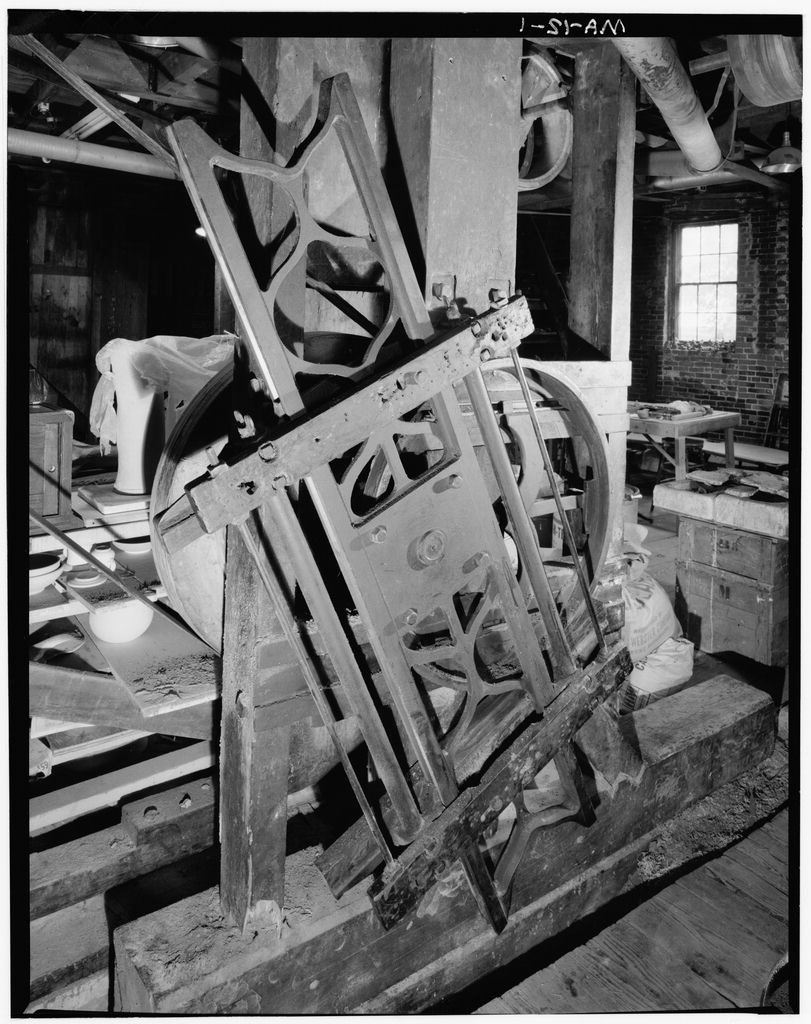
The frame returned to the first floor where the back was planed. Planing permitted a close fit on the faceplate of the lathe. The Schwamb*s hand or buzz planer is placed almost in the middle of the mill's first floor. It features a horizontal 24-inch cutter bar with four blades. It is an "American" planer made by F. H. Clement Company of Rochester, New York, The Schwambs purchased it from Wood Machinery Company, Boston, Massachusetts. The frame was turned on one of the mill's five lathes. Three are located near the mill's northeast corner; one is disconnected and sitting on a bench in the northwest corner; and one large lathe is in the basement. (More lathes may have been used at one time.) Frames were screwed to the basswood faceplates of these lathes.
The face- plates screwed onto the spindle of an ellipse chuck, which in turn screwed onto a spindle that was part of a regular lathe headstock, mounted on a bench. The Schwamb's lathes exhibit neither manufacturers' nor sellers1 names. Turning could not begin until the lathe-hand adjusted the chuck's eccentricity. If he moved the chuck off-center by one inch, he could turn an ellipse whose major axis was two inches longer than its minor axis. Two inches of eccentricity resulted in a four-inch difference, and so on. During the turning itself, the turner's hand- held cutting tool was supported on a large T rest. The turner carefully cut the ordered pattern onto the frame with several hand tools. The most important were the left-handed rounder, Schwamb Mill HAER HA-12 (Page /<?
) chisel, right-handed rounder, rabbet cutter, pointer, and small round- er. The Schwamb's purchased these two-foot-long, wood-handled, tem- pered-steel tools. Lathe hands prepared their cutting edges on a grinder near the ,lathes. While turning the frame, the lathe hand frequently referred to a hardwood template to gauge the progress and accuracy of the design. When the design had been reproduced, he applied a rabbet cutter to the back inside edge of the frame, creating the cut that would hold a picture or mirror. The turner's last steps included rubbing the frame with wood shavings, steel wool, and sand paper. Frames were then shipped unless the customer desired gessoing to seal the wood and act as a base for further finishing.
An edge moulding machine, located just west of the three lathes on the workbench facing the northeast wall, was part of the frame making process. The Schwamb's used this machine's cutter heads to cut pieces for "shallow ovals." These were plain circular or elliptical frames which did not need to be turned on the shop lathes. This machine is an "American" model by the F. H. Clement Company of Rochester. Mouldings The machinery to make mouldings, sold in shared the first floor with equipment used to make circular and elliptical frames. Moulding equipment included a swinging cut-off saw; single-headed edge moulding machine; rip saw; jig saw; and an S. A.
Woods Company number 132 "Ball-Bearing (four head) Belt-Drive Moulder." The moulder's cutting heads shaped the lumber into either a stan- dard pattern or a special design agreed upon by the customer and the mill. The moulding machine was placed on the first floor of the mill's southwest wing. Schwamb Mill HAER MA-12 (Page jj ) Moulding dominated the second floor. Racks for finished pieces filled cnosc of the original building's second floor. A belt sander used for moulding occupies Che second floor of the southwestern wing. The early gearing of the sander is of interest. Vises used to lami- nate moulding share this space. The second floor's southeastern wing contained the shipping area for moulding. The door on this level features a block and tackle.
Other Machinery There are several other pieces of equipment on the first floor of the mill in They include a long wood lathe, a much smaller treadle lathe, and a foot powered jig saw. The long wood lathe features a five step cone pulley; it has an eighteen-inch swing and a nine-foot gap. The bed and legs are wood. Near this lathe is a smaller treadle wood lathe made about Its swing is ten inches and its gap is three feet. This piece of of equipment also has a wooden bed and legs. Like the long wood lathe, it is located near the southwest wall of the first floor. The foot-powered jig saw was made by W. F. & J. Barnes Company of Rockford, Illinois. The design was patented in January, This saw stands in the northwest corner.
Two additional pieces of equipment complete the machines on the first floor. A belt-driven horizontal boring machine made about sits on the eastern side of the building near the lathes for turning frames. Its "maker" was Alvin Streeter, Winchendon, Massachusetts. The second item is a disc sander of 28-inches diameter encased in a wooden frame. The sander is a lathe headstock whose spindle carries the sanding disc. Schwamb Mill HAER MA-12 (Page /Z ) The Schwamb Mill used four power systems at different times be- tween and In Charles and Frederick Schwamb acquired with their new mill a 10-foot water wheel of 18-foot diameter. This wheel converted the potential energy of Mill or Sucker Brook into mechanical power for Schwamb Mill.
A system of two "ponds" or reser- voirs provided a 20-foot fall for the wheel. The larger pond was southwest of the mill across nearby Lowell Street. Water ran down to a small holding pond in front of the mill. Some time between and Charles Schwamb installed boilers and a steam engine "used when there is a lack of water." The two steam boilers, "having a capacity of about 35 horsepower," were located in the basement of the 16 by 30 brick "drying house." The engine developed 25 horsepower. It was located in the basement of the two story 20 by 40 storage room or "barn" just north of the dry house.
"Underground shafting, sixty feet in length" connected the engine "with the machinery in the main building." Besides power- ing the engine, the boilers heated "the complete net-work of steam pipes under the compartments (in the dry house) filled with tiers of ... lumber." This second system survived until During that year the Mill installed a 9-inch Hercules water turbine. The 20-foot head the Mill possessed meant that this turbine generated horsepower, 578 revolutions per minute, and consumed cubic feet per second. A Gillespie Hydraulic Governor regulated the turgine. This device was patented 15 August by James E. Gillespie. This third power system - a combination of steam and water tur- bine - functioned for four decades.
Contemporaries recall the "constant shoveling" that was required to keep the steam pressure at 125 pounds per square inch. Schwamb Mill was apparently an example the Arlington newspaper had in mind in when it noted that locally "for a considerable period the water turbines were used in connection with the steam engines." Schwamb Mill HAER MA-12 (Page fg) In 19 27 Clinton and Louis Schwamb decided to replace steam power with electric motors at individual pieces of equipment. This last major change in the mill's power system resulted in large part from the desire to end the expense of the fireman/engineer the steam plant required. Sawdust collection formed an integral part of power generation during the twentieth century.
Ducts under each woodworking machine collected sawdust, which traveled to the basement and was blown through duct-work to the basement of the dry house. A worker then shoveled the saw dust into the boilers, along with coal the mill had purchased. This system reduced fuel bills and disposed of a waste product- Schwamb Mill HAER MA-12 (Page ^ ) NOTES ln Our Home Industries," Arlington Advocate, 28 May p. 2. Hereafter referred to as "Home Industries." The second source for this statement is Atlas of the Towns of Watertown, Belmont, Arlington and Lexington, Middlesex County, Massachusetts (Boston, Mass.: Geo. W. Stadley & Co., p. 27. The small addition to the south front of the southwest front is apparently later than However, local interviewees date it earlier than ^"Home Industries," p. 2.
U. S., Department of Commerce, Bureau of the Census, Tenth Census of the Unite d States, Population, Vol. 16, Roll p. 41. Other census years refer to "Germany" or other locations, Arlington resident Amy Schwamb believes this is the most accurate. A U. S. , Department of Commerce, Bureau of the Census, Seventh Census of th e United States, Population, Middlesex County, Massachusett s Reel. Note that the census name is Carl Schwamb. I believe it t 0 be an error and should be Charles because the age is correct and 1 have discovered no Carl who would be 21. Loose file, Old Schwamb Mill Title Search, in possession of Schwamb Mill Preservation Trust. Hereafter referred to as U.
S., Department of Commerce, Bureau of the Census, Seventh Census of the United States, Products of Industry, West Cambridge, Middlesex County, Massachusetts. Woodbridge's business is not mentioned in the census. Smith & Hill is this author's inference because their mill appears in between properties which were near the Schwamb's, Woodbridge is described as a spice mill in several accounts. See, for example, "Home Industries," p. 2. ^"Home Industries," "p. 2. 8ll Arlington Locals," Arlington Advocate, 10 August p. 2. Schwamb Mill HAER MA-12 (Page Ibid. IQlbid. Home Industries," p. 2. __ 12 "Charles Schwamb's Mill," Arlington Advocate, March 7, p. 5.
Hereafter referred to as "Charles Schwamb's Mill." This article is part of a series called "Industries along Sucker Brook," which were published in the Advocate during the winter and spring of 13 Ibid. U. S,, Department of Commerce, Bureau of the Census, Tenth Census of the United States, Products of Industry, Arlington, Middlesex County, Massachusetts. Other statistics for this census year were: capital; per day was the average daily wage for a skilled mechanic; in wages was paid during the preceding year; was the value of raw materials; was the value of the final product. 15 Charles Schwamb's Mill," p. 5. 16 Ibid. 17 Schwamb account book, in possession of l ft -^Blueprint for turbine for Schwamb Mill, Holyoke Machine Com- pany catalogue, Kinne Collection, Old Sturbridge Village, p. 23.
19 Holyoke Machine Company catalogue, Kinne Collection, Old Sturbridge Village, p. 23. ^Quoted phrase is from several early Arlington, Massachusetts directories located in Robbins Library, Arlington. 21 "Charles Schwamb's Mill," p. 5. Schwamb Mill HAER MA-12 (Page /^* ) ^Loose accounts, Schwamb Mill, in possession,of Orra L. Stone, History of Massachusetts Industries (Boston, Chicago: S. J. Clarke, 19 Vol. 1, p. 971 notes that Clinton and Louis Schwamb employed 25 hands at the'time of Stone's research during the late twenties. ^JLoose accounts, Schwamb Mill, in possession of The accounts are exerpted here. Records are fairly complete for There are fewer figures for and and are sketchy. All the figures are summary.
They include monthly breakdowns but lack names of customers or suppliers or other details. 24 Interview with Elmer C. Schwamb, 18 July Z3 See photos #11 and 12 which illustrate the increase in the price of Schwamb frames during the twnetieth century. 26-Paraphrase from conversation with Elmer C. Schwamb, 22 July 19 77. 7iy7The Elwane Company, Catalog No. 9, original in possession of 28 Interview with Elmer C. Schwamb, 1 August 29 Interview with Elmer C. Schwamb, 18 July 30 lb id. 31 Ibid. 32 Interview with Elmer C. Schwamb, 1 August 33 Interview with Elmer C. Schwamb, 13 July ^Interview with Elmer C. Schwamb, 22 August Gessoing is apparently a more recent term.
"Home Industries," for example, refers to what seems to be the same process as "whitening." Schwamb Mill HAER MA-12 (Page /7 ) ^Quotation is from copy provided by Boshco Woodworking Machinery, Billerica, Massachusetts, purchasers of Schwamb Mill's moulding machine. 36 "Home Industries," p. 2. 37 Charles Schwamb & Sons' Mill privilege Near Foot of Rocks in Arlington, Chas. P. Elliot, Civil Engineer, 6 June 38 "Home Industries," p. 2. 39 Ibid. Ibid. The dimensions of the outbuildings are quoted here as they appeared in the Advocate in They are only roughly accurate. See HAER drawings for exact measurements. 41 Ibid. 42 Ibid. ^The Hercules Turbine Water Wheel, Catalogue Number Thirteen. Holyoke, Massachusetts: Holyoke Machine Company, p. 30.
Note that these specifications apparently do not apply if this wheel is a type C or D with balanced swing gates rather than the standard cylin- der gate wheels. This is doubtful because specifications in this catalogue for C and D wheels do not contain data for wheels below 15 inches diameter. 44 U. S., Patent Office, Letters Patent No. 71, dated November 19, Gillespie received several patents. This one appears to be the closest to the Schwamb governor. ^Interviews with Bruce Young, 15 August and Elmer Schwamb, several occasions during July and August, 19 77. Apparently, the steam engine provided most of the power during the early twentieth Schwarab Mill HAER MA-12 (Page /S ) century. Mr.
Schwamb recalled the water power working only once in his recollection of events at the mill since 46 Interview with Elmer C. Schwamb, 22 July 47 . 'Charles Schwamb's Mill/1 p. 5. 48 Interview with Elmer C. Schwamb, 18 July Schwamb Mill HAER MA-12 (Page /$ )
Bibliography
Manuscripts Schwamb Mill Preservation Trust. Collection of original sources pertaining to the Schwamb Mill. Various insurance policies written for the Mill between and These are general, not descriptive. Account book, 31 August to 13 February This is an in- formal list of some of the Mill's expenses. It is not a ledger and apparently does not document the business in detail. Thirteen sales books from the second and third decades of the twentieth century. These volumes are apparently daily ledgers of individual orders for moulding. Loose accounts summarizing income and expenses for much of and, to some extent, the years and Some separate accounts apparently chronicle activity with certain customers. All accounts are monthly dollar summaries and annual totals.
The also holds several drawings and blueprints of the site prepared during the and century. These items are very general and lack details needed to understand the plan and activi- ties within the Mill. A number of loose items supplement these sources. However, no doc- umentation antedates the century and no detailed business records survive. Public Documents Arlington, Massachusetts. Valuation List for the Town of West Cambridge (later Arlington). reviewed. Schwamb Mill HAER MA-12 (Page 0 ) The descriptions were too general and the valuations too var- iable to offer much help. Arlington, Massachusetts Board of Assessors. Tax List of the Personal and Real Estate of the Town of Arlington of the year(s) and 19 24. U. 5. Department of Commerce. Bureau of the Census.
Sixth, Seventh, Eighth, Ninth and Tenth Censuses of the United States: Products of Industry. is the best for the Schwamb Mill. The other years carry very little or no information for the Schwamb Mill or other businesses which preceded it on the site. U. S. Department of Commerce. Bureau of the Census. Sixth, Seventh, Eighth, Ninth and Tenth Censuses of the United States: Fopula- tion. No Schwambs are listed for Middlesex County in Family members are listed for the other years. The most important is which credits Charles Schwamb with in real estate and a personal estate. Maps and Atlases Sanborn Map Company. Arlington Middlesex County Massachusetts. New York: Sanborn Map Company, Sanborn maps do not show the Mill in detail.
They do, however, confirm the lay out of the interior and list the power system and fuel used. Beers, F. L. County Atlas of Middlesex Massachusetts. New York: J. B. Beers and Company, Schwarab Mill HAER MA-12 (Page f ) Atlas of the Towns of Watertown, Belmont, Arlington,_ and Lexington, Middlesex County, Massachusetts. Boston: Geo. W. Stadly and Company, Interviews Schwamb, Elmer C. Lexington, Kentucky. Telephone interviews, 25 July, 1 August, 15 August and 19 August, Young, Bruce. Arlington, Massachusetts. Interviews, 11 August and 15 August, Trade Catalogue Holyoke Machine Company of Worcester, Massachusetts, Manufacturers of the Hercules Trubine Water Wheel on Vertical and Horizontal Shafts, Catalogue forms part of the Kinne Collection held by Old Sturbridge Village.
Newspapers Arlington Advocate. Entire file consulted at Robbins Library, Arling- ton, Massachusetts. This newspaper is indexed and cross-referenced. It is the most important source for the century history of the Schwamb family in Arlington and the mill. Articles Bitzer, Jacob. "Industries along Sucker Brook," Arlington Advocate, 8 February p. 2 and continuation in subsequent issues. Unpublished Articles Feldberg, Michael. "The Old Schwamb Mill." paper in possession of . Schwamb Mill HAER MA-12 (Page Z ) Herzan, John. "Turning Ovals: A Study in Victorian Craft Technology." 19 73 paper held by Martin, Thomas, The Circle of the Mechanical Arts. London: Printed for Richard Rees, 62 Pall Mall, Includes a section discussing the principles of eccentric turning. Maxwell, Hu.
A Study of the Massachusetts Wood-Using Industries. Boston: Wright and Potter Printing Company, This Massachusetts sponsored volume is disappointing for the study of the Schwamb Mill. The book stresses what types of businesses use various kinds of lumber. The book is pamphlet length. Nicolson, Peter. The Mechanic's Companion. Philadelphia: James Locken, A part of this volume is a contemporary discussion of lathes for eccentric turning. Tomlinson, Charles, ed. Cyclopedian of Useful Arts, Mechanical and Chemical, Manufactures, Mining, and Engineering. Vol.
II, Hammer to Zirconium, London and New York: George Virtue & Company, A useful contemporaneous account of "elliptic turning." Schwamb Mill HAER MA-12 (Page 3 ) ELLIPSE CHUCK ECCENTRIC RING and (nonrotating) Sliding Frame Guidebars ELLIPTICAL PICTURE FRAME CUTTING TOOL SLIDING FRAME (moved back and forth on Ellipse Chuck distance (X) between centers of Guidebars by Eccentric ECCENTRIC RING and
Ellipse Chuck
Ring as chuck rotates) SHAFT adjustable to produce ellipses of different proportions; for any ellipse, its major axis Is longer than its minor axis by the dimension 2X. NOTE: In this animation, operating parts of the lathe have been greatly simplified in order to emphasize basic mechanical principles of their operation. For more detailed views of their construction, see HAER draw- ings 9 and 10 and HAER photos MA-12-1, 8, 15 and 16.
The original filed report, and the sheets the survey produced. Those published here appear above.
Also surveyed in Arlington
2 records
The federal surveyors worked through Arlington building by building. These are the other structures
they measured and filed a report on, longest report first.
 Block
Block