A resident of this house from William Monroe Trotter was an active proponent of civil rights for blacks, and was especially known for his continuous opposition to the accommodationist racial policies exemplified by Booker T. Washington. PART I. HISTORICAL INFORMATION A. Physical History: date of construction is late or B. Historical Context: William Monroe Trotter was one of the few Americans of national prominence who actively and consistently spoke out against racism during the first decade of the twentieth century. Although his adult life was one of protest against inequality and injustice, Trotter is best remembered for his steadfast opposition to the accommodationist policies of Booker T. Washington.
Washington was accepted and promoted by most whites as the national black leader of the time because his philosophy concerning the status of black Americans supported segregationist views. Trotter and other radical leaders believed that their efforts should be directed against Washington in order to achieve racial equality. Born April 7, Trotter was raised in the black elite society of Boston. Ever anxious to prove the abilities of blacks, Trotter excelled in his studies at school, and was elected president of his senior class. After working a year as a shipping clerk, Trotter entered Harvard where he became the first black elected to Phi Beta Kappa at that institution. He graduated Magna Cum Laude in WILLIAM MONROE TROTTER HOUSE KAES Ho.
MA-1165 (Page ) At a time when Trotter was preparing to embark upon a career in real estate and a comfortable life in Boston's upper-class black society, conditions for blacks throughout the country were generally deteriorating. Reconstruction had failed* By the violence designed to keep blacks from participating in the political process in the south was flourishing. The Supreme Court's decision to sanction second-class citizenship for blacks in Plessy v. Ferguson stimulated greater measures to intimidate blacks. Looker T. Washington rose to prominence during this period because he believed that blacks should concentrate on economic development through industrial training rather than advancement through political measures.
Influenced by these events, Trotter became increasingly militant over questions of race sometime after In March of he helped organize the Boston Literary and Historical Association to serve as a forum for militant political opinion. He also joined the Massachusetts Racial Protective Association, and later became active in the short-lived Niagara Movement. Trotter occasionally participated in the National Association for the Advancement of Colored People (founded in but did not join as he was skeptical of an organization dominated by whites.
One forum for Trotter's activities and views was The Guardian, a weekly newspaper he co-founded in Here he strenuously protested against what he thought of as Washington's willingness to relegate blacks to industrial serfdom and promoted voting as an indispensable means of gaining political power. He also protested publicly. In Trotter formed the Boston Suffrage League, which was expanded into a New England-wide organisation as blacks from other areas joined. In efforts to publicise the oppression of blacks, the group advocated anti-lynching legislation, the expenditure of a year on southern schools until the elimination of segregation on interstate carriers, and the enforcement of the Fifteenth Amendment.
As a political activist, Trotter "believed that power resulted from suffrage, and worked to have blacks vote as a block for whichever candidate promised most to them, rather than become affiliated with a specific party. His support for various candidates swung depending on those individuals' stance on blacks at the time. Although Trotter praised Theodore Roosevelt for appointing a black customs collector for the Port of Charleston, he later strongly opposed Roosevelt's inaction regarding blacks and was horrified by the president's handling of the Erownsville incident of in which black soldiers were summarily dismissed from the Army without honor.
Anxious to defeat both Roosevelt and Taft, Trotter turned to the Democrats in in the belief that is was better to vote for a known enemy than false friends. WILLIAM MONROE TROTTER HOUSE HAES No. MA-1I65 (Page 3) During Woodrow Wilson's races for governor of New Jersey and later for president, Trotter and his National Independent Political League (NIPL) endorsed him. With W.E.B. DuBois' endorsement in his publication The Crisis, Wilson managed to draw a considerable number of black votes from the Eepublican Party. Later Trotter was appalled by the president's sanction of segregation in Federal offices in Washington. Concerned over this course of events, Trotter and the NIPL drafted a petition signed by people from % states to present to Wilson.
In November of Trotter, Ida Wells-Barnett, William Sinclair and others were granted a meeting with the president. He received them politely but did not commit himself to a course of action. A year passed with no effort on the part of the Administration to make any changes. Another meeting of Trotter and Wilson in also proved fruitless. Trotter's remaining years were anti-climatic but still active. Having lost his home and property through publishing The Guardian and being an activist rather than a businessperson, he spent many years in poverty. Still, he continued to publish the paper and particularly supported the cause of black soldiers in World War I. He believed that blacks would be more loyal fighters in war if they could anticipate better treatment in peacetime.
After the war, Trotter managed to get to the Peace Conference in Paris, despite a State Department ban against blacks travelling to the event. Here he protested against the lack of a clause in the treaty on racial justice and successfully educated the French on racial issues but did not receive a response from Wilson or the League of Nations. Trotter continued to be involved in racial equity efforts up to the time of his death in He supported Dyer's Anti-Lynching Bill in spoke out against Garvey's Back-to-Africa Movement in the and petitioned Franklin D. Roosevelt to end segregation in the District of Columbia in PART II. ARCHITECTURAL INFORMATION A.
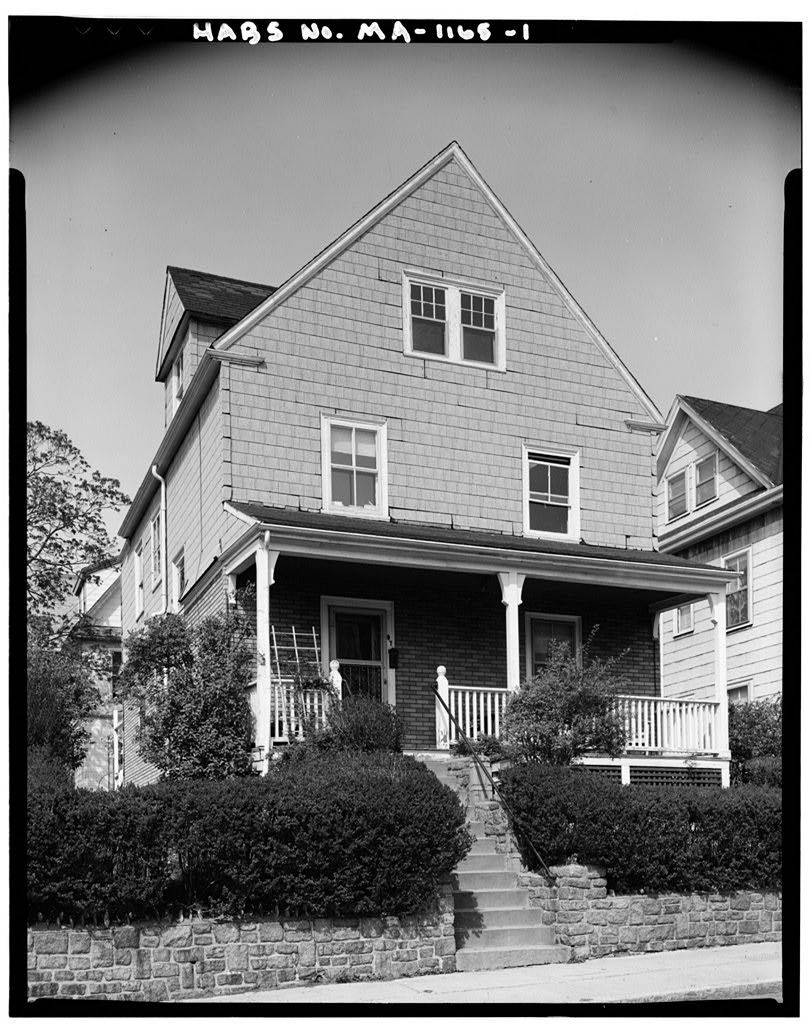
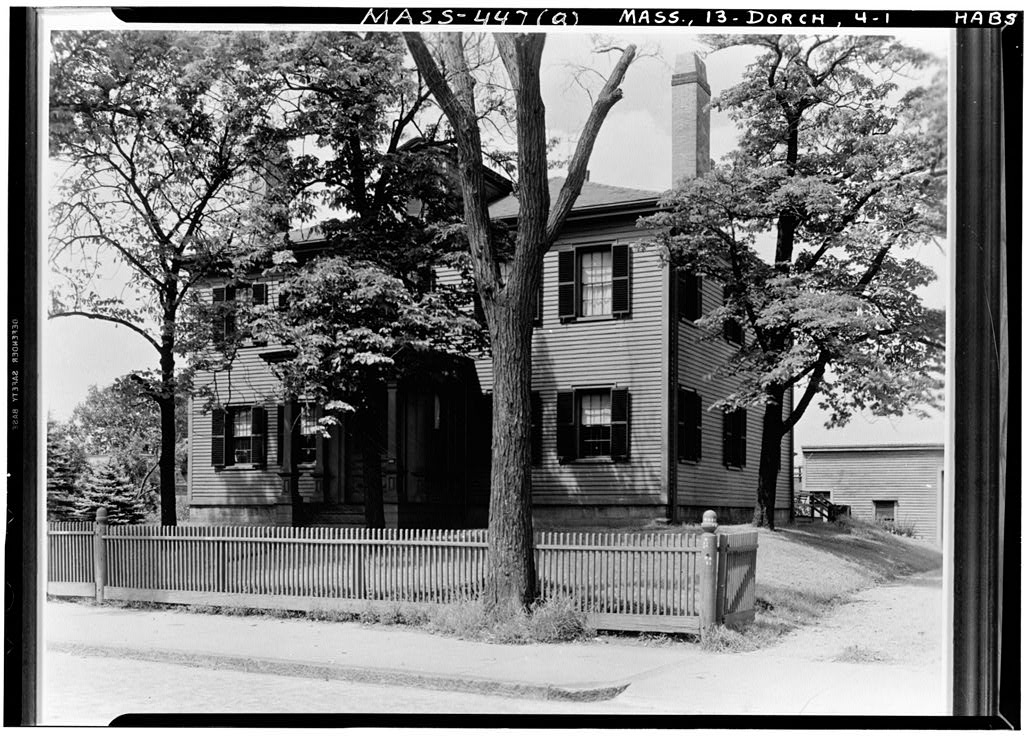
General Statement: Although this rectangular house with a rear ell has little decoration to suggest a construction date or to mark it with a particular style, its stair hall window, stone foundation, gabled roof, and curved second floor wall suggest that its original appearance may have combined Shingle Style and Queen Anne details. B. Description of Exterior: 1. Foundations: coursed rubble granite 2. Walls: The first floor is covered with imitation brick siding made of asphalt; the second is covered with imitation shingles made of asphalt. Between the two stories is a molding which provides the base for an upper outward curving section. WILLIAM MONROE TROTTER HOUSE HABS Mo. MA-1165 (Page 4) 3. Structural system: balloon frame 4.
Porch: The front (southern) facade is covered by a two-bay wide by one-bay deep porch set on brick posts which are concealed by latticework. It has a stairway slightly west of center on its western bay. At the first floor the porch is supported by square wooden posts which have beveled corners above the railing level, and solid curved brackets at their tops. Set in between the posts are railings of square wooden balusters set into wooden upper and lower rails. On either side of the stairway the railings terminate with square wooden posts having turned tops with ball finials. An iron handrail extends from each of these posts to the base of the stairway at the sidewalk. The low sloping roof of the porch, which rises from south to north, is covered with asphalt shingles. 5.
Chimney: The house has one chimney which rises through the roof's ridge at a point slightly north of the center of the building. 6. Openings: a. Doorway: The facade entrance has an oak door with glazed upper half and a solid, paneled lower half. It is protected by an aluminum combination door. At the first floor, the facade has a door on its western half. b. Windows: The lower front facade has a two-over-one sliding sash window in its eastern half arranged symmetrically about the center line. There are two windows in corresponding positions in the second floor, the western one being covered by a two-over-two pane wooden storm window. Throughout the house all windows are set in frames with moulded outer edges.
Ail windows, unless stated otherwise, are of two-over-one double hung sash; all first floor windows have aluminum combination windows. There is one set of six-over-one windows centered in the gable. The east side of the house has one window centered in each story in the southern half, and a half hexagonal two-story bay window on its northern half. The bay window is set on a foundation of coursed, rubble granite and has one window on each side of both stories. Two windows are set in the northern half of the west wall at both stories. Slightly south of center at the floor level of the second story is a square window of colored glass.
Lighting the interior stairhall, this window is made up of a large square center pane, surrounded by four rectangular panes and four small square panes, one at each corner. WILLIAM MONROE TROTTER HOUSE HABS No. MA-1165 (Page 5) 7. Roof: a. Shape, covering: high gable covered with asphalt shingles b. Cornice: The whole length of the east wall is capped by an undecoratsd box cornice and wooden gutter. PART III. SOURCES OF INFORMATION Trotter, William Monroe, House. National Historic Landmark nomination form, Prepared and transmitted by: Holly K. Chamberlain Historian HABS June 24,
 Block
Block