This documentation was initiated in August in accordance with the Memorandum of Agreement by the Massachusetts Bay Transportation Authority (MBTA) as a mitigative measure prior to the rehabilitation of the bridge. Howard Needles Tammen & Bergendoff Suite Prudential Center Boston, MA In conjunction with: McGinley Hart & Associates 77 North Washington Street Boston, MA Saugus River Drawbridge Eastern Route Bridge HAER No. MA-84 (Page 2) Site Description The Saugus River Drawbridge (MBTA Eastern Route Bridge No. on contract documents) was constructed in for the Boston and Maine Railroad on the eastern route over the Saugus River between the City of on the north and the Town of Saugus on the south.
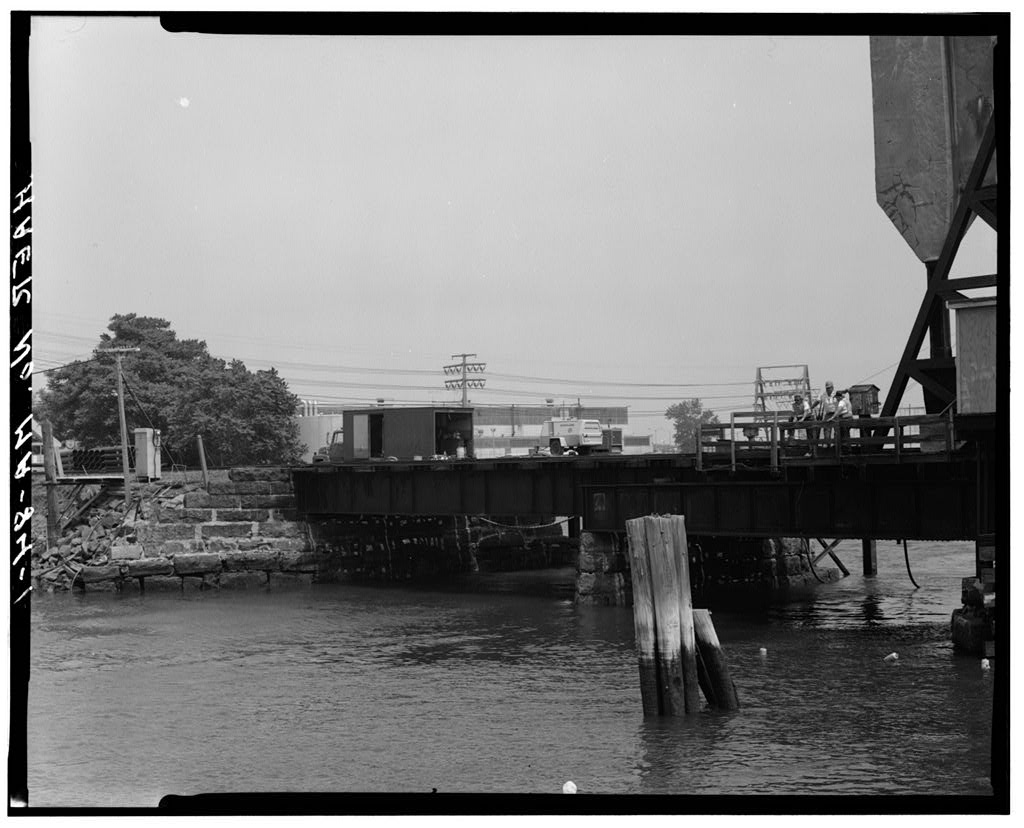
The bascule-type bridge is located on the Saugus River between the General Edwards Bridge (Route 1A) on the southeast and the Fox Hill Bridge (Route on the northwest. The draw section is at the northeast end of the bridge, which is supported by several masonry piers. General Electric's River Works Plant is on the north side. The Saugus River is a tidal estuary which supports a fishing, shellfishing and lobstering fleet, as well as pleasure boats. Saltmarsh and shellfish beds are located on the river to the south, with commercial marinas upstream to the north. The original and existing conditions of both the site and the bridge are documented by the accompanying drawings and photographs.
Construction and Alterations The first bridge at this site was a wooden drawbridge built on piles, constructed ca. as part of the original Eastern Railroad which constructed this line between Boston and The present Strauss trunnion bascule bridge, with overhead counterweight, was constructed in as part of a general upgrading of the railroad route. The bridge was built 1.2 miles south of the station at West using plans for an almost identical bridge at Manchester, Massachusetts.
The existing bascule bridge has undergone several alterations, as follows: Platform support was installed Bridge towers were laterally reinforced with stiffeners Timber fender system was replaced Tower was strengthened with longitudinal bracing Machinery support was repaired Construction of concrete-filled pipe pile bents was undertaken adjacent to the existing piers. Concrete-encased steel cored piles were drilled through the granite channel piers. Original drawbridge operating machinery that was replaced included 2 racks, 2 rack- pinions, 4 rack pinion bearings, 1 open gear set at the centerline of the bridge, the line shaft and the cross shaft. Equipment installed included: motors, brakes, reducers and associated support frames, rack, rack pinions and pinion bearings.
The related operating levels, cranks, and gears were also removed. General maintenance over the years has included shimming of the steel girders and grouting of the mortar joints in the granite piers. Saugus River Drawbridge Eastern Route Bridge HAER No. MA-84 (Page 3) Key Individuals The bridge was designed by the Strauss Bascule Bridge Company of Chicago, Illinois. This firm, founded by the engineer Joseph Baermann Strauss, was the leading builder of trunnion-bascule bridges, and did much to further their use.
Strauss, a member of the American Society of Mechanical Engineers, began his career in bridge engineering in Trenton, New Jersey, as a draftsman for the New Jersey Steel and Iron Company in Strauss moved to Chicago in revising several recently-introduced bascule bridges in the area. His simplified operating mechanism and new types of pin-connected counterweight systems led to a rapid increase in the use of the bascule designs after the first Strauss bascule was constructed in Of over 400 bridges associated with Strauss and his firm in his lifetime, about 375 were of this basic bascule type.
In Strauss designed two structures in San Francisco: the present Fourth Street Bridge, a trunnion bascule; and the Aeroscope (essentially a bascule bridge set on end) the most popular ride at the Panama-Pacific International Exposition. The most famous achievement of Strauss's company was as designer of San Francisco's Golden Gate Bridge, completed in The fabricator of the Saugus River Drawbridge was the Phoenix Bridge Company of Phoenixville, Pennsylvania, successors to Clarke, Reeves & Co., founded in The Phoenix Bridge Company, organized in advertised as engineers and builders of iron and steel bridges, viaducts, roofs, elevated railroads, ocean piers and turntables, etc.
Builders of the Rondout Bridge for the New York, West Shore, and Buffalo Railroad, among others, Phoenix Bridge Company had its offices in Philadelphia. Its principals near the turn of the century were President David Reeves, Vice and President and Chief Engineer Adolphus Bonzano, and General Superintendent William H. Reeves. The chief engineer of the Boston and Maine Railroad at the time of construction of the Saugus River Drawbridge was Jonathan Parker Snow Other unidentified Boston and Maine engineers worked on minor alterations and maintenance of the bridge is succeeding years. Construction Techniques A temporary pile bridge was built across the Saugus River in to construct the bascule bridge.
Caissons were used to construct the granite piers which rested on wood piers below the river bed. The upper portions of the masonry were built to accommodate two tracks; the piles, mats, and lower courses of granite blocks were constructed, however, to accommodate a four-track structure. The two additional tracks have never been constructed. The Saugus River Drawbridge employs a riveted steel frame. Steel truss towers provide lateral stability to the hinged drawbridge and the counterweight. The original operating mechanism (now removed) consisted of cast-iron trunnions and a rack-and-pinion drive system. Concrete was used for the construction of the bascule's counterweight.
The concrete counterweight, despite its bulk, resulted in considerable cost savings over the previous use of expensive cast iron for weights; this was a Strauss innovation. The proximity of the high-water level to the track elevation required the use of an overhead, rather underneath (sub-deck) placement of the counterweight. Saugus River Drawbridge Eastern Route Bridge HAER No. MA-84 (Page 4) Description and Operation The two-track railroad bridge has a steel superstructure which rests on granite block piers and abutments; these, in turn, are supported by timber mats and friction piles.
The Saugus River Drawbridge consists of nine spans, eight are fixed, open-deck, steel through-girders averaging each; one is a single-leaf, open-deck steel Strauss trunnion bascule bridge, which is 65 feet in length from main trunnion to the tip of the leaf. The total length of the bridge is from abutment to abutment. The minimum horizontal clearance through the draw is 50 feet between fenders; the vertical clearance is 17 feet from mean low water to bottom of steel, and 7.7 feet at mean high water. The bridge is operated by a draw tender to allow the passage of boats. The operating mechanism consisted of a system of rack-and-pinion gears driven by electric motors. A manual crank-dive system was employed in the event of electrical failure.
The machinery was organized to include two racks, two rack-pinions, four rack-pinion bearings, one open gear set at the centerline of the bridge, the line shaft, and the cross shaft (see operating machinery drawings). The pinion-connected, parallel-link trunnion system which assisted the counterweight to open the bridge, was driven by the electric motor. The electric drive was a 15 horsepower motor (3 phase - 60 cycles - 550 volts - 815 maximum starting torque 114 Electric power required two and one-half minutes to fully open the draw, while the manual drive required seventeen minutes. Historical Significance a. Engineering Significance The primary significance of the Saugus River Drawbridge is in regard to its engineering design.
The bridge was designed by the Strauss Bascule Bridge Company, a nationally prominent firm. Between and the Strauss Company developed four types of bascule bridges: the "heel trunnion," the "vertical overhead counter-weight," "underneath [sub-deck] counterweight," and the "simple span type." Strauss's innovation was the substitution of concrete for the more expensive cast iron employed in the counterweights. A pinion-connected, parallel-link or "trunnion" system developed by Strauss allowed the larger-bulk counterweights to function without obstructing the bridge. The Saugus River Drawbridge is described as an overhead counterweight bridge in a article in The Engineer entitled "Bascule Bridges" (see Bibliography).
Its cast identification tablet is inscribed: STRAUSS TRUNNION BASCULE BRIDGE BUILT FOR BOSTON & MAINE THE STRAUSS BASCULE BRIDGE CO. CHICAGO, ILL. * DESIGNERS THE PHOENIX BRIDGE CO. PHOENIXVILLE, PA. * BUILDERS PATENTED. Saugus River Drawbridge Eastern Route Bridge HAER No. MA-84 (Page 5) This innovative bridge was illustrated in The Engineer, London, as one built on "the bascule principle [which] has, more especially in the United States, been actively developed and extensively adopted." The article describes several designs which "have all been developed in the last seven years or so by the Strauss Bridge Co.
of Chicago, and they will serve to give our readers an excellent idea of the general progress which has been made." The Saugus Rive Drawbridge is cited as an example of the overhead counterweight bridge used "in many instances where head room between high water and the bridge floor is limited" and use of the underneath-type counterweight is precluded (see Appendix, Fig. 7). This single-leaf trunnion bascule is one of the oldest known examples of this type in Massachusetts, and is one of the best-documented (see drawings). b. Cultural Significance The bridge has secondary historical associations with the early development of Saugus, since the tracks run along a right-of-way established ca. The later expansion of this route influenced the development of as a working class industrial city.
The bridge is part of the Boston & Maine's Eastern Route, which played a significant role in the development of communities along the coastal region north of Boston. c. Architectural Significance The bridge has less importance from an architectural than an engineering standpoint; however, the original tower trusses remain intact. The patented design of the bridge and the principles involved in its original construction and operation are significant features. The bridge is a familiar landmark to Saugus River traffic, and visible from nearby highway bridges as well.
Contextual Information The apparent conflict between the needs of mariners and the requirements of the railroad resulted in the design of a movable bridge rather than a fixed bridge in The drawbridge design accommodated both interests. The replacement of the earlier bridge with the present bridge in incorporated the original movable design. The Saugus River Drawbridge was built from the plans for a similar bridge in Manchester, Massachusetts (today, this bridge is in commuter service on the MBTA's Rockport line at milepost The Manchester Bridge was also built in but by a different contractor, the Pennsylvania Steel Bridge Company at Steelton. The machinery for the Manchester Bridge was identical to that of the Saugus River Drawbridge when originally constructed.
The Saugus River Drawbridge is having its machinery updated, but its structure and superstructure are intact, with later additions for reinforcement, as of this writing. Bibliography "Bascule Bridges," The Engineer (London), March 28, pp. Saugus River Drawbridge Eastern Route Bridge HAER No. MA-84 (Page 6) Darnell, Victor C, Directory of American Bridge Building Companies. Washington, Society for Industrial Archeology, Hool, G. A. and Kinne, W. S., Movable and Long-Span Steel Bridges. New York: McGraw-Hill Co., Inc., pp. Humphrey, T. J. and Norton D. Clark, Boston's Commuter Rail. The First 150 Years. Bulletins No. 15 and 20, Cambridge: Boston Street Railway Association, "Joseph Baermann Strauss," The National Cyclopaedia of American Biography 27, p. 30.
Poor, Henry V., History of the Railroads and Canals of the United States of America. New York: A. M. Kelley, Reprint of Edition). Van Der Zee, John. "The True Story of the Design and Construction of the Golden Gate Bridge," The Gate. New York: Simon and Schuster, pp. Archival Collections Boston and Maine Railroad Historical Society Archives University of Lowell History Center for Lowell History Patrick Mogan Cultural Center 40 French Street Extension Lowell, MA Massachusetts Bay Transportation Authority Records 10 Park Plaza Boston, MA SAUGUS RIVER DRAWBRIDGE EASTERN ROUTE BRIDGE HAER No. MA-84 (Page 7) Site Plan
 Block
Block