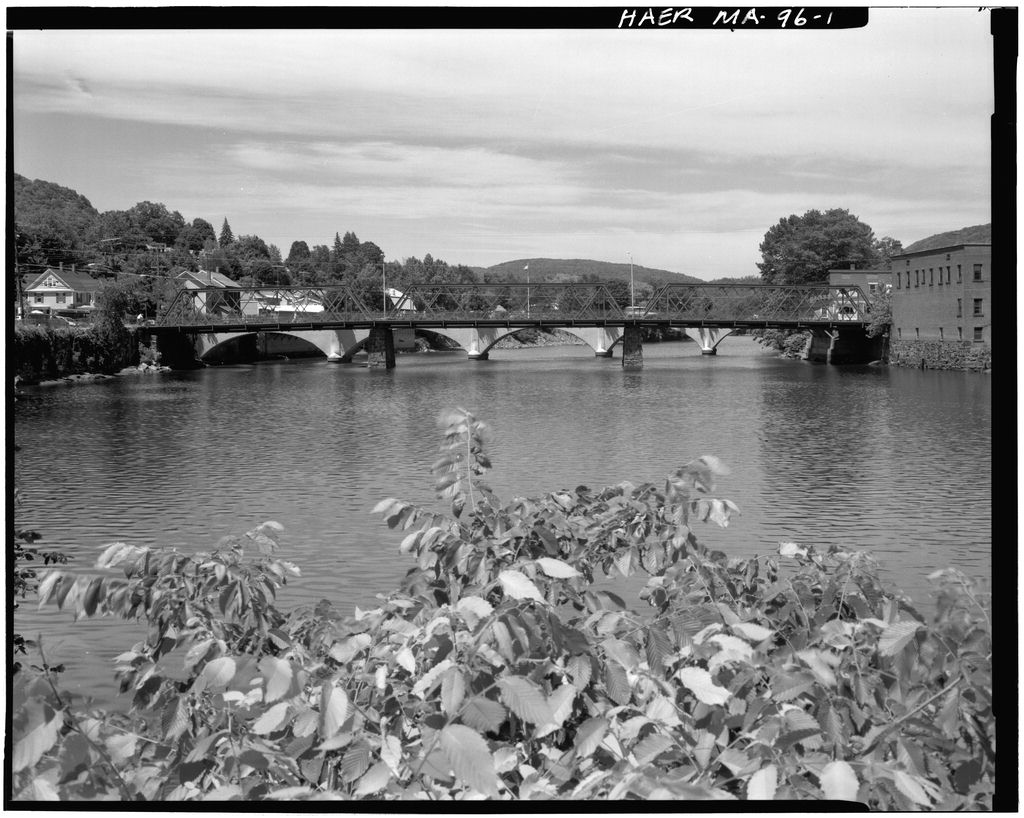
Documentation of the Shelburne Falls Bridge is part of the Massachusetts Historic Bridge Recording Project, conducted during the summer of under the co-sponsorship of HABS/HAER and the Massachusetts Department of Public Works, in cooperation with the Massachusetts Historical Commission. Lola Bennett, HAER Historian, August SHELBURNE FALLS BRIDGE HAER No. MA.-96 (page 2) Description The Shelburne Falls Bridge is a three-span, 313-foot, riveted wrought iron double-intersection Warren through truss, resting on mortared granite piers and abutments. The east and center spans are identical, both being in length. The west span is similar in form, but is somewhat shorter, being in length.
The top chord and inclined endposts are built-up members, consisting of three plates and four angles, with lacing and tie plates on the underside. The lower chord is two parallel built-up members, in the shape of inverted each comprised of a 12" plate and two angles. The upper and lower chords are connected by means of sub-struts (two angles with lacing) and vertical hip posts (two angles) at the ends of each truss, and a series of built-up diagonal members, crossing at even intervals along the length of each truss. Diagonals angling down toward the ends are two angles connected with lacing; diagonals angling up toward the ends are paired angles.
The lower chord passes between the paired diagonal members and carries the built-up, I-section floor beams, which consist of a 28" plate and four angles. The trusses are laterally braced between the upper and lower chords by two pairs of angles crossing at each bay between panel points. The wrought iron stringers, running between the floor beams, support a timber plank deck, covered with asphalt paving. The deck is wide between the wheel guards. Raised sidewalks, approximately 7' wide, resting on latticed outriggers, run the length of the bridge on either side of the roadway. The sidewalk railings are riveted iron lattice work with squared, cast-iron endposts. The portals are defined by the inclined endposts of the trusses and latticed transverse struts crossing between them.
The portals have latticed brackets, and decorative builder's plates, which read: Bridge Committee George G. Merrill, Emerson J. Griswold, David W. Temple, Michael Atkins, George E. Taylor, George Rowland, Edward S. Shaw, Engineer, Vermont Construction Co. Contractors, Hawkins, President (See Figures 1 and 2.) Shelburne Falls Shelburne Falls, once known as "Salmon Falls," was an important Indian fishing ground prior to English settlement of the area in the mid Today the village is home to many artisans and craftsmen, and is known for its quaint little shops and restaurants, as well as for a unique tourist attraction known as the "Bridge of Flowers," a tum-of-the-century trolley bridge which has been restored and turned into a garden walkway.
The village, which is divided in half by the Deerfield River, is actually comprised of parts of two towns, Buckland on the west and Shelburne on the east. (See Figure 3.) Standing directly in the center of town, the Shelburne Falls Bridge is SHELBURNE FALLS BRIDGE HAER No. MA-96 (page 3) the main connection between the two parts of the village, and has always carried a heavy flow of traffic across the river. Although the two towns have always had a primarily agricultural economy, the village of Shelburne Falls developed around small manufactories, which utilized the water power of the falls.
An county history described Shelburne Falls this way: Shelburne Falls is a thriving manufacturing village, numbering inhabitants, located upon both sides of Deerfield River, and connected by an Iron bridge. The Shelburne side of the village contains about people, and is the chief business portion of the place. Many handsome residences border its finely- shaded avenues, and upon its main business thoroughfare--Bridge Street--are several substantial and imposing brick blocks. ... There are also in this portion of the village, the Shelburne Falls Academy, two banks, three churches, two public halls, numerous stores, Gardner's cutlery-works, a silk-twist manufactory, a harmonica factory, a brace-bit factory, a tannery, and other minor industries.
The Shelburne side of the village derives considerable business support and population from the employees of the Lamson & Goodnow Cutlery Company, whose works are on the Buckland side of the river. Shelburne Falls possesses a naturally attractive location, and, resting upon the sinuous and swiftly-flowing Deerfield, within the shadows of gigantic hills which tower aloft upon the east and west, it presents to the eye of the passing traveler a picture upon which it may rest with more than ordinary pleasure. A river crossing in the center of the village has historically been the critical component, not only to the success of the industries there, but to the economic and social well-being of the village as a whole.
Early Bridges at Shelburne Falls Perhaps the earliest bridge at Shelburne Falls was a log foot bridge, built by Jonathan Wood, owner of the first saw mill there, sometime prior to In the towns of Buckland and Shelburne voted to build a bridge above the falls, but there are no records of this bridge ever being built. The community relied, instead, on a crude boat hollowed out of a pine tree.
As was the custom of the times when a person wished to cross the river, he would go to the water's edge, and if the boat was on the opposite shore, call, "Hello, the boat!" It then became the duty of anyone who heard the call, no matter how busy he might be, to cross the river and get the passenger.3 For heavier loads, crossing was made by ford in the summer when the river was low, or ice bridges in the winter when the river was frozen. This, of course, tended to be rather inconvenient at times, particularly when the weather was SHELBURNE FALLS BRIDGE HAER No. MA-96 (page 4) uncooperative.
In March of William Wells and others petitioned the county commissioners for a grant of money to build a bridge over the Deerfield River at a place called "the falls" between Shelburne and Buckland.4 This request was granted the following year. Captain Johnson, a stone mason from Buckland, built the abutments, and a man from Deerfield, by the name of Sheldon, erected the bridge, said to be a Burr arch bridge, a type commonly built in New England during the nineteenth century.5 This bridge served the village for many years, until October 4, the day of The Great Flood--a day not soon to be forgotten in New England's history.
It is said that the Deerfield River, "a stream fed by mountain brooks and flowing in places through narrow gorges at the foot of precipitous slopes, may rise suddenly, calamitously in a very short time, changing quickly from a peaceful river into a raging torrent."6 On that fateful October day, the rain became a veritable deluge, the flood waters rose, and along the lengths of many rivers, roads, bridges, homes and businesses were severly damaged or destroyed. A few days later, the Greenfield newspaper reported the damage at Shelburne Falls: Seven o'clock, Monday morning, the water was over the foot bridge over the Deerfield.
From that time till 1, the water kept rising, part of the time at the rate of six feet per hour, till it was higher by several feet than the oldest inhabitant had ever seen. The brook first commenced to do damage, flooding cellars, undermining houses and compelling the inmates to flee to the house tops and to be taken of in boats. When the river rose, the brook which runs under the village dammed up, set back and became a mighty river. About 12, the damage from the river commenced. The middle section of the bridge went first, then the east side, then the west. ... The river was full of bridges, machinery, cotton, logs, trees, float-wood and about every conceivable thing that would float."7 The village immediately set to work making plans for a new bridge.
In the meantime, the ferry was put back in use, and a temporary foot bridge was erected. About a month after the flood, the newspaper reported that, by unanimous vote, the Shelburne Falls bridge committee had decided to erect,"a fine substantial iron bridge, Herthel's Patent Parabolic Iron Truss Bridge, instead of the lattice one, to replace the one swept away by the flood. Price, $58 per foot; length, 360 feet."8 The two towns contracted with Hawkins & Burrall of Springfield for the construction of this new bridge.9 The erection of the bridge took place between January and April of It was an incredible event for the village, and newspaper items during the winter months indicated a growing impatience with the primitive ferry and footbridge systems.
The weather that winter was quite unpredictable, and consequently, there was alot of grumbling over the "everlasting raining," the level of the river, the grounding of the ferry boat, and the loss of two foot bridges. Work on the bridge was progressing, but obviously not fast enough for the villagers. Their high spirits getting the best of them, the towns- people began crossing the bridge even before it seemed reasonably safe to do so, often to the annoyance of the workmen. Finally they could contain SHELBURNE FALLS BRIDGE HAER No. MA-96 (page 5) themselves no longer. On February 17, while the contractors were at lunch, someone laid some temporary planks on the bridge and several teams snuck across, much to the delight and amusement of everyone present.
Later that afternoon, the contractors laid the last "official" plank on the deck, and although the bridge was still not complete, the celebration began: The Shelburne Falls band volunteered their services and played several spirited tunes. Three times three rousing cheers were given for the bridge, contractors and band. ... The band then marched to the ferry boat and were ferried over in good style while they played a funeral dirge. ... The boat then made its last trip with Its flag half mast. Every inch of the rope was covered with willing hands and we made the quickest time on record. We considered it as great an honor to make the last trip in that staunch boat with its faithful, good natured ferryman, as to first cross our new bridge.
It is only four months since our old bridge went off, and now we have a substantial and ornamental bridge of which we are all proud.10(See Figure 4.) That was not the end of the celebrating, however. A week later, the village held a dedication ball, and on April 1, after the bridge was completed and accepted by the bridge committee, there was "a grand finishing up dedication supper and celebration." Shortly after the bridge was made passable, the newspaper carried a number of reports of incidents reflecting the gay mood among the villagers. Among them, were the following items: Everybody has been so happy and good in consequence of having the new bridge, that we have no criminal proceedings to record.
1 believe, however, that there has been some tall swearing done by persons who had their hats and caps blown off into the river while crossing. Four hats were blown off the first day of its use. But there is no use of grumbling. A man better have all his clothing blown off than have to resort to the ferry boat again.11 An attempt to make us walk our horses across the new bridge proved a failure. There is no need for such a law as the bridge has been pronounced by the builders competent to carry one hundred tons to each span and allow of fast driving.12 Unfortunately, these feelings were short-lived.
Less than three years after the bridge was completed, on December 27, a cart loaded with planks and drawn by two teams of oxen was crossing the bridge, when the middle span collapsed and fell into the river.13 Fortunately, only one person was injured, and he eventually recovered. The town selectmen immediately began to make arrangements for the bridge to be repaired, in spite of "a growing feeling in town in favor of wooden bridges."14 A few days later, Hawkins, the bridge contractor, met with the selectmen and agreed to replace the middle span at his expense.15 Work commenced on the bridge repairs in March, In the meantime, townspeople were forced to resort to crossing the river on the ice, or over a SHELBURNE FALLS BRIDGE HAER No.
MA-96 (page 6) rather precarious rope suspension bridge erected between the east and west spans of the iron bridge, although this was done without many complaints. As a more viable long-term solution, the ferry boat was put back into service late in January. Interestingly enough, the newspaper carried no reports of people trying to cross the bridge before it was finished this time. The bridge repairs were finally completed early in May, and this somewhat subdued item appeared in the newspaper: Supt. Hitman has arrived with the cross iron arches for the steadying of the spans. They are to be placed over the roadway. From the end ones will be suspended notices stating the penalty for trotting across the bridge.
We are going to treat this bridge better than we did the last one.16(See Figures 5 and 6.) On the other hand, some people were beginning to feel that perhaps the "newfangled" iron bridges were not as strong as they had been led to believe, and that they might have been too quick to rid themselves of the more primitive, yet time-tested, methods of crossing the river. A few days after the bridge repairs were completed, this item appeared in the newspaper: Now if possible we shall get our town fathers to test the support- ing power of the bridge before any lives are lost on account of its weakness. Considering the many iron bridges that are falling in different parts of the country, it is due every citizen of this county that our own be properly tested. It can be done very easily.
If it falls we had rather wade the river ... To business and no more fooling.17 Apparently, however, the repairs held in good order, the villagers were more cautious in their use of the bridge, and it wasn't until nearly twenty years later that the safety of the bridge came into question once again. The Shelburne Falls Bridge In February of Katie Bender of Buckland sued the town of Shelburne for after she allegedly sprained her ankle by catching her foot in a hole in the sidewalk of the bridge.18 The selectmen of the two towns immediately sent for civil engineer Edward S. Shaw of Boston, and asked him to inspect the bridge and make recommendations.
On March 29, shortly after Shaw had examined the structure, the newspaper reported this of his visit: [His] official report has not yet been received, but he did remark that it was liable to go down any time under the heavy load, that it would apparently sustain forty pounds to the square foot. Sometimes by actual weight there has been thirty pounds of ice, rain and snow to the square foot. He said a new bridge now would contain nearly twice as much iron, and that cast iron was not good material for bridges, either alone or In connection with wrought iron. It is evident that something radical must be done.19 SHELBURNE FALLS BRIDGE HAER No.
MA-96 (page 7) Based on Shaw's report, in April at separate town meetings, the towns of Buckland and Shelburne voted to build a new bridge over the Deerfield River. A bridge committee was formed and they immediately engaged Edward Shaw as the consulting engineer on the project. By early May, the committee had decided to build "an iron riveted lattice bridge of three spans."20 According to the newspaper's description, this bridge was to be "as good an iron bridge ... as money and skill will procure. There will be as little wood about it as possible. The sleepers will be iron, and the flooring plank. ... Its estimated cost is not far from n21 Plans and specifications were drawn up by Shaw, and set forth in a 23-page pamphlet issued to all companies giving estimates for the bridge.
The May and June issues of Engineering News carried advertisements for bids for the proposed structure. These bids were opened at a meeting on June 12. The twelve bids were as follows22: Vermont Construction Co., St. Albans, VT, Penn Bridge Co., Beaver Falls, PA, Boston Bridge Works, Boston, MA, Rochester Bridge Works, Rochester, NY, King Bridge Co, Cleveland, OH, Groton Bridge Co., Groton, NY, Berlin Iron Bridge Co., East Berlin, CT, Hilton Bridge Co., Albany, NY, Canton Bridge Co., Canton, OH, Pittsburgh Bridge Co., Pittsburgh, PA, Wallis Ironworks, Jersey City, NJ, New Jersey Steel & Iron Co., Trenton, NJ, The Vermont Construction Company, being the low bidder, was awarded the contract.
Later that month, they bought the old bridge from the two towns for Construction of the bridge began in August A local mason, George G. Merrill, made necessary repairs to the abutments and piers. During the first week of September, the first load of iron arrived, and work on the spans commenced.2^ Work proceeded steadily throughout the fall of that year. The plan was to erect the new bridge and dismantle the old one simultaneously, so as to inconvenience the public as little as possible. According to newspaper accounts, the bridge was only closed three times during the entire construction, while the flooring was being laid.
The Shelburne Falls Bridge was completed early in December, and the newspaper described it as follows: The new iron bridge is practically completed and the traveling public take solid comfort in crossing it. It is above the reach of floods, tasty in looks and thoroughly and strongly built. It is practically safe for any speed or any strain it can be subjected to, and with care should last ninety-nine years. And yet the cold and heat will move it from one-fourth to one inch. It has been erected without any serious accident to the laborers or the public. It is a wrought-iron, riveted, lattice bridge of three spans, with lower floor of spruce two inches thick. The stringers and beams are all iron. No iron used has less tensible SHELBURNE FALLS BRIDGE HAER No.
MA-96 (page 8) strength than per square inch. ... Each end of the bridge will have an iron tablet containing the date of construction the names of the committee, engineer and contractor. 25 That winter, the villagers began putting the bridge to good use, as evidenced by the following items from the newspaper: No one but pedestrians stop to walk the bridge and the ice is a great rival to that.26 Notwithstanding the large amount of snow which has fallen, the town fathers have already had to order the new bridge snowed. There seems to be no end to the wood and lumber yet to be drawn over the bridge to the depot.27 Conclusion One hundred years have passed since the Shelburne Falls Bridge was erected, and during that time it has served the community well.
In recent years, however, the community has had to pull together in an effort to save this important piece of its heritage. In the Massachusetts Department of Public Works took over the Shelburne Falls Bridge, as part of a state-wide program. Since that time, the bridge has been maintained by the state. In the state determined that the bridge's load rating was insufficient for school buses and fire trucks, and proposed to replace the old span with a modern concrete structure. This proposal met with stiff resistance from the townspeople, who felt that without the bridge, the integrity of the village would be lost.
The state then offered a revised plan for a bridge "more in keeping with the nineteenth century character of the village."28 This plan was tentatively approved by the town selectmen, but the townspeople were outraged and immediately began circulating petitions, writing letters, and meeting with state officials. In after many months of concerted effort, the villagers won the fight to save the bridge. The state now has plans for a million reconstruction project, which will include replacement of the diagonal members and floor beams, and the laying of a new concrete deck. The Shelburne Falls Bridge is significant as the second oldest of seven double-intersection Warren through trusses identified in the Massachusetts Department of Public Works database.
It was designed by an important late- nineteenth and early-twentieth century engineer, Edward S. Shaw, and built by a significant New England bridge-building firm, the Vermont Construction Company. The bridge is notable for its three-span length, and its detailing, including a latticed railing, latticed portal bracing, and ornamental builder's plates. The bridge is an integral part, both visually and historically, of the historic village of Shelburne Falls. Edward S. Shaw Edward S. Shaw was a civil engineer who lived in Cambridge, Massachusetts, and maintained a professional office in Boston during the late- SHELBURNE FALLS BRIDGE HAER No. MA-96 (page 9) nineteenth and early-twentieth centuries.
Although the number of significant Massachusetts bridges attributed to him attest to his talent, Shaw apparently led a rather unassuming life, and little was ever recorded about him; however, nearly all contemporary mentions of his work pay tribute to his engineering expertise. For example, a newspaper article about one of the bridges he designed at Northfield in said that Shaw was "regarded as one of the most expert bridge engineers in New England."29 Shaw was first listed in Cambridge directories in He was listed as a student, boarding at 10 Kirkland Place, the home of George S. Shaw (apparently his father), a dealer in "fancy goods." George S. Shaw was not listed in directories prior to The following year, the directories carried the same listing for both Edward and his father.
Beginning in and ending in Edward Shaw was listed as a civil engineer in Cambridge directories. During this period, Shaw was also listed in Boston city directories. The first listings, in and say that he was a draughtsman for the Boston & Lowell Railroad. Beginning in Shaw was listed under the heading of "Civil Engineers and Surveyors," and advertised his specialty as the design of "Bridges, Roofs, Railroad Stations and Buildings." By the early Shaw was advertising as a "Bridge and Structural Engineer, and after as a "Consulting Engineer." Apparently, he retired in when he was last given an occupational listing. Edward Shaw died in Cambridge on October 3, at the age of 65.
Among the eleven other surviving Massachusetts bridges, known to have been designed by him, are: the Holyoke Bridge, between Holyoke and South Hadley, (HAER No. MA-18); the Willimansett Bridge, between Holyoke and Chicopee, the Schell Memorial Bridge at Northfield, (HAER No. MA- spans 1, 2 and 3 of the Merrimac Bridge, between Haverhill and West Newbury, and (HAER No. MA-103); the Chapman Street Bridge at Canton, and the Essex Bridge, between Salem and Beverly, Hawkins and the Vermont Construction Co. Richard Fenner Hawkins was born in Lowell, Massachusetts, March 9, When he was still very young, his family moved to Springfield, because his father, Alpheus Hawkins, received a contract to work on the construction of the Western Railroad from Worcester to Albany.
At the age of 16, Richard began work as an office boy for Stone & Harris, a firm specializing in railroad and bridge building. This was the company which, in had succeeded the establishment of William Howe, inventor of the Howe truss bridge. In when Mr. Stone retired, Hawkins became a partner with Harris. Five years later, when Harris retired, Hawkins took over the business, under the name of Hawkins Iron Works.(See Figure 7.) The Hawkins plant manufactured iron bridges, steam boilers, castings, and machinery. It was said that Hawkins: should be credited in considerable measure with the development of the use of iron as a building commodity in New England.
In addition to bridges he has conceived and turned out a large quantity of the iron and steel material used in the construction of the railroads and locomotives of today.30 SHELBURNE FALLS BRIDGE HAER No. MA-96 (page 10) Among his most notable works were the New Bedford and Springfield jails, the Willimansett Bridge near Holyoke, a series of bridges for the LaMoille Valley Railroad, and the Central Massachusetts Railroad Bridge at Northampton. In about Hawkins established a branch of the Springfield works at St. Albans, Vermont, in a building formerly used by the St. Albans Iron & Steel Works.
There, he employed about sixty men in the manufacture of iron and steel bridges, many of which were for the railroads.31 A year later, Hawkins, along with several other New England industrialists, incorporated the Vermont Construction Company.(See Figures Within just five years, the works occupied by the company were proving inadequate, so they leased property from the Central Vermont Railroad, and built a large complex of shops.
A county history from that year described the Vermont Construction Company as follows: This is the only bridge-building company in Northern New England, and they are designers and manufacturers of iron and steel bridges for railroads and highways, and also viaducts, girders, turntables, iron roofs, iron piers, trestles, and every variety of iron construction and iron and steel structural work.
The capacity of the works has been doubled and employment is now given to 130 hands, and under the present manager the business has increased over one hundred percent.32 The Vermont Construction Company built a number of notable bridges, among them: a 2,000-foot bridge crossing the east channel of Lake Champlain, the 650-foot Hartford Bridge of the Central Vermont Railroad, a 330-foot highway bridge at Sheldon, Vermont, and the Shelburne Falls Bridge at Shelburne, Massachusetts. The Massachusetts Department of Public Works has compiled a list of approximately twenty bridges thought to have been built by the Vermont Construction Company between and The last listing for the Vermont Construction Company was in the St. Albans directory.
In the company apparently changed its name to New England Bridge Works, perhaps reflecting a change in ownership. This company continued to be listed in Vermont directories until the Hawkins Iron Works continued to be listed in Springfield directories until Three years later, on March 5, Hawkins died at the age of 76.
Biographical sketches of his life suggest that Hawkins would not only be remembered for his success in the bridge-building industry, but for his strength of character as well: Although to the majority of its citizens he was known as the owner of the great R.F.Hawkins iron works, whose skill and ability was responsible for some of the best railway bridges in New England, to his closest freinds he was the kindly man, who in the heat of the industrial conflict, in which he won his way from the position of office boy in the firm of Stone and Harris, to partnership in was still the warm friend and true citizen,33(See Figure SHELBURNE FALLS BRIDGE HAER No. MA-96 (page 11) 0> to 03 0) / c ,0 r-t V X Is w 1 Li-go: o c UJ XL o 1-1 a) r-t W LO CD 0) 1-1 &0 SHELBURNE FALLS BRIDGE HAER No.
MA-96 (page 13) *g> u / v > T v rJ v v ! v f TT W * > ? v v.v r? . / v 7 y.v 'n , ^ n v "' v v.y y v - ? f.VA p. <> o wSlLE:LIIUIRMEil ]^ \ P 4A*.'if,,),A >! . Sheibums Falls BUSINESS NOTICES. i~ ^ _." ' ; .' ~J * - .. /- :,. Vl 9 ' -* \ 1 ' \ r * I . p; . -> ^ . ^^ ^-^ A-A^- ^,A-*-*,A-A i--iD Figure 3. Hap of Shelbume Falls, Massachusetts, Beers, SHELBURNE FALLS BRIDGE HAER No. MA-96 age 14) w J-> CD W d x: "N o w w T-* 1 1 CO CO X U-H Ul C i i M . i 3 cd X) U t t <D 0> x; c CO 1-1 3 " X (U r-l ^ CD 0 x: -U CO CO 4J bO cfl C *H 0) X bf! U o 0 H T-* ^ o XI CO o - r >-. 00 w . f ^ CO U-J NJ O Cw o 0) M-t ^ ?> w a> 0 u .-t s-i J-< 3 o 0 4J o CO w 0 35 u 0 X Pu o- N^* 0) n 3 GO u. v .-- "h' HSHELBURNE FALLS BRIDGE HAER No.
MA-96 (page 15) ij w 3 o r-t CO w c u 3 XI r-l 0) a; c in u 3 XI CD r-l a> O X. CO t/s 4J b0 cQ C a_3 *H tesJD <D X bO U o o to - co u f-i u O 5 o >>> VI <D o J-l H 1-1 3 o o o o U o x P-. in a; u 3 &0 i * SHELBURNE FALLS BRIDGE HAER No. MA-96 (page 16) SHELBURNE FALLS BRIDGE HAER No. HA-96 (page 17) PS w ti JJ <U 10 3 rC o CO w to s. co . E o a* - 00 o 1 1 i-i 0) - 1-i o *H <U bf> 4J ff CO -rA Vi U U o- Ifl w 3 rH - rH V) l-H M u M o iJ ns U (D c CO o 3 1-iX 1 l o CO CO w c w H <D ^ 3S I* a) *C X c CO En C a) bO SHELBURNE FALLS BRIDGE HAER No. MA-96 (page 18) ^ -> 2 Testing the Sanford BriJ^, C V. 2. R., GSO fe-;'- lus*; 12 locc=:otiv?9 ; T-u-it, 354 oas. VERMONT CONSTRUCTION CO. SHOPS. ST. ALBAMS. VT.
OEM'-,>'-H :~-U III ILUKH.H 'If iron, #tee^ TFbocZ am/ Stone ^ i 33 o- :ES Every Variety of Iron Construction, inc. ncmttcjdLI KCiumi-rLui; OICLL ouiLcno. R. F. HAWKINS, Pre3. D. E. BRADLEY, Manager and Treas. GEO. A. AYER.Vice-Pres. E. B. JENNINGS, Consulting Engineer. (The Vermont Business Directory for ii I1. HAWKINS. Fmi. \V. II. and Sec. \ t: f. HOYT, Enpr. C. K. 11ABIHTT. : THE VERMONT i CONSTRUCTION GO. ; DESIGNERS AND MANUFACTURERS OF Iron mi Steel Bridges, f Viaducts, Girders, Turntables and lion Hoofs. ! ST. ALBANS, VT. W|i n writing Advectiterl, pleaw mention Walton'* Vl. Register. (Walton's Vermont Register and Business Directory for Figures Advertisements for the Vermont Construction Company. SHELBURNE FALLS BRIDGE HAER No. MA-96 (page 19) Z.
& Z y ^^ 2 c i a o ^V > - o 0 o 3 D G. z =: < z 0 C z. CJ3 CO o 5 u u P Of UJ "5 "a z o U 0 w 4-1 f- < ^ < " CO w 3* Q 0 CO 0) E 5 c u O t/7 C=3 u c z 1 u X 0 10 _l 3 3 -J *8 5 z2 E2 lil u c .CD C=> LL o O * t u 0 0 U u. < I*. 1- z Z <I c . O UJ C=> L. t/i UJ Q. D a) en 3 tt lu (J LJ U Q. Z. > c S 3= Ul Z 2: 2E I* a. 0 o CO en X <JJ C Hi 0 CD u > < Q o .CO tj (/) S^ u. in o 3. <X 0 0 0 z z O < OJ C o 4J c p CO UJ 59 i= tU 3 O w c o f-4 U o CO }-J JJ u < C 1A 'uopjaqs > ooiisriJUDO^ iaoiui A ^l ' 3pug on-ij, CO CO o 1-1 3 o VI 0) VI CD bl 4J c CO > SHELBURNE FALLS BRIDGE HAER No. MA-96 (page 20) RICHARD F. HAWKINS. Figure 11. Portrait of Richard F. Hawkins. (Toomey, SHELBURNE FALLS BRIDGE HAER No. MA-96 (page 21) ENDNOTES 1. Louis H.
Everts, History of the Connecticut Valley in Massachusetts, vol. 2 (Philadelphia, 2. Fannie Shaw Kendrick, The History of Buckland. to (Buckland, Massachusetts, 3. Ibid. 4. Ibid, 5. Ibid. 6. History and Tradition of Shelburne. Massachusetts (Shelburne, Massachusetts, 7. Gazette and Courier. Greenfield, Massachusetts, October 11, 8. Ibid, November 1, 9. This was the predecessor to the R.F.Hawkins Iron Works. 10. Gazette and Courier. February 21, 11. Ibid, February 28, 12. Ibid, March 14, 13. Ibid, December 30, 14. Ibid. 15. Ibid, January 6, 16. Ibid, May 5, 17. Ibid, May 12, 18. Ibid, February 15, 19. Ibid, March 29, 20. Ibid, May 3, 21. Ibid, May 17, 22. Engineering News. June 21, SHELBURNE FALLS BRIDGE HAER No. MA-96 (page 22) 23. Gazette and Courier. June 21, 24. Ibid, September 6, 25.
Ibid, December 13, 26. Ibid, January 10, 27. Ibid, February 28, 28. "Town Wins Fight To Save Bridge," New York Times. March 13, 29. Gazette and Courier. July 30, 30. Daniel P. Toomey, "Richard F. Hawkins," Massachusetts of To-Day: A Memorial of the State Issued for the World's Columbian Exposition at Chicago (Boston, 31. Board of Trade, St. Albans, Vermont, "The Vermont Construction Co.," Advantages. Resources and Attractions of St. Albans. Vermont (Glens Falls, New York, 32. Lewis Cass Aldrich, History of Franklin and Grand Isle Counties. Vermont (Syracuse, New York, 33. Ibid, SHELBURNE FALLS BRIDGE HAER No. MA-96 (page 23)
Aldrich, Lewis Cass. History of Franklin and Grand Isle Counties. Vermont. Syracuse, New York: D. Mason and Co., Board of Trade, St. Albans, Vermont. "The Vermont Construction Co.," Advantages. Resources and Attractions of St. Albans. Vermont. Glens Falls, New York: Charles H. Possons, Clippings filed under Hawkins," in the vertical file at the Springfield Public Library, Springfield, Massachusetts. Clippings and photos, filed under "Vermont Construction Company," in the vertical file at the St. Albans Historical Museum, St. Albans, Vermont. "Death of Hawkins: A Pioneer Bridge Builder," obituary, in The Springfield Daily Republican. March 6, Directory of St. Albans and Swanton. Newburgh, New York: Waite and Co., Engineering Record. May 24, June 14, and June 21, Everts, Louis H.
History of the Connecticut Valley in Massachusetts, vol. 2. Philadelphia: Lippincott and Co., Greenfield Gazette and Courier. Greenfield, Massachusetts, History and Tradition of Shelburne Committee. History and Tradition of Shelburne. Massachusetts. Springfield, Massachusetts: Pond-Ekberg Company Press, Kendrick, Fannie Shaw. The History of Buckland. to Town of Buckland, Massachusetts, King, Moses, ed. Hawkins Iron Works," King's Handbook of Springfield. Massachusetts. Springfield, Massachusetts: James D. Gill, Publisher, Nason, Elias. A Gazetteer of the State of Massachusetts, revised and enlarged by George J. Varney. Boston: Russell, Progressive Springfield, vol. 1, no. 2 (January Hawkins Iron Works," Commerce. Manufactures and Resources of Springfield. Mass.: A Historical.
Statistical and Descriptive Review. Springfield, Massachusetts: National Publishing Co., SHELBURNE FALLS BRIDGE HAER No. MA-96 (page 24) Hawkins Ironworks," Inland Massachusetts Illustrated. Springfield, Massachusetts: Elstner Publishing Co., Hawkins Iron Works," Springfield. Supplement to the Springfield Daily News. June 26, "Richard Fenner Hawkins," The Leading Citizens of Hampden County. Massachusetts. Boston: Biographical Review Publishing Co., Toomey, Daniel P. "Richard F. Hawkins," Massachusetts of To-Day: A Memorial of the State Issued for the World's Columbian Exposition at Chicago. Boston: Columbia Publishing Co., Town of Shelburne Annual Reports. The Vermont Business Directory. Boston: Briggs and Co., The Vermont State Directory and Gazetteer.
Boston: Union Publishing Co., various years. Walton's Vermont Register and Business Directory for Bur1ington, Vermont: Home Publishing Co.,
 Block
Block