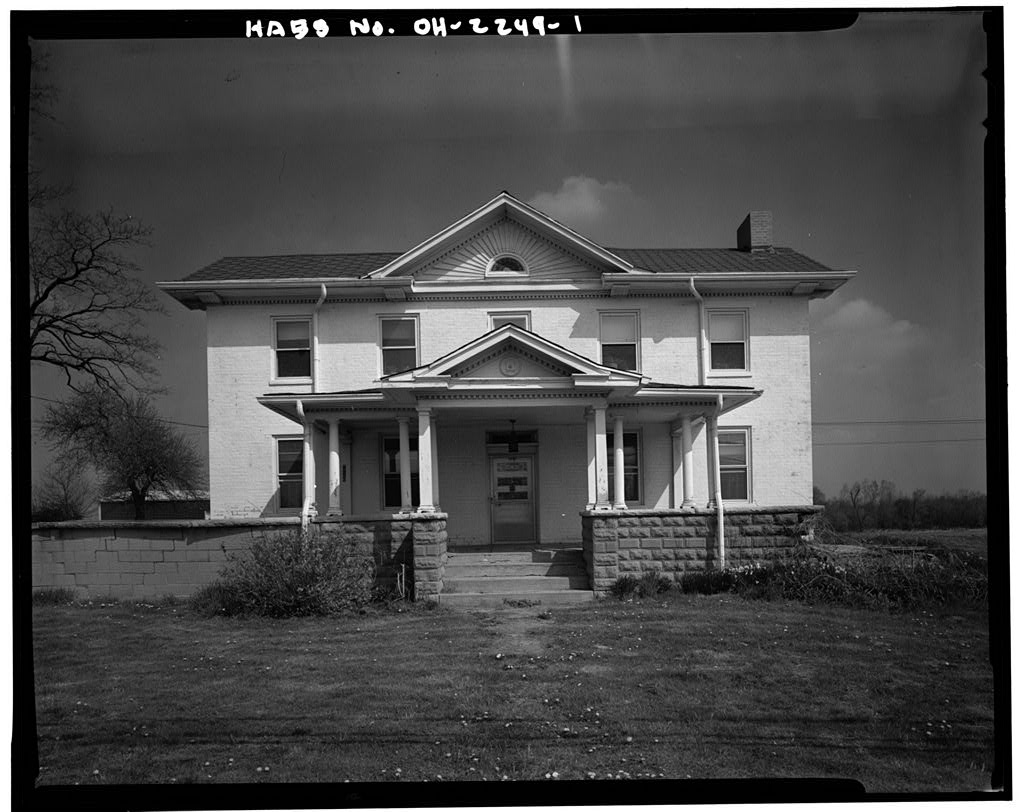
Columbus Pike between Clifton and Stevenson Roads, Wilberforce, Greene County, Ohio Chester A. and Marilyn E. Ware Allen Residential Colonel Charles Young the third black to graduate from the United States Military Academy at West point, was the highest ranking black officer in World War I. He was also the first black military attache in American history and the second black federally appointed to a military department. Young lived in this house during his years teaching at Wilberforce. PART I. HISTORICAL INFORMATION A. Physical History: 1. Original plan: T-shaped 2. Alterations and additions: A rectangular addition was added on the north (rear) side of the building. B.
Historical Context: Upon graduating from West Point (the third black to do so), Colonel Charles Young started his career in the Tenth Cavalry, was briefly seconded to the Twenty-fifth Infantry and on October 31, was permanently reassigned to the Ninth Cavalry. In Young became the second black to receive a Federal appointment to a military department when he was assigned to the position of Professor of Science and Military Tactics at Wilberforce University in Ohio. While at Wilberforce, Young taught French and mathematics in addition to his military courses and coached the drama and glee clubs.
He served with marked success until the outbreak of the Spanish-American War in At that time, although he had requested that he be given permission to join his regiment, he was given the command of the Ninth Ohio Volunteer Infantry (Colored) for a brief period. His troops did not serve in Cuba as he wished them to despite the fact that he drilled them to peak efficiency. The Ninth Ohio Volunteers' first camp was Camp Alger, Virginia. Here a group of white soldiers refused to salute Young because he was black. Young took off his coat and made them salute it, showing respect for the rank if not for him. ; -, * % COLONEL CHARLES YOUNG HOUSE HABS No.
OH-2249 (Page 2) Young was honorably mustered out of the volunteer service in January of and rejoined his troop, the Ninth Cavalry, at Fort Du Chesne. Following eighteen months of distinguished service in the Philippines, Young commanded Troop "I" at San Francisco in and then was appointed acting superintendent of the Sequoia and General Grant National Parks, California. (Patrolling and administering the national parks was an Army responsibility until the establishment of the National Park Service in Young was given credit for his meritorious service in this arena. Following his service in the west, Young was appointed as the United States military attache to Haiti by Theodore Roosevelt, the first black to be so assigned.
He was also the first foreign military attache ever assigned by any country to the Republic of Haiti. When presented at the national palace to President Nord-Alexis, the local newspapers described Young as a "beau noir" whose charming manners captivated all who met him. During his service in Haiti from Young was responsible for producing a map of Haiti, and translating and writing several Haiti-related works. Expecting active service with the outbreak of World War I., Colonel Young was instead found medically unfit for active service by Army doctors and forced to retire from service. Rather than accept this verdict, Colonel Young rode 500 miles from his home in Ohio to Washington, to personally appeal for a reversal of the Army's decision.
Less than a week before the armistice, the Army recalled Young. He was reassigned to Liberia, serving as the military attache and adviser to the Liberian Frontier Force. He died in Nigeria in on his way to a reunion with his family in Paris. PART II. ARCHITECTURAL INFORMATION A. General Statement: 1. Architectural character: This eclectically styled house has a stately appearance without being pretentious. 2. Condition of fabric: The cellar, foundation, and porch wall are in need of repair, B. Description of Exterior: 1. Foundation: stone 2. Walls: brick - original portion; stucco - addition 3. Structural system: load bearing, exterior brick with wood floor joists COLONEL CHARLES YOUNG HOUSE HABS No. OH-2249 (Page 3) 4.
Porch: A one-story porch shades almost all of the south (front) elevation, and wraps around onto the west side. The outside edge is supported by two columns; the back edge of the porch roof rests on two semi-recessed columns on the face of the building. The roof over the porch has a center gable which reflects the gable on the house roof above. 5. Windows: The rectangular windows are symmetrically placed across the front of the house. Those on the main floor level have a rectangular stained glass section over each window. 6. Roof: a. Shape: gable b. Cornice: ornate and heavy with a renaissance character c. Dormers: On the west side of the house two flat-roofed dormers protrude; on the east, one. D.
Site: The Young house is located approximately fifty feet from the north side of Columbus Pike, approximately two-thirds of the way from Xenia to Wilberforce, Ohio. On the west side of the building a wood-framed arbor supported "by three concrete columns is still intact. Under the arbor is a paved patio with a decorative water fountain in the center. PAET III. SOURCES OF INFORMATION Young, Colonel Charles, House. National Historic Landmark nomination form, Prepared and transmitted by: Holly K. Chamberlain Historian HABS June 24,
 Block
Block