White Bowstring Arch Truss Bridge, Spanning Yellow Creek at Cemetery Drive (Riverside Drive), Poland
White Bowstring Arch Truss Bridge, Spanning Yellow Creek at Cemetery Drive (Riverside Drive), Poland, Mahoning County, OH. Surveyed as HAER OHIO,50-POL,2-, with 1 photograph, 1 measured drawing and a 3,436-word written history.
From the record
“The White Bowstring Arch Truss Bridge is the only known example in Ohio of William Rezner's patented oval wrought-iron tubular arch design.”
Written record, HAER OHIO,50-POL,2- survey. Machine-read text.
surveyed by the federal HAER program as HAER OHIO,50-POL,2- · the record runs 3436 words · one of 16 surveyed structures published for this county.
Source document
Quoted word for word from HAER OHIO,50-POL,2-.
Not written, edited or summarised by this site.
The White Bowstring Arch Truss Bridge is the only known example in Ohio of William Rezner's patented oval wrought-iron tubular arch design. Only two other examples are known to exist in the United States (as of August Bowstring arch bridges were once common, and many were built between and but few have survived. This bridge was built by the Wrought Iron Bridge Company of Canton, Ohio, which was one of America's largest and most important bridge building companies in the late century. The bridge was listed on the National Register of Historic Places in Report prepared by: Frances A. Jones Project Historian Ohio Historic Bridge Recording Project Summer WHITE BOWSTRING ARCH TRUSS BRIDGE HAER No.
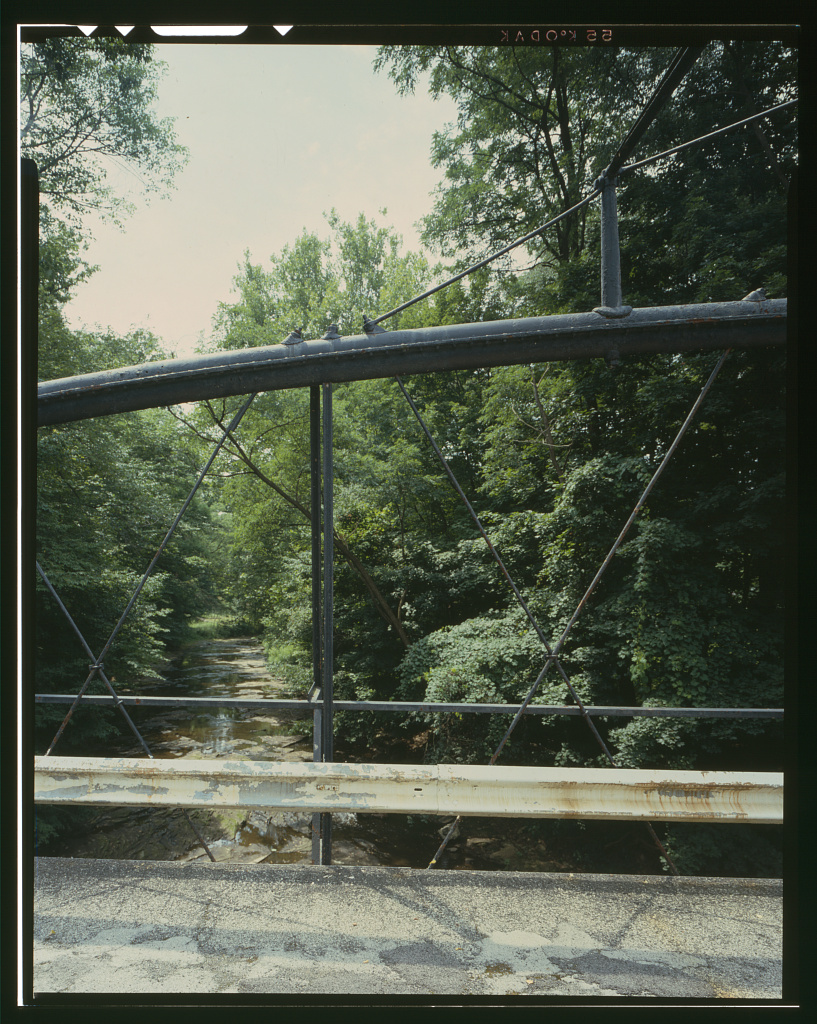
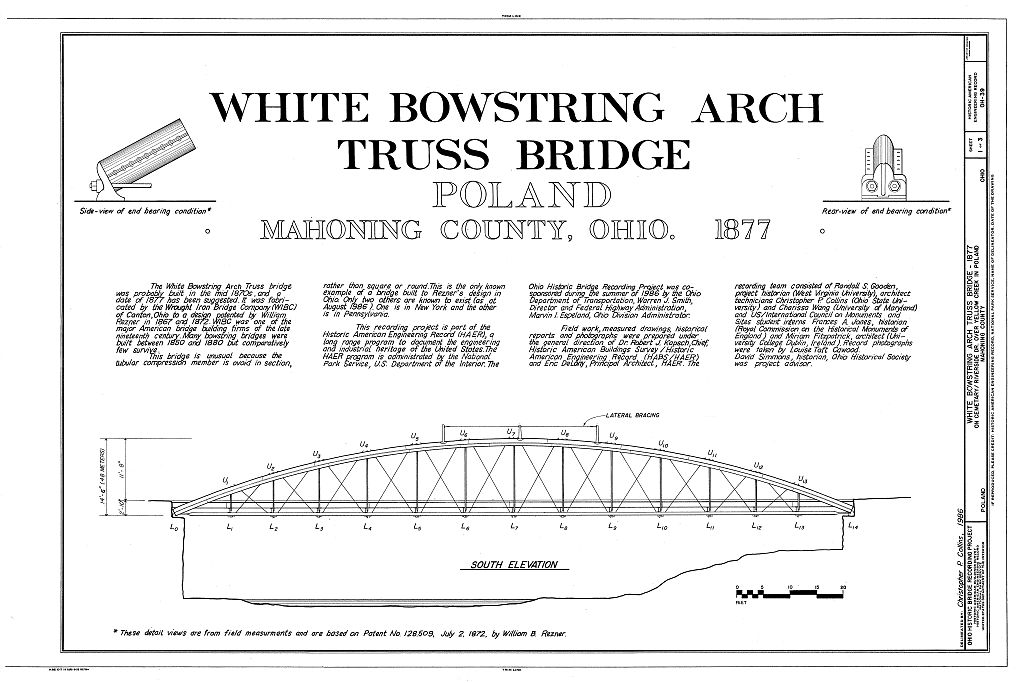
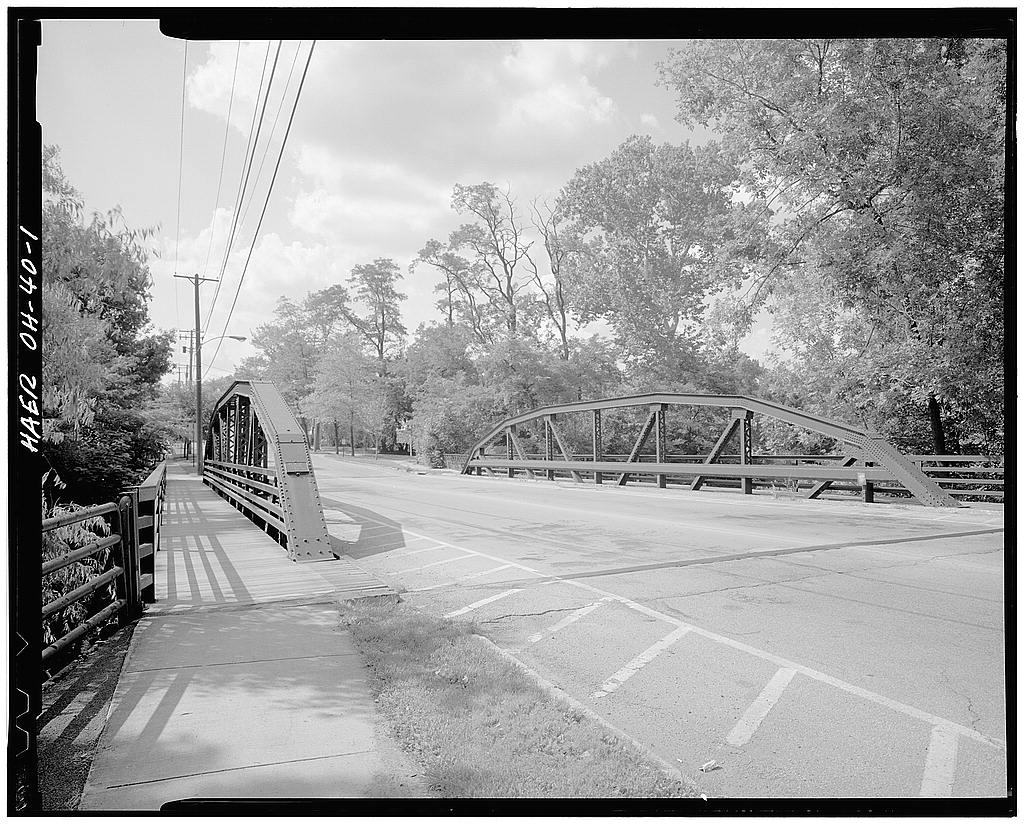
OH-39 Page 2 This "bridge is a bowstring arch truss which was built in It is referred to in primary records as the White Bridge, but it is also called the Cemetery Drive, or Riverside Drive Bridge. Many bridges in the second half of the nineteenth century were built with a bowstring design, although few survive today. Most bowstrings had a tubular compression member that was square or round in section, but this particular bridge is unusual because it has an elliptical (ovoid) tubular arch. The bridge was constructed by the Wrought Iron Bridge Company of Canton, Ohio, but it was built to a design patented in and later improved upon by a patent in by William Rezner of 2 Cleveland. The bridge is 127 feet long and eighteen feet wide.
The compressive member of the truss is composed of two semi-elliptical sections riveted to a flat plate. The lower chord is in tension. There are fourteen panels, twelve of which are crossed by two diagonal wrought-iron rods. The vertical cruciform columns are in compression, and the diagonal rods are in tension. Lateral bracing in the plane of the bottom chord is attached to the end of the deck beams. There is also overhead bracing at three panel points composed simply of three horizontal bars set across the width of the bridge, and stiffened by diagonal bracing. Builders of bowstring bridges utilized a variety of top lateral bracing often using latticed girders, thus, the use of a bar system on this bridge is unusual. The deck beams rest on top of the bottom chord.
WHITE BOWSTRING ARCH TRUSS BRIDGE HAER Wo. OH-39 Page 3 The design of the White Bridge is very similar to Rezner's "Patented Oval Wrought Iron Tubular Arch Bridge". He "believed that the oval shape would increase the bridge's vertical stiffness. A hollow tube of wrought iron often was used for the arch in bowstring bridges. Various designs were first produced in an attempt to increase the rigidity of the bridge. A patent for the design was finally developed in by Rezner working with John Glass, a foundryman, and George Schneider, a railroad machinist, both from Cleveland. In Rezner submitted his own patent for an improvement on the first design, which was used on the White bridge. This was for a special bearing shoe that sat on the abutment which connected the arch to the lower chord.
The lower chord is of two continuous bars, 6" by which taper down to threaded diameter rods at their extreme ends. The rods pass through the cast iron shoe and are held by hexagonal or square nuts. The shoe also receives the end of the oval tube, in a manner to allow for the expansion and contraction of the iron in the bridge. Rezner's first patented design is very similar in many ways to that of the White Bridge. In the latter, however, there are a series of vertical columns with diagonal rods between them, but in the drawing accompanying Rezner's patent the "main stays" appear to radiate along the curve of the bowstring. There are diagonal braces in his original WHITE BOWSTRING ARCH TRUSS BRIDGE HAER No.
OH-59 Page 4 design, but they run, not between the posts, but from the centre of the bottom chord out to the bowstring, across two of the main stays. William Rezner was a physician by profession, not an engineer. He had an inventive nature, however, and besides designing bridges he founded the Ohio Bridge Company in In doing so, Rezner capitalized on the vast resources of the major Cleveland developers of the Marquette, Michigan iron ore deposits. However, the company could not survive the Depression of and Resner went back to medicine. Because the company operated for such a short time there are few examples of his distinctive bowstring design. This is the only known example in Ohio, and only two others have been found in other states. One is in Beacon, New York (see HAER No.
and the other is in Pennsylvania. The design is very much a reflection of the technology of its period, as the bowstring was extremely popular from to but hardly any were built after Once iron began to be used for bridges in the builders searched for the best designs (i.e. designs which were efficient in the use of materials and labor). The bowstring was popular because it had a high carrying capacity, but required a comparatively small amount of material. Although it was popular for about thirty years, some professional engineers felt it had limited use since it could not be properly braced overhead and therefore had a tendency to sway sideways. J.A.L. Waddell, a late century bridge designer and .. 3 author, said that bowstring bridges ought to be condemned .
WHITE BOWSTRING ARCH TRUSS BRIDGE HAER No. OH-39 Page 5 The construction date was taken from an entry in the Mahoning County, County Commissioners Journal (volume 2, page f r 2 July The entry concerns a contract between the County and the Wrought Iron Bridge Company for building a bridge over Yellow Creek in Poland. The bridge was to be 18 feet wide (which the White Bridge is), and was to have one "5 foot walk". It was to sit on the stonework "as it now stands", and it was to be constructed on the "low truss plan". The White Bridge could have had a sidewalk originally, it being carried on the outside of one of the lines of trussing, on top of extensions of the deck beams. This could explain the fact that some of the external sway bracing appears to have been altered.
It is possible that the abutments were from an earlier bridge. The fact that the County Commissioners Journal mentions a "low" bridge, however, suggests that the entry is for a different structure. The road that the White Bridge carries across Yellow Creek was built in the early so there should have been a bridge there earlier than References for an earlier bridge had not been found. In addition, The bridge must have been built after Rezner's second patent. Thus, a date in the mid seems fairly certain from a stylistic point of view. WHITE BOWSTRING ARCH TRUSS BRIDGE HAER No. OH-39 Page 6 The Wrought Iron Bridge Company, Canton, Ohio. This company was one of the major American bridge building firms in the late nineteenth century.
It had agents, and built bridges in New England and the eastern, midwestern, southern and southwestern sections of the United States. It also built bridges in Canada and in Mexico. The company began operations in expanding into a partnership 4 venture in At that point it was incorporated under state laws with capital of with much ofthat money coming from David Hammond. Hammond was born in Canton, Ohio on 12 September He worked as a contractor and builder until when he was given a contract to build a 60 foot iron bridge across the east branch of the Nimishillen Creek in Canton. This was said to be the second iron bridge erected in Stark County. After this experience Hammond concentrated on bridge building, and together with W. R.
Reeves he started the firm of 'Hammond and Reeves', bridge builders and contractors based near Fort Wayne, Indiana. Their partnership continued until when Hammond 'retired', only to invest in the Wrought Iron Bridge Company and become its President. He disposed of his interest in the firm in and though intending to retire, actually went on to organise the Canton 5 Bridge Company in In it was that the Wrought Iron Bridge Company (WIBCo.) had built more highway bridges than any other works in the United States. With a WHITE BOWSTRING ARCH TRUSS BRIDGE HAER No. OH-39 Page 7 staff of about 150 men , they had erected about spans, varying in length from six to 120 feet.
By that early stage in its history it had worked in 25 different states as well as in Canada, and had constructed truss, arch, swing, and plate bridges as well as iron piers (they built both all-iron, and combination bridges). The material they used was specially manufactured for them to rigid specifications, with regard to tensile strength and quality and was tested on its arrival at the shop. By they had had no cases of failure or accident - an important boast in a century which had seen a number of bad accidents due to experimentation with bridge design. It was said that: Their facilities for accurate and reliable work are unequaled by those of any similar establishment, and enable them to complete contracts with great dispatch.
' They prided themselves not just on the quality, but on the speed of their work: Our extensive facilities for manufacture are so complete, that we have shipped the iron work for a 60 ft. span within 7 hours after receiving the iron from the mill, and have completed 100 to 140 ft. spans at points from 100 to 300 miles from our works, in 8 to 15 days.8 In the firm's original plant became too small and they moved to a larger, specially built plant in the southwestern section of Canton. This was on a 12 acre site, on the line of the Coshocton and Zanesville Branch of the C. C. & S. R. R. The railway tracks entered the site at the northeast corner, and from there other tracks allowed for the WHITE BOWSTRING ARCH TRUSS BRIDGE HAER No. OH-39 Page 8 distribution of material as it arrived.
Material was stored on skids adapted for that purpose, or was conveyed by rail to the stock house. Material for built-up members was conveyed to the shop on the north track and was unloaded on adjacent skids in the shop. It was laid off there and marked for punches and shears. From punches and shears it passed to straightening machines, or curving rolls to the assemblers and from there to the reaming tools, the riveters and riveting machines, the planers, the fitters and the drills. It was then stored ready for loading. The machinery for the various operations was laid out in consecutive lines from east to west. The finished bridge parts were either stored or loaded directly on to the cars for transportation to the appropriate destination.
The Main Building was 256 feet square, part of which was divided into a Superintendent's office, a template and pattern room, a tool room, a machine shop for small tools, and a packing room. The major part of the building was devoted to the Main Shop for the manufacture of built-up members. There was also a Forge Shop, which was connected by tracks to the Yards, the Stock House, and the Main Shop itself. The Main Shop was designed to have only four columns in the whole area, so the floor area was unimproved for the assembly of large bridge parts. The Engine Room had engines, an electric generator, incandescent and arc light dynamos, an air compressor and receivers, with pressure and heating fans overhead.
The electric generator powered 17 dynamos, each WHITE BOWSTRING ARCH TRUSS BRIDGE HAER JJo. OH-39 Page 9 one operating one or more machines, as needed. The Boiler Room was outside the Main Building, and next to the Engine Room. It had a boiler and furnace, the feed water being purified before passing to the boiler. The exhaust steam heated the feed water and was used in cold weather to heat the works, by being passed through coils of pipe in aheater box, through which air was forced by a fan for distribution through the building. The plant was completely electrified with each machine having its own electric motor instead of being powered by belting and shafting. The company claimed that it was the first bridge manufacturer to adopt that method of transmission for the whole plant.
WIBC's new site design seems to have been much influenced by up-to-date thinking on plant layouts. The metal industry was the first in the United States to pay attention to the design of works and plants in order to increase productivity. An American engineer, Alexander Lyman Holley, was behind a number of innovative plant layouts in the and the primary goal of which, according to Holley was "to assure a very large and regular output". He believed that good plant design was as important for this as technological innovation.
He said that: It will have been observed that the capacity of these works for a very large and regular output, lies chiefly in an arrangement which provides large and unhampered spaces for all the principal operations of manufacture and maintenance, while it at the same time concentrates these operations. Holley was very proud of his design for Andrew Carnegie's Edgar Thomson Works in Pittsburg, Pennsylvania. The site was on the Monongahela River WHITE BOWSTRING ARCH TRUSS BRIDGE HAER No. OH-39 Page 10 at the junction of three railroads. It was selected to make the fullest use of existing railroad transportation.
The plant was designed to assure as continuous a flow as possible from suppliers of the raw material, through the processes of production, to the shipment of the finished product to the customer. . . . these works were laid out, not with a view of making the buildings artistically parallel with the existing roads or with each other, but of laying down convenient railroads with easy- curves: the buildings were made to fit the transportation. The design of the works allowed it to become the most efficient steel producers in the country, or in the world. Although not in the same league. WIBCo was one of the major bridge building companies in the country at the time, so presumably it was worthwhile for them to invest 10 in a well designed works.
A Sanborn Insurance Map of Canton for shows both the old and the proposed plants. In the Wrought Iron Bridge Company was bought up by the American Bridge Company, becoming one of its 35 plants. David Hammond had a major role in the expansion of the Wrought Iron Bridge Company but he was not the only significant figure. Job Abbott was vice president in the and although he left in he was still a director at the time of his death in August Abbott went to Harvard and graduated from its scientific department in He worked for several railroad companies, eventually moving to Canton, Ohio, where he became interested in patent law, and then in construction WHITE BOWSTRING ARCH TRUSS BRIDGE HAER No. OH-39 Page 11 work.
During the be advertised himself as an architect, civil and mining engineer and "solicitor of patents." Ironically as a patent attorney he sometimes represented other Ohio bridge builders who later directed rival companies. He took a major part in the building up ofthe Wrought Iron Bridge Company, and received numerous patents for bridges jointly with Hammond in the His designs included several bowstring bridges that were used by the company. Abbott went on to organize the Toronto Bridge Company in and the Dominion Bridge Company, Montreal in which built some of the heaviest bridges in Canada (the Lachine Bridge for the Canadian Pacific Railroad over the St. Lawrence River for example).
During Abbott's career he established business relations with the great European rolling mills and with foreign engineers, especially those in Scotland and Belgium. Another key figure in the development and management of WIBCo was Edward Landor fborn in Norwich, England in Kay who worked for the company from to He was assistant Engineer, Chief Engineer and then President and Manager. In Landor went to work for the American Bridge Company at the time when the latter brought out Wrought Iron Bridge Company. In that year, however, he was working at Zanesville, Ohio, as resident engineer on the construction of the 'Y' bridge, the design for which he said he had prepared with the Wrought Iron Bridge 1^ Company. "' WHITE BOWSTRING ARCH TRUSS BRIDGE HAER No.
OH-39 Page 12 WIBCo was one of the bridge companies heavily involved in "bridge pools" in Ohio in the late l th century. Bridge pools were alliances between participating companies which helped to regulate prices paid to companies for their work. The companies would decide which of them would put in the lowest bid before submitting their supposedly secret bids for a bridge contract. Information on "bridge pools" are in the report on the Forder Pratt Through Truss Bridge (HAER No. OH-42)
Notes
National Register Nomination. The firm patented an arch bridge design ("The Hammond and Abbott Arch Bridge", named after two of the founders). The design is not that used for this bridge, however, as apart from any other differences the bowstring does not have the distinctive cross-section of the White Bridge. Bridge Files Ohio Historical Society (compiled by David A. Simmons, OHS) C. E. Church, Wrought Iron Bridges Built by the Wrought Iron Bridge Co., Canton, Ohio. (Fitchburg, Mass: Illustrated pamphlet. WHITE BOWSTRING ARCH TRUSS BRIDGE HAER No. OH-39 Page 13 5 "Bridge Building" American Pictorial Monthly (Midsummer 25. The article gives further details of Hammond's career. He began the Canton Bridge Company in with his son Vinton H. Hammond, and son-in-law John R. Reed.
He was elected vice-president in His sons Geo. I., Vinton H. t and Harry were general agents for the Canton Bridge Company. They were known as the 'Hammond Brothers'. 6 Win. H. Perrin, ed., History of Stark County, Ohio (Chicago: Baskin and Batley, 7 Ibid. 8 Church, Wrought Iron Bridges by the Wrought Iron Bridge Co. 9 Wrought Iron Bridge Company, Canton, Ohio Booklet published at the time of the Company's move in c. 10 All the information on Alexander Holley is from Alfred D. Chandler, The Visible Hand: The Managerial Revolution in American Business (Cambridge, Massachusetts: The Belknap Press of Harvard University Press, pp. 11 See note 2 above. 12 Obituary. Engineering Record 34, (5 September 13 Bridge Files, Ohio Historical Society (compiled by David A. Simmmons, OHS).
Landor was a Life Member of the American Society of Civil Engineers. The information is taken from a copy of the "Permanent Biographical and Professional Record of All Members of the American Society of Civil Engineers" for Landor. WHITE BOWSTRING ARCH TRUSS BRIDGE HAER No. OH-39 Page 14
Bibliography
Chandler, Alfred D. The Visible Hand: The Managerial Revolution in American Business . Cambridge, Massachusetts: The Belknap Press of Harvard University Press, pp. Perrin, Wm. H. ed. History of Stark County, Ohio . Chicago: Baskin and Batley, Church, C. E. Wrought Iron Bridges Built by the Wrought Iron Bridge Co., Canton, Ohio . Pitchburg, Mass.: Wrought Iron Bridge Company, Canton, Ohio . "Bridge Building." American Pictorial Monthly 25 (Midsummer National Register Nomination. Obituary. Engineering Record 34 (5 September "Permanent Biographical and Professional Record of All Members of the American Society of Civil Engineers,"** Bridge Files, Ohio Historical Society (compiled by David A. Simmons, OHS). ** denotes material taken from the Bridge Piles at the Ohio Historical Society.
The original filed report, and the sheets the survey produced. Those published here appear above.
Also surveyed in Poland
1 record
The federal surveyors worked through Poland building by building. These are the other structures
they measured and filed a report on, longest report first.
 Block
Block