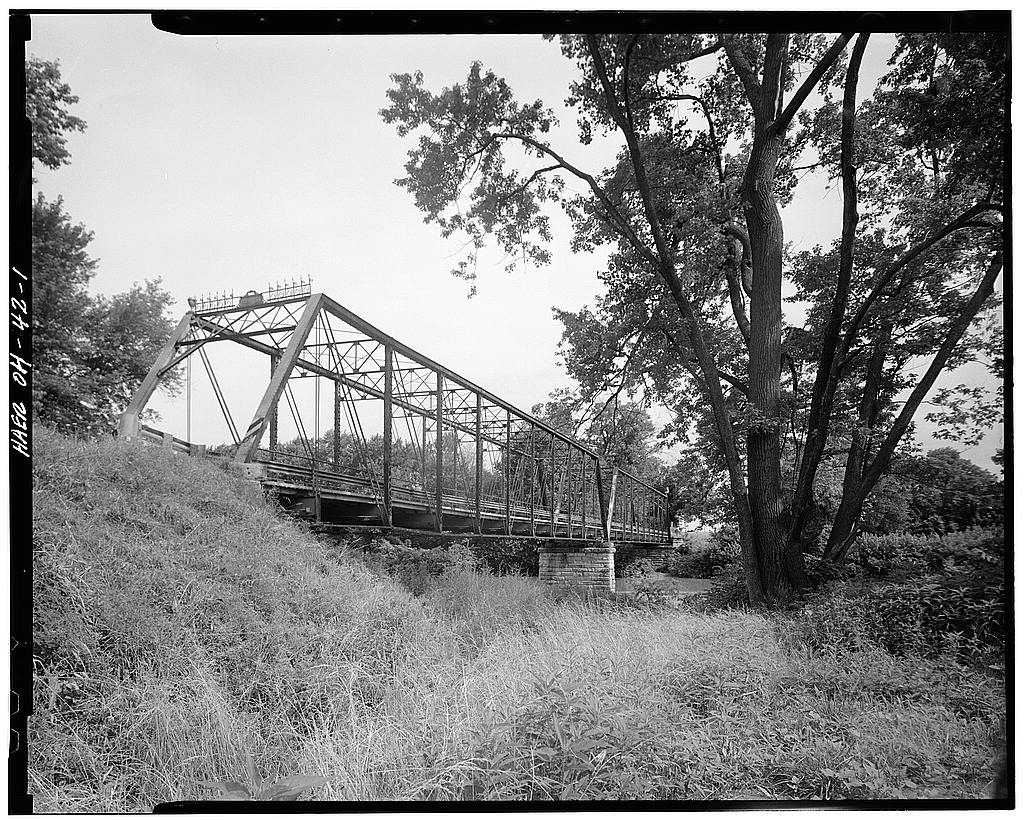
"Forder" Pratt Through Truss Bridge, Spanning Maumee River at County Route 73, Antwerp
"Forder" Pratt Through Truss Bridge, Spanning Maumee River at County Route 73, Antwerp, Paulding County, OH. Surveyed as HAER OHIO,63-ANT.V,1-, with 1 photograph and a 2,503-word written history.
From the record
“The Forder Bridge is a "textbook" example of a typical, prefabricated metal-truss that represents the transition from bridges made of wrought-iron to steel between to It is the oldest all-steel Pratt truss in Ohio.”
Written record, HAER OHIO,63-ANT.V,1- survey. Machine-read text.
surveyed by the federal HAER program as HAER OHIO,63-ANT.V,1- · the record runs 2503 words · one of 1 surveyed structures published for this county.
Source document
Quoted word for word from HAER OHIO,63-ANT.V,1-.
Not written, edited or summarised by this site.
The Forder Bridge is a "textbook" example of a typical, prefabricated metal-truss that represents the transition from bridges made of wrought-iron to steel between to It is the oldest all-steel Pratt truss in Ohio. Report prepared by: Randall S. Gooden Project Historian Ohio Historic Bridge Recording Project Summer FORDER BRIDGE HAER No. OH-42 Page 2 Metal truss bridges became increasingly popular in the United States after Among metal truss types, the Pratt truss appealed to many bridge builders, and, in Ohio, its popularity is readily manifested by county records and the number of Pratt trusses still extant. Tbe Forder Bridge is an example of a Pratt through truss and is one of tbe first Pratt through trusses in Ohio built with steel instead of iron.
As with other Pratt trusses, tbe diagonals and bottom chord are in tension, and the verticals and top chord are in compression. Tbe bridge 2 consists of two spans of eleven panels, each measuring feet. Tbe pier and abutments are stone. Tbe bridge has an overall length of 356 feet. The roadway has a total width of 16 feet, and tbe deck rests 28 feet above tbe stream, carried by ten 24 inch built-up floor beams. The height of tbe bridge is 24 feet from tbe lower chord to tbe upper chord. Each portal has a height 4 clearance of feet in tbe center and feet at tbe sides. In addition, this bridge retains many decorative elements. Vase-shaped finials top tbe inclined end-posts, and decorative iron crestings enhance tbe portal openings. Decorative plates at each portal identies tbe builder.
FORDER BRIDGE HAER No. OH-42 Page 3 The Paulding County Board of Commissioners decided on March 20, to build Forder Bridge over Maumee River at the border of sections 17 and 18 in Crane Township. This bridge was a major undertaking for the county government, and extraordinary financing was needed to build the relatively expensive bridge at an important crossing of a major river. The commissioners found it necessary to sell worth of bonds to 5 finance the bridge. Despite tbe vital political role of the board of commissioners in contracting to build tbe bridge, the major government duty concerning the bridge rested with the county surveyor, in Ohio, the county surveyor provided guidance to tbe commissioners in reviewing proposals for bridge plans.
Often, he provided bridge plans prepared by engineers in his own office. The surveyor gave overall supervision of bridge construction, guaranteeing that the wishes of the county officials were followed by the contractors. He held the responsibility to maintain and repair all county bridges and to supervise maintenance and repair work. The office of county surveyor originated with an act of tbe Ohio General Assembly in The court of common pleas originally appointed tbe county surveyor, but tbe office became elective in Elected for a three-year term, the surveyor dealt with tbe survey of all lands which FORDER BRIDGE HAER No. OH-42 Page 4 were sold for taxes or were scheduled to be sold for taxes. He employed cbainmen to establish boundaries.
The county surveyor also reported trespassing on public lands, transcribed maps and plats, and eventually, performed many of the same services as a justice of the peace. By when the Eorder Bridge was built, the surveyors bad assumed duties involving roads, bridges, and culverts more than land, and many county surveyors employed professional engineers. In state legislation formalised the responsibilities for bridges, roads, culverts, and ditches that a number of surveyors bad already assumed.
In the state legislature granted the surveyor the authority to designate a deputy as a maintenance engineer, A legislative act changed the name of the office to "county engineer," requiring the officer to be a registered professional engineer and registered surveyor, and set the term of office at four years. The county surveyor of Paulding County reviewed the work of the contractors on the Forder Bridge in George Forder, a local property owner after whom the bridge was named, received the contract for the masonry work on the bridge. However, the superstructure work required a contractor which could accomplish a large-scale project in a short time and produce a durable bridge at this important river FORDER BRIDGE HAER No. OH-42 Page 5 crossing.
Thus, the county commissioners awarded the contract to Milwaukee Bridge and Iron Works. Although the company was an out-of-state firm, it enjoyed a long history of bridge building in northwestern Ohio in the centuries. 7 Despite its long record of iron and steel bridge building in Ohio, Milwaukee Bridge and Iron Works left a more prominent mark in Ohio history for its role in bridge company pools or trusts. More specifically, an Ohio agent of the company, John J. Dun, brought Milwaukee Bridge and Iron Works to full public attention in when he testified against bis employer and other bridge companies in the case of the State of Ohio e^_rel. Kora F. Brigs vs. Henry Hughes et al.
In this lawsuit, Sandusky County alleged that a number of bridge companies bad cooperated to artificially raise bridge construction costs in order to boost profits at the expense of county taxpayers. Dun testified that while he was an agent of J, G. Wagner Company, an alias of Milwaukee Bridge, in and the company built no bridges in Ohio but received as the result of an agreement with other companies. That agreement provided that Milwaukee Bridge refrain from bidding or competing for bridge contracts in exchange for a share of the profits from companies that received contracts. Contractors artificially FORDER BRIDGE HAER NO, OH-42 Page 6 increased bridge prices in order to provide for enough profits to share with bridge pool members.
Dun charged that bridge contractors pushed bridge prices 50% over actual construction costs and gave one-half of the resulting profits to a Cleveland based trust. Other trust members received dividends from the profits. Dun alleged that agents of pool members secretly met when governments advertised bridge contracts and decided which companies submitted bids, which received contracts, and what the bridge price would be. He named the prolific Columbus Bridge Company, Mt.
Vernon Bridge Company, King Iron Bridge Manufacturing Company, Wrought Iron Bridge Company, Canton Bridge Company, Toledo Bridge Company, Massillon Bridge Company, Pittsburgh Bridge Company, Penn Bridge Company, Brackett Bridge Company, Champion Bridge Company, Bellefontaine Bridge Company, Horseheads Bridge Company, Havana Bridge Company, Variety Iron Works, Iron Substructure Company, J. G. Wagner Bridge Company, Youngstown Bridge Company, and Oregonia Bridge Company as members of the clandestine bridge trust. The concept of bridge pools developed during the Suffering from the economic depression of the decade, bridge companies copied railroads and banded together to promote and protect their mutual interests.
In order to increase profits and bolster business, pool members ran "specials" to undercut the prices charged by non-members; they agreed to FORDER BRIDGE HAER No. OH-42 Page 7 split profits from projects which were deferred to them by other pool members; the pool members added "service fees" and "handling costs" in order to assure greater profits. Pool members who received contracts divided profits with other companies according to either a fixed amount per square foot on the contracted bridges or according to predetermined percentage shares of the sales prices of the bridges.
In bis doctoral dissertation about Chicago Bridge & Iron Company, Eli Woodruff Imberman wrote that a ledger of Chicago Bridge listed Brackett Bridge Company, Canton Bridge Company, Columbus Bridge Company, King Iron Bridge -S Manufacturing Company, Lane Brothers, Massillon Bridge Company, Milwaukee Bridge & Iron Works, Morse Bridge Company, Penn Bridge Company, Pittsburgh Bridge Company, Wrought Iron Bridge Company, Smith Bridge Company, Toledo Bridge Company, Variety Bridge Company, Youngstown Bridge Company, and Queen City Bridge Company among early 9 bridge pool members. Milwaukee Bridge and Iron Works played a leadership role in the earliest Ohio-oriented bridge pool.
Sixteen companies organized the pool, known as the "Clearing House," in and agreed to pay 13% of the gross amount on all contracts into a general pool fund, Milwaukee Bridge acted under the name, Keepers # Riddell, and . H. Keepers served on the executive committee of the "Clearing House." H. G. Morse of Morse FORDER BRIDGE HAEH No. OH-42 Page 8 Bridge Company, 2. King of King Iron Bridge & Manufacturing Company, and A. J. Sprague of Massillon Bridge Company also served on the executive committee as representatives of the companies that received the highest dividends from the pool fund.
Other members of the Ohio bridge trust included Missouri Valley Bridge and Iron Works, Wrought Iron Bridge Company, Smith Bridge Company, Kansas City Bridge and Iron Company, Berlin Bridge Company, Columbia Bridge Company, Penn Bridge Works, Horace E. Horton, Raymond & Campbell, Mt. Vernon Bridge Company, Champion Bridge Company, Lomas Forge and Bridge Works, and Indianapolis Bridge Company. The bridge companies began pooling practices as an attempt at economic survival during a competitive era. However, the pools became excessive and unethical in their practices, and Ohioans became alarmed.
A number of taxpayers and county governments filed civil suits in the early years of the in efforts to recover public money that many people felt the bridge companies had cheated the counties through price boosting methods. A general mood of muckraking and progressivism swept the United States during this period, and it was partly manifested in Ohio through investigations of trusts. FORDER BRIDGE HAER No. OH-42 Page 9 Tbe growing anti-trust sentiment among the people of Ohio and in local government resulted in anti-trust efforts by tbe state government. Ohio legislators passed anti-trust provisions wbicb made conspiracy in tbe restraint of trade a crime. Tbe law, known as tbe Valentine Anti-Trust Act, was tested in court in by tbe stats attorney general.
Attorney General Wade H- Ellis paid close attention to tbe Brigs vs. Hughes case tried in Sandusky County in tbe autumn of Ellis made further investigations of John J. Dun's allegations against bridge 11 companies. As a result, Ellis filed criminal charges against American Bridge Company, Penn Bridge Company, Canton Bridge Company, Massillon Bridge Company, Variety Iron Works, King Bridge Company, Brackett Bridge Company, Champion Bridge Company, Adams Brothers Company, Mt. Vernon Bridge Company, Columbus Bridge Company (Huston & Cleveland), Bellefontaine Bridge Company, and Iron Substructure Company on tbe basis 12 of tbe Valentine Anti-Trust Act. Tbe case resulted in tbe ouster of the defendant companies from business in Ohio by the circuit court in Logan County.
13 Most of tbe convicted companies continued operations by reorganizing under tbe laws of other states or making organizational revisions under Ohio laws. Still criminal prosecutions and civil suits continued, and collectively, these weakened tbe once impregnable FORDER BRIDGE HAER WO. OH-42 Page 10 positions of the bridge firms. Although Milwaukee Bridge & Iron was not prosecuted, its operations in Ohio suffered. In spite of the legal difficulties experienced by Milwaukee Bridge and Iron, the company left a remarkable record of bridge building in Ohio, and Forder Bridge stands as a reminder of the company's years of success. Unfortunately, the bridge has suffered many structural problems, and numerous repairs have been made.
Engineers replaced the wood floor with corrugated steel, and steel guardrails were added in In that year, a 50$ load restriction was placed on the bridge. An engineering consultant's report in suggested that complete repairs be made on the bridge in order to preserve its historical integrity. After a vertical on the south span was bit by an automobile in it was improperly repaired, causing a dip in the top chord and a rise in the bottom chord. This resulted in an unstable deck 15 and floor joists. By the suggested repairs bad not been made, and a diagonal on the south span bad been bent by an ice jam in February Two horizontal braces were loose and the deck was loose from the stringers on the south span. Rust also plagued the structure.
The county engineer is concerned about this historic structure and its preservation. Yet, repairs and maintenance are constant demands on the FORDER BRIDGE HAER No. OH-42 Page 11 county government. The weight limit has been reduced another to eight tons, and it appears that the bridge will require replacement as repairs become increasingly insufficient. FORDER BRIDGE HAER No. OH-42 Page 12 NOTES 1 Ohio Department of Transportation, T^e_^b^o_^stoj^_Br_idg9 Inventory Evaluation and Preservation_Plan_ (Columbus: Ohio Dept. of Transportation, p. 49. 2 Obio, County of Paulding, Office of the County Engineer, Forder Bridge Engineering Report (30 July Bridge File .
5 Ohio, County of Paulding, Office of the County Engineer, 4 Ohio, County of Paulding, Office of the County Engineer, Forder Bridge Engineering Report (30 July Bridge Files. 5 Ohio, County of Paulding, Board of Commissioners, C^mm^sjaon ^_Joj rnal 15, Obio Historical Society Archives-Library Division, OMo County Records Manual, rev. ed. (Columbus: Obio Historical Society, 7 Obio, County of Paulding, Board of Commissioners, Commissioners Journal 52. 8 "Says Bridge pool Always Divided the Profits," Columbus Citizen, 10 October 9 Eli Woodruff Imberman, "The formative Years of Chicago Bridge & Iron Company" dissertation, U. of Chicago, pp. 10 Champion Bridge Co., Bridge Files, Historic Preservation Office, Obio Historical Society, Columbus, Ohio.
H "May Go after Bridge Merger," Columbus Citizen, 7 October p. 5. 12 Vinton R. Sbepard, ed., Ohio Circuit Court Reports (Cincinnati: Ohio Law Reporter Co., p. FORDER BRIDGE HAER NO. OH-42 Page 13 13 "Courthouse Notes," Weekly Examiner (Beliefontaine), 12, 19, 26 October ~ ^4 Ohio, County of paulding, Office of the County Engineer, No^ !5 Ohio, County of Paulding, Office of the County Engineer, 2.1._?jP0L'Li'^ .Jir^ ^._5i21 BrJ^je_Eiles. ^ Ohio, County of paulding, Office of the County Engineer, County Report on Porder Bridge Bridge Files. FORDER BRIDGE HAER No. OH-42 Page 14
Bibliography
Columbus, Ohio, Ohio Historical Society, Historic Preservation Office. Bridge Files. Champion Bridge Co. "Courthouse Notes." Weekly Examiner (Beliefontaine), 12, 19, 26 October Imberman, Eli Woodruff. "The Formative Years of Chicago Bridge & Iron Company." dissertation, U. of Chicago, "May Go after Bridge Merger." Pj^^J^u^JUti^en, 7 October Ohio, County of Paulding, Board of Commissioners. Commissioners Journal vol. 5. Ohio, County of Paulding. Office of the County Engineer. Sr_idge_and , . Bridge Files. Ohio Department of Transportation. The Ohio HisJ^r^c_^^ge_Jnventory Evaluation and Preservation Plan. Columbus: Ohio Dept. of Transportation, * Ohio Historical Society Archives-Library Division, Ohio County Records Manual. Rev. ed. Columbus: Ohio Historical Society.
"Says Bridge Pool Always Divided the Profits." Columbus Citizen, 10 October "" Shepard, Vinton R., ed. Ohio Ci^cuit_Court_Reports. Cincinnati: Ohio Law Reporter Co.,
 Block
Block