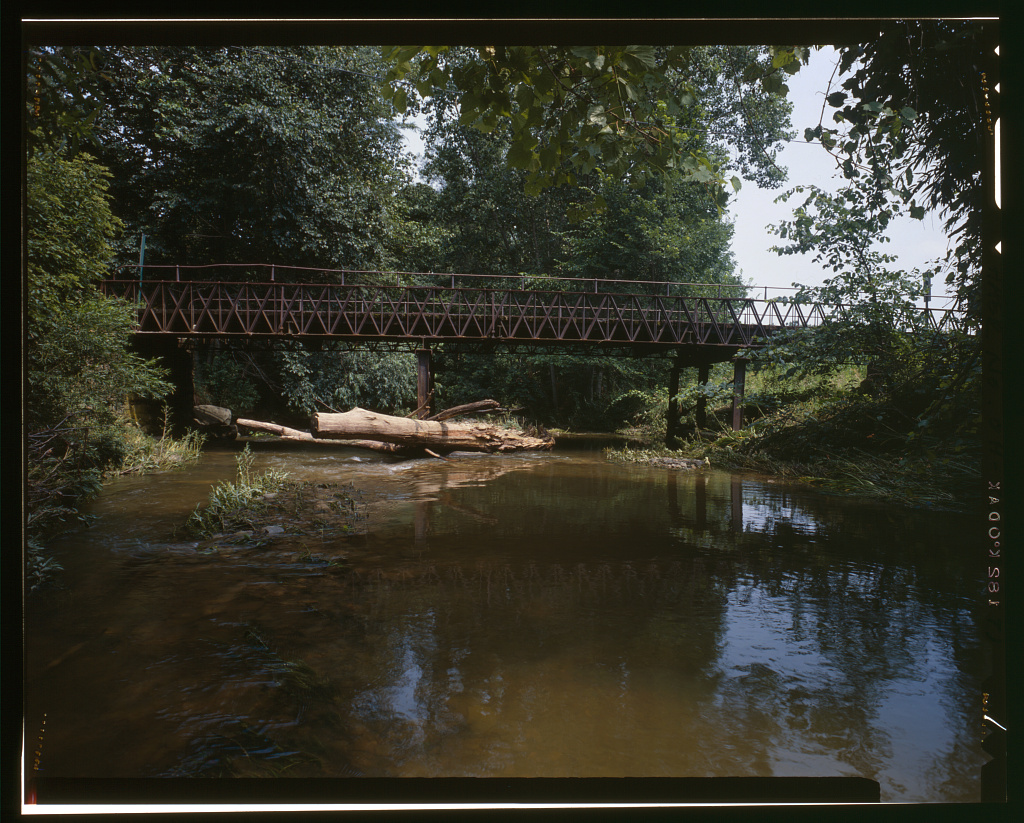
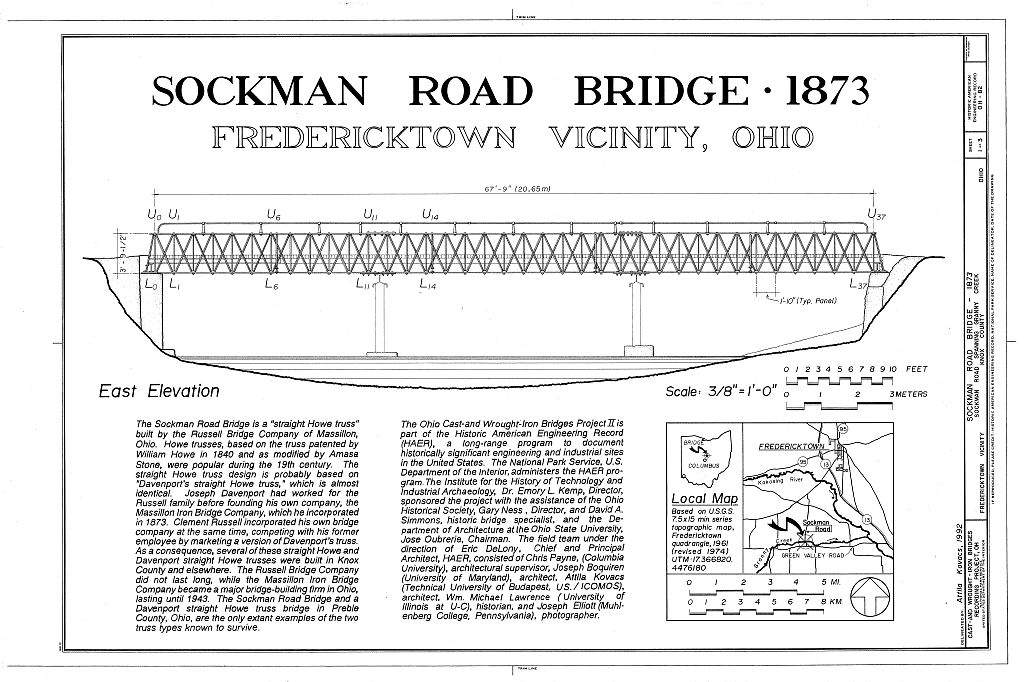
Sockman Road Bridge, Spanning Granny Creek on Sockman Road, Fredericktown
Sockman Road Bridge, Spanning Granny Creek on Sockman Road, Fredericktown, Knox County, OH. Surveyed as HAER OHIO,42-FRED.V,2-, with 1 photograph, 1 measured drawing and a 3,085-word written history.
From the record
“Sockman Road Bridge, Spanning Granny Creek on Sockman Road, Fredericktown, Knox County, OH”
Survey record header. Machine-read text.
surveyed by the federal HAER program as HAER OHIO,42-FRED.V,2- · the record runs 3085 words · one of 7 surveyed structures published for this county.
1 photograph and 1 measured drawing from the federal survey record, Library of Congress.
Written history
116 words
Source document
Quoted word for word from HAER OHIO,42-FRED.V,2-.
Not written, edited or summarised by this site.
Sockman Road (Township Road spanning Granny Creek, Fredericktowns vicinity, Knox County, Ohio. UTM: Russell Bridge Company, Massillon, OH County of Knox, Board of Commissioners, 110 E. High Mount Vernon, OH Vehicular Traffic A "straight Howe truss" bridge, its design was likely based on the "Davenport Straight Howe truss" developed by Joseph Davenport, founder of the Massillon Bridge Company, of Massillon, Ohio. The Ohio Cast- and Wrought-Iron Bridges Project was cosponsored by HAER, Dr. Robert J. Kapsch Chief; the Instute for the History of Technology and Industrial Archaeology, Dr. Emory L. Kemp, Director; the Ohio Historical Society, Gary Ness, Director and David Simmons, Historic Bridge Specialist; and the Department of Architecture, Ohio State University, Jose Obrerie, Chairman.
Written history
2895 words
The headings the report itself prints. Each one jumps to where it begins.
Source document
Quoted word for word from HAER OHIO,42-FRED.V,2-.
Not written, edited or summarised by this site.
Wm. Michael Lawrence SOCKMAN ROAD BRIDGE HAER No. OH-82 (Page 2) The Sockman Road bridge is one of eight iron Howe trusses built in Knox County during the by two rival bridge companies of Massillon, Ohio. This "straight Howe truss," built by the Russell Bridge Company in was probably based on the "Davenport straight Howe truss" designed by Joseph Davenport and marketed by the Massillon Bridge Company. Davenport, a former employee of the Russell's, was not only an important Ohio bridge builder but was credited with a number of inventions besides his bridges.
The Sockman Road bridge is a 70* iron Howe truss spanning Granny Creek, 1 one of a number of "straight Howe trusses" or "straight Howe trusses on the Davenport plan" built in the county by the Massillon Bridge Company and the Russell Bridge Company, both of Massillon, Ohio, during the 2 The two companies competed against each other in part by marketing similar trusses. In fact, County Commissioners at this time contracted with a number of bridge companies rather than one preferred company. 3 Five months after selecting the Russell Bridge Company to build the bridge over Granny Creek, they contracted to lengthen the span from 50* to 4 The Sockman Bridge is a pony truss derived from the bridge invented by William Howe in and modified by Amasa Stone and D. L. Harris.
The Howe truss employed diagonal wood compression members and vertical wrought iron tension members. The diagonal members inclined towards the center carried compression loads while the members slanted towards the ends acted as braces. Top chords were in compression while lower chords were in tension. The truss was quite popular during the century, especially for railroad bridges; as iron replaced wood in bridge construction, Howe trusses were used in some of the first iron bridges. 5 On the Sockman Bridge, vertical tension members consist of pairs of long "bolts" 6 extending from the top to the bottom chords, "string-pieces." String-pieces were likely of boiler-plate iron.
Pairs of "main braces," cruciform in section, serve as diagonal compression members, while single "counter-braces" help stiffen the truss. Several wrought-iron main braces and counter-braces, also cruciform in section, have been bent. Fitting into cast- iron "shoes," they are held in place by bolts passing through them and holding the entire assembly together. There is an iron handrail on the top string-pieces and the ends of the bottom string-pieces rest on and fit into iron "shoes." These originally rested on rather crude abutments of uncut stone, which are visible behind concrete poured over them sometime after SOCKMAN ROAD BRIDGE HAER No. OH-82 (Page 3) Four cross beams consisting of deep I-beams rest on the bottom string-pieces and extend outside the bridge.
U-bolts through the webs secure the cross-beams to the string-pieces. Braces, cruciform in section, fit into the enc|s_ of the cross- beams and are bolted to the top string-pieces. These braces, along with x-bracing under the deck, give the bridge lateral stability. In a way, the design is an elegant one, very simple with a minimum number of parts. Each string-piece is made of several strips joined together with splice plates. This feature permitted the manufacturer to ship trusses in sections and made possible the 20' extension. This modification, after September 9, might account for the fact that the trusses are not quite symmetrical.
The panel-point where in-slanting main braces meet at the top string-course is off-center, with 19 panels to the north and 18 to the south, and the northern-most of the truss' three parts is shorter than the others by 2'. The central part of the truss also lacks symmetry, with seven panels to the north and five to the south of the structural center. In addition, the five bays between the ends of the bridge and the cross beams are unequal in length. These characteristics suggest substantial experimentation in design, a common feature of this period of American bridge engineering and fabrication. The bridge has been altered substantially since its construction.
Neither the wooden deck and I-beam stringers, nor the 5" deep wide-flange cross-beams supporting them, are original, and likely deformed the bottom string-pieces of the trusses and contributed to the loss of several braces. The original cross beams were probably not intended to support stringers as they are hardly deep enough to carry any loads. The deck may have been supported by wooden cross-beams at 1' to 2' on center, resting on the lower string-pieces. Two makeshift piers constructed of what appear to be scraps from demolished bridges, including some eye- bars, are also retrofits.
Although Joseph Davenport does not appear to have participated directly in the bridge f s construction, its similarity to other structures suggest that the Russell Bridge Company based it on his "Davenport Straight Howe Truss" mentioned in the County Commissioners' Journal . Few such trusses survive in Ohio. The Oak Knoll Park Bridge, built in is an early Davenport version of a Howe truss that anticipates this design, 7 and its handrail is very similar to that of the Sockman Bridge. A probable example of a Davenport straight Howe truss bridge survives at Longman Road over the Sugar Creek in Preble County. 8 The Towpath Bridge at Roscoe Village is constructed of pieces of a Davenport Straight Howe Truss welded together. 9 SOCKMAN ROAD BRIDGE HAER No.
OH-82 (Page 4) Trusses in both the Towpath and Longman Road Bridges resemble those of the Sockman Road Bridge with one difference: the main braces and counter-braces are tubes fit over "pins" on the shoes. This is similar to the lattice bow in Davenport's design for a bowstring truss that he patented in 1 0 Several examples survive in Ohio, 1 1 and at least one was built in Knox County in (although it no longer survives). 1 2 All distinctive components are present in the design: long bolts, string-pieces, main braces, counter-braces, shoes with pins, and shoes. Braces were made of common gas pipe, cut to size, and string-pieces of common boiler plate with bolt holes punched out. Construction is identical to the Davenport Straight Howe truss, except that the assembly is curved.
Straightening the bow may have given rise to the name, "Davenport straight Howe truss." 1 3 A letter written by Joseph Davenport provides additional evidence that the Russell Company's straight Howe truss was based on his design. Although the script is unclear, it appears to be dated March 12, The letterhead includes an illustration entitled "Plan of Wrought Iron Bridges Built By J. Davenport, Massillon, 0," and depicts three kinds of trusses. Two were versions of his bowstring truss, one designed to span to 150 f and the other 50* to The stationary also depicts a Howe truss with a camber intended for spans of 20' to 1 4 None of the Davenport straight Howe trusses built in Knox County exceeded 50' in length.
Trusses of the Sockman Road Bridge, 70' in length, appear too shallow for its span, and have required additional supports. The two other straight Howe trusses built by the Russell Bridge Company were each 60' long. All three likely were built by men who copied Davenport's truss without his understanding of its limitations. Surviving records do not make clear the relationship between Joseph Davenport and the company that built the Sockman Bridge. Davenport worked with the Russell family in Massillon long before He is thought to have entered into a partnership named Davenport, Russell and Company with the eldest of the Charles M. Russell family, building and repairing railroad cars, from to 1 5 An directory lists Davenport as a "car but does not indicate where he worked.
1 6 Shortly before Russell's death in 18 60 the two men invented and obtained a patent for an iron railroad car. 1 7 Russell founded C. M. Russell and Co. in later renamed Russell and Co., manufacturers of agricultural implements and, for decades after, the most important business in Massillon and Canton. Davenport built the Oak Knoll Park Bridge in conjunction with this company in 1 8 Davenport left the Russell Company sometime in the He did not mention any members of the Russell family in his patent SOCKMAN ROAD BRIDGE HAER No. OH-82 (Page 5) application or assign the patent to their company, and he submitted a bid for the Canal Dover River Bridge the following year.
1 9 Nor does the Journal of the County Commissioners of Tuscarawas County indicate he was acting on behalf of the Russell Company. Davenport is thought to have founded the Massillon Iron Bridge Company "with others" in 2 0 yet his letterheads display only his name, not that of a company. An atlas does not locate a Massillon Bridge Company, 2 1 while another published in lists it as an important industry and depicts it within 3 blocks of Russell and Company. 2 2 The company incorporated on March 15, under two names, the Massillon Bridge Company and the Massillon Iron Bridge Company, with capital stock of 2 3 The Russell Bridge Company appears to have been a small-scale, short-lived venture. It does not appear in the above-mentioned directories and atlases.
Clement Russell and several associates incorporated the company with stock of one day before Davenport's company, probably to build bridges within the huge Russell and Co. complex. Any connection between the two companies is unclear. Any link between Joseph Davenport and the Sockman Road Bridge would have been indirect. There are several possibilities. He may have been involved as a consulting engineer or in some similar role. The Russell Bridge Company might have paid Davenport for the rights to manufacture his design, or the company simply may have manufactured the truss without doing so, since his patent was more applicable to a bowstring truss than a straight one. Davenport may have been manufacturing the truss for the Russells before starting off on his own.
With the formation of the two companies, Davenport and Clement Russell went their separate ways, competing with each other by marketing the same truss, albeit with slight differences. In any case, the Sockman Road Bridge and the other Russell bridges probably were copies of Davenport's. Davenport withdrew from his company two years after its incorporation. 2 5 The company continued to specialize in Howe trusses, but of a different design, until it closed in 2 6 Joseph Davenport was a very creative individual, also credited with the invention of the first railway passenger car with a center aisle, the cow-catcher (unpatented), the first enclosed locomotive cab, a forerunner of the street car, a design for a flying machine, and a steam propeller.
Little remains of his work, except for a few of his bridge designs and a derivative in the form of the Sockman Road Bridge. Its current condition, with its lower string-pieces buckled and several braces deformed or missing, suggests it will not exist much longer. SOCKMAN ROAD BRIDGE HAER No. OH-82 (Page 6)
Appendix
Knox County, OH Bridges built by the Massillon and Russell Bridge Companies in the Massillon Bridge Company Straight Howe truss on the Davenport plan - 50 f span across Dry Creek at Thather's Ford. 2 7 Russell Bridge Company Straight Howe Truss Bridge - 60' span, Middle Branch of Owl Creek at Strong's Ford in Middlebury Township. 2 8 Russell Bridge Company Massillon Bridge Company Russell Bridge Company Wrought Iron Straight Howe Truss Bridge - 50' span, Granny's Creek, Clark's Ford in Wayne Township. 2 9 Wrought iron straight Howe truss - 50' span, Licking Creek at Debolt's Mill in Hillian Township. 3 0 Straight Howe Truss Bridge, 60' span, Sycamore Creek at Row's [?] Ford in Miller Township.
3 1 Massillon Bridge Company Massillon Bridge Company Davenport's Straight Howe Truss Bridge, 30' span, Branch of Jelloway near Depot at Rossville in Union Township. 3 2 Davenport's Straight Howe Truss, 35' over Jelloway Creek near James Souring in Brown Township. 3 3 SOCKMAN ROAD BRIDGE HAER No. OH-82 (Page 7) Massillon Bridge Company Davenport's Straight Howe Truss Bridge, 40* span, Wakatemakata Creek, near Bailey's Ford near Charles Van Voorhees, in Jackson Township. 3 4 SOCKMAN ROAD BRIDGE HAER No. OH-82 (Page 8) ENDNOTES l.The Atlas of Knox County, Ohio, from Actual Surveys (Granville, Ohio: J. A. Caldwell and J. W. Starr, p. 67, lists W.E. Clarke as owner of the land on either side of the site. Noted in Bridge File at the Ohio Historical Society (compiled by David A. Simmons, OHS).
2.See Appendix for Knox County bridges built in the by the two companies. 3.This is the opinion of David A. Simmons of the Ohio Historical Society. 4.Journal, p. September 9, 5.Carl W. Condit, American Building Art in the Nineteenth Century (New York: Oxford University Press, A Howe truss bridge designed by Amasa Stone ironically played a tragic role in the history of Ohio bridge building. This was the infamous Ashtabula bridge disaster of See David A. Simmons, "Fall From Grace: Amasa Stone and the Ashtabula Bridge Collapse," Timeline , Vol.
6 (June-July, 6.Following David Simmons' conclusion that this truss was either built with Joseph Davenport's involvement or it derived from his "straight Howe truss," I have used terminology from his patent application for a bowstring truss, in which a curved version of his Howe truss is used for the bow. These terms are in quotation marks. 7.David A. Simmons, "Two Ohio Structures Represent Earliest Period of Iron Bridges," Ohio County Engineer (May, or HAER report No S.Gary Colburn (ed.). The Ohio Historic Bridge Inventory. Evaluation, and Preservation Plan (Ohio Department of Transportation, 9.Site visit by Wm. Michael Lawrence and Joseph Elliot (HAER Photographer) on July 26, 10.Patent No. December 24, Copy in the Bridge File. 11.
J ournal of the County Commissioners of Knox County , Vol. F, p. March 20, SOCKMAN ROAD BRIDGE HAER NO. OH-82 (Page 9) 12.Journal of the County Commissioners, Vol. F, p. March 20, 13. This is the opinion of David A. Simmons. 14.Letter by Joseph Davenport, March 12, copy in the Bridge File. Original in the Morrison Family collection, Beaverdam, Pennsylvania. "Bridge Builders of Canton and Massillon," broadcast on November 7, Script published by Edward T. Herald, The Stark County Story . Vol. 1 (Canton: The Stark County Historical Society, The information on Davenport came from the Scrapbooks of the Alliance Historical Society and the Massillon Museum. Copy in the Bridge File. 16. W illiams' Canton and Massillon Directory, city Guide, and Business Mirror . Vol. 1 Williams: 88.
17.William Henry Perrin (ed.), History of Stark County (Chicago: Baskin and Battey, Historical Publishers, 18.See HAER report No. OH-85. 19.See HAER report No. OH-84. Broadcast. 2I. A tlas of Stark County, Ohio (New York: F. W. Beers & Co., 24. 22. C ombination Atlas Map of Stark County, Ohio (Philadelphia: L. H. Everts & Co., 23 & 84. 23.Secretary of State of Ohio, Records of Incorporation, Vol. 12, p. filed March 17, From notes in the Bridge File. 24.Ibid., p. filed March 18, 25. "Bridge Builders of Massillon." 26. Advertisements, Ohio Society of Surveying and Civil Engineering, Copies in the Bridge File. 27. J ournal of the County Commissioners of Knox County . Vol. F, p. March 20, According to notes in the Bridge File. 28.Ibid., p. April 3, SOCKMAN ROAD BRIDGE HAER No.
OH-82 (Page 10) 29.Ibid. 30.Ibid., p. 31.Ibid., p. May 22, 32.Ibid., Vol. G., p. 56, May 21, 33.Ibid. 34.Ibid. SOCKMAN ROAD BRIDGE HAER No. OH-82 (Page 11)
Bibliography
Atlas of Stark County, Ohio (New York: F. W. Beers & Co., Atlas of Knox County, Ohio, from Actual Surveys (Granville, Ohio: J. A. Caldwell and J. W. Starr, 67. ** Condit, Carl W. American Building Art in the Nineteenth Century. New York: Oxford University Press, 19 60. Colburn, Gary. The Ohio Historic Bridge Inventory, Evaluation, and Preservation Plan . Ohio Department of Transportation, Combination Atlas Map of Stark County. Ohio . Philadelphia: L. H. Everts & Co., Davenport, Joseph. Letter. March 12, Original in the Morrison Family collection, Beaverdam, Pennsylvania. ** Journal of the County Commissioners of Knox County . Vol. Massillon Bridge Company Advertisements. Ohio Society of Surveying and Civil Engineering . ** Patent No. December 24, ** Perrin, William Henry (ed.).
History of Stark County . Chicago: Baskin and Battey, Historical Publishers, ** Secretary of State of Ohio, Records of Incorporation, Vol. 12. ** David A. Simmons, "Fall From Grace: Amasa Stone and the Ashtabula Bridge Collapse," Timeline , Vol. 6 (June-July, David A. Simmons. "Two Ohio Structures Represent Earliest Period of Iron Bridges," Ohio County Engineer (May, "Bridge Builders of Canton and Massillon," broadcast on November 7, Script published by Edward T. Herald. The Stark County Story . Vol. 1 (Canton: The Stark County Historical Society, The information on Davenport came from the Scrapbooks of the Alliance Historical Society and the Massillon Museum.** Williams' Canton and Massillon Directory, City Guide, and Business Mirror . Vol. 1 Williams: SOCKMAN ROAD BRIDGE HAER No.
OH-82 (Page 12) Bridge Files, Ohio Historical Society (compiled by David A. Simmons, OHS). ** Denotes material taken from the Bridge Files at the Ohio Historical Society. ADDENDUM TO HAER No. OH-82
Sockman Road Bridge
Cast and Wrought Iron Bridges Project Speckman Road Spanning Granny Creek f-V J f ~ ' Fredericktown Vicinity Knox County Ohio OHIO XEROGRAPHIC COPIES OF COLOR TRANSPARENCIES HISTORIC AMERICAN ENGINEERING RECORD National Park Service U.S. Department of the Interior Washington,
The original filed report, and the sheets the survey produced. Those published here appear above.
Also surveyed in Fredericktown
1 record
The federal surveyors worked through Fredericktown building by building. These are the other structures
they measured and filed a report on, longest report first.
 Block
Block