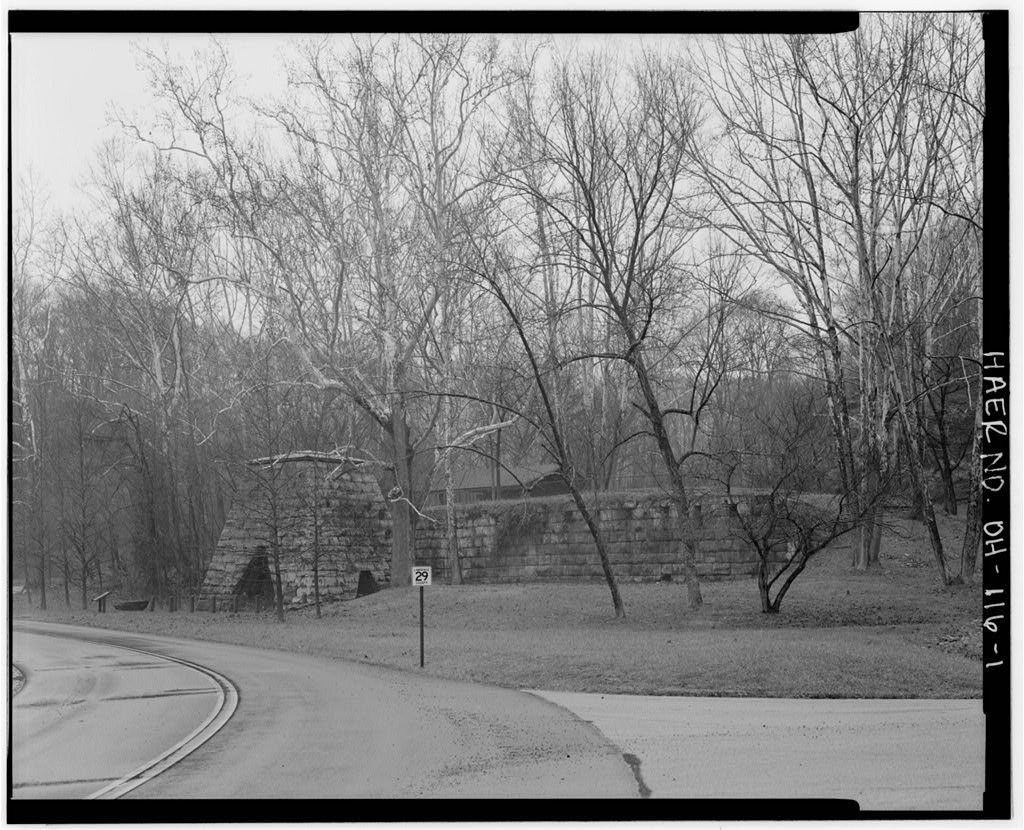
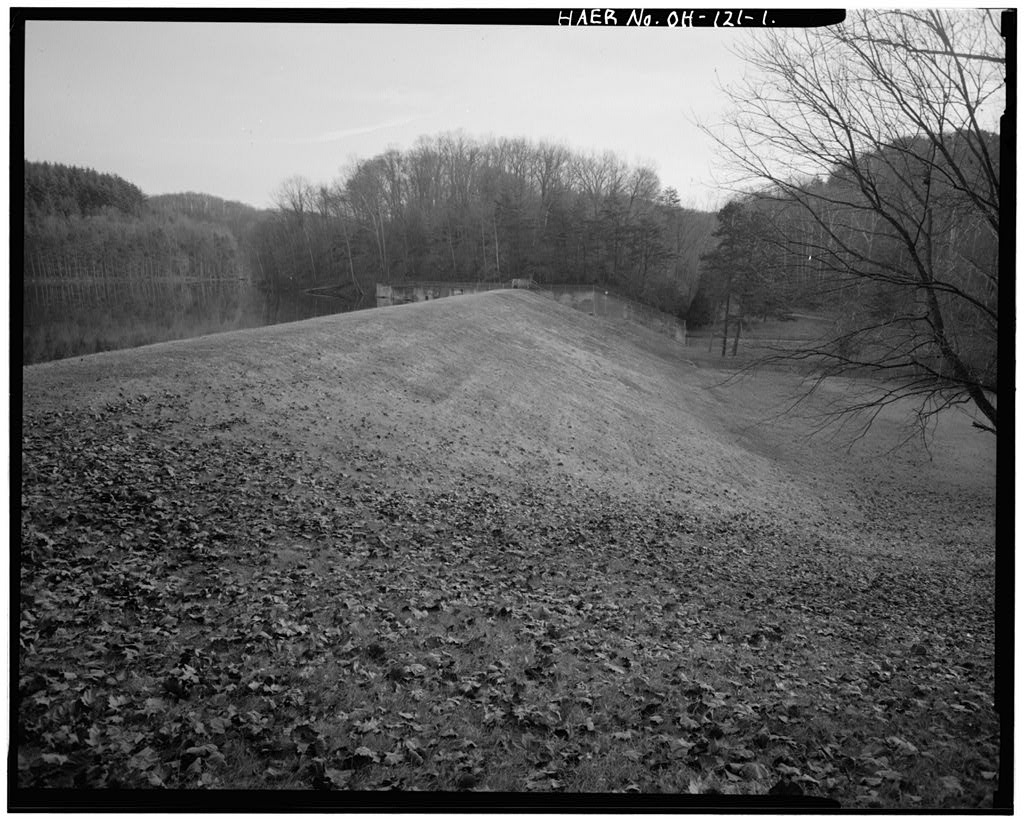
Description : County Road 29 Ironton Vicinity Lawrence County, Ohio USGS Ironton, Ohio Quadrangle 17 Constructed as a charcoal iron furnace, the Vesuvius Iron Furnace is significant for its contribution to the early industry and settlement of Southern Ohio and the American frontier in the early The Vesuvius Iron Furnace site consists of a pyramidal furnace stack and a large earthworks supported by a stone retaining wall. The limestone furnace stack is approximately 28 feet high and contains 17 courses of shaped stone. Dressed stones vary in size but are typically 36" x The structure is approximately 30 feet square at its base and 20 feet square around its rim. There is a central, triangular opening on three of the sides, and a circular opening at the top.
The four corners of the furnace are carefully tooled to crisp corners. The furnace sits within a larger landscape of stone earthworks. The furnace is sited in a lower area to the north side of the complex. A large stone retaining wall separates the furnace from the area of the site above. Accessed by a gradually sloping road from the south, the upper portion of the site is a flat plane approximately deep and long. Behind this plane a shear rock cliff rises approximately To the north of the furnace, a creek curves below the site. The front elevation is on the west side of the structure. On this elevation there is a central opening high and triangular in shape, 11 at the bottom and at the top. This side of the furnace now faces the road.
On the north side elevation there is a central opening high, at the bottom and at the top. The sides of the stone around the opening have tool marks from where they were dressed on the site. The depth of the stone around the opening ranges from on the left to on the right side. To either side of the opening there are two shafts cut into the stone. Both shafts are placed off the ground, with a deep ledge cut into the stone. The shaft to the right is positioned from the opening and is wide. The shaft on the left is positioned from the opening and is wide. This shaft on the left is only 32" from the edge of the structure. Vesuvius Iron Furnace HAERNo. OH-116 (Page 2) The south elevation contains an opening high, 8M M at the bottom, and at the top.
The inside faces of the stone are angled so that the front of the opening is wider than the rear of the opening. The side dimensions are on the left and on the right. Above and to the sides of the opening are two 16* square put holes. The two holes are 0" from the ground and are evenly space apart. The east elevation is the rear of the structure. There is a small ditch extending behind the stack with a stone retaining wall. The retaining wall extends and turns in with corners on both ends. The corners have eroded and do not extend far along the sides of the furnace. On the south side there is between the retaining wall and the furnace. Beyond the small retaining wall to the rear of the furnace there is a larger retaining wall edging the higher area of the furnace works behind.
The larger wall is behind the small wall and is high and wide. The wall extends to the south of the furnace for On the south portion of the wall there is a series of six holes 11 off the ground. The holes are 12" wide and 29" tall. They are evenly spaced 7'- 0*' apart with a central bay. The interior of the furnace has the remnants of the inner circular sleeve. The rear wall of the interior is approximately 20' from the front opening. Many of the interior stones have fallen revealing the rubble infill behind. Stones and rubble lie strewn on the interior floor. In an attempt to preserve the structure from further deterioration, iron grates have been placed on the three openings and a pyramidal metal roof has been placed on top of the structure.
History : The Hanging Rock Iron Region consisted of the iron furnaces and furnace lands of an extended and rich vein of iron ore, limestone, and charcoal located across Southern Ohio and Northern Kentucky. The region is located in Carter, Boyd, and Greenup Counties in Kentucky, and parts of Lawrence, Scioto, Gallia, Jackson, Vinton, and Hocking Counties in Ohio. Elliptical in shape, the district had a length of over 100 miles with a width of over 28 miles. Within these boundaries, nature had located an abundance of all the raw materials necessary for the smelting of iron ore. Vesuvius Iron Furnace HAERNo. OH-116 (Page 3) By the district contained 69 charcoal furnaces and 16 coal fired furnaces.
The first smelting furnace in the district was erected in Greenup County, Kentucky, in by Richard Deering and Trimble Brothers. In the first furnace on the Ohio side of the region was built a few miles above Hanging Rock by James Rogers and Company. These furnaces, the Axgillite Furnace and the Union Furnace, respectively, produced about one ton of ore per day. The success of these two operations resulted in a furnace boom that ended with the completion of the Grant Furnace on the river bank at Ironton in These furnaces brought wealth and industry to Southern Ohio until the last blast of the Jefferson Furnace in December The iron furnace operations became the centers of industrial development in the region.
Constructed in phases, the first 15 stacks were built between Between and another 21 stacks were added in response to railroad improvements. In between these periods of expansion, new furnace construction averaged almost one a year. The activity of construction and industry attracted both capital and labor to the area. The substantial amount of activity drew iron masters from declining regions in Pennsylvania, Virginia, and New Jersey. The production of ore had a tremendous impact on the area and required tremendous natural resources to meet the production of a single furnace. Typically, each furnace produced between and tons of iron a year. The charcoal fuel for a furnace in full production required the annual year timber renewal, the average furnace tract ranged from to acres of forest.
The lumber could not directly fuel the iron ore in the furnace; consequently, charcoal making became an important process of production. To produce charcoal, men known as colliers stacked cut lumber into firing pits. The firing pit was a circular mound, approximately 40 to 50 feet in diameter, constructed on leveled ground. The average pit contained 35 to 45 cords of wood and was 10 to 12 feet high. The pit required constant attention during the 12 to 20 day slow burning process. After ignition, colliers kept the wood covered with dirt and leaves to control the amount of burning. Small amounts of charcoal were drawn off at a time and quenched with water, requiring most pits to be located near streams or creeks.
The remainder of wood in the pit was resealed with dirt and a team of oxen transported the coal back to the furnace. Vesuvius Iron Furnace HAERNo. OH-1I6 (Page 4) Additional labor excavated the ore and limestone needed for the smelting from nearby hills. The mining operation was extensive; with the tenor of the ore running between 25 and 40 percent iron, the furnace required pounds of ore for every ton of iron produced. Using only picks and shovels, miners removed ores with colorful names such as Guinea Fowl, Hallelujah, and Sour Apple. The ore ran from four to eighteen inches in thickness and could be removed up to twelve feet deep by hand. Profitable mining allowed for the removal of one foot of dirt for every one inch of ore.
When an ore seam became unprofitable, the digging crews moved to another hill. For the most part, furnaces were spaced uniformly from three to five miles apart along the outcrops of the iron ore veins. This allowed for the maximum use of the natural resources located within range of any one furnace. Due to better shipping facilities, a large concentration of furnaces were constructed within access of the Ohio River. Even so, the dominant mode of transportation of the raw ore and finished iron was by open ox cart. The quality of iron ore for the Hanging Rock Region was unsurpassed, however, and soon established a high demand.
On the recommendation of John Christopher, a professional mineralogical chemist, the English government bought large amounts of Hanging Rock iron during the Crimean War Christopher performed numerous tests on American and English irons and found Hanging Rock ore superior for the production of ordnance. During the Civil War, area furnaces produced iron for the Swamp Angel, the famous cannon used during the siege of Charleston Harbor, and the plates for the Union ironclad, Monitor. The demand for armaments became so great, in fact, that iron masters began to send off pigs of iron still hot. This practice, unfortunately, had the disastrous effect of setting several wooden carts on fire. Each furnace developed its own community surrounding the output of ore.
The furnace required approximately 100 men and 50 teams of oxen to operate. The laborers came from the older iron fields east of the Allegheny mountains. A large number of Irish, Scotch, English, and German immigrants also found work in the ore mines and charcoal pits. Coming with their families, the influx of labor resulted in the construction of houses, a church, a school, and a company store around each furnace operation. Vesuvius Iron Furnace HAERNo. OH-116 (Page 5) There were a total of 46 charcoal furnaces in Ohio. Lawrence County had the largest number of furnaces with a total of 16. Vesuvius Furnace was a highly successful furnace located in Lawrence County. Built in by Hurd, Gould, and Company, the furnace had a capacity to fire 10 tons of iron a day.
Along with the furnace works, Hurd, Gould, and company owned acres of surrounding land to obtain raw materials. The Vesuvius Furnace was constructed by influential founders of the iron industry in the Hanging Rock Region. Hurd, Gould, and Company consisted of Jacob Hurd, John Gould, Joseph Mills, Glidden Smith, and John Cambell. Cambell owned several furnaces in the region, including Mount Vernon Furnace and Helca Furnace. In he became principle stockholder of the Ohio Iron and Coal Company. In he bought 400 acres of land on the Ohio River and founded the town of Ironton, The stone stack was the most important part of the furnace operation. Quarried nearby, stonemasons dressed each stone to its desired shape on site and erected the outer wall of the stack without mortar.
The inner lining proved a little more difficult. Selected with care, the stone needed to be a fine grained, dense, sandstone with good refractory qualities. The stonemasons carefully dressed the circular battered wall of the furnace, each stone fitting perfectly and laid in a mortar of sand and plastic clay. The stack was a small part of the Vesuvius Furnace. Constructed on two levels, stonemasons built the top of the stack to be even with the level above. The upper level contained numerous storage sheds for keeping charcoal dry with ore and limestone piled in the open. A shed bridge connected the top of the furnace and the upper area. Furnace operators trundled the charcoal, limestone, and ore charge across this bridge to the open top of the furnace stack.
On the lower level, to the left side of the stack, was a pump house used to blast air into the furnace. To the right of the furnace a large blacksmith shop was located to maintain all of the elements of the operation. The casting house was located directly in front of the stone stack. A wooden structure open on three sides, the casting house had a sand floor used to capture molten iron as it funneled out of the central mouth of the furnace. A furnace operator scooped the sand into a ditch with several elongated holes off to each side. The molten iron filled these troughs, which were said to resemble suckling pigs. After it cooled, the "pig iron" was broken off and carted to a shipping destination. Vesuvius Iron Furnace HAERNo.
OH-116 (Page 6) The furnace obtained iron by smelting ore in the stack. The charge of the blast was fairly simple in character. The basic method involved dumping iron ore, limestone, and fuel into the top opening of the stack, igniting it, and blasting air up through the charge to make it hotter. As the ore melted, the iron flowed into troughs dug into the sand in front of the stack. Once cooled, the chunks of iron, known as pigs, were loaded and shipped to foundries in Cincinnati or Pittsburgh. To make one ton of iron required approximately 200 bushels of charcoal, pounds of ore, and 300 pounds of limestone. Vesuvius Furnace gained prominence in as the first furnace to introduce the hot-blast technique. This process consisted of the injection of hot air into the blast instead of cold air.
Placing the boilers and hot blast over the tunnel head, iron masters utilized waste gasses to heat air before being blasted back into the furnace. Under the direction of William Firmstone, the new technique reduced heat requirements and produced larger quantities of iron. The iron masters, including John Cambell, met at Vesuvius and decided to test the theory. With Hurd, Gould and Co. backing the venture, Firmstone installed the blast with stoves located above the stack in the upper bridge and a steam pump and house on the lower level to the left of the stack. Skeptics argued that the hot blast would weaken the iron. The results, however, were satisfactory and iron production continued with the hot blast technique eventually adapted at all furnace sites in Lawrence County.
Vesuvius Furnace produced an abundance of iron ore for eastern markets. After the conversion to hot blast, the production of iron increased to 12 tons per day. In the furnace was owned by Gray, Amos, and Company. Employing 120 men, the furnace produced pig iron suitable for casting rail car wheels, chill rolls, plows, and other heavy machinery. The iron, at this time, was of considerable quality and sold for a ton, considerably more than that produced by other furnaces. The furnace maintained continuous operation until it ceased operations between and In the furnace was rebuilt and resumed operation as a cold blast furnace. By Vesuvius Furnace was the only cold blast furnace in operation in the Hanging Rock Region. The last blast occurred in after which the furnace was dismantled.
Vesuvius iron Furnace HAERNo. OH-116 (Page 7)
 Block
Block