 Block
Block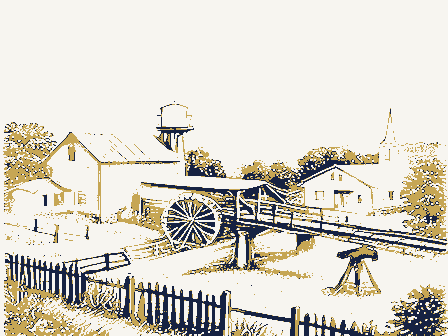
Muskingum Township (part 2 of 2)
Part 2 of 2 of the account of this township in History of Washington County, Ohio, published 1881; History of Marietta and Washington County, Ohio, and Representative Citizens, published 1902. 3,843 words, covering 5 settlements. Source changes inside the text are labelled at the exact paragraph where the next book begins.
Contents
3 sectionsThe section headings the book prints inside this chapter, on this part. Each one jumps to where it begins.
Parts
2 pagesThe source prints this as one continuous account. It is split here so no single page grows too heavy to load; the text runs straight on across the parts and nothing is omitted.
- Part 1
- Part 2
The chapter
3,843 wordsReproduced complete and unedited from History of Washington County, Ohio, published 1881; History of Marietta and Washington County, Ohio, and Representative Citizens, published 1902. The text is machine-read from scans, so expect recognition errors: misspelled names, dropped words, and stray characters. Nothing has been corrected, because correcting a proper name invents one. The headings below are the books' own; source changes are labelled in place.
Mr. Dyar married in February, 1827, Amanda Hall, of Muskingum township. She died June 25, 1837, leaving six children. Augustine, the oldest, was born December 10, 1827; he is married and lives in Muskingum township. Edwin was born February 1, 1829; he died in the south January 29, 1852. Charles C. was born October 22, 1830, died January 24, 1857. Mary was born October 2, 1830; she lives on the homestead. James H. died in youth. Joseph was born February 24, 1836; he lives in Muskingum township. Adelaide was married to General H. F. Devol in 1856, and died at Waterford in 1860. |
Mr. Dyar married for his second wife Abigail Proctor, daughter of Nathan Proctor, of Muskingum township, January 24, 1839. Her father emigrated to Ohio, from Massachusetts, at an early period of the setttlement, and after the Indian war, returned and brought to the county his family. They stopped with hts brother, Jacob Proctor, in Watertown township, and then removed to Barlow as soon as a cabin could be erected. Mr. Proctor made the first improvement in the township, and Abigail (Mrs. Dyar) was the second child born in the township. She was one of seven children. By his second wife Mr. Dyar had three children, two of whom are living, viz: Amelia E., wife of E. N. Cole, of Harmar, born December 28, 1841; and Harriet A., wife of Miles A. Stacey, born December 26, 1844.
Mr. Dyar can look over his possessions with the comforting consciousness that they are the product of his own labor, care, and business sagacity. He has made it a rule in life to attend strictly and closely to his own business and operated on a cash basis. He earned his start, and has never since ventured beyond his ready capital.
In politics he acted with the Democrats until 1856, since when he has been a Republican. He has never connected himself with any organized society.
James S. Stowe
Erastus Stowe, father of the subject of this sketch, was born at Cooverstown, New York. While yet a child, one of the celebrated Indian massacres of the Revolution occurred in that valley, and both his parents were murdered by the savage woodsmen. The child was carried away and left in a corn field and there found by Abijah Hubble who adcpted him into his family. About 1800, Mr. Stowe, then more than twenty years old, came with the Hubble family to Ohio, and settled in Meigs county. He married in Meigs county, Jane Smith, a daughter of James Smith, who, like many others, sold his property in New England, in the hope of bettering his condition by joining the Ohio emigrants, but also like many others, he received for his property continental money and was in consequence reduced to penury. 'The family lived at the Marietta garrison during the Indian war and afterwards settled in Meigs county. Mr. Stowe, after he was married, engaged in farming. He died in Meigs county at the age of sixty-five years; his wife died at the age of ninety-three years.
James S. Stowe, whose portrait appears above, was the oldest son of Erastus Stowe, and was born in Meigs county, in 1806. He was a spirited youth and never afraid to undertake anything assigned for him to do. His services were always iz: demand on the farms in the neighborhood. When a small boy, he made a lonely trip on horseback through the cow-paths in the woods to Athens to mill; at the age of seventeen he was apprenticed to a cabinet-maker, in Gallipolis. He was sadly afflicted with homesickness, which the religious practices of his boss were not calculated to alleviate, and, as he expressed it, "the man fortunately died soon," being stricken with the prevailing epidemic. He returned home and was variously employed in Meigs county until the age of twenty, when he began work for his uncle, Sardine Stone, in Muskingum township. At the end of five years he became impatient and affected an arrangement by which the Stone farm came into his possession.
In 1829, Mr. Stowe began flat-boating - a business which he pursued with great profit for more than thirty years. The first load was fitted out at an expense of five hundred dollars, which was borrowed for the purpose. The load was disposed of at a profit-of three hundred dollars. This was the beginning of a long and successful business career. Every planter along the river knew Smith Stowe. He had the reputation of being a sharp but honest dealer. In all his experience he never lost money on a season's trade. But the winter of 1861 was full of danger for flat-boatmen. The opening of rebel lion is characterized by a certain enthusiasm which is worn off by the fatigue of military movements. Mr. Stowe, although well acquainted, did not escape the general threat against Ohio men and abolitionists. At Lake Providence an incident occurred which shows the spirit of the times in the south and also Mr. Stowe's sagacity. The boat was tied up at the shore and he had been doing considerable trading when the news came of the secession of South Carolina. The community was thrown into a whirlwind of excitement, and flat-boatmen notified that it was unsafe for them toremain. Mr. Stowe fastened a line to the bottom of his boat, where it could not be seen. That night the main line was cut, and when he appeared on the roof a shot was fired. The next morning a deputation waited on him and warned him against remaining, declaring that "no Lincoln abolitionists could land at their shores." He was given till four o'clock to leave. This is one of many similar incidents which shows the feeling at the south during the formation of the confederacy. One fact is worthy of mention in connection with the subject of this sketch in regard to the use of fire-arms. He has been down the Mississippi and up Red river and in the most dangerous parts of the south at the most dangerous times, and yet has never owned a revolver or cafried a firearm. Mr. Stowe, in connection with the produce trade, carried on farming and milling. He always kept things moving, employed hands and paid them and in that way has been a useful man in his community. His first possession was the Stone farm, but since then he has invested as much as ninety thousand dollars in land lying in the fine bottom within the bow of the Muskingum, just above Devol's dam, and forty thousand dollars in farms in the Rainbow bottom. He has made his money by industrious, hard work and sharp dealing. He attributes a large measure of his success to punctuality, whether working by the day in his boyhood, or in business transactions throughout life.
Mr. Stowe was married in 1830, to Anne Meriam of Lowell, by whom he had six children; four of whom are now living: Sardine, Nancy (Marshall), Diantha (Devol), and Seldon. Mrs. Stowe died in 1842. In 1843 he married for his second wife, Mrs. Eliza Ferrin, daughter of Freeman Davis, and widow of Davis Ferrin. She had by her first husband one son, Liman Ferrin, who was killed in the war. By Mr. Stowe she had five children, viz.: Charles, died in 1866; Lucy (Drake), Dudley, J. Smith, and Pitt. All the children live on farms within the sound of the dinner-bell at their parents' house, except J. Smith, who is in business at Marietta.
Source changes here: from History of Marietta and Washington County, Ohio, and Representative Citizens, by Andrews, Martin Register, published 1902; 2,588 words in this source stream.
Muskingum Township
The territory embraced in Muskingum township was formerly embraced in Adams township as established by the Court of Quarter Sessions convened at Marietta in March, 1797. Ever since the formation of old Adams township, it has been crumbling away to establish the several northern townships and prior to the year 1861 Muskingum township was included within the limiits of Marietta, Fearing and Union townships. Tlie name "Muskingum'" is appropriately derived from the river which runs through the extent oi the township.
Section I. Be it enacted by the General Assembly of the Stiite of Ohic . That the territory now constituting parts of the townships of Marietta, Union, and Fearing, in tlie county of Washington and bounded as follows, to-wit: Beginning at a point on the Muskingutn River, where the same is intersected by the west line of a seventy-eight acre lot, numbered sixteen, in Bear Creek allottment of donation lands, running thence south on said line to the southwest corner of said lot numbered sixteen, thence west to the imrtliwesr corner of an eighty-five acre lot, numbered twenty-two, in Rainbow Creek allottment of donation lands, thence south on the west line of said lot numbered twenty-two, to the north line of Wiseman's botton: allottment of the donation lands, thence east on said line to the Muskingum River, thence down said river on the west bank thereof until the same is intersected hy the west line of one hundred and sixty r.cre lot, numbered four hundred, thence south on said line and its continuation to the south line of township numbered three, in range numbered eight, thence east on said line to the east bank of the Muskingum River,- thence down said river to the south line of commons lot numbered twenty-fight, thence northeasterly along the corporation line of tlu city of Marietta to the southwest corner <*{ -.nuii.ms lot nunrbered seventeen, thence easterly abuig the south line of commons lot numbered seventeen, to the southwest .corner of commons lot numbered twelve, thence easterly along the south line of commons lot numbered twelve, to the southwest corner of commons lot numbered fourteen, thence north on the line of original survey to the south line of Fearing township, thence east on said line to the east line of three acre lot numbered three hundred and two, thence north on the east line of a range of three acre lots numbered three hundred and eighty-nine, thence west to the cast line of section numljered twentyfive in township numbered three, of range eight, thence north on the section line to the south line of Salem township, thence west on said township line to Bear Creek, 'thence down said creek to the Muskingum River, thence up said river to a point due north of the place of beginning, thence south across the river to ths place of beginning, be and the same is hereby erected and constituted into a new township to be designated as Muskingum township, and that the eastern boundary of Union township, the western boundary of Fearing township, and the northern boundary oi Marietta township be so changed as to conform to the lines of said Muskingum township.
The boundaries of the newly-established Muskingum township, as thus defined, still exist and the township, then as now, is bounded on the north by Adams and Salem, on the east by Fearing and Marietta, on the south by Marietta city and township and Warren, and on the west by Watertown.
A petition was presented to the Board of County Commissioners at the June session in 1877, praying for the dissolution of Union township. At the commissioners' December session of the same year the following was ordered :
The petitioners having made application at the Juiie session of 1877 for the partition of Union township among the townships of Adams, Muskingum. Warren and Watertown, and the board being of the opinion that it is necessary and expedient that the prayer of said petitioners be granted, hereby order that said Union township be divided, and annexed to the adjoining townships - Watertown, Adams and Muskingum.
And Representative Citizens
northeast corner of one hundred and sixty acre lot No. 392, west to the northwest corner of said lot No. 392, thence north to Wiseman's Bottom, thence east to the Muskingum River, thence following the course of the Muskingum to the northeast corner of one hundred and sixty acre lot No. 413, thence south to the place of beginning, containing section eight, one hundred and sixty acre lot No. 413, part of Donation line (lot No. 418) and all of Wiseman's Bottom allottment that lies in Union township.
Xatiirally the fertile bottoms of the "donation" land weie the centers of the first settlemerits, and so we find that the first settlements in Muskinguml township were made in Rfiiinbow and Wiseman's bottoms. l%ese bottoms were named for the backwoodsman, Wisen-tan. who entered about 400 acres of bottom) land lying along tlie Muskiiiigum while Virginia still claimed the right to the Northwest Territory. Wiseman disappeared after remaining long enough to give his name to the neighborhood. Tlie Kainbow settleinent was begun April 29, 1795, by a company of scA'eral families from Marietta, wdio had drawn land located on the western shore of the Muskingum River. On the farm now owned by J. E. and A. R. Stacy, a hlock-house was erected. Tliis was centrally located and served as a shelter anid (protecting roof until the cabins could 1>e built.
The first settlers in Rainbow were Israel Stone and family. He located on the farm now owned b}- the S. S. Stowe heirs. Other early settlers were Stq^hen Smith, E'benezer Nye and sons, Simon Wright, Archibald and Mary Lake, Captain and Mrs. Abel Mathews and family, Williani Stacy and Joseph Stacy, sons of Col. William Stacy, Preserved' Seamfon, Cogswell Olney, John Dyar, Sr.
The territory forming the eastern boundary oif the township and known as "the ridge," because it divides the waters of Diick Creek from the Muskingum, was not generally settled until a comparatively recent date.
ascertained was Miss Esther Levings. Abigail Poole was in all probability the next. She was followed b}- Theophilus Cotton. Not long after the erection of the school house on the ri\'er it was found that the building was too near the water and liable to be surrounded during a heavy rise in the river. On this account it was deemed advisable to remove the school house farther back on higher ground. Accordingly this was done, the building being located on Israel Putnam's farm, where, in 1816, through Mr. Putnam's instrumentality, a conmiodious brick school house was erected,, which served the do'uble purpose of school house and church. In this building the people of the neighborhood continued to worship for a number of years. The people were of various denominations, Ixit in those early days they worshiped in common. Rev. Joseph Willard, an Episcopal clergymian of talent, is remen-^bered to have been the first minister who preached in the school house. When the school house was first moved back from the river the teachers were Colonel Stone, Mr. Brown, of New England, a ]\Ir. Allen, and perhaps others.' Whipple Spooner was the first teacher in the brick house.
In early times Rainbow had two* neighborhood school houses, which, in this modern day, have been consolidated into one. These were what were known as the "upper" and "lower" school houses, the former being located on the Mkiskingmn, not far from Stephen Smith's place, and the latter being on the site of the presait school house of the neigh borhoo<l, imni.ediately in the 1x)av of the river.
Nathaniel Dodge is said tO' have been the first teacher in the "lower'' school. The first teacher in the "upper" school was I\Ir. Walbridge.
An interesting document testifying to the Christian fidelity of the early pioneers in jMuskingum township is an old subscription paper drawn up in 1810, which appears to be in the handwriting of Col. Joseph Barker. The obtject of the subscription was to establish divine worship in Rainbow and ^\^iseman's Bottom. None of those whose names ap|>pear below are now living. It reads thus :
Please pay in money or produce to Mr. Thomas Lake, on or before the fifteenth day of December next, for the purpose of introducing the regular preaching of the Gospel of Jesus Christ, and for inculcating and introducing habits of good order, morality and piety, by holding up to public view examples worthy the imitation and practice of tlie rising generation.
The only churches in the township are the Gernmn Church on "the Ridge" and the Colored "SI. E. Church on Rainbow Creek. "The Putnam-Rain'bow branch" of the First Congregational Church at Marietta holds services in the Putnam and Rainlx>w school houses on alternate Sundays.
In i.Soj Captain Devol erected a very large frame flouring irill near where the present mill now stands. Its large under-shot wheel is said to have been more than 40 feet in diameter, it being the largest mill-wheel e\'eT seen in the West. In 1866 ]M]ajor Putnaml erected the mill at Devol's Dam', whicli was considered the best mill on the river.
The community in Wiseman's Bottom was fortunate in ha\-ing among its members two m^en of such marked mechanical skill as Col. Joseph Barker and Capt. Jonathan Devol. Both of them were skilled architects. Captain Devol being a shipwrig-ht by trade, and Colonel Barker a house-builder. About the year 1800, shipbuilding ha\ing become an important industry at Marietta and on the Muskingum, these men readily took part in the work for which they were so well adapted by previous education and natural skill. The dense forests on either side of the river furnished excellc-.n material for the work. Giant oaks were felled, and under the skillful hands of these me'-i were joined together and moulded into symmetrical shape. Noting first the work of Colonel Barker, we find that his shipyard was on his farm on the east bank of the Muskingum. In 1802 he constructed two ocean vessels. One was a brig, built for Messrs. Blennerhassett and Woodbridge, and named the "Dominic." after the name of M'r. Blennetiiassett's oldest son. The other was a schooner called the "Indiana." This last-named vessel, together with the "Louisa," built in 1803. were for E. W. Tupper of Marietta. During the fall of 1806 he was employed by Harman Blennerhassett tO' construct 15 large bateaux for the use of the expedition of Aaron Burr to Mexico. The fate of these boats and this intended expedition is more fully described elsewhere in this work.
Captain Devol's ship-building was quite extensive. He also worked along the Muskingun upon his farm. In 1801 he 'built a sloop of 200 tons for B. I. Gilman. a merchant of Marietta. The vessel was wholly constructed of black walnut, and was named after the river by whose side it was built. In 1802 he built two brigs of 200 tons each, the "Eliza Greene" and the "Ohio." In 1804 the schooner "Nonpareil" was built. The passage of the "Emibargo Act," in 1807, suspended all further operations on this line.
Is beautifully situated near the Ahiskingum River in Muskingum township. The Home is situated on the east bank of the Muskingum River, about one mile north of the corporation line of the city of Marietta. It is the first Hornlp in the State estabHshed under the act of the Legislature passed March 20, 1866, the act itself being a response to petitions from this county.
The farm contains aljout 100 acres favorably located, and from the buildings and grounds is presented a beautiful and picturesque view of die Miiskingum Valley.
The object, as carried out, has been to afford ail asylum to indigent children of the county under the age of 16 years, until suitable bomes can be provided for them with kindly disposed persons, arel all reasonable efforts are made for their improvement in industriuus habits and morals while the}- remain in the Honie. Children from other counties ma}- al^o be admitted on terms approved by the trustees.
At the June session of 1866, following the passage of the act authorizing Children's Homes, the Board of County Con'missioiiers - Messrs. J. J. Hollister, Dr. James Little and George Benedict - initiated proceedings for the selection of suitable premises for the permanent location O'f the Home which resulted in the selection of the present site and a contract was made for its purchase. At the sanre session Cof. \V. R. Putnam, W. S. Ward and F. A. Wheeler, EJscis., were appointed the first Board of Trustees. Prior to this time. Miss Catherine A. Fay had about 30 children at her "Hbmie" in Lawrence township under aii arrangement made with her by the directors of the County Infirmary, who were ready to be transfeired to the new Home as soon as the buildings cotdd be made ready for occupation, which occurred April i, 1867.
Tlie first matron, with many of the responsibilities of superintendent, was Mrs. A. G. Brown, who discharged her duties successfully one year.
Mrs. Blown was succeeded by R-ev. Ira M.. Preston and v,-ife, who resigned at the close of their year, and were followed by Dr. S. D, Hart and wife, who were continued superintendent and matron from April i, 1869, until the lamented death of Mrs. Hart, August 27, 1884. In-amediately afterward Dr. Hart was asked to contimue as superintendent, and Miss
E. A. Nixon, wlio had been teacher since 1870, wias promloted to be matron, a place her long experience in the Home greatly aided her to fill to the entire satisfaction of the tru.stees. Dr. Hart was succeeded by S. L. Grosvenor. and he in turn by J. N. Bell. After the death of Mir. Bell, Principal J. L. Jordan of the Harniar public schools, was elected superintendent and is still in charge. Afrs. Jordan is matron. In the presait Board of Trustees are S. J. Hathaway, president ; L. W. Ellenwood, W. F. Robertson, and W. A. Snififen. Mr. Hathav\^ay is the senior member in years of ser-i-ice. About 1889 the system oif assigning children to homes was revolutionized. Since that time instead of waiting for people to coane and select children, homes have been sought through the aid of the Cincinnati Chiklren's Homje, a private institution under strong- Christian influence. Tlie Cincinnati institution employs an agent and visitors to seek homes for children. He follows up the children thus placed, visits them at least once a year until they are 21, and reports to the trustees of the Home in Washington County. The result has been, that while the number passing through the Home every year has increased, he number of inmates at any one tin\e has been much smJaller. The County Children's Horrje is made a stopping place until another home can be found in a good family.
Tlie first building used as a Home was a large two story brick, originally constructed by Prof. Samuel Maxwell as an advanced school for bo}-s, the cost of the fami and Ixiildings being at the time $18,000. Subsecpient additions and buildings have been made so that the value of the premises now is estin'Jated at $30.- 000. One large building of three stories has been erected, the first floor being used as a school roon-j, and the second and third as a dormitory for the lx>}-s. A \-iew of the Home is presented on a preceding page, in connection with a mJore extended notice of the origin of the Home.
Provenance
Text from History of Washington County, Ohio, published 1881; History of Marietta and Washington County, Ohio, and Representative Citizens, published 1902, in the public domain in the United States and digitised by the Internet Archive. The settlements listed against this township are matched by point-in-polygon test of each Geographic Names Information System coordinate against the Census Bureau's county subdivision boundary, not by name.