 Block
Block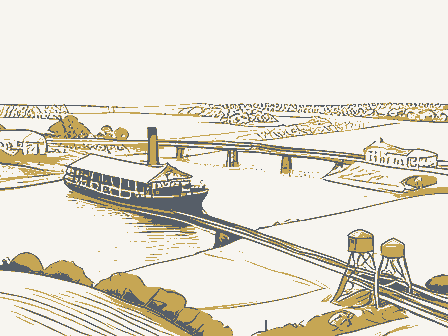
Portsmouth City
The complete chapter on this township from A History of Scioto County, Ohio,, published in 1903. 2,591 words, covering 4 settlements.
Contents
4 sectionsThe section headings the book prints inside this chapter. Each one jumps to where it begins.
The modern record here
4 settlementsWhat the federal record holds for each settlement inside this township: wildfires and storm reports since the 1950s, mineral workings, and museum specimens collected nearby. These are counted within a few miles of each settlement, so neighbours share them and the columns are deliberately not added up. Every row links to the settlement's own page, where each figure is broken out.
| Settlement | Fires | Storm reports | Mines and quarries | Specimens |
|---|---|---|---|---|
| East Portsmouth (historical) | 122 | - | 7 | 1,054 |
| North Moreland | 111 | - | 6 | 1,092 |
| Portsmouth | 133 | 98 | 4 | 1,313 |
| Sciotoville | 114 | 10 | 7 | 871 |
Settlements in this township
4 placesEvery populated place the Geographic Names Information System records inside this township's Census boundary. 0 of the 4 are named in the chapter; the rest were founded later or were never more than a post office.
The chapter
2,591 wordsReproduced complete and unedited. The text is machine-read from a scan of the 1903 printing, so expect the errors a machine makes reading a century-old page: misspelled names, dropped words, stray characters. Nothing has been corrected, because correcting a proper name invents one. The headings below are the book's own.
Also, Every Variety Of English And American Hardware
Plans, Specifications and Detail Drawings furnished lor Piblic or Private Euildings, of all kinds, on short notice, and at reasonable terms. Accurate Estimates given in all cases. No Extra Bills to be collected at the completion of a contract by reason of inaccurate or impracticable Drawings and Specifications.
Portsmouth, Ohio Wholesale
Portsmouth is situated on the Ohio river, 116 miles above Cincinnati, at the mouth of the Scioto river, which flows from the centre of this great State through valleys unequalled in fertility, and of such extent as to add largely to our National exports. It is also the southern terminus of the Ohio Canal, thus affording a direct water communication between the South and West, and North and East; also of the Hocking Valley Railroad, long since constructed, and the Scioto Valley Road, now being completed from Columbus to this city. It will also necessarily form an important point in the extension of the Chesapeake and Ohio Railroad, now completed from Norfolk, Virginia, to Huntington, West Virginia, on the Ohio river, forty-five miles above this city, in its connection with the Northwest, and its point of divergence to strike the Southern Pacific Railroad. It is also probable that, either by public or private means, the James River and Kanawha Canal will be completed at no distant day,, and Portsmouth will then be the central point of three great water lines to the sea, and, as we shall proceed to show, naturally and artificially, the best entrepot of the trade, of a large and rich district of country, as it now is.
While, as we have said, Portsmouth is one hundred and sixteen miles nearer than Cincinnati to the Atlantic seaports, the navigation of the river from New Orleans to the former is as good as to the latter, in all stages of water, while there is no important point above to which it is not obstructed by low water, or ice. None, in fact, approaching it in business or population, nearer than Wheeling, two hundred and seventy miles above,
[2] while serious bars exist within thirty miles ; thus making Portsmouth the most eligible port for the import and transhipment of the vast sugars, coffees, fruits, tobaccos, and spices of the islands and South America ; the cotton, sugars aud fruits of the South, and for sending off in large vessels the minerals and products of the North.
The following steamboats arrive at this port and depart on their regular days, making this the terminus of their routes, viz: Potomac, Cincinnati to Portsmouth, tri-weekly ; Carrie, Portsmouth, to Concord, daily; Handy, Portsmouth to Rome, daily; Fannie Dugan, daily, between Portsmouth and Guyandotte . Scioto, daily, between Portsmouth and Huntington; Granite State, between Portsmouth aud Pittsburg, weekly. Thus, we have four boats daily, one tri-weekly, and one weekly, that end their trips at this city; those above being lighter, and often obstructed by low water. Towboats and barges also arrive frequently from the Mississippi, with ores for exchange. The following boats land and do a large business here, viz : Fleetwood and Bostona, Cincinnati to Huntington, daily; Ohio No. 4, Tele, graph and St. James, Cincinnati to Pomeroy, making a daily line; Hudson and Andes, Cincinnati, to Wheeling, tri-weekly line; Julia No. 2, Cincinnati to Charleston, W. Va., weekly; Emma Graham, Cincinnati to Pittsburg, weekly. These comprise the boats that now navigate the river, except occasional towboats.
Such is the present importance of the city, so far as the business of the river is concerned; but it is the general opinion that the effect of the improvement at the mouth of the Mississippi will be to insure the building of a class of low-pressure boats that will navigate the Gulf and the large rivers, exchanging our iron, coal aud produce for that of the islands and Gulf coasts without breakiug bulk between the points. From her position relative to navigation and avenues of interior trade, as well as from her mineral wealth aud manufactures, Portsmouth would necessarily be the terminus of such Ohio river lines, distributing by other meaus of transport the imports, and able to give return freights of iron, machinery and agricultural implements. A glance at the map will show that this trade must extend through
Ohio, Eastern Kentucky, West Virginia, and Western Pennsyl. vania, all of which are now much dependent upon Portsmouth for their trade, and the intimacy of that connection is daily increasing.
In this connection, we should do injustice to our cause did we not name the projected Portsmouth and Pound Gap Railroad, which has attracted much attention, both here and alone the line, one hundred and sixty-eight miles, through Kentucky to Pound Gap, in the Cumberland mountains, about thirty miles east of the well-known Cumberland Gap. This road extends through coal and iron deposits the whole distance - is surveyed, and all preliminary work done. Deposits of iron at one poiut on the road are pronounced by competent geologists only inferior to those of Lake Superior or Missouri. Of this rich region, Portsmouth must become the commercial and manufacturing centre, alike from her location and past progress.
Portsmouth And Its Environs
Portsmouth is situated upon a bluff, which extends several miles eastward from the Scioto River, above the highest water, and is one of the most beautiful and healthy locations, with a temperate and pleasant climate. Hon. T. H. Benton once justly said that the buffalo and the Indian were the best engineers and land agents, selecting nature's routes and the best lands. Not only these, but the traces of a pre-historic race, and the behemoth and mammoth abound more extensively in and around our city than anywhere else in the State. It was also early settled by an industrious and economical people, depending on their owu resources, and without asking or receiving any aid from the National or State Governments, or from foreign capital ; has grown to a population, according to the local census of 1875, of 13,731, with manufactures within the city amounting to $4,202,140 annually, her wholesale trade to $7,069,185, of which the value of foreign products exceeds two millions, now necessarily bought at second hand for want of a Port of Entry; while the entire business of the city exceeds fourteen millions of dollars annually. Our well-supported churches number twenty-seven, of almost all denominations. The public schools of the city are thirty-seven, with thirty-nine competent teachers, occupying six large buildings, including one being erected for a colored school, at a cost of $12,500, the whole schools being supported at an annual cost to the city for teachers and incidentals of $27,000. We have also a large and prosperous ladies' seminary, aud several private schools, with a Children's Home, costing $30,000. In 1871, the last year of which we have full data, the public aud private improvements amounted to $637,630. The city water works, with eleven miles of pipe, cost $150,000 ; gas works, with thirteen miles, cost $160,000, and several miles of street railroad are now being completed.
Internal Revenue. - The internal revenue collected from this, the Eleventh District, as we learn from Col. B. F. Coates, Collector, was, during the last fiscal year, $805,018.30, and while the District consisted of Scioto, Lawrence, Vinton, Jackson, Adams and Gallia Counties, including the cities of Ironton and Gallipolis, the city of Portsmouth alone paid $750,000 of that, or nearly fourteen-fifteeuths of the whole. The District now includes what was the Twelfth, being the Counties of Pike, Ross, Hocking, Pickaway, Fairfield and Perry, which last year paid $424,928.10. The estimates for the current year for the whole District, are $1,250,000, of which Portsmouth alone will pay nearly three-fifths, as she has paid that proportion of the $13.- 556,555.86 collected since 1862, of which none has been expeuded here.
Is twenty by thirty miles square, and is as rich as any District of the size in the West, in agricultural and mineral wealth. The Scioto Valley is broad, annually overflowed, and thus kept surpassingly fertile. The western portiou of the county, as well as some of the eastern, is still well timbered, while the eastern portiou, though hilly, is kept fertile by the fact that its soil is a calcareous loam, continually renewed by the underlying limestone. The timber of portions of the county is well preserved, and the adjoiniug counties in Ohio, Kentucky and West Virginia, are abundantly supplied with the best of oak, poplar, ash, walnut?
8tone. - In the whole western part of the County are valuable deposits of the best building stone, of beautiful drab and brown, receiving a perfect finish, and more valuable as building stone than most of the celebrated Waverly, or the Connecticut brown stone, being more durable. It was used in the suspension bridge piers at Cincinnati, and supplies the whole demand of that city for building and flagging. It is also sent to Chicago, Cleveland and New York for building purposes.
In the north part of the county is a large deposit of Burr stone, prouounced by Mr. Mather, late State Geologist, to be superior to any except the French Burr. East of the river are deposits of fire clay of the best quality a«d inexhaustible in quantity, the manufactures from which supply this city, Cincinnati, and nearly all the cities on the Ohio and Mississippi rivers. They also supply Chicago, and many thousands are annually sent West as far as Utah, and sold in all the principal cities in Ohio, Indiana, Illinois, and Michigan. There are niue manufactories in our immediate vicinity, principally owned in this city, which supply fifty thousand of these brick per day, or about fifteen millions annually. 80 great is the supply of fire clay of the be9t quality, that the manufacture can be trebled, and yet the supply last thousands of years.
A portion of the rock in the region is so perfect an argillaceous sand-stone, or nearly silicate of alumina, that it is largely used at home and abroad for fire-beds and cupolas to furnaces; supplies Tennessee for that purpose, and cargoes have been sent to Oregon. The deposits of coarse sandstone are very large and valuable - are, and will be, used for furnaces, as well as other buildings. The deposits of blue, white, and ferriferous limestone are also large in the eastern part of the county and not the least valuable of her vast deposits.
Iron and Coal. - Upon these deposits, in their abundance and their superior quality, we might rest our claims to your action, had we no other, as the facility they give for the manufacture of iron over anywhere else in the country, insure us heavy exports by means of our routes to the seaboards, bringing back imports to a like extent. Within an average of less than thirty miles of Portsmouth, and mainly dependent upon it for trade, are fiftyseven furnaces, each manufacturing 2,500 tons annually - an aggregate of 142,500 tons of the best pig iron, known as the Hanging Rock, of which the iron and steel was made, which, in the late war, covered our Mississippi gun- boats, and protected them from Forts Henry and Douelson's Confederate balls. It is remarkable for its body, strength and tenacity, and largely sup. plies Wheeling, Steuben ville, Pittsburg, Cincinnati, Cleveland, Chicago, Detroit and Buffalo. The demand is only limited by the present capacity of the furnaces, which will be much increased as soon as the manufacturing sites are opened to the world by railroads. Prof. Briggs, State Geologist, some years ago, stated that the counties of Scioto, Lawrence, and Jackson were able to supply 400,000 tons of this superior iron annually for 2,700 years, and as much more has been since developed. Four other Ohio counties adjoining these are richly supplied, and a greater scope in eastern Kentucky and West Virginia, until it is forced upon us that this immediate region, to all of which Portsmouth is the commercial and manufacturing centre, is unsurpassed in its capacity for iron manufacture by any section of the country. Such developments are now being made in the eastern part of this county - finding all varieties of ore, coal, and limestone in the same hill - as prove that the best quality of iron can be manufactured at the lowest price possible in any locality. In this connection we call your attention to the following facts embraced in the statistical report of the Secretary of the'National Iron Masters' Convention, held in Philadelphia in 1875. "Imports of iron and steel and the manufactures thereof iu 1874, $24,600,720; being a reduction from $61,724,237 in 1872. The direct exports of the same for the year 1874 were $20,460,752, an increase from 1873 of nearly four millions," and showing a regular increase of about two millions annually for several years. He also remarks that the greatest increase in the manufacture of iron with bituminous coal is in South-eastern Ohio. The recent discoveries of black band ore, among the other varieties, further adds to our conviction that large exports, a6 well as imports, must find here their most valuable interior port, and that, if the Government desires economy, as well as convenience in her own iron manufactures, all things point to this as the best and cheapest place for the establishment of a National Armory, or removal of the same from points where the manufacture is necessarily more expensive.
Charcoal has hitherto been used here for the manufacture of iron very extensively, and the supply is still large, and will always be sufficient for this manufacture, when desired, as the nature of the soil and climate is such as to renew the forest growth with remarkable rapidity.
Bituminous Coal. - The quantity of coal of the sulphurless variety, and well calculated for the manufacture of iron in the raw state, and other coals, is greatly beyond any possible demand. Prof. Briggs, in his Geological report, says: "This belt of coal is equivalent to fifty miles in length, five miles in width, and nine feet .thick, and will yield nine millions of tons per square mile. Prof. Mather endorses this, and says: "This coal is very pure, yielding but little ash or residuum, and has scarce a trace of sulphur." A recent development of this coal and iron in this county has been examined by a scientific and practical Committee of this Board, who report that in all the numerous hills, in some five miles square, which they examined, they found nineteen feet ot pure coal, which by a railroad of less than twenty miles, can be delivered in this city at $1.40 per ton, or 5 cents the bushel, and to manufactures for a less price.
Labor. - The cost of good and free labor depends upon health, comfort of climate, cost of food and clothing, churches and schools. As we have shown, these are all that labor can desire, therefore labor here is fully as cheap as at any other place in the country, and yields more comfort for the same money.
The facts we have presented render this cityone of the most safe and desirable points in the country for the location of capital or manufactures of any description, and they will be welcomed here by an eminently refined, social and friendly people.
Over Iron National Bank
Parties desiring to buy or sell Real Estate in city or county, and those who have Timber or Mineral Lands for sale, or who desire to purchase, are respectfully invited to correspond with us, as ours is the only accredited Agency in this section. References - To any business men of Portsmouth.
Provenance
Text from A History of Scioto County, Ohio,, by Evans, Nelson W. (Nelson Wiley), published 1903 and in the public domain in the United States. Digitised by the Internet Archive. The settlements listed against this township are matched by point-in-polygon test of each Geographic Names Information System coordinate against the Census Bureau's county subdivision boundary, not by name.