 Block
Denmark, Illinois
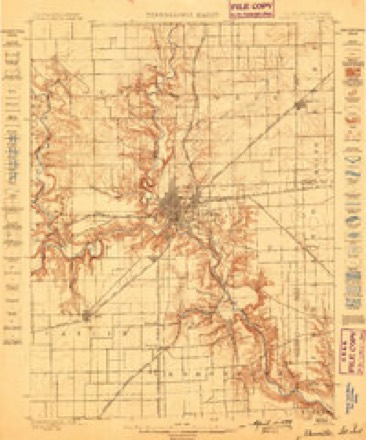
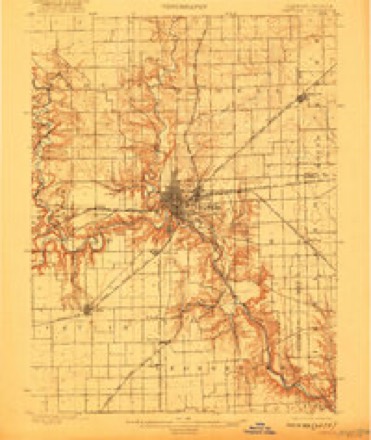
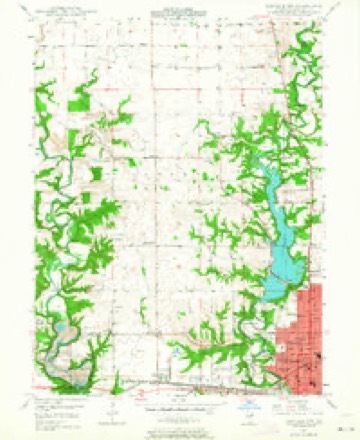
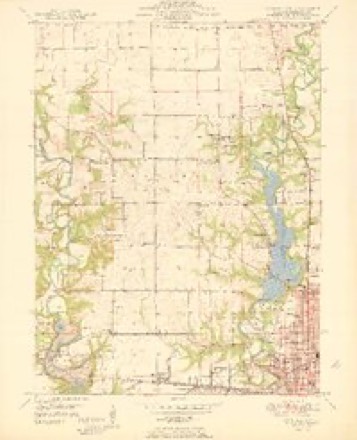
19 topographic sheets cover this place, the earliest surveyed in 1899 and the latest in 1987. It stands in Newell Township. It lies in ZIP code area 61832. The Survey maps it on the Danville NW quadrangle. The federal gazetteer marks this settlement historical: it is no longer a populated place, though the surveys that recorded it still are.
Topographic sheets covering this place
10 surveys from 19 printed sheetsMatched by testing this settlement's coordinate against the published boundary of every sheet in the United States Geological Survey's historical collection. Each opens the scanned sheet at the Survey.
- 1899 USGS Danville quadrangle1:62500
- 1900 USGS Danville quadrangle1:62500, 7 printings
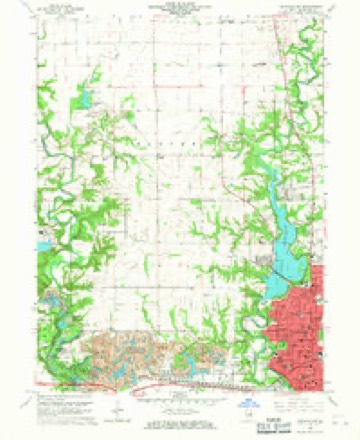
- 1948 USGS Danville NW quadrangle1:24000
- 1950 USGS Danville NW quadrangle1:24000
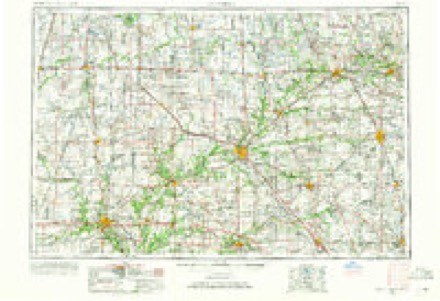
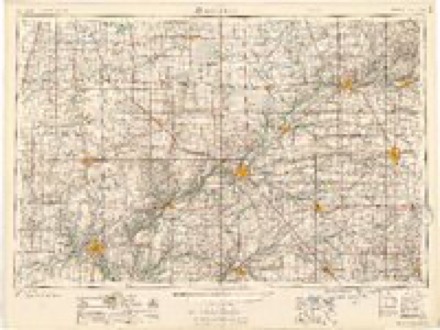
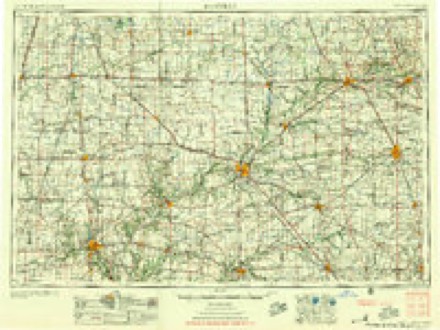
- 1953 USGS Danville quadrangle1:250000, 3 printings
- 1955 USGS Danville quadrangle1:250000
- 1956 USGS Danville quadrangle1:250000
- 1966 USGS Danville NW quadrangle1:24000, 2 printings
- 1984 USGS Danville quadrangle1:100000
- 1987 USGS Danville quadrangle1:100000
In the county-history sources
21,866 words on this townshipHistory of Vermilion County, Together with Historic Notes on the Northwest, Gleaned from Early Authors, Old Maps and Manuscripts, Private and Official Correspondence, and Other Authentic, Though, for the Most Part, Out-of-the-way Sources, published 1879 names this settlement in its chapter on Newell Township. These are the passages that mention it, exactly as the scans read.
The pioneers were early attracted to this section of country. Its rich soil, pure water, abundant timber, and picturesque configuration, afforded strong inducements to them to accept with cheerfulness the deprivations of the border. The earlier settlers came mostly from Ohio and Kentucky. In those theaters of stirring experience they had been trained to vigorous exercise and ingenious resource. Their capital - steady and industrious habits, strong wills and constitutions - was the best for the times and the circumstances; with little else, they came to build homes and to gather around them the ordinary conveniences of civilized life. To leave comfortable firesides and happy associations and emigrate to this wild region, was no trifling episode in their lives. It was not unmixed with trials and difficulties, which abounded with disheartening constancy. The splendor and mazy activities of the present day so monopolize our interest that we cannot content ourselves, while looking back, to dwell on the picture long enough to get a distinct view of objects. The failure, therefore, nigh universal, to comprehend and appreciate the personal sacrifices of these resolute men and women, is not surprising. But the fact, however, is the same - that they laid the foundations of the local inheritance and prosperity of this generation. To the Le Neves must be accorded the honor of making the first beginning in Newell township. In the fall of 1823, Obadiah Le Neve journeyed on horse-back from Vincennes to St. Louis, and thence into Northeast Missouri, and on his homeward trip made a circuit in northern Illinois. With very correct judgment he pronounced the region enclosed in the present limits of Newell township the best that he had seen. Obtaining the numbers of the following tracts - W. \ N.W. \ Sec. 23, and E. \ N.E. \ Sec. 24, town 20 N., range 11 W., 3d principal meridian - he returned home, and a public land sale shortly after occurring, he purchased those pieces. Just prior to Christmas, in the year 1824, Obadiah and John Le Neve left their relations in Lawrence (then Crawford) county, Illinois, and with a team loaded with provisions and a small outfit of bedding, they set out for their future home. A third person accompanied to take the team back. On arriving at their destination, they rived a few rails and laid up a square, chinking and filling the interstices with pulled grass, and covering one half of the rude structure with puncheons. The Indians were numerous, and came to their camp with freedom, and behaved in the most friendly manner. They never disturbed anything while the men were away, though they often came about the place during their absence. They proved themselves honest and conscionable neighbors. When the pioneers spread their homely meals, the Indians, if any were present, were invited to the repast, and they always accepted with the best familiarity which hunger and gratitude could prompt. The immigrants had other neighbors far less companionable. These were the wolves that came about in great numbers, making the woods resonant with their hideous nocturnal serenade. The two brothers had come to prepare for their ultimate removal, and during the whole winter, which they spent in this neighborhood, were splitting rails. Toward the latter part of February they began to prepare for their departure. They first erected a cabin on section 14, town 20, about forty rods west of where John Le Neve has always lived. This was for occupation by Ben. Buttertield, who was expected to arrive soon with his family. He came near the close of the month, and two or three days later the Le Neves went back. The actual settlement of Newell township was thus begun by Buttertield, in February, 1825. In the course of the summer and fall quite numerous additions were made to the number of inhabitants, as the following list will show: John Current arrived from Virginia. The Howards - Henry, Lackland, Amos, Aaron and Nathan - and William and James Delay emigrated from Ohio. Jeremiah Delay, son of James Delay, probably came at the same time. Oliver Miller settled on Stony Creek in section 14. The Le Neves returned in November or December. Samuel and John Adams and Joseph Martin came together, from Harrison county, Kentucky. The first located on section 22, town 20, where he has always resided. William Newell, from the same place, settled on section 23, just east of Adams. John Lamb and his son Simeon (Quakers), natives of North Carolina, came from Indiana. John Goodener, Elijah Hale and John Swisher settled in the timber between Samuel Adams' and Solomon Rodrick's. Three brothers of John Swisher - Samuel, Lewis and Jacob - also lived in the same neighborhood, but the date of their settlement cannot be given. All these persons were from Ohio. George Ware came to Vermilion county this year. He made a farm on section 16 in this township. The next year Adam Starr came up from Georgetown. Samuel Swinford, Richard Blair, William Adams, Edward Martin and James Newell came from Harrison county, Kentucky. The last came the year before to examine the country, and entered land on section 10, on the 5th day of October. Abraham and Frederick Stipp, from Virginia, settled on section 9. John Watson settled in the south part of the township. In 1827 William Current, from Virginia, settled on section 36, town 20. David Tickle, Jacob and George Swisher, and Eli Hewitt, came from Ken- tucky. Nathaniel Taylor settled in the Le Neve neighborhood, and afterward went to Denmark. Joseph Gundy began improvements near Myersville, but did not bring his family until the next year. Luke Wiles, from Indiana, settled across the Fork from Myersville. In 1828 Hugh Bolton and Solomon Rodrick emigrated from Ohio. The latter settled where he now lives, on section 34, town 20. Dr. John Woods, a native of New York, located in the southeast part of the township as early as this year. It is believed that his father-in-law, Supply Butterfield, came not far from this time. Those from Kentucky were Thomas Hendren, Jehu Chandler, Jacob Eckler, James Duncan and his sons Asa, Alpha, Darius and James. In 1829 Ralph Martin and his step-son John P. Lindsey, Henry Ferguerson, William Cunningham and his minor sons James and Joseph, Harrison Oliver, George W. Smith, Samuel Oliver and his son Bushrod, John Shafer, and James and Andrew Makemson. arrived from Kentucky. Ambrose Andrews and his family, including his son Ambrose Phelps, just then of age, Nathaniel Glaze and family, Thomas Carter and family, Jacob Bumgardner, William Longshore, Robert Thornsburg, and John Stalcup, came together. Abram and Josiah Henkle, Henry Wood, Peter Starr, a native of North Carolina, William G. Blair, a native of Kentucky, Andrew Davison and his sons James and Robert, Virginians, all came from Ohio. Samuel Torrence came this year or earlier. In 1830, George Stipp, Robert Price, Richard Brewer, William J. Barger, and Consider Scott, a native of New York, came from Ohio. Valentine Leonard and his sons-in-law, Charles S. Young, John Young and Otho Allison, emigrated from Kentucky. The next year Caleb Worley arrived from Kentucky, and George French from Indiana. Louis Neely came in 1832; also Daniel P. Huffman came from Kentucky. John Campbell, and Samuel Campbell, jr., migrated from New York in 1833. In the following year Harper J. and Joseph Campbell, brothers to these, and Samuel Campbell, sr., located in this township. Clarendon E. Loring, a native of Maine, came from Indiana. Zachariah Robertson, Jacob Huffman, John Deck and John Rutledge, arrived from Kentucky. Michael Deck probably came at the same time. Jacob Deck, a Pennsylvanian, settled here in 1835. John Stipp, a brother to those who had already located in the township, and John Williams, recently from England, came about this time. The following is a list of early settlers who came perhaps not later than 1835: Armenus Miller, Michael and James Leonard, Edward Morgan, Samuel Briarly, Isaiah Treat, William Stevens, a preacher, Robert Layton, from Kentucky, Abel and Vatchel Newborough, Duncan Lindsey, a man named Long, and another named Moss. The latter built a tannery on section 26, town 20, but in 1834 sold his place to Samuel Campbell, sr., and settled in Danville township, where he built another tannery.
Passage source: History of Vermilion County, Together with Historic Notes on the Northwest, Gleaned from Early Authors, Old Maps and Manuscripts, Private and Official Correspondence, and Other Authentic, Though, for the Most Part, Out-of-the-way Sources, published 1879.
Henry Wood came from Ohio about 1829, arriving in October. He split rails and laid up a square, covering it with clapboards, which he also rived, and this he occupied for a house. Mrs. Wood, with her four children, used to stay alone in this place over night while her husband was away at the Wabash after provisions. The wolves and Indians abounded in the neighborhood, seemingly in equal numbers; but, fortunately for Mrs. Wood's equanimity of mind, the former exhibited the greater anxiety to cultivate acquaintance. By Christmas they had a more substantial habitation enclosed. Though neither door nor floor was made, nor chinking and daubing done, they were forced to occupy it. One day about midwinter the Henkles came over, and the three men chinked and daubed the house. That night it set in cold, and continued so a long time. The fire-place was planked up only as high as the mantel, and their experience with a "smoking chimney" was indeed distressing. In course of time, as opportunity was given, the floor was put down, the door hung, and the flue Raised to its proper height. This is a specimen of the experience of quite a number who came early. Those who came later were generally in better circumstances. They had means to enter a little piece of land for a home, some eighty, some one hundred and twenty, and a few one hundred and sixty acres. Until they had built and become settled they camped out and bunked down in the most convenient manner. As a rule, all had to struggle hard to get a living, and were content if they could make a few scanty improvements. Making rails became the staple employment for those who could spare any time from home, and they eagerly sought the opportunity to work for thirty-seven and a hall cents per hundred, and did not feel themselves unfortunate if they got but twenty-five.
Passage source: History of Vermilion County, Together with Historic Notes on the Northwest, Gleaned from Early Authors, Old Maps and Manuscripts, Private and Official Correspondence, and Other Authentic, Though, for the Most Part, Out-of-the-way Sources, published 1879.
This ancient town, situated on the left bank of the North Fork, two miles above Danville, was settled by Seymour Treat, probably in 1826. In "Coffeen's Hand-Book of Vermilion County" we find this information : "The first settler within the present limits of this county was Seymour Treat, in 1819, or perhaps in 1820. He came with a man by the name of Blackburn, to the salt springs, on Salt Fork, for the purpose of manufacturing salt. He afterward settled Denmark and built a saw-mill at that place." Treat's mill was a "corn cracker" and sawmill combined. He was the first blacksmith in Newell township, and besides operating his mill, worked some at his trade.
Passage source: History of Vermilion County, Together with Historic Notes on the Northwest, Gleaned from Early Authors, Old Maps and Manuscripts, Private and Official Correspondence, and Other Authentic, Though, for the Most Part, Out-of-the-way Sources, published 1879.
Machine-read from a century-old scan, so expect the errors a machine makes: misspelled names, dropped words, stray characters.
Read the whole chapter on Newell Township - it names this place 6 more 6 times.
Fires near this place
9 since 2004Regional context, not property-specific evidence. The federal wildfire occurrence database lists 9 fires within 5 miles of Denmark (historical) between 2004 and 2014, burning about 36 acres in total. None started naturally. None was recorded as arson. Distance is straight-line from the map coordinates, so a fire counted here may appear on a neighbouring settlement's page as well.
| Reported cause | Fires |
|---|---|
| Debris and open burning | 3 |
| Missing data/not specified/undetermined | 3 |
| Smoking | 2 |
| Equipment and vehicle use | 1 |
The most recent of them, most recent first, with the day each was reported and the service that recorded it.
| Date | Cause | Size | Reported by | Name on the report |
|---|---|---|---|---|
| 23 September 2011 | Missing data/not specified/undetermined | 10 acres | Illinois Division of Forestry Resources | DANVILLE |
| 19 April 2004 | Missing data/not specified/undetermined | 4.0 acres | Illinois State Fire Marshal's Office | not named |
| 24 March 2014 | Smoking | under an acre | Illinois Division of Forestry Resources | JORDAN3 |
| 23 March 2004 | Smoking | under an acre | Illinois State Fire Marshal's Office | not named |
| 19 March 2011 | Missing data/not specified/undetermined | under an acre | Illinois Division of Forestry Resources | TIERMAN |
| 17 March 2014 | Debris and open burning | 3.0 acres | Illinois Division of Forestry Resources | HOLLOWRD92 |
| 29 December 2013 | Debris and open burning | under an acre | Illinois Division of Forestry Resources | JORDAN1 |
| 8 October 2010 | Equipment and vehicle use | 1.5 acres | Illinois Division of Forestry Resources | HUGHES |
Settlements close enough to share some of these fires:
Mines and quarries near this place
6 within 5 milesRegional context, not property-specific evidence. The federal mineral resources record lists 6 workings within 5 miles of Denmark (historical): 3 past producers, 2 occurrences, 1 producer. 1 still produces. What was taken out: Sand and Gravel, Construction, Fire Clay (Refractory), Clay. Distance is straight-line from the map coordinates, so a quarry counted here may appear on a neighbouring settlement's page as well.
| Where | Site | Commodity | Status | Recorded |
|---|---|---|---|---|
| Danville Pit | Clay | Past Producer | ||
| Harmattan Mine Shale Exposure | Fire Clay (Refractory) | Occurrence | ||
| Western Brick Co. Shale Exposure | Fire Clay (Refractory) | Occurrence | ||
| Sand Valley Sand & Gravel | Sand and Gravel, Construction | Producer | ||
| Thomas Pit | Sand and Gravel, Construction | Past Producer | ||
| Tucker Pit | Sand and Gravel, Construction | Past Producer |
Nearest settlements
The eight closest, with where each one stands in the county. Distances are straight-line, computed from the Geographic Names Information System coordinates.
| Map | Place | Distance | Sheets |
|---|---|---|---|
| Wyton | 2.3 miles | 19 | |
| Beeler Terrace | 2.5 miles | 19 | |
| Danville | 2.8 miles | 20 | |
| Vermilion Heights | 2.8 miles | 20 | |
| West Newell | 3.1 miles | 19 | |
| Newell | 3.2 miles | 19 | |
| South Danville | 3.3 miles | 20 | |
| Hillery | 3.5 miles | 19 |
Provenance
This settlement is recorded in the Geographic Names Information System as feature 1823608. The sheet list is computed by point-in-boundary test against the United States Geological Survey's historical topographic inventory. Both are works of the United States government and carry no copyright under 17 U.S.C. 105.
Wildfire. Short, Karen C. 2022. Spatial wildfire occurrence data for the United States, 1992-2020 [FPA_FOD_20221014]. 6th Edition. Fort Collins, CO: Forest Service Research Data Archive. https://doi.org/10.2737/RDS-2013-0009.6 Collected with United States Government funding and usable without additional permissions or fees.
Mines and quarries. USGS Mineral Resources Data System (MRDS) https://mrdata.usgs.gov/mrds/ A work of the United States government, no copyright under 17 U.S.C. 105.