 Block
Zanesville, Illinois
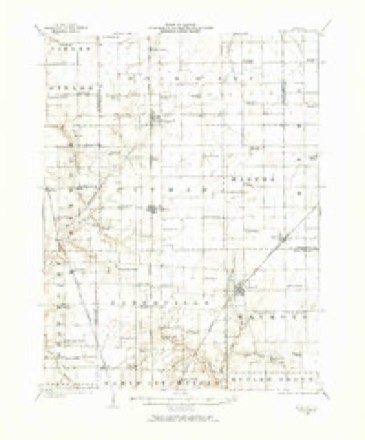
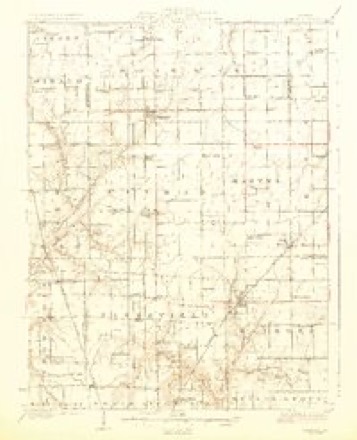
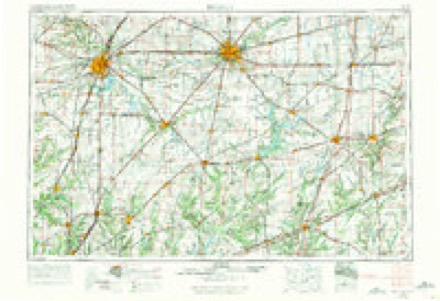
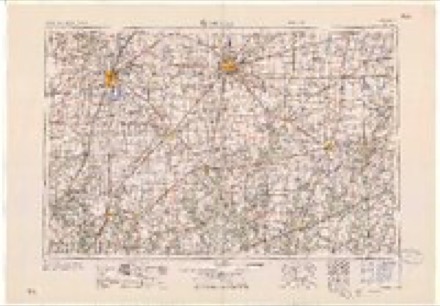
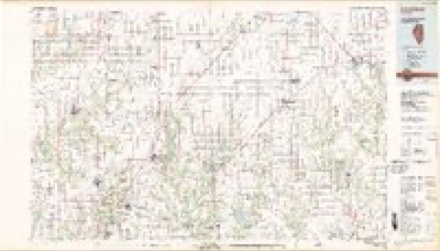
10 topographic sheets cover this place, the earliest surveyed in 1923 and the latest in 1982. It stands in Zanesville Township. It lies in ZIP code area 62560. The Survey maps it on the Atwater quadrangle. It stands 646 feet above sea level.
Topographic sheets covering this place
5 surveys from 10 printed sheetsMatched by testing this settlement's coordinate against the published boundary of every sheet in the United States Geological Survey's historical collection. Each opens the scanned sheet at the Survey.
- 1923 USGS Raymond quadrangle1:62500, 2 printings
- 1925 USGS Raymond quadrangle1:62500, 2 printings
- 1958 USGS Decatur quadrangle1:250000, 3 printings
- 1961 USGS Decatur quadrangle1:250000, 2 printings
- 1982 USGS Litchfield quadrangle1:100000
In the county-history sources
6,325 words on this townshipPast and Present of Montgomery County, Illinois, published 1904 names this settlement in its chapter on Zanesville Township. These are the passages that mention it, exactly as the scans read.
Tins township is undulating in part and level in part. It is drained by tributaries of the west fork of Shoal creek and Macoupin creek. Robert Palmer is supposed to have been the first settler within the limits of this township, at bast we find it recorded that he had established an inn near the site of Old Zanesville as early as 1824. Tradition speaks of Robert Palmer as an all around hard character. Many robberies having been com mil led in his locality, suspicion soon attached to him. His tavern was stopping place for a gang of thieves and gamblers and soon became noted in this western country as a dangerous place for one to stop who had money. It was no uncommon thing in an early <la\ for the traveler to disappear to be heard of no more ami doubtless Palmer and his gang were quite as notorious as the Benders, who operated some years ago along the Kansas frontier. Palmer, finding that he was under suspicion, disappeared rather mysteriously. Later, it is reported, that he was hanged afterward for complicity in a brutal murder in the state of Iowa. Conditions were -ueh in the immediate neighborhood of the Palmer tavern that few permanent settlements were made while he remained in that section. We find that in 1828 George Brewer entered the land on which the village of Old Zanesville was located and that he laid out a part of his land in town Lots. Be secured the Location of a postoffiee at this place and called it Leesburg in honor of a wholesale merchant in St. Louis, in whose name the laud was entered. Mr. Brewer built a commodious store building and piil in a stock of general merchandise. Other parties were attracted 1>\ the opportunities which seemed to present themselves in the been accessions to the town and surrounding community thai warranted the organization of a school and the building of a place of worship. So rapidly did this frontier burg improve that in 1835 it lacked but few in population of being as large as Hillsboro. While this settlement at Leesburg; was being made, several pioneers had entered the southwest corner of the township and had made a settlement there. Among those wliose names have been kept were Isaac Bailey, James Crawford. Thomas and Zebedee Williams. Somewhat later Robert Allen settled near them and following Mr. Allen was Beatty Burk, George Burroughs, D. V. Schumway and Oliver Chastme. About 1840 a settlement was made near the head waters of Shoal creek and among these we find Walker Williams. Elgin Smith, Jefferson Parrott and Moses Martin. Another party settled in close proximity to the village of Leesburg. Among those are Joseph Vignos, Dr. (aldwell and Spence Smitherman. Dr. Caldwell was one of the earliest physicians of this section and at last accounts, the doctor was living in retirement at the village of Waggoner. The writer remembers him as a resident, of the old village of Zanesville, about twelve years ago. The doctor was very entertaining and enjoyed reciting the experiences of pioneer times. Spence Smitherman was engaged in farming and stock-raising. He took especial pride in breeding a class of traveling horses and some of the Inst roadsters that were sold from this county went from the Smitherman farm. He also operated a flouring mill in the village of Old Zanesville (formerly called Leesburg). The Jacksonville and Vandalia stage-coach lines passed through Leesburg and the state road leading from Carlinville to Taylorville intersected the old Vandalia road at this place. In 1838 Edward Crawford erected the first horse mill in the township. This primitive concern was operated almost day and night to supply the settlements adjacent with bread stuff. In 1869 a company consisting of Messrs. Sharp, Johnson ami Berry erected and equipped the Zanesville flouring mill. It is reported that i he first cosi of this mill was sixteen thousand dollars. At its completion it was the largest ami nio>t complete null in Montgomery county, having a capacity of one hundred barrels of flour per day. For three or four years this mill did an extensive business and paid large dividend to its owners, but m ls;:i. when the financial crash came and a panic seized the people, this enterprise, like many others, became seriously involved. Sharp and Berry, who had become sole owners, disposed of the mill to Spence Smitherman and Clark Sinclaire, who for reasons best known to themselves, never attempted to operate it. At the first election held in this precinct which, al that time, 1835, included the entire northwest part of the county. George Brewer and .lames Crawford were elected justices of the peace Stephen Crawford, son of James Crawford, horn in 1831, on the night of the 13th of November, was the first child horn in the township. It is recorded that the great metoric shower, known as the falling stars, occurred on this date. Certainly James Crawford, tin' pioneer, would ha\ icasion to reinber the event. The first school teacher was recorded. The schools of this township were not different from those in other earl] settlements in the county. Usually some vacated cabin was appropriated and made to serve as a school room. In other cases we find that the settlers came together at some point near the center of the settlement and built a log cabin for school purposes. In many instances these rude structures were not provided with other than a dirt floor and a log sawed out of the easl or south side served as a window to admit light. At the west or north was built a large open tire place with a stick chimney daubed with mud. ami in these primitive academies our fathers and mothers, the sons and daughters of the pioneers of Montgomery county learned to read, to cipher and to write. Elder James Street, id' Clear Spring settlement, preached at the residence of Jacob Baker as early as L830. and a Baptist organization was effected in that neighborhood soon after. Other denominations have bad their organizations, have built ejnirehes and each in its time lias flourished, but the building up of surrounding villages and towns along our railroads has interfered ut\ seriously with the maintenance of church organization in rural communities and Zanesville township is no1 an exception to these conditions. While we do not desire to bar the progress or stay the immutable law of change, yet to travel throughout the country districts in any part of our state, the decay of the rural church is so noticeable as to bring a feeling of sadness over one whose early life knew only the sacredness of the country church. To-day these tenantless houses standing so near the burial places of our fathers keep silent watch as they crumble into decay over the last resting place of our pioneer dead. If there is aughi that can stay the mad rush of the present generation in its scramble for wealth, it might be for each to walk alone through the deserted graveyards which may be found in many parts of the country where slabs of marble, green with lichens that almost obliterate the letters carved on the face, tells in few words the name of the worthy dead who lies beneath. To reflect upon the end of the struggle which has no purpose higher than dollars might well afford to listen to the teachings that come from those silent graves. Tn 1869 the village of Zanesville had four large general stores, one grocery, three blacksmith shops, two wagon shops, two hotels, one cooper shop and two saloons. The latter always a eurso to any people. Three physicians hung out their signs in this busy little burg, George Mayfield. J. W. Wheeler and G. W. Caldwell. Dr. Mayfield was among the earlier physicians of the town. In an altercation with a man by the name of Hardy, Mayfield was killed. Tn the trial it was proven that Mayfield was the aggressor and Hardy was acquitted on the ground nf self-defense. Another record of murder belongs to Zanesville township. Tn 1853 Andrew Nash, in a drunken brawl, killed Peter Lookerman. Nash, escaping from the country, was afterward apprehended in Arkansas, brought hack and placed in jail at Carlinville. lie was tried ami condemned to he hung. Ih- friends circulated a petition to he presented to the governor to have his sentence commuted to life imprisonment, fearing that the governor might grant the petition, a mob of Lockerman's friends appeared before the jail in Carlinville at night and so frightened Nash that he committed suicide by hanging himself in his cell. Among those who are to-day foremost in the affairs of Zanesville township are George W. .Martin, who owns a wry line farm ii the southeastern part of the township. 0. K. Rummons, who lives in the neighborhood of Old Zanesville. and Oscar B. Cane, his neighbor, a iv both farmers who contribute to the progressive spirit of the community. R. A. Barnett, who lives in tin1 southwestern part of the township, has also been a leading character in his immediate section. Among those, whose names were familiar a few years ago. was Dan P. Rogers, Perry Martin, .lames Duff. Joseph Vignos, Spenee Smitherman and many others whose accounts are closed but whose works are living still. At present there is no postoffiee within the limits of the township unless it be at Barnett, where a portion of the village lies within Zanesville. Three railroads, the Wabash, crossing the southeast corner, the Illinois Central, dividing the township almost into two parts from north to south, and the Burlington, which touches the southwest comer, have proven of but little immediate value to Zanesville township, as no station of importance has been located therein.
Passage source: Past and Present of Montgomery County, Illinois, published 1904.
Machine-read from a century-old scan, so expect the errors a machine makes: misspelled names, dropped words, stray characters.
Nearest settlements
The eight closest, with where each one stands in the county. Distances are straight-line, computed from the Geographic Names Information System coordinates.
| Map | Place | Distance | Sheets |
|---|---|---|---|
| Shop Creek | 3.2 miles | 10 | |
| Waggoner | 3.8 miles | 12 | |
| Raymond | 4.3 miles | 13 | |
| Barnett | 4.6 miles | 10 | |
| Honey Bend | 4.9 miles | 13 | |
| Sunrise Hills | 6.7 miles | 12 | |
| Harvel | 6.8 miles | 13 | |
| Stagecoach Junction | 7.4 miles | 12 |
Elsewhere
Matched on this settlement's Geographic Names Information System number rather than its name, so it cannot be a different place of the same name in another state.
| Wikipedia article on Zanesville | An encyclopaedic summary. Its text is share-alike, so it is linked here rather than copied. |
| Wikidata item Q8066138 | The structured record the population and elevation above come from. Public domain (CC0). |
Provenance
This settlement is recorded in the Geographic Names Information System as feature 423346. The sheet list is computed by point-in-boundary test against the United States Geological Survey's historical topographic inventory. Both are works of the United States government and carry no copyright under 17 U.S.C. 105.