 Block
Northfield, Indiana
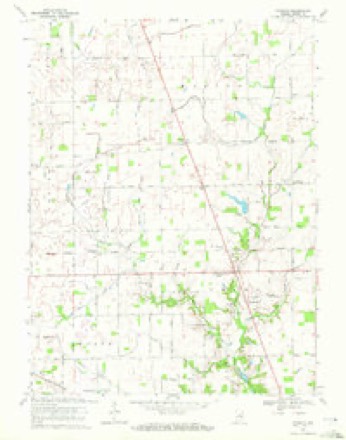
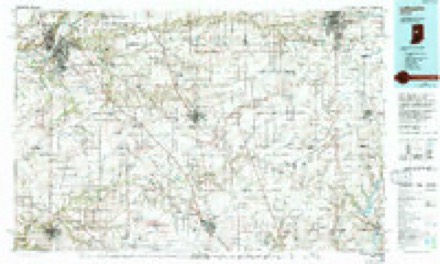
11 topographic sheets cover this place, the earliest surveyed in 1953 and the latest in 1984. It stands in Zionsville town. It lies in ZIP code area 46077. It stands on Mounts Run. The Survey maps it on the Rosston quadrangle. It stands 902 feet above sea level.
Topographic sheets covering this place
6 surveys from 11 printed sheetsMatched by testing this settlement's coordinate against the published boundary of every sheet in the United States Geological Survey's historical collection. Each opens the scanned sheet at the Survey.
- 1953 USGS Danville quadrangle1:250000, 3 printings
- 1953 USGS Rosston quadrangle1:24000, 2 printings
- 1955 USGS Danville quadrangle1:250000
- 1956 USGS Danville quadrangle1:250000
- 1969 USGS Rosston quadrangle1:24000, 2 printings
- 1984 USGS Lafayette quadrangle1:100000, 2 printings
In the county-history sources
37,254 words on this townshipEarly Life and Times in Boone County Indiana, published 1861 names this settlement in its chapter on Zionsville Town. These are the passages that mention it, exactly as the scans read.
Northfield was laid out in the year 1834. Jesse Lane was the proprietor. It is situated in Umiuu Township, on the Michigan road. Big Eagle crosses the Michigan road just north, and Findly Creek on the south. It at one time was a place of considerable business, and at one time a piece of ground was purchased with a view of building a court-house. But the prospect of the county seat being located there vanished. But Northfield lived, notwithstanding. Among the first settlers and business men were as follows: Hiram McQuidy built the first horse mill or corn cracker. Mr. A. Sanburn was the first postmaster. First merchants were Mr. Long, Chance Cole, Jacob Tipton. Doctors were Knowlton, McLeod, Presly and Samuel Hardy. First blacksmith was Mr. Robinson. First school teacher Mr. Bray. First justices of the peace was Mr. Sanburn and Riley B. Hogshier. 'The first church was built by the Methodists. A church called Adventists' was built here in 1886, and dedicated in December of that year by Rev. Covert, of Howard County. It is a very good frame building ; cost $800. Northfield now and for the past forty-five years had a postoffice, and is now the voting place of Union Township. Election day several years ago was looked forward to with interest, when it was understood that sundry disputes were to be settled, and an occasional fight was no unusual sight. Among the early families of the place were: George Shirts, Hiram McQuidy, Mr. Sanburn, Jacob Tipton and Mr. Robin- son. The first tavern was kept by Hiram McQuidy. The town contains a good brick school house and M. E. Church. Northfield was once the home of Jonathan H. Rose, also that of Jacob Tipton. The present postmaster is Henry Nicholas. Among the early citizens of Union Township now living within its borders are: Mrs. Nicholas, Mrs. Koontz, Washington Hutton, Mr. Alexander, Mrs. Sedgewick, Andrew Harvey, Squire Duly, Samuel Davis, John J. Ross and Jesse Lane.
Passage source: Early Life and Times in Boone County Indiana, published 1861.
My father moved from Washington County, Indiana, in the early winter of 1826. He stopped in Marion County on Big Eagle about ten miles from Indianapolis until the 10th of March, when, with his family of eight children, he moved on his land in the thick forest with not a stick amiss save the cabin logs that then lay at the stumps from which they were cut. Through the kindness of friends we called neighbors (though some of them came ten miles), we had our cabin raised on the day we got there, having arrangements previously made. Mr. Austin Davenport, with his ox team, hauled the logs while the neighbors notched them up, covered with clap-boards and cut out a door, so we slept under the shelter of our own roof that night. We were unharmed, though serenaded by wolves, which was a nightly occurrence. Our cabin is up, but there is yet no floor, fire-place or door shutter, nor a foot of land cleared, and one-third of March gone. Six acres of land was measured off that would have to be cleared, under-grubbed and fenced. Father and two of us boys (aged eleven and thirteen years) found we would have to build some kind of a pen to protect our horses from the horse-flies. We raised a pen fourteen by twenty feet, high enough for the joists, then covered it with brush to-make it dark. That kept the flies off when in the stable, but when working they were very annoying. Deer was plenty, but there was no time to look after them. The creek, too, was full of fish, but they must also be let alone (only on Sundays we boys would take them in out of the wet). Turkeys would make their presence known by gobbling close by in the early morning. Father would take in one of them once ina while. By the 10th of June we had six acres of corn planted. The squirrels came as though it had been planted purposely for them, but we stoutly contested their claim, and when they were out of the way the raccoons entered their title. We contested their claim, too, and many of their skins went into the fur market at from five to twenty-five cents apiece. Coon skins and ginsang were the staple articles of trade with us in those days. In the winter of 1827 father got his leg so badly cut by the flying of an axe handle in the hands of Austin Davenport, that he was laid up all winter and spring till our crop was in the ground. With the help of our neighbors we had added another six acres to our farm. We helped to roll logs and raise cabins every week in the early spring. We had to keep a sharp lookout for rattlesnakes, for they were very plenty on Eagle Creek when first settled by the whites. Indians were very plenty when we first came to the territory afterwards organized into Boone County. Our house was on the trace leading from Thorntown to Billy Conner's, who was agent for the Miamis. We saw Indians nearly every day the first summer we lived on the old homestead, and it was interesting to see the ingenuity of these red men. When they wanted a sack to carry potatoes, turnips or corn, they would spread down a blanket and double the first side over two-thirds of the width, then the other side so as to lap over one third of the first lap, then gather the ends and tic a string tightly around each end. They would open the fold in the middle and fill the ends with whatever they wished to take with them. If they bought pumpkins they would, with their butcher knives, plug out the stem and blossom ends, double a small rope and put this through four pumpkins, two on each end, with a small stick to keep them from slipping. Throwing them across their ponies they would scamper. They always had handkerchiefs, shawls, calico, broadcloths, fancy moccasins or some beads to trade for our produce. The nearest mill was fourteen miles and no good roads. We would shell two sacks of corn, throw them across two horses, mount two boys and away to mill. Sometimes we would live for two days and a night on parched corn. 'Sometimes sve would throw corn into a mortar made by barning out a stump or the end of a block, and pound it into a kind of a coarse meal, sieve out the finest for bread, and use the rest fur hominy. Although we had hardships to undergo, we had a great deal of pleasure. The social relations among our friends was fine. A man only had to say he was going to roll logs such a day and the men and boys would be on hand. The women are worthy of great praise for the part they took. As a matter of course our fare was very plain, consisting of corn bread, hog meat, potatoes, turnip greens, with sometimes pumpkin pies. Often after a hard day's rolling logs, the young folks would have a dance; the women having a quilting, wool picking or some other attraction to bring them together. After a few years, when they began to raise a few sheep, the farmers would take their wool to the carding machine and have it made into rolls, then they would spin, scour and color such as was to be used for wearing apparel, but for blankets they wove in the grease as it was spun. Then the scouring was to be done. Some neighbors having a suitable floor in his house would have what they called a "blanket kicking." This was the work of the boys. Taking off their shoes and socks they would sit down in a ring with their feet together. The women would then throw down four or five blankets between their feet. Then warm water and soap were thrown on the blankets and the kicking commenced. The flow of soap-suds on the floor can be imagined. The boys would.sit on blocks four or five inches high and the girls on chairs at their backs to keep them in place. The girls for fun would sometimes kick the blocks from under the boys, letting them sit down in the soap-suds, but it was all taken in good part. When the blankets were finished the floor was cleaned, supper was set, and that disposed of. After that the fiddle was brought out and the dance commenced, lasting till twelve or one o'clock. These are some of the pas- times of early settlers. Those that were heads of families sixty years ago are gone, and those that were children are now old and but few in number. Many have died and others moved away, and in counting my playmates I find many of their names on tombstones. There are many incidents I might record that would be more amusing than interesting, but I will now try to give a short history of our family. My father, Frederick Lowe, was born in Gifford County, North Carolina, October 13, 1786. He was married to Patience Grist, in the spring of 1811; they lived in Roan County, in the same state, until] October, 1816, when, with his family of four children, he moved to Indiana and settled in Washington County, where he lived ten years. With an addition of four children he moved to what is now Boone County. He remained in this county until his death. In the meantime six other children were added to the family, four of whom died in infancy. Of the ten left seven are now living. Their names. are as follows: Sarah, who is now dead, was married to Jacob Hoover; John, the writer; George, who is now dead; Celia, who is now dead, was married to Jesse Essex; Polly, widow of James W. Blake; Charity, widow of Hiram Wolf; William Grist; Nancy, widow of Asa Cox: David G. and Benj. F. These constitute the ten that reached maturity. Father died March 20, 1866. Mother was born March 17, 1788, and died May 13, 1878. Sarah Hoover died in Kansas; Celia Essex died in Pulaski County, Indiana; George Lowe died in Stockwell, Tippecanoe County. Mother also died in Tippecanoe County, at the advanced age of ninety years and two months. The settlement in Boone County, commencing at the south line, was first Jacob Sheets, Exsq., his brother John, P. H. Sullivan, David Hoover, who was the first clerk of Boone County, Austin Davenport, the first sheriff, also first representative ; Jesse Davenport, John Johns, Robt. Johns, Henry Johns, their father, Jesse Lane and Edward Jackson. These were here when we came. In the fall of the same year John King settled adjoining our place. The county then began to be settled very fast, and improvements increased. In the winter of 1829-30 the legislature passed the law organizing the territory into what is now Boone County. My father was appointed agent of the new county, consequently I waz one of the boys to cut the brush off of the public square, and carry one end of the chain to lay out the lots in the original plat. Geo. L. Kinnard and Jas. P. Drake were the original proprietors, and donated every alternate lot, and bric! to a court-house for the county. There was some trouble about the location of the county seat. It was first located where Northfield now is, but being so far from the center, a protest entered and commissioners were appointed to locate the spot. The commissioners were John Harlin, of Clinton County, A. M. French, of Montgomery, P. H. Sullivan, of Boone, Bazil Brown, of Marion, and the fifth I have forgotten. They located the capital of Boone County, and called it ' Lebanon." The site was not very promising for a town, but through the energy of the people and the natural growth of the country, it has attained to its present condition, a little city of four thousand inhabitants. As the country became settled up by hardy frontiersmen, and the dense forest gave way to the woodman's ax, improvements in implements advanced. Our harvesting was first done by the sickle, then the cradle, next the McCormack horse-power, and now we have the various self-binders. The many social gatherings, such as husking parties, flax-pullings, chopping-frolics, log-rollings and house-raisings are things of the past. The flax and wool wheels have no place in our farm-house, and the loom is used only for rag carpets. Inthe loss of these social gatherings much of genuine friendship is lost. I believe that selfishness is growing and caste in society is on the increase. In writing this imperfect sketch I have lived over some of my juvenile days.
Passage source: Early Life and Times in Boone County Indiana, published 1861.
Machine-read from a century-old scan, so expect the errors a machine makes: misspelled names, dropped words, stray characters.
Mines and quarries near this place
1 within 5 milesRegional context, not property-specific evidence. The federal mineral resources record lists 1 working within 5 miles of Northfield: 1 past producer. None of them still produces. What was taken out: Sand and Gravel, Construction. Distance is straight-line from the map coordinates, so a quarry counted here may appear on a neighbouring settlement's page as well.
| Where | Site | Commodity | Status | Recorded |
|---|---|---|---|---|
| Routh Sand and Gravel Pit | Sand and Gravel, Construction | Past Producer |
Storms near this place
2 since 2003Regional context, not property-specific evidence. The National Weather Service names Northfield in 2 storm reports between 2003 and 2014: 1 thunderstorm wind, 1 hail. No death or injury is recorded in these reports. Each account below is quoted exactly as the forecast office filed it, from the NOAA Storm Events Database, and each date opens the federal record of that event.
| When | Event | Place named | Harm | What the report says |
|---|---|---|---|---|
| April 2003 | Thunderstorm Wind | Northfield | $100,000 | no account filed |
| May 2014 | Hail | Northfield | - | no account filed |
Nearest settlements
The eight closest, with where each one stands in the county. Distances are straight-line, computed from the Geographic Names Information System coordinates.
| Map | Place | Distance | Sheets |
|---|---|---|---|
| Rosston | 1.3 miles | 11 | |
| Allens Acres | 2.9 miles | 18 | |
| Big Springs | 2.9 miles | 11 | |
| Gadsden | 3.7 miles | 11 | |
| Waugh | 4.0 miles | 11 | |
| Hamilton (historical) | 4.1 miles | 18 | |
| Whitestown | 4.2 miles | 18 | |
| Northern Meadows | 4.6 miles | 18 |
Elsewhere
Matched on this settlement's Geographic Names Information System number rather than its name, so it cannot be a different place of the same name in another state.
| Wikipedia article on Northfield | An encyclopaedic summary. Its text is share-alike, so it is linked here rather than copied. |
| Wikidata item Q7059354 | The structured record the population and elevation above come from. Public domain (CC0). |
Provenance
This settlement is recorded in the Geographic Names Information System as feature 440326. The sheet list is computed by point-in-boundary test against the United States Geological Survey's historical topographic inventory. Both are works of the United States government and carry no copyright under 17 U.S.C. 105.
Mines and quarries. USGS Mineral Resources Data System (MRDS) https://mrdata.usgs.gov/mrds/ A work of the United States government, no copyright under 17 U.S.C. 105.
Storms. NOAA National Centers for Environmental Information, Storm Events Database https://www.ncei.noaa.gov/stormevents/ A work of the United States government, no copyright under 17 U.S.C. 105. Narratives are quoted verbatim from the National Weather Service report and are not edited or summarised.