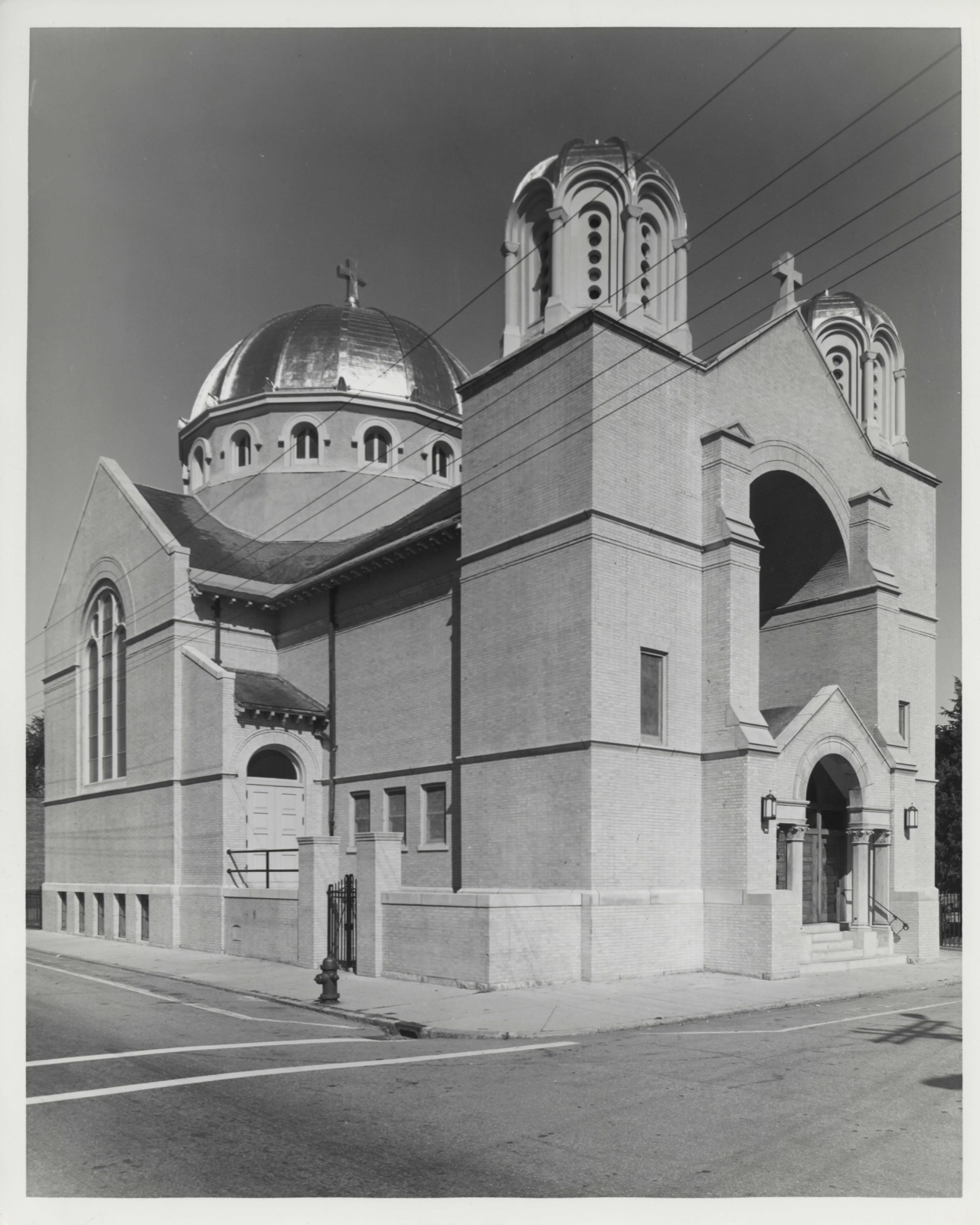
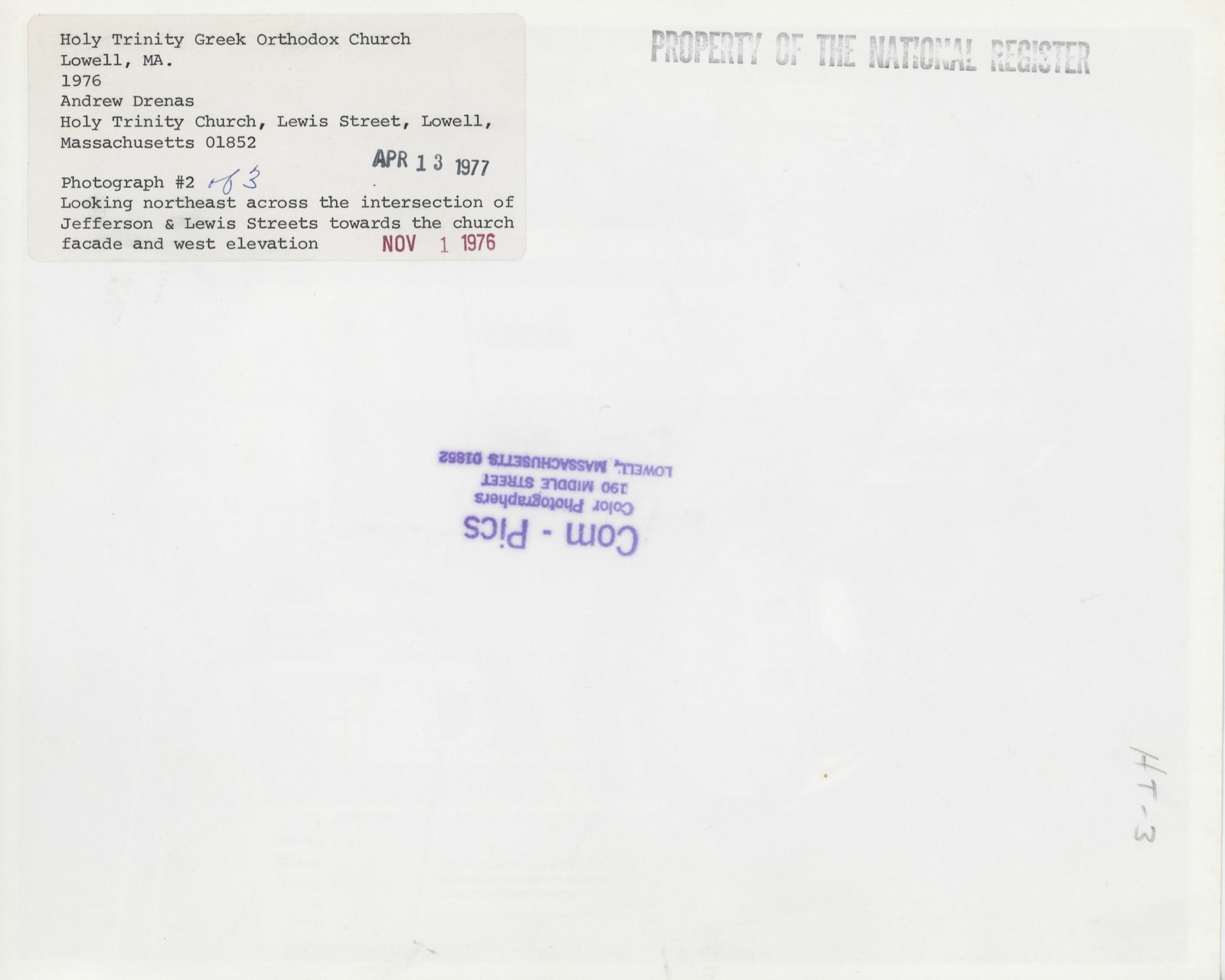
Photographs from the nomination case file, National Park Service records.
Holy Trinity Greek Orthodox Church
Listed on the National Register of Historic Places in
1977. A historic map-sheet match is not published yet. The record needs a coordinate-quality review before it can be joined to a sheet boundary.
From the record
“(VII) Daniel Smith Gray, son of Timothy Gray (6), born in Wilton, New Hampshire, October 6, 1816, died October 9, 1900, at Lowell. He attended the district schools of his native town, and remained at home working on his father's farm until he was about twenty years of age.”
Historic Homes and Places and Genealogical and Personal Memoirs Relating to the Families of Middlesex County, Massachusetts ; (1908). Machine-read text.
one of 1100 National Register listings in Middlesex County · listed in 1977 · category: Building · one of 3 National Historic Landmarks in Middlesex County.
National Register reference number.77000181- the number the National Park Service assigned this property when it was listed, and the key its nomination file is catalogued under at the National Archives.
It appears that immediately after ilr. Lowell's return he had at once gone to work to construct a loom ; but he found its construction no easy task. Without patterns, or even drawings, so far as we know, each part had to be planned and tried, altered and rearranged, until tlie whole assumed the shape of a machine. We are told that " many little matters were to be overcome or adjusted before it would work perfectly." Mr. Appleton says : " Mr. Lowell said to me that he did not wish me to see it until it was complete, of whicli he would give me notice. At length the time arrived. He invited me to go out with him and see the loom operate. I well recollect the state of admiration and satisfaction with which we sat by the hour watching the beautiful movement of this new and wonderful machine, destined, as it evidently was, to change the character of all textile industry. This was in the autumn of 1814."
The great obstacle to tlie use of the power-loom, at that time, proved to be dressing the yarn ; it required a man at each loom to dress the warp as it unrolled from the beam. This rendered it necessary to stop the loom while the man was doing it. This difficulty was removed by the invention of an ingenious mode of dressing the warp before it was placed in the loom. Mr. Lowell procured from England a drawing of Horrocks' dressing-frame, and Mr. Moody, whose services he had secured, made an improvement which more than doubled its efficiency, - a very ingenious machine called a warper, that wound the threads from the bobbins on the beam. After this there was no farther difficulty in running a power-loom.
Regional context, not property-specific
evidence. The
federal wildfire occurrence database
lists 132 fires within 5 miles of Holy Trinity Greek Orthodox Church between
2001 and 2020, burning about 72 acres in total. 3 started naturally. 30 were recorded as arson.
Distance is straight-line from the map coordinates, so a fire counted
here may appear on a neighbouring settlement's page as well.
Reported cause
Fires
Missing data/not specified/undetermined
37
Arson/incendiarism
30
Debris and open burning
28
Recreation and ceremony
20
Equipment and vehicle use
4
Smoking
4
Power generation/transmission/distribution
3
Natural
3
Railroad operations and maintenance
2
Other causes
1
The most recent of
them, most recent first, with the day each was reported and the service
that recorded it.
Regional context, not property-specific
evidence. Museums hold 548 specimens
collected within 10 miles of Holy Trinity Greek Orthodox Church between 1898 and
1975: 358 Plantae, 122 Animalia, 35 Fungi, 29 Protozoa, 3 Chromista, 1 Unrecorded. 12 distinct Species records are shown.
Collected by A. C. Mathieson, A. F. Newton, A. F. Newton, M. K. Thayer and others. Each is a
physical object with a catalogue
number, and each entry opens the museum's record. This is what was
collected and kept, not a survey of what lives here - nothing can be
concluded from a species being absent.
Regional context, not property-specific
evidence. The federal mineral resources record lists
22 workings within 5 miles of Holy Trinity Greek Orthodox Church: 10 past producers, 7 producers, 4 plants, 1 unknown.
11 still produce. What was taken out: Sand and Gravel, Construction, Stone, Crushed/Broken, Graphite, Nickel, Gold, Silver, Copper. Distance is straight-line from the
map coordinates, so a quarry counted here may appear on a neighbouring
settlement's page as well.
Regional context, not property-specific
evidence. The National Weather Service names
Lowell, the town this property stands in, in 16 storm reports between 1995 and 2023: 6 thunderstorm wind, 4 flood, 3 lightning, 2 hail.
The reports record 2 injuries. Each account below is quoted exactly as the forecast office
filed it, from the NOAA Storm Events Database, and each date
opens the federal record of that event.
No historic map-sheet match is published
for this property yet. That does not mean no map exists. This record needs
a coordinate-quality review before it can be joined to a sheet boundary.
Browse the county's mapped places while that work is
pending.
From the nomination file
2,436 words on record
When this property was proposed for the
National Register, someone wrote the case for it: what the building is,
and why it matters. That document is a federal record in the public domain.
It is quoted below word for word, never summarised. The text was read off the scanned case file by machine, so the
occasional stray character is the recogniser's and the 1970s
typewriter's.
Description of the property
Holy Trinity Church is sited at the corner of Lewis and Jefferson Streets in the "Acre" neighborhood of Lowell. The Greek Orthodox church's urban location is reinforced by its siting on the lot. The church is built contiguous to the sidewalks of Lewis and Jefferson Streets. It is surrounded on three sides by North Common Village (1937-1940). The first public housing project in Massachusetts, the village is composed of 2 story multi-unit buildings sited amidst ample green space inspired by the "Greenbelt" move- ment of that period. To the west of the church, across Jefferson Street, is Western Canal (1830) (NR 1976; Locks and Canals Historic District). On the other side of the canal is Suffolk Street and facing Holy Trinity, across the streets and canal, is St.
Patrick's Roman Catholic Church (organized 1830; this structure constructed c. 1853), the first Catholic church in Lowell. The streets and canal banks were recent targets of a "Mode1 Cities" financed beautification program; this entailed intensive and com- patible plantings, lighting and walkways. The plan of the church is a Greek cross with ridge roofs. The load bearing walls are built of yellow-toned brick. Above the crossing of the nave is a gilded dome set on a 16 sided base and drum of the same yellow-toned brick. In each of the 16 sections of the drum is a round arched window, with dripstone molding. Atop the dome is a gilded cross. The facade faces southeast onto Lewis Street. It is composed of two square bell towers joined by a round arched bridge.
Above the bridge is a triangular pediment with a Greek cross atop its apex. The towers are divided into three stages by two limestone string courses.
/ARCHITECT Henry I. Rourke STATEMENT OF SIGNIFICANCE The Holy Irinity Church is significant as the first structure built to house Greek Orthodox worship in the United States and for the central role it played in the develop- ment of the Greek community in New England. Architecturally, it is significant as a rare example of a Byzantine-derived style. Greeks began arriving in Lowell in large numbers in the 1890's. In 1894 the community organized a society called "The Washington-Acropolis" to perpetuate Greek traditions and religion, and a priest was secured to minister to religious needs.
This was the fourth Greek orthodox community organized in the United States, following within one or two years the communities in New York and Chicago; the New Orleans church was the earliest, established in 1865. The church was incorporated in 1900, plans were ini- tiated in 1901, and construction of this structure began in 1906. A Lowell architect, Henry L. Rourke, was hired. Rourke had visited the Aiga Sophia in Constantinople (Is- tanbul), and the parishioners requested a Byzantine structure based on that model. Life in Lowell was difficult for the Greek community. Faced with an alien culture and language, the church became a natural center for the emerging community.
The Greeks were a part of a continuing process of exploitation of successive immigrant groups by the textile mill owners. This church served as a symbol of unity and permanence in an often hostile environment. In 1909 the parish began the first Greek school in the area in the church basement. The school was later moved to separate facilities. In 1918, the very Reverend Panaretos G. Anagnos-Topoulos, Pastor of Holy Trinity, died during the influenza epidemic, acquired while ministering to his parisioners.
Quoted from the National Register nomination
for reference 77000181, 14 pages, held by the National Archives in Record
Group 79. See the
catalogue record.
Listed places nearby
6 within 8 miles
Other National Register properties close
enough to walk or drive between, ordered by distance from this one. Both
positions come from the same geocoding pass that matched these properties
to their map sheets.
Listing record. National Park Service National Register of Historic Places, listed-properties dataset, current to 2026-05-22.
Map join. Address geocoded through the United States Census geocoder, then tested against the published boundary of every sheet in the USGS Historical Topographic Map Collection.
How this page is made. Listing fields come from federal records; map-sheet coverage is a labelled coordinate-to-boundary calculation, not a source-field claim.
Wildfire. Short, Karen C. 2022. Spatial wildfire occurrence data for the United States, 1992-2020 [FPA_FOD_20221014]. 6th Edition. Fort Collins, CO: Forest Service Research Data Archive. https://doi.org/10.2737/RDS-2013-0009.6 Collected with United States Government funding and usable without additional permissions or fees.
Specimens. Global Biodiversity Information Facility (GBIF), https://www.gbif.org/. Only records licensed CC0 or CC BY are used. Records licensed CC BY-NC are excluded because this site carries advertising. Images are checked individually and any whose licence is non-commercial, no-derivatives or unreadable is refused.
Mines and quarries. USGS Mineral Resources Data System (MRDS) https://mrdata.usgs.gov/mrds/ A work of the United States government, no copyright under 17 U.S.C. 105.
Storms. NOAA National Centers for Environmental Information, Storm Events Database https://www.ncei.noaa.gov/stormevents/ A work of the United States government, no copyright under 17 U.S.C. 105. Narratives are quoted verbatim from the National Weather Service report and are not edited or summarised.
 Block
Block