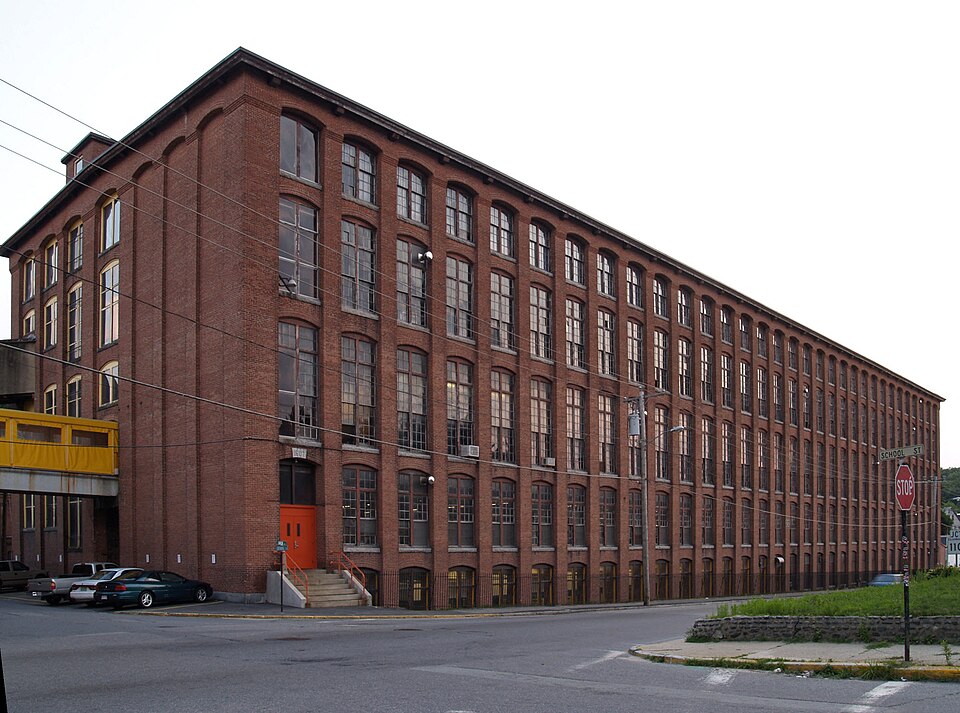
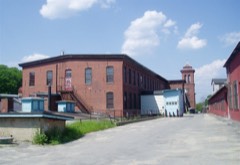
Photograph by Marcbela (Marc N. Belanger), Public domain. Via
Wikimedia Commons.
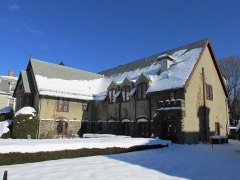
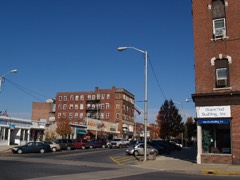
Bigelow Carpet Mill
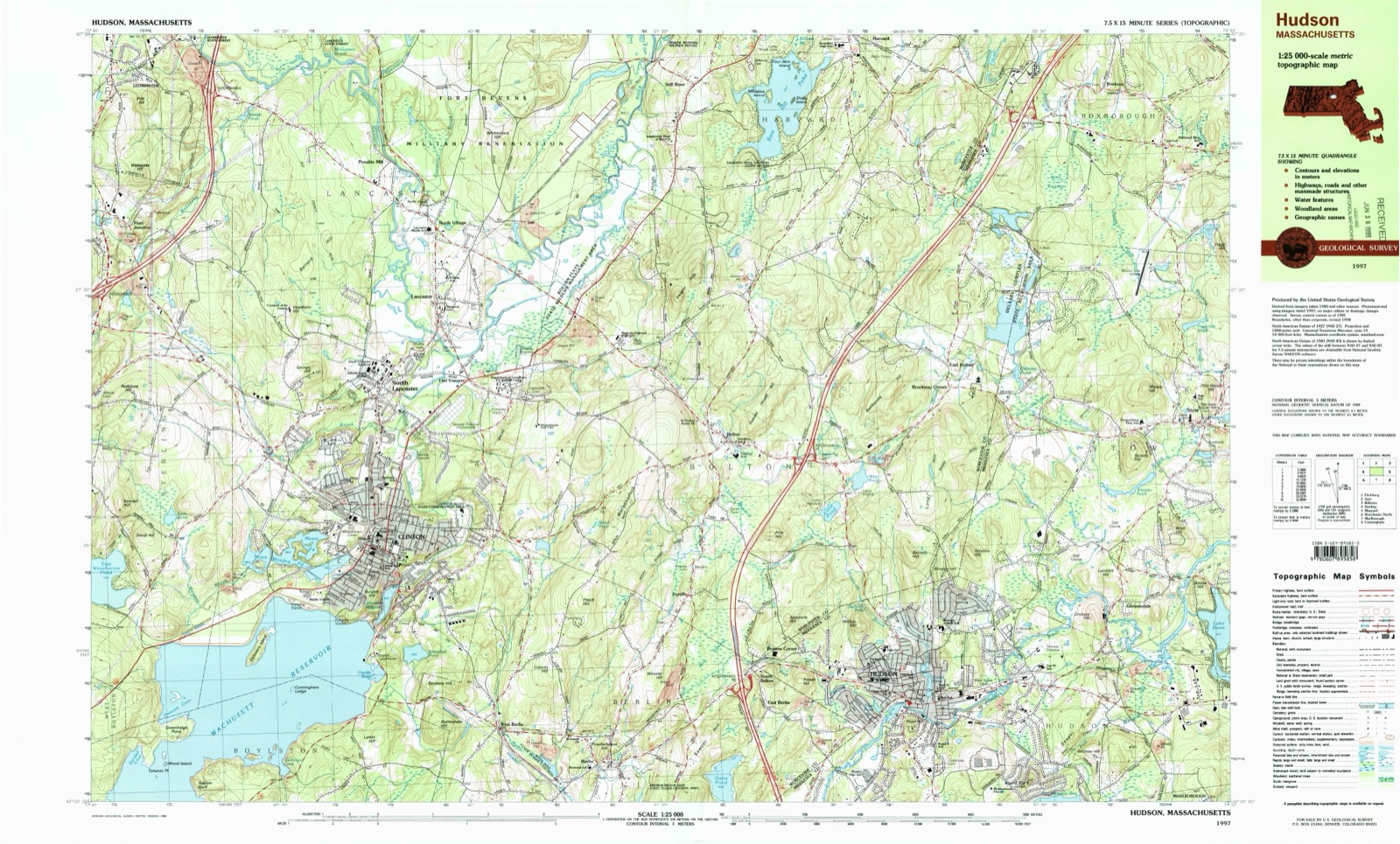
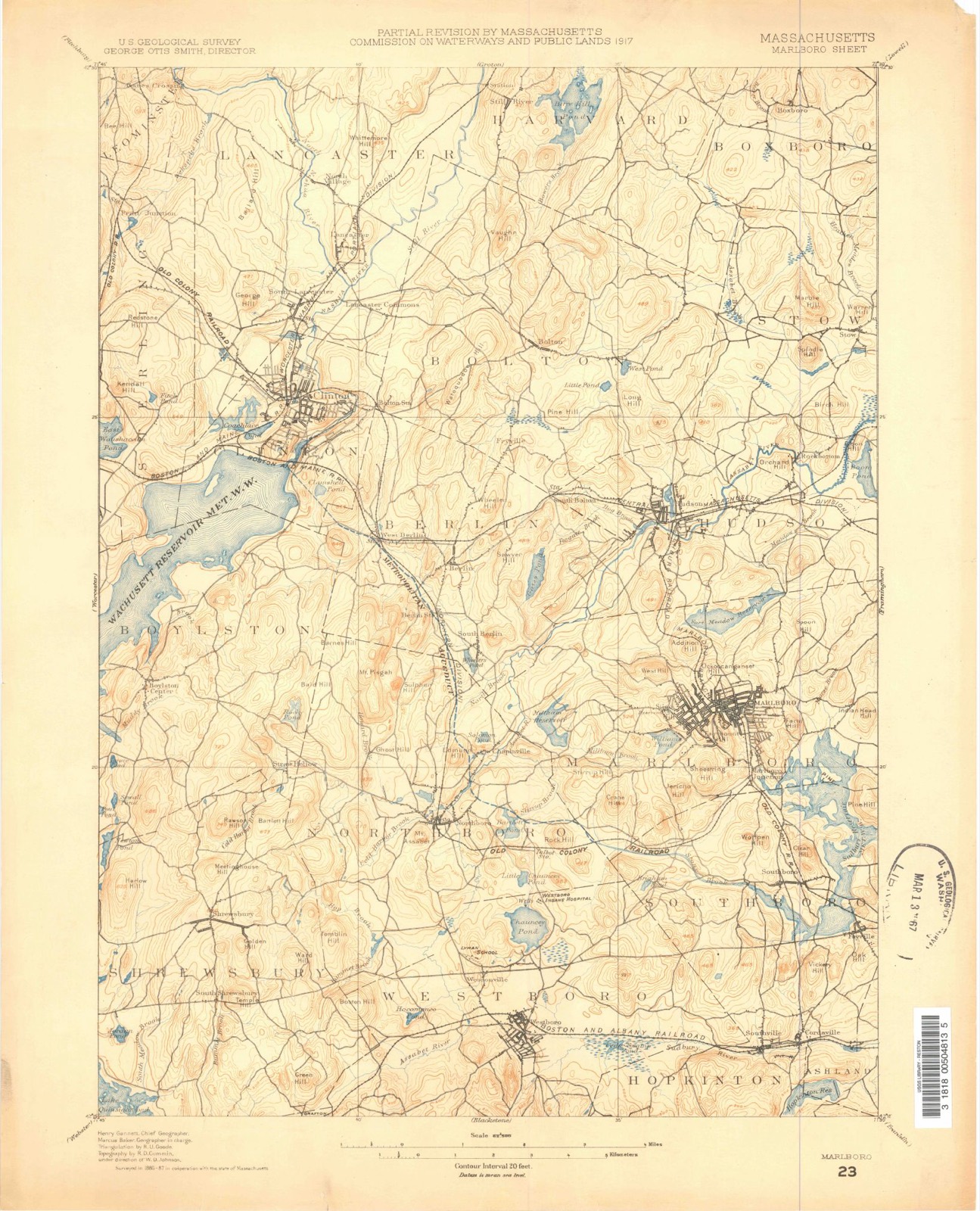
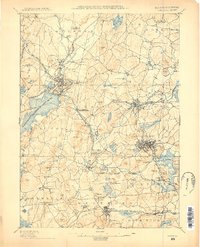
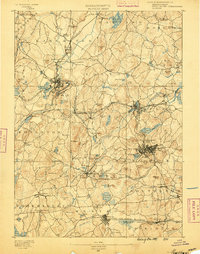
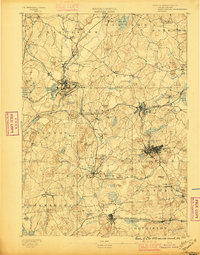
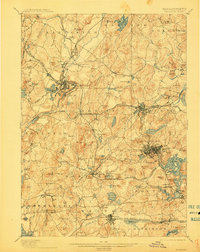
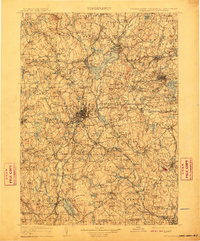
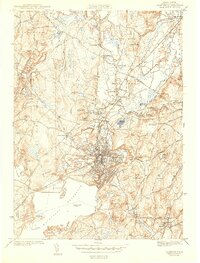
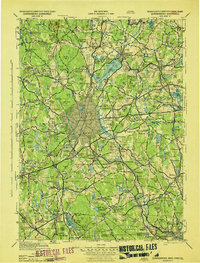
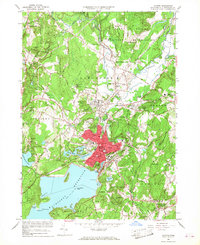
Listed on the National Register of Historic Places in 1978. 20 historic topographic surveys show this location, the earliest from 1887.
From the record
“This new position brought more fully his mechanical ability to the test. Following the coach-lace loom came the reconstruction of the counterpane looms then running, but had not done satisfactory work.”
History of Worcester County, Massachusetts (1889). Machine-read text.
One of 686 National Register listings published here for Worcester County · listed in 1978 · category: Building.
National Register reference number.78000467- the number the National Park Service assigned this property when it was listed, and the key its nomination file is catalogued under at the National Archives.
Then and now
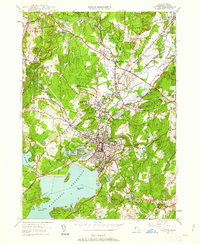
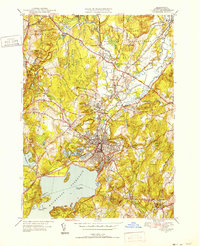
1887 to 1997
The ground this property stands on, surveyed
110 years apart. Drag the handle to wipe between them. Both sheets are
United States Geological Survey originals; neither has been altered.
A by-path very early connected Prescott's Mills with the county highway leading to Washacum and westward. Widened and otherwise altered at various dates, this is yet in use and known as the Rigby road. This name does not appear attached to it in old records, but the brooklet which it crosses in Clinton was called Rigby's Brook before 1718. What connection the cross-road or the stream had with John Rigby, who was one of the pioneer settlers of Lancaster, or with his heirs, has not been discovered. No family of the name is mentioned in the town lists since 1700, but a very old house which stood upon this road in the early years of this century was commonly known as the Rigby place.
In the surprise and massacre by the Indians, September 22, 1697, and in the attack by the French and Indians of July 31, 1704, no loss of life or property at Prescott's Mills was reported, though this, it would seem, must have been one of the six fortified posts said to have been assailed. The men belonging to this garrison in 1704 were John Prescott, his two sons, John and Ebenezer, and John Keyes, the weaver, three of whom were married men with little families. By a report of an inspection of garrisons ordered by Governor Dudley, in November, 1711, we learn that there were at that time but three families at the Mills, including four males of military age, besides two soldiers billeted there - fifteen souls in all. This may be called the earliest census of Clinton. For half a century the householders in this neighborhood had numbered no more, and no less ; for half a century more the accessions hardly trebled this population. Along the roads leading westward, to Leominster, to Woonksechocksett, (now Sterling,) to Boylston, and to "Shrewsbury Leg," farms were cleared, humble dwellings arose, children were born, grew to manhood, migrated, and themselves set up roof-trees farther west ; but at Prescott's Mills all remained apparently as when the fathers fell asleep.
Regional context, not property-specific
evidence. The
federal wildfire occurrence database
lists 100 fires within 5 miles of Bigelow Carpet Mill
between 2004 and 2020, burning about 121 acres in total. None started naturally. 6 were recorded as arson.
Distance is straight-line from the map coordinates, so a fire counted
here may appear on a neighbouring settlement's page as well.
Reported cause
Fires
Debris and open burning
46
Recreation and ceremony
23
Missing data/not specified/undetermined
15
Arson/incendiarism
6
Smoking
4
Misuse of fire by a minor
3
Equipment and vehicle use
3
The most recent of
them, most recent first, with the day each was reported and the service
that recorded it.
Regional context, not property-specific
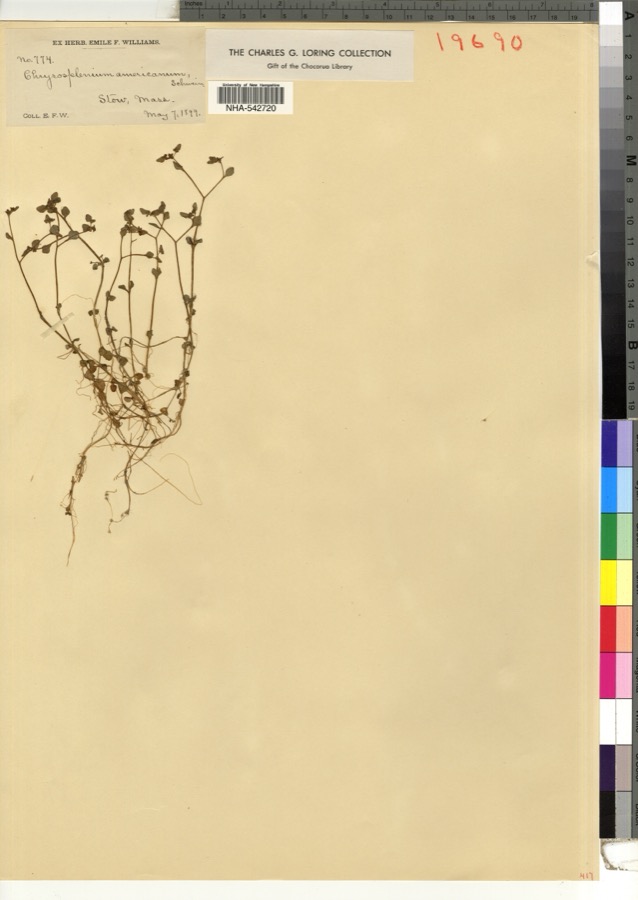
evidence. Museums hold 1,678 specimens
collected within 10 miles of Bigelow Carpet Mill between 1858 and 1974: 1,100 Animalia, 293 Plantae, 270 Fungi, 6 Unrecorded, 5 Chromista, 4 Protozoa.
12 distinct Species records are shown.
Collected by A. C. Gibson, A. Ferrett, A. G. Chandler and others. Each is a
physical object with a catalogue
number, and each entry opens the museum's record. This is what was
collected and kept, not a survey of what lives here - nothing can be
concluded from a species being absent.
Regional context, not property-specific
evidence. The federal mineral resources record lists
20 workings within 5 miles of Bigelow Carpet Mill: 14 past producers, 5 producers, 1 prospect.
5 still produce. What was taken out: Sand and Gravel, Construction, Stone, Crushed/Broken, Stone, Dimension, Peat. Distance is straight-line from the
map coordinates, so a quarry counted here may appear on a neighbouring
settlement's page as well.
Regional context, not property-specific
evidence. The National Weather Service names
Clinton, the town this property stands in, in 12 storm reports between 1999 and 2021: 5 thunderstorm wind, 4 hail, 1 lightning, 1 funnel cloud.
No death or injury is recorded in these reports. Each account below is quoted exactly as the forecast office
filed it, from the NOAA Storm Events Database, and each date
opens the federal record of that event.
A weak tornado touched down in the early afternoon in the town of |Clinton in eastern Worcester County, Massachusetts. A NWS |meteorologist conducted a storm survey following tips from amateur |radio operators and the local fire chief. The following information |summarizes all of the reports. ||The tornado touched down near the intersection of Cedar Street and |Church Street. It tracked northeastward, impacting Benefit Street, |Haskell Avenue, and Water Street at Beech Street. This is a path |length of 0.5 miles. The approximate path width was 35 yards. Damage |photos led to estimates of maximum wind speeds of 75 to 80 mph, |which is an EF0 on the Enhanced Fujita Scale. The time, based on |radar and eyewitness accounts, was from 130 PM to 131 PM EDT. ||A row of trees was snapped and downed in a convergent fashion near |Church Street at Cedar Street. Other trees were downed on Haskell |Avenue at Beech Street. The fire chief relayed that multiple |residents witnessed a tornado touchdown on Water Street, where |extensive damage was observed.
In Clinton, power lines were down on California Court at Beacon Street. Also, power lines were down elsewhere on Beacon Street and on Route 110. Trees and wires were down on a car on Parker Street.
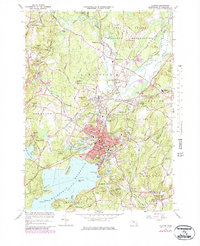
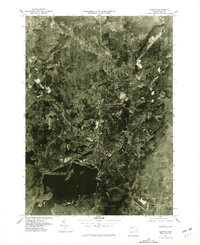
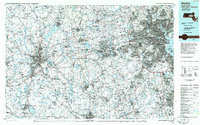
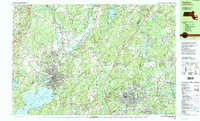
United States Geological Survey topographic
sheets whose coverage includes this point. Matched by taking the coordinate the National Park Service records for this property, then
testing that coordinate against the published boundary of every sheet.
When this property was proposed for the
National Register, someone wrote the case for it: what the building is,
and why it matters. That document is a federal record in the public domain.
It is quoted below word for word, never summarised. The text was read off the scanned case file by machine, so the
occasional stray character is the recogniser's and the 1970s
typewriter's.
Description of the property
The Bigelow Carpet Mill is located on Union Street in Clinton. It consists of a complex of six interconnected buildings set on approximately nine and one half acres of land. Building #5 is separated from the others by School Street but can Be tea ched b nelerated w l naxed dennly seomled residenti a1 ay a 1tes to battn. north of the mill, while a mixed residential commercial area taces it to the Other mill buildings are located on its eastern edge, and open space on its west. The mill was constructed over a seventy-five year period from 1847 to 1922. Its original dimensions were 100' by 42'. This space was doubled in 1850 and enlarged again in 1852 with a 50' ell. Other mill buildings were constructed in 1855 and 1857 and a dye house and reservoir in 1860.
By 1876 the mill consisted of ten distinct structures linked in a huge G. This complex which had evolved as the mill expanded was consolidated in the 1880's when it began to assume its present form. The buildings which now comprise the mill are all rectangular in plan but vary in tresses and corbelling, form the focal point. All three are two stories in height with round arched windows in the upper level. The other buildings, also constructed of brick are more functional in design. The interiors of all six buildings, consisting of colums, beams, and flooring, are wood. Building #1; erected in 1886, is two stories in height and contains 51,675 square feet. A central gable on a flat roof provides a small attic space.
Thhe south-east elevation contains the main entrance, which is set in a wide arch.
/ARCHITECT The Bigelow Carpet Mill is significant for its associations with Erastus B. Bigelow, a mechanical genius who helped to revolutionize the textile industry in America. It is also significant as an intact group of buildings still used for an industrial purpose. Bigelow (1814-1879) developed a series of power looms that brought mechanization to weaving operations so complex that they had previously been relegated to hand labor. His stature in the textile industry is demonstrated by the fact that of fifty patents hereceived in his lifetime, forty were obtained for improvements in looms. his more notable contributions were power looms for weaving coach-lace (1837), knotted counterpanes (1838), ginghams (1845), and wire cloth (1857).
Bigelow was best known, however, for his invention of the first machines for weaving carpets. He began with the Lowell Manufacturing Company where he developed power 1ooms for weaving in-grain carpeting by 1842. Starting in 1845, he turned his attention to the mass production of Brussels carpets, patenting the first power loom for this purpose in 104, then patenting a machine for weaving tapestry Brussels carpeting 1n 1850. In addition, between 1851 and 1857, he obtained six patents for power looms for pile and cut pile carpeting. During this period, in 1849, Bigelow joined with his brother Horatio in the firm of H.N. and E.B. Bigelow to manufacture Brussels carpeting on his newly developed looms.
For this purpose, they took over a small one story building that Horatio had built in 1847 as a real estate investment. With the increasing perfection of Erastus' machinery, the company grew and prospered. Its capital had risen to $160,000 by 1854 when the brothers incorporated as the Bigelow Carpet Company. By 1875 capital gains had reached $1,000,000. During this period of financial expansion, the mill was also expanding physically.
Quoted from the National Register nomination
for reference 78000467, 22 pages, held by the National Archives in Record
Group 79. See the
catalogue record.
Listed places nearby
6 within 8 miles
Other National Register properties close
enough to walk or drive between, ordered by distance from this one. Both
positions come from the same geocoding pass that matched these properties
to their map sheets.
Listing record. National Park Service National Register of Historic Places, listed-properties dataset, current to 2026-05-22.
Map join. Address geocoded through the United States Census geocoder, then tested against the published boundary of every sheet in the USGS Historical Topographic Map Collection.
How this page is made. Listing fields come from federal records; map-sheet coverage is a labelled coordinate-to-boundary calculation, not a source-field claim.
Wildfire. Short, Karen C. 2022. Spatial wildfire occurrence data for the United States, 1992-2020 [FPA_FOD_20221014]. 6th Edition. Fort Collins, CO: Forest Service Research Data Archive. https://doi.org/10.2737/RDS-2013-0009.6 Collected with United States Government funding and usable without additional permissions or fees.
Specimens. Global Biodiversity Information Facility (GBIF), https://www.gbif.org/. Only records licensed CC0 or CC BY are used. Records licensed CC BY-NC are excluded because this site carries advertising. Images are checked individually and any whose licence is non-commercial, no-derivatives or unreadable is refused.
Mines and quarries. USGS Mineral Resources Data System (MRDS) https://mrdata.usgs.gov/mrds/ A work of the United States government, no copyright under 17 U.S.C. 105.
Storms. NOAA National Centers for Environmental Information, Storm Events Database https://www.ncei.noaa.gov/stormevents/ A work of the United States government, no copyright under 17 U.S.C. 105. Narratives are quoted verbatim from the National Weather Service report and are not edited or summarised.
 Block