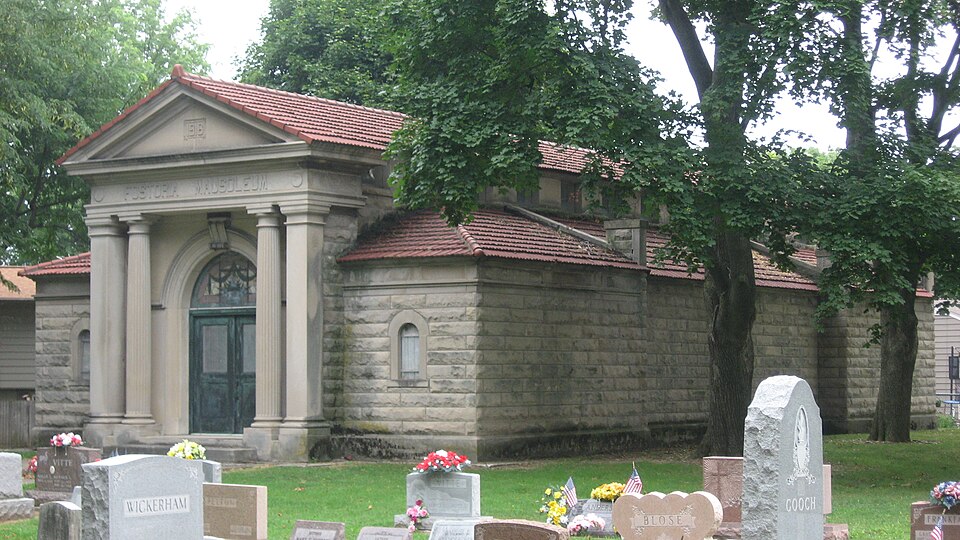
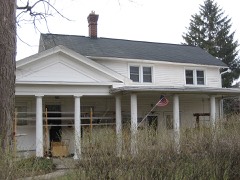
Listed on the National Register of Historic Places in
1978. A historic map-sheet match is not published yet. The record needs a coordinate-quality review before it can be joined to a sheet boundary.
From the record
“Michael Thomas and wife, and sons, Liverton, Michael, Hugh and Jonathan, came here fi-om Wayne County, Ohio, in the spring of 1832. The parents settled on the northwest quarter of Section 3, and Liverton, who was then married, on the southwest quarter of Section 2.”
History of Hancock County, Ohio : Containing a History of the County, Its Townships, Towns ... Portraits of Early Settlers and Prominent Men, Biographies, History of the Northwest Territory, History of Ohio, Statistical and Miscellaneous Matter, Etc (1886). Machine-read text.
one of 12 National Register listings in Hancock County · listed in 1978 · category: Building.
National Register reference number.78002085- the number the National Park Service assigned this property when it was listed, and the key its nomination file is catalogued under at the National Archives.
This township is watered by the east and middle branches of the Portage River. These branches are now known by the names of x\rcadia and Fostoria Creeks, one passing through the town of Arcadia, and the other one through Fostoria. The east branch has its source in section twelve, in Big Lick Tow nship, running in a north-easterly direction, entering this township in section thirty-five, running across the township in a north-easterly course, leaving it near the north-east corner of the county. The middle branch rises at the south line of the township, about four miles southeast of the village of Arcadia, crossing the township, leaving it near the north-west corner.
The first church in this township was built in i^'.Vl. at the center of section five, by the Methodists. xVlthough the building was erected at this time, yet for some reason it was not occupied for church purposes until some years later.. The first church in which worship was conducted, was on section one, near the north-east corner of the county, now West Fostoria, and was built by the Methodists. It was a hewed log building, about tw^euty-six by thirty-two feet, and probably seven feet between the floor and ceiling, and was* covered with lap shingles.
Regional context, not property-specific
evidence. The
federal wildfire occurrence database
lists 2 fires within 5 miles of Fostoria Mausoleum between
2002 and 2002, burning about 0 acres in total. None started naturally. None was recorded as arson.
Distance is straight-line from the map coordinates, so a fire counted
here may appear on a neighbouring settlement's page as well.
Reported cause
Fires
Missing data/not specified/undetermined
2
The most recent of
them, most recent first, with the day each was reported and the service
that recorded it.
Regional context, not property-specific
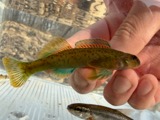
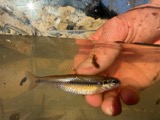
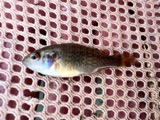
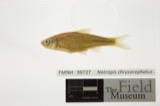
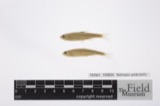
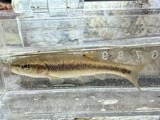
evidence. Museums hold 10 specimens
collected within 10 miles of Fostoria Mausoleum between 1929 and
1975: 10 Animalia. 9 distinct Species records are shown.
Collected by Hoke, B. & Norrocky, M. J. (Michael J.), Norrocky, M. J. (Michael J.), Trautman, M. B. (Milton Bernard). Each is a
physical object with a catalogue
number, and each entry opens the museum's record. This is what was
collected and kept, not a survey of what lives here - nothing can be
concluded from a species being absent.
No historic map-sheet match is published
for this property yet. That does not mean no map exists. This record needs
a coordinate-quality review before it can be joined to a sheet boundary.
Browse the county's mapped places while that work is
pending.
From the nomination file
5,688 words on record
When this property was proposed for the
National Register, someone wrote the case for it: what the building is,
and why it matters. That document is a federal record in the public domain.
It is quoted below word for word, never summarised. The text was read off the scanned case file by machine, so the
occasional stray character is the recogniser's and the 1970s
typewriter's.
Description of the property
Tuscan pillars. The two interior pillers are free standing, round, end round arches with keystones. serve to divide the lorgrows of crypts. CONDITION UNEXPOSED FAIR The exterior gables are marked on the inside by pilasters; the pilasters for the floor. part of the original building.All valls are of solid construction. fluted; the two exterior ones are square pilasters. to its detailing. side.This can be seen in the treatment of the roof which is separated with This limestone and concrete building features Foman details in its plain slip sills. _DETERIORATED almost-square windows on each side.The windows are recessed end have CHECK ONE _EXCELLENT is carved into the frieze. There are a total of 2cl crypts..
X_GOOD -RUINS The gabled red-tile roof is interrupted by a monitor vaich has twelve Two small window openings, one on either side of the main entrance, have There have been no changes made to the structure of this building or effect on the floor.Square black and white tiles create a darker border DATE.
Statement of significance
secretary), E.i. Barkley, Christian German, and David Cole (first treasurer). from 1925 to 1933) and J.W. Corl. The architéctural style and quality of the building provide the main significance Mausoleum The Fostoria Mausoleum was built by the Latchaw Brothers of Findlay, PERIOD ARCHEOLOGY-HISTORIC ART RELIGION BUILDER/ARCHITECT CONSERVATION SCIENCE XARCHITECTURE 1500-1599 EXPLORATION/SETTLEMENT AGRICULTURE THEATER ARCHEOLOGY-PREHISTORIC _PHILOSOPHY (first vice-president), George Yochum, S.R. Wilcox, Roscoe Carle (first INDUSTRY _COMMUNICATIONS LITERATURE interested in a glass company, the J.c. Crawford Clothing Manufacturing Co., regular meeting.The Articles were granted by William D.Fulton, Secretary X1900- ident), Ollivene Bolen (secretary), and LaDonna Ropp (treasurer).
Goodyear The Latchaw Brothers, according to the minutes (l9l7), did a fine job interested in attracting new industry to Fostoria; they were especially Other prominent Fostorians in the group included Thomas B.Hartley (a trustee _POLITICS/GOVERNMENT _TRANSPORTATION its associationwith a number of prominent citizens. _COMMERCE -1800-1899 _ENGINEERING -1400-1499 _PREHISTORIC He was a farmer before retiring to Fostoria and was a member of the Seneca -1600-1699 carried out much like a modern business enterprise. for the structure.It is important locally for its prominent siting and for furnish the music. At this time,the City of Fostoria and the Chamber of Commerce were -ECONOMICS -EDUCATION -1700-1799 George Yochum served as a trustee from l9l7 until his death in 1926.
-SCULPTURE - MILITARY 2:00 P.M.with the Hon.R.Clinton Cole as orator end a male quartette to -LAW 18,1918,189 crypts had been sold;95 are still sealed today. The mausoleum is not owned by the City of Fostoria or a cemetery -MUSIC Ohio. Work began shortly after July 3, 1916 and was conpleted shortly before profit corporation known as the fostoria llausoleum Association. The organi- on the building and all believed it would last a long time. The fostoria Mausoleun Association was re-instated on September 3, 1976.
Quoted from the National Register nomination
for reference 78002085, 34 pages, held by the National Archives in Record
Group 79. See the
catalogue record.
Listed places nearby
1 within 8 miles
Other National Register properties close
enough to walk or drive between, ordered by distance from this one. Both
positions come from the same geocoding pass that matched these properties
to their map sheets.
Listing record. National Park Service National Register of Historic Places, listed-properties dataset, current to 2026-05-22.
Map join. Address geocoded through the United States Census geocoder, then tested against the published boundary of every sheet in the USGS Historical Topographic Map Collection.
How this page is made. Listing fields come from federal records; map-sheet coverage is a labelled coordinate-to-boundary calculation, not a source-field claim.
Wildfire. Short, Karen C. 2022. Spatial wildfire occurrence data for the United States, 1992-2020 [FPA_FOD_20221014]. 6th Edition. Fort Collins, CO: Forest Service Research Data Archive. https://doi.org/10.2737/RDS-2013-0009.6 Collected with United States Government funding and usable without additional permissions or fees.
Specimens. Global Biodiversity Information Facility (GBIF), https://www.gbif.org/. Only records licensed CC0 or CC BY are used. Records licensed CC BY-NC are excluded because this site carries advertising. Images are checked individually and any whose licence is non-commercial, no-derivatives or unreadable is refused.
 Block
Block