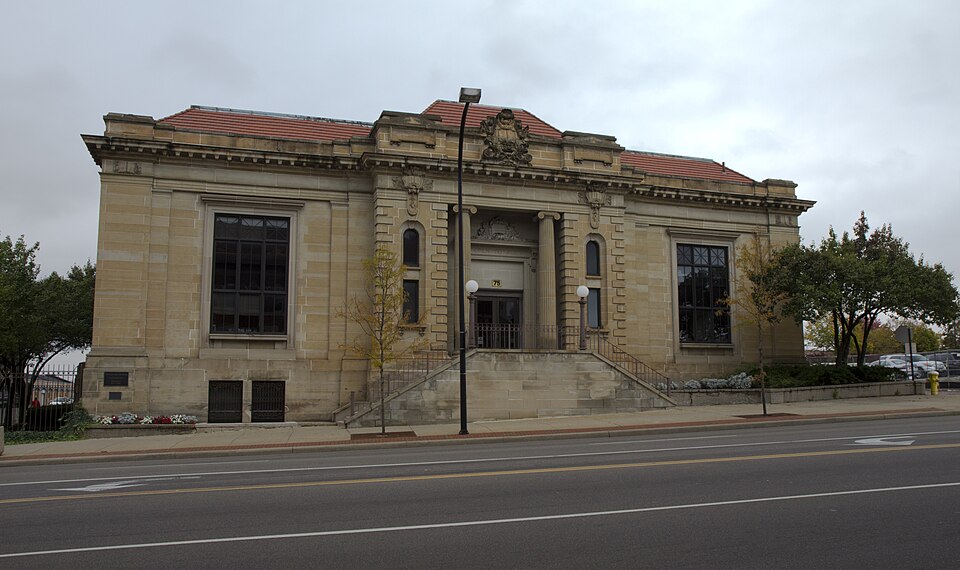
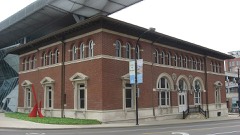
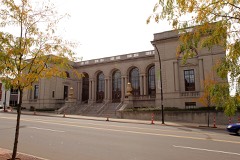
Built in 1904 in the Beaux-Arts. Listed on the National Register of Historic Places in
1983. A historic map-sheet match is not published yet. The record needs a coordinate-quality review before it can be joined to a sheet boundary.
From the record
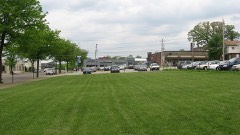
“The Akron Public Library is located on the north-east corners of East Market Street and South High Street in downtown Akron, Ohio, United States. Also known as the Carnegie Building, it was built in 1904 using a donation of $82,000 from U.S. industrialist Andrew Carnegie.”
Wikipedia article Akron Public Library, CC BY-SA 4.0.
one of 137 National Register listings in Summit County · listed in 1983 · category: Building · built in 1904, Beaux-Arts, by Frank Weary · one of 1 National Historic Landmarks in Summit County.
National Register reference number.83002060- the number the National Park Service assigned this property when it was listed, and the key its nomination file is catalogued under at the National Archives.
It is inaccurate to say that the Ohio Canal made Akron. The city as it stands today is the resultant of many causes. Many and different influences, and various men and measures, have co-operated toward the end now attained. The start was made long before the Ohio Canal was built. - Within the present limits of the city, settlements at two different points had been made, which antedate the canal by nearly two decades. In 1807 the first settlement had been made in Middlebury. In 1811 Miner Spicer had started "Spicertown." In the same year Paul Williams settled upon the lands immediately west of the Spicer settlement and adjoining the land of General Simon Perkins on the east. When the canal was opened in 1827 Middlebury was an important village. It had attracted many settlers from the East, principally from Connecticut, and boasted of half a dozen mills and factories, a dozen stores, three inns and about five hundred inhabitants. It certainly deserved a place on the maps of the time.
Let us search that we may find, if we can, the economic reasons for the existence of Akron. The sentence that begins this chapter contains the idea that is ordinarily advanced as the sole reason for the Akron of today. The unthinking man repeats: "The canal made Akron." The wTiter on Akron history records: "Dr. Eliakim G. Crosby made Akron."
Regional context, not property-specific
evidence. The
federal wildfire occurrence database
lists 1 fire within 5 miles of Akron Public Library between
2014 and 2014, burning about 0 acres in total. None started naturally. None was recorded as arson.
Distance is straight-line from the map coordinates, so a fire counted
here may appear on a neighbouring settlement's page as well.
Reported cause
Fires
Missing data/not specified/undetermined
1
The most recent of
them, most recent first, with the day each was reported and the service
that recorded it.
Regional context, not property-specific
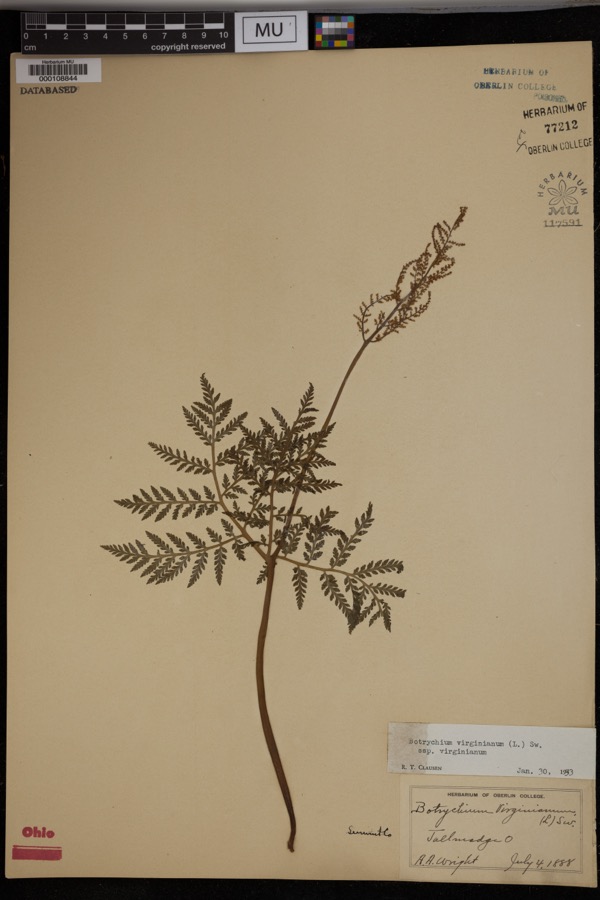
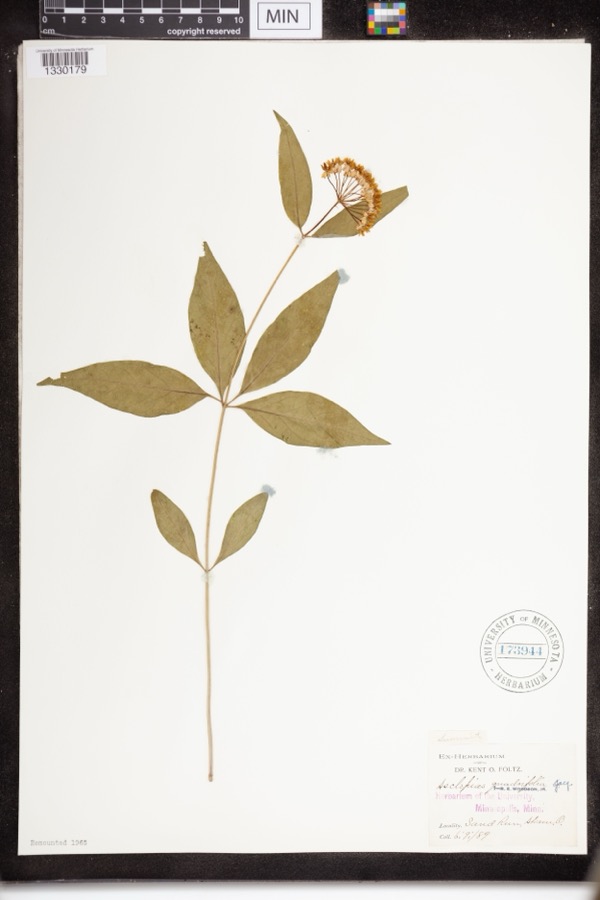
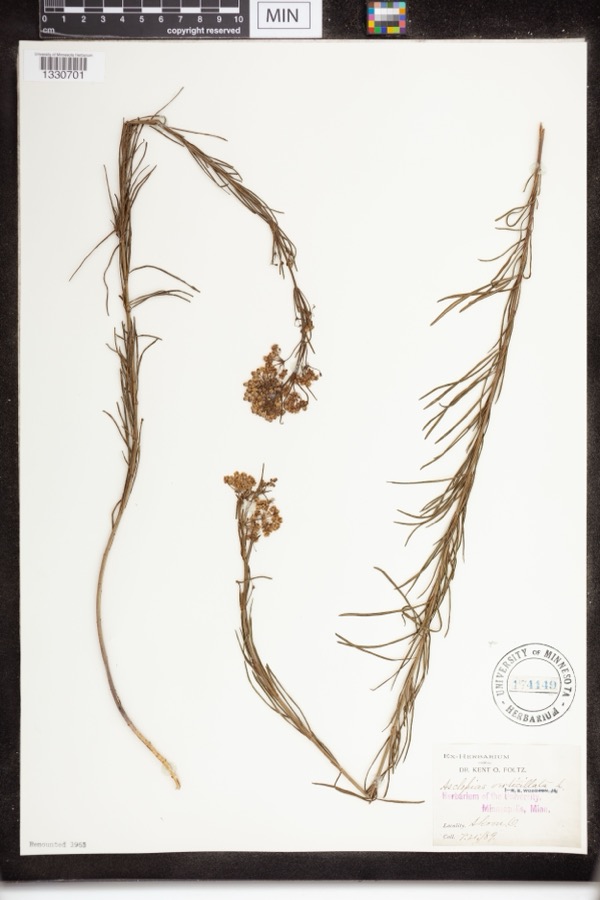
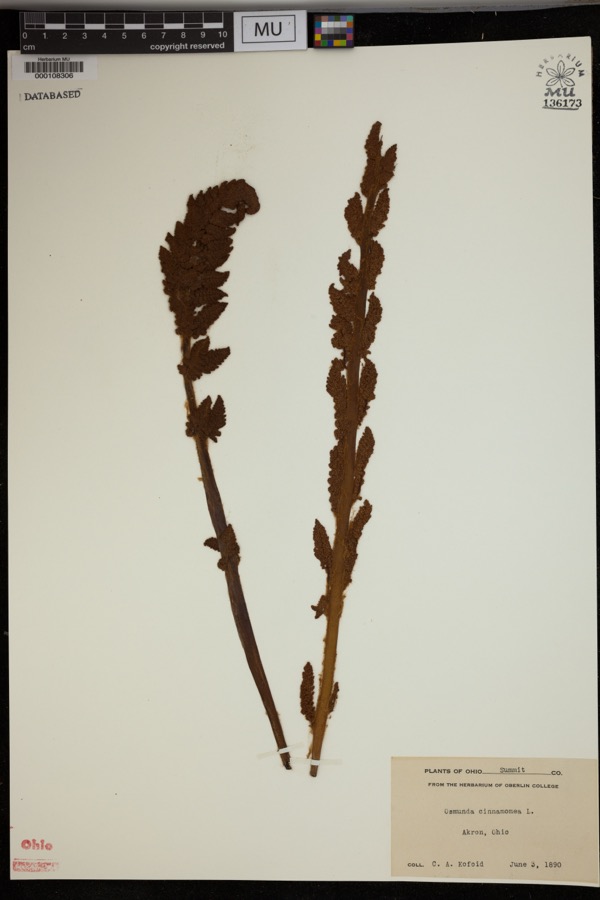
evidence. Museums hold 819 specimens
collected within 10 miles of Akron Public Library between 1867 and
1975: 703 Animalia, 69 Plantae, 45 Fungi, 1 Unrecorded, 1 Bacteria. 12 distinct Species records are shown.
Collected by (no collector listed), A. Black, A. W. Cusick and others. Each is a
physical object with a catalogue
number, and each entry opens the museum's record. This is what was
collected and kept, not a survey of what lives here - nothing can be
concluded from a species being absent.
Regional context, not property-specific
evidence. The federal mineral resources record lists
11 workings within 5 miles of Akron Public Library: 9 past producers, 2 producers.
2 still produce. What was taken out: Sand and Gravel, Construction. Distance is straight-line from the
map coordinates, so a quarry counted here may appear on a neighbouring
settlement's page as well.
Regional context, not property-specific
evidence. The National Weather Service names
Akron, the town this property stands in, in 75 storm reports between 1996 and 2025: 38 hail, 31 thunderstorm wind, 5 flash flood, 1 lightning.
The reports record 2 deaths. Each account below is quoted exactly as the forecast office
filed it, from the NOAA Storm Events Database, and each date
opens the federal record of that event.
On Wednesday afternoon, July 10, the City of Akron experienced 3 to 4 inches of rain in an hour and a half. Flooding occurred causing the closings of roadways and expressways. Along with the roadway flooding, the City received reports of nearly 200 flooded basements. Widespread flooding was reported throughout the city and numerous homes, businesses, and vehicles were inundated by the rain.
Weakened tree fell onto home in Akron and killed occupant. Thunderstorm was likely sub-severe per radar data. The nearby Akron-Fulton International Airport ASOS recorded a peak convective wind gust of 44 mph at 9:26 AM EST. No other reports of thunderstorm-related damage or severe convective weather were received as the cluster of storms moved through the Akron area.
A severe thunderstorm moved across Summit County and caused unprecedented damage. Hail as large as softballs fell across much of the county. Extensive damage was done to homes and vehicles in Akron and surrounding areas. Nearly 51,100 insurance claims were filed for damage in the county. The south side of Akron was the hardest hit.
Thunderstorm winds downed trees and limbs in the Akron and Stow areas resulting in scattered power outages. At the peak of the storm a few thousand customers were without power.
Route 8 northbound was closed from Perkins St to E. Tallmadge Avenue. Akron police reported traffic accidents and delays due to the high water conditions. Route 8 southbound closed at Seasons Rd in Hudson/Stow to flooding. Storm total rainfall from Hudson 4.75.
2 papers published in this town,
digitised by the Library of Congress and free to read: 0 issues,
0 pages. Every page is searchable, so a name or a street can be
looked for directly in what the town printed about itself at the time.
No historic map-sheet match is published
for this property yet. That does not mean no map exists. This record needs
a coordinate-quality review before it can be joined to a sheet boundary.
Browse the county's mapped places while that work is
pending.
Named in the fire insurance atlases
Sanborn surveyors printed an index of the
town's establishments at the front of each atlas. This property is named in
one, read straight off the scanned sheet.
When this property was proposed for the
National Register, someone wrote the case for it: what the building is,
and why it matters. That document is a federal record in the public domain.
It is quoted below word for word, never summarised. The text was read off the scanned case file by machine, so the
occasional stray character is the recogniser's and the 1970s
typewriter's.
Description of the property
and involved replacing the original stairs with a new set providing side After the Art Institute occupied the build- The double side-ramped stairs of the center pavilion ascend to the double- crossettes,is centered with a prominent scrolled and foliated cartouche. 7. Description ing, the interior was substantially altered and a mezzanine was installed be resurfaced with sandstone matching the exterior of the building so as to The former Akron Publie Library is a monumental single story block is raised at the pavilion. book device are set into the frieze above the piers at the far ends of the In the center of the pavilion parapet is a dramatic trophy ornament:a large the Akron Art Institute
_ deteriorated _ unaltered The interior layout is suggested by the components of the facade, a pro- flanking two narrow windows, one above the other, treated as a unit within The mansard-roofed attic, once covered in red tile but now tarred sheeting, restore the structure as much as possible to its original appearance. doored entry, which is framed by an architrave with crossettes. The dentil- an elongated round arch, the whole resting on a heavy sill with corbels. facade. Engirdling the structure is a robustly modillioned cornice, on which date twice. unexposed entry. During rehabilitation of the building The entire ated cartouche in the building's frieze. fluted Ionic columns in antis. with stucco.
festooned and garlanded escutcheon enriched by a mascaron under an open book The keystone is extended upward to connect with a drop ornament from a foli- The second alteration involved facing the facade of the staircase The third change resulted in removal of a colossal tripartite Similar cartouches with an open which bears the date of construction.
(in one paragraph) The former Akron Public Library is architecturally significant because it Frank O. Weary, a major turn of the century architect, designed in his long home of the city's first general circulation library (1904-1942) and the Frank Orlando Weary (1849-1921) practiced architecture in Akron from 1875 for Oberlin College, he designed three stone buildings - Peters Hall, Baldwin newly erected (1899) Akron Post Office building that was directly across the being built at more remote and inaccessible localities, to the end that this The Library is, strictly speaking, a Beaux Arts/French Renaissance building.
The French elements include the mansard roof, the projecting central pavil- the entry, enframed windows, rusticated ashlar basement, enriched entablature 1800-1899 1400-1499 1600-1699 1500-1599 1700-1799 communications Period humanitarian science Shaw's style. much closer personal attention than is possible on other new structures sculpture Mr.Weary saw his reputation grow rapidly and his practice attain what local started out as highly skilled interpreters of the High Victorian Gothic is the best example in downtown Akron of Beaux Arts Classicism in the French 8.
Significance Areas ofSignificance-Check and justify below By the time Mr.Weary did the Akron Public Library he had fully embraced the He added:"I would take great pride in giving this building the benefit of _industry During the period of his partnership with George W.Kramer of Akron be erected on the site. shall be the ideal piece of construction ever attempted in our City." Board of Control dated March 22,1902,he noted that "the design of our The only other Beaux Arts/French Renaissance structure in downtown Akron is - commerce building is 30 feet high from grade line to sidewalk which, we learn, is first permanent home of the Akron Art Institute
Quoted from the National Register nomination
for reference 83002060, 27 pages, held by the National Archives in Record
Group 79. See the
catalogue record.
Listed places nearby
6 within 8 miles
Other National Register properties close
enough to walk or drive between, ordered by distance from this one. Both
positions come from the same geocoding pass that matched these properties
to their map sheets.
Listing record. National Park Service National Register of Historic Places, listed-properties dataset, current to 2026-05-22.
Map join. Address geocoded through the United States Census geocoder, then tested against the published boundary of every sheet in the USGS Historical Topographic Map Collection.
How this page is made. Listing fields come from federal records; map-sheet coverage is a labelled coordinate-to-boundary calculation, not a source-field claim.
Wildfire. Short, Karen C. 2022. Spatial wildfire occurrence data for the United States, 1992-2020 [FPA_FOD_20221014]. 6th Edition. Fort Collins, CO: Forest Service Research Data Archive. https://doi.org/10.2737/RDS-2013-0009.6 Collected with United States Government funding and usable without additional permissions or fees.
Specimens. Global Biodiversity Information Facility (GBIF), https://www.gbif.org/. Only records licensed CC0 or CC BY are used. Records licensed CC BY-NC are excluded because this site carries advertising. Images are checked individually and any whose licence is non-commercial, no-derivatives or unreadable is refused.
Mines and quarries. USGS Mineral Resources Data System (MRDS) https://mrdata.usgs.gov/mrds/ A work of the United States government, no copyright under 17 U.S.C. 105.
Storms. NOAA National Centers for Environmental Information, Storm Events Database https://www.ncei.noaa.gov/stormevents/ A work of the United States government, no copyright under 17 U.S.C. 105. Narratives are quoted verbatim from the National Weather Service report and are not edited or summarised.
 Block
Block