Documentation of the Atherton Bridge is part of the Massachusetts Historic Bridge Recording Project, conducted during the summer of under the co-sponsorship of HABS/HAER and the Massachusetts Department of Public Works, in cooperation with the Massachusetts Historical Commission. Patrick Harshbarger, HAER Historian, August ".7 ATHERTON BRIDGE (BOLTON ROAD BRIDGE) HAER No. MA-17 (page 3) Introduction The Post truss, although never as prevalent as its nineteenth-century counterparts--the Howe, Warren and Pratt trusses--nonetheless played a definitive role in the development of American bridge building. Designed by Civil Engineer Simeon S. Post the truss enjoyed a brief period of popularity in the late and early primarily for long-span railroad bridges.
Post never patented the web configuration of the truss, but in he received a patent for the joint connections. Engineers considered Post's design ideal because of its apparent stiffness and economy of material. Nevertheless, a number of factors, including heavier load requirements, led to the obsolescence of the Post truss by the century's last decade.1 The Atherton Bridge, and the Ponakin Bridge, (HAER No. MA- both located in Lancaster, Massachusetts, are two of only a small number of surviving examples of Post-type trusses in the United States.2 Unlike the majority of Post trusses built in the nineteenth century, the Atherton and Ponakin Bridges are short-span highway bridges, rather than long-span railroad bridges.
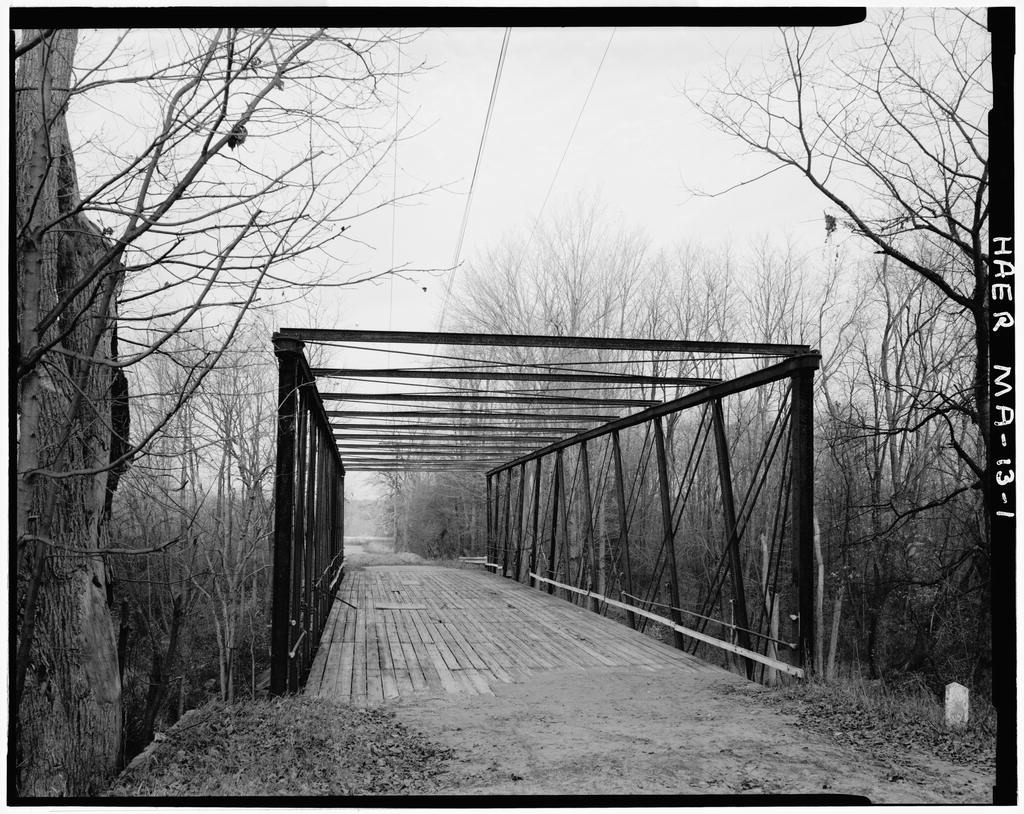
The two bridges, excellent examples of this now-rare truss type, owe their survival to their location on less-traveled byways of the nineteenth century. Both bridges are listed on the National Register of Historic Places. Although somewhat similar in form, the Atherton and Ponakin Bridges differ with regard to their incorporation of features of the Post patent. The Ponakin Bridge, built by the Watson Manufacturing Company of Paterson, New Jersey, incorporates all of the features of Post's design. The Atherton Bridge, built by Cofrode & Company of Philadelphia, adapts the Post-truss configuration to a smaller highway bridge, but does not make use of the specific features of Post's patent.3(See Figure 1.) For more information on the Ponakin Bridge, refer to HAER No. MA-13.
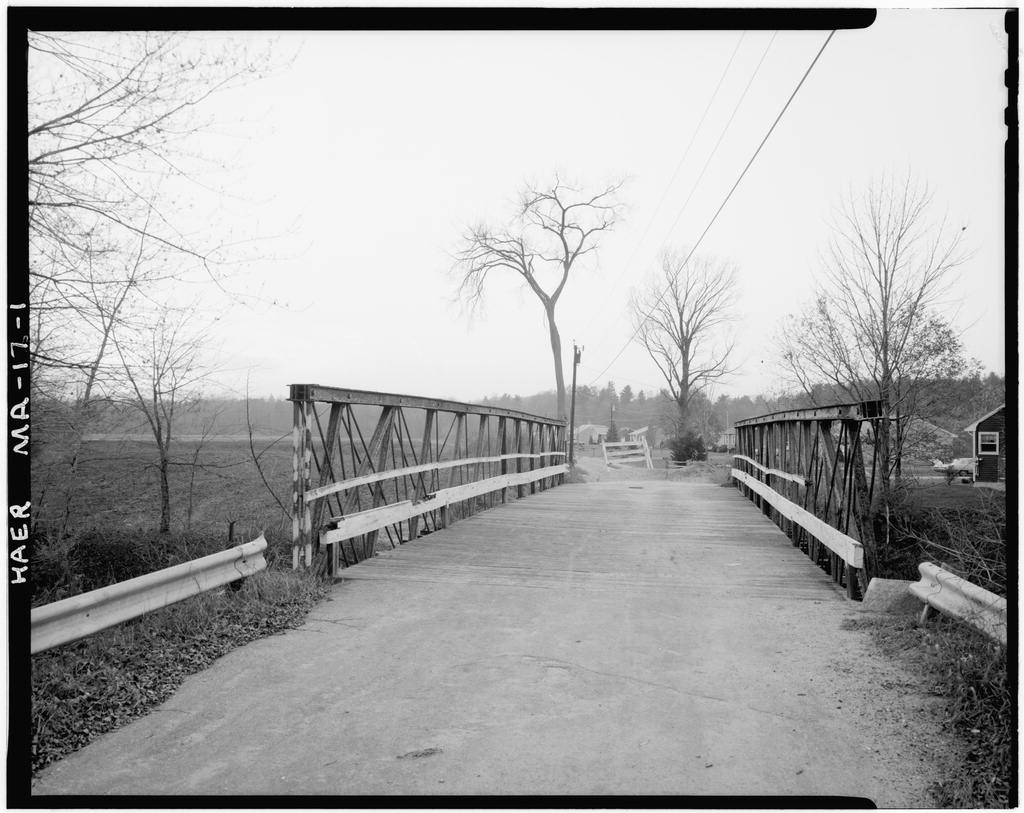
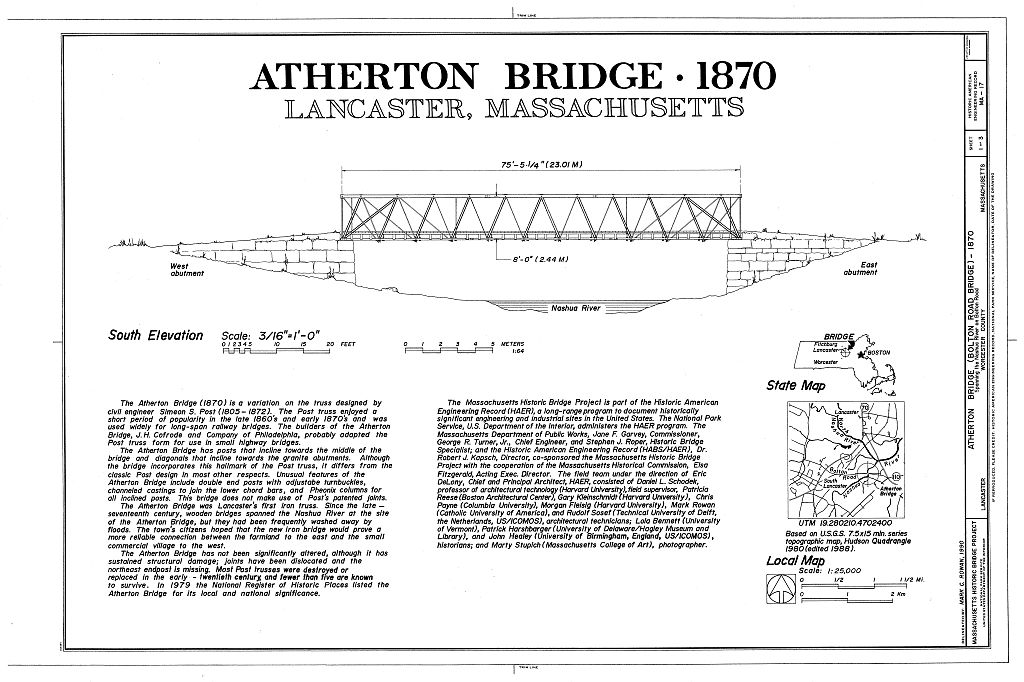
Description The Atherton Bridge spans the Nashua River on Bolton Road about three- quarters of a mile south of Lancaster Center. The bridge sits in a low-lying flood plain near the confluence of the North Nashua and Nashua Rivers. A residential neighborhood and an adjacent cornfield lie to the west of the bridge, and the town garage is located to the east. Scrub trees line the river banks. The bridge has been closed to vehicular traffic since and the road is blocked with concrete barriers, but the bridge is still used by pedestrians and bicyclists. The Atherton Bridge is a single-span pony truss, measuring long, wide, and high. The upper chord is comprised of two wrought- iron, C-shaped beams, joined across the top by a riveted reinforcing plate.
The lower chord varies across the length of the bridge. From the footing to the second joint, the lower chord consists of two kuxkn wrought-iron bars. From the second joint to the middle of the bridge, the lower chord consists of four of these bars. The chord bars are of various lengths and joined together by riveted plates at staggered intervals. The upper and lower chords are joined by posts and diagonals, whose web pattern mimics a Post truss. The posts incline at approximately 22h degrees towards the center of the bridge, ATHERTON BRIDGE (BOLTON ROAD BRIDGE) HAER No. MA-17 (page 4) and the diagonals at 22H degrees towards the abutments. The inclined posts are hollow, 4"-diameter, riveted wrought-iron Phoenix-type columns, manufactured by the Phoenix Iron Works of Philadelphia.
The diagonals are 1"- diameter wrought-iron rods. At either end of each truss are two posts anomalous to the classic Post-truss design. One of these Phoenix-column posts runs from the footing to the first joint in the upper chord, and the other from the footing to the second joint. Another distinguishing feature of the Atherton Bridge is the lack of counters, and single (rather than double-intersecting) diagonals. Of further interest are the diagonals which run through the centers of the two hollow Phoenix-type columns at the center of the span. The endposts consist of two hollow cast-iron tubes and an adjustable tension rod that fit into cast-iron joint boxes at the lower and upper chords. Sockets in the lower castings also hold the two anomalous Phoenix-type columns.
The upper and lower chords attach to the end-post joints by bolts. The other lower-chord connections have cast-iron joint boxes with bolts threaded onto the ends of the diagonals. The upper chord joint boxes are similar, except that the diagonals are held by pins. The Phoenix-type columns fit into sockets in the castings and are held in place by metal sleeves. Wrought-iron, I-shaped floor beams rest directly on the lower-chord bars near the joints. Pairs of timber floor beams have been placed between the iron floor beams. Wooden plank decking runs the length of the bridge. Four wrought-iron outriggers, two on either side of the bridge, riveted to the inside of the upper chord and are bolted to the top of the iron floor beams about 21' from either end of the trusses.
They are intended to improve the lateral stability of the pony truss. The Atherton Bridge has not been significantly altered, although it has suffered from major structural damage. The northeast endpost has been forceably removed and many of the Phoenix-type columns have been dislocated from their sockets. One column has been replaced by a simple iron pipe. A number of the diagonals are bent and twisted, and the lower chord has slid from its channel in the northeast footing. The Atherton Bridge does not have a builder's plate.(See HAER drawings and photos.) Simeon S.
Post and the Post-Truss Patent During the nineteenth century, bridge building evolved from an art to a science; a craft once practiced by local carpenters and millwrights became a business organized by engineers and industrialists. Iron and steel replaced wood as the engineer's material of choice, and monumental bridges spanned rivers at one time thought impassable. The career of Simeon S. Post reflected this transformation. Born in New Hampshire In Post did not receive an education in engineering, but rather, learned the trade of a house-joiner. The facts of Post's early life are sketchy, but sometime after completing his apprenticeship he moved to Montpelier, Vermont, to begin his career.
While there, he made the acquaintance of the state's Surveyor General, John Johnson, and became involved with surveying for the new state capitol. Johnson, perhaps as a political favor, arranged to have his son, Edwin Johnson, the chief engineer ATHERTON BRIDGE (BOLTON ROAD BRIDGE) HAER No. MA-17 (page 5) of the newly-formed Auburn & Syracuse Railroad, appoint Post to a resident engineer's position on the railway.* The fledgling railroad industry provided one of the greatest training grounds for civil engineers. A survey of the first fifty-five members of the American Society of Civil Engineers (ASCE), the oldest professional engineering organization in the United States, found that thirty had worked for the railroads and that fully 60 percent had not attended an engineering school.
Like Post, they gained their education from the practical experiences of surveying railways, digging tunnels, and erecting bridges.5 Although the railroads provided opportunities for ambitious young men, the early history of railroad-bridge engineering was frequently marked by trial-and-error methods, inadequate knowledge of the strength of building materials, and irresponsible construction practices. The railroads required bridges stronger and more durable than the traditional wooden ones built by American craftsmen. Iron offered a solution to the railroads' bridge problem but manufacturing technology limited the size, width and strength of truss members.
Engineers poorly understood the factors that determined the maximum load and structural action of iron trusses; consequently, they met with limited successes, and some disastrous failures.6 Post was in an ideal position to observe and participate in the development of iron bridge-building technology. In he became the New York & Erie Railroad's resident engineer, a position that was to bring him in contact with Squire Whipple, one of the most highly-regarded American bridge builders of his day, who also worked for the railroad company. Whipple patented two iron trusses, one in and the other in both of which became important models for later bridges, whipple was also foremost among his American contemporaries in understanding the nature of truss action.
His book, A Work on Bridge Building was the first scientific treatise to accurately describe the way loads distribute themselves through the joints and the separate members of a truss. In the late the New York & Erie built a number of Whipple trusses. By that time Post had climbed to the position of Superintendent of Transportation, and may have had some oversight responsibilities for the bridges' construction.7 If Post had the good fortune to associate with America's foremost bridge engineer, he also had the bad fortune to experience iron bridge disasters first hand. In and the New York & Erie contracted with Nathaniel Rider, a bridge-builder from New York City, to erect several trusses along its lines.
Two of the bridges failed, and public outcry convinced officials of the New York & Erie Railroad to suspend the building of new iron bridges and to tear down all of the railroad's existing iron trusses, including those designed by Whipple. Fifteen years passed before the New York & Erie built another iron bridge.8 Despite the railroad's bridge problems, Post's career began to earn him the respect and admiration of his peers. Post worked with Ezra Cornell to introduce the earliest-known system of telegraphy to monitor the movement of trains and to prevent collisions. He also Invented a parabolic headlight reflector used by locomotives, a system of railroad baggage checks, and a design for railroad timetables widely adopted by other railroad companies.
In after eleven years of employment with the company, the New York & Erie ATHERTON BRIDGE (BOLTON ROAD BRIDGE) HAER No. MA-17 (page 6) Railroad promoted Post to the position of Chief Engineer. As his career unfolded, Post took some interest in the development of engineering as a profession. In Post accepted an invitation to join with eleven other engineers as a founding member of the American Society of Civil Engineers (ASCE) in New York City. The early history of this organization was full of disappointment; meetings were underattended, and one of the association's officers lost the organization's money in a doubtful investment scheme.
The organization became viable only after the Civil War, Shortly after gaining his charter membership, Post left the East Coast for a new position with the Ohio & Mississippi Railroad; henceforth, he appeared to take only a passing interest in the ASCE's activities.10 In Post returned to the New York & Erie Railroad as a consulting engineer and received charge of the construction of New York's Bergen Tunnel. Three years later, as the project neared completion, funds ran short and Post found himself without a job. Consequently, he set up his own independent civil engineering practice in New York City, and turned his attention to the problems of bridge construction. Few engineers could have been better prepared to consider the needs of American bridge builders.
In Post published his "Treatise on the Principles of Civil Engineering as Applied to the Construction of Wooden Bridges." The treatise appeared in weekly installments in American Railroad Journal, and was clearly aimed at an audience of railway men uninitiated to calculating loads and strains.
Beginning with an explanation of Newtonian forces, and ending with numerous examples of how to determine the correct size and length of wooden truss members, Post demonstrated a clear understanding of Whipple's principles of truss building.(See Appendix A.) Post's decision to apply this knowledge to wooden bridges probably reflected the simple and overwhelming fact that most American railroads still preferred to build out of the less-costly material.11 Still, Post understood that the future of American bridge-building lay in the construction of strong and durable iron trusses. Beginning in the many engineers formerly employed by the railroads came to the same conclusion. They struck out on their own into the potentially profitable business of contract iron-bridge building.
These entrepreneurs associated themselves with existing firms or organized new companies, often making a specialty of a certain type of truss, sometimes controlled by a patent or license.*2 In June Post obtained letters of patent for an improvement in iron bridge joints.(See Appendix B.) He claimed that his method of construction allowed the struts and braces to revolve upon a bolt to the degree that the bridge expanded and contracted from changing load conditions and variations in temperature. Post's patented joints consisted of a joint box and pin that connected segments of the top chord and received the heads of the posts, struts and braces; a cylindrical joint that held the rounded end post; and a slotted chord used in combination with the cylindrical joint.
Bridge engineers considered increasing the rigidity of iron trusses while maintaining enough flexibility to keep them from buckling a fundamental problem, and Post attempted to address this concern.13 Two years after receiving his patent, Post contracted with his old ATHERTON BRIDGE (BOLTON ROAD BRIDGE) HAER No. MA-17 (page 7) employer, the New York & Erie Railroad, to build the first bridge based upon his improved design. Post's truss at Washingtonville, New York, was also probably the first iron bridge erected by the railroad since the disasters in This bridge made use of Post's patented joints and had the distinctive arrangement of inclined posts and diagonals found in his later trusses. During the next five years, Post devoted his time to the construction of his bridges.
Unfortunately, the record of these years is vague, and Post's attempts to turn a profit through licensing agreements, partnerships and other business dealings can only be surmised. Apparently, either because of old age, disinterest, or lack of financial resources, Post made no attempt to start his own bridge-building firm, but licensed his patent to the Watson Manufacturing Company of Paterson, New Jersey, of which his son, Andrew Post, was a managing partner. In the Illinois & St. Louis Bridge Company, which probably also held license to build the patented trusses, listed Post as a consulting engineer.14 Whether or not Post had relationships with other bridge manufacturers is unknown. It is also unclear what involvement Post had with the construction and engineering of specific bridges.
In March at the age of 65, Post accepted a position as Engineer of Construction for the Northern Pacific Railroad. Four months later, he was stricken by paralysis, probably from a stroke, and his professional career came to an abrupt end. Post died in Jersey City, New Jersey, on June 29, The Post Truss in the United States The Post truss enjoyed a brief, but vigorous, period of popularity in the late and early In Post's design received national recognition when the Union Pacific Railroad decided to use It for the largest river crossing on its line, spanning the Missouri River between Council Bluffs, Iowa, and Omaha, Nebraska.
The Union Pacific's choice was surprising, considering the untested nature of the bridge, but Post's truss claimed greater rigidity under moving loads, and this appealed to the railroads. The Illinois & St. Louis Bridge Company completed this extraordinary bridge in 1872.(See Figure 2.) Including the approaches, it was a little over two-and- a-half miles long, with eleven cast- and wrought-iron Post truss spans measuring each.16 Not to be outdone by the Union Pacific, other railroads expanding into the west also chose Post trusses for their crossings of the Missouri River. In the Chicago, Burlington & Quincy Railroad began building a five-span bridge, measuring approximately long, at Kansas City, and shortly thereafter, another of nearly the same length at Leavenworth, Kansas.
The Post truss reached its maximum length in the Missouri River Bridge of the Missouri, Kansas & Texas Railroad, at Booneville, Missouri, in This bridge had a swing span long. At least for a short while, the enthusiasm that followed in the wake of the transcontinental railroads secured the popular reputation of the Post truss as a viable option for longer bridge spans.17 The Post truss belonged to a family of trusses that could be distinguished by posts or verticals in compression, and diagonals in tension. ATHERTON BRIDGE (BOLTON ROAD BRIDGE) HAER No.
MA-17 (page 8) Throughout the mid-nineteenth century countless engineers and bridge- manufacturers built variations on this design, the most common of which was the Pratt truss, but to which the less-common Parker, Camelback, Lenticular, Baltimore, Pennsylvania, Kellog, Whipple and Post trusses were all related. This impressive list of truss types was the result of experimentation by engineers, and of keen competition among firms searching for advantages against their rivals. Engineering journals constantly featured articles comparing the merits of one truss against another. The Post truss's distinction as a long-span bridge was an important factor in this debate.
Not surprisingly, bridge builders found the most attractive feature of the Post truss to be the unusual pattern of inclined posts and verticals, and not the special joints, which Post had thought important enough to patent. Post's patented joints could not be copied except under license from the engineer or his assignees, but the distinctive diagonals and posts held no such restrictions. In Col. William E. Merrill, an engineering graduate of the United States Military Academy, published a book that claimed that the Post-truss type conformed with his theoretical determinations of the most economical angles for bridge members.
He argued that given trusses of equal length, depth, width and strength, the Post truss would contain less metal than other trusses, at a minor, although perhaps not insignificant, cost advantage to its manufacturer.19 Although Merrill's calculations were somewhat misleading, because many other factors influenced bridge costs, his assertions created a stir in the engineering community. Whether Merrill had anything to gain by promoting the Post truss over the other types is unknown, but his assertions touched off a fierce debate with Squire Whipple, the dean of American bridge builders.
In a paper read before the ASCE in Whipple, in a scathing tone untypical for engineering journals, told the society's members that Merrill had misrepresented the Whipple Truss and made it appear vastly inferior to the Post Truss. In fact, Whipple concluded, the Post truss was merely a modification of the Whipple truss, "first used and thoroughly discussed" by himself.20 Simeon Post lay dying, and could not answer either Merrill's or Whipple's assertions. Post may have inclined the truss posts for economic reasons, but no historical records have been found to say that Post might not have also felt that his modifications strengthened the truss or offered a technical advantage in the manufacturing process.
Whipple directed his attack solely at Merrill, so there was also no reason to believe that Post had fallen out with the well-regarded engineer.21 Persuaded by the economy of the Post-truss form, any number of bridge builders may have designed variations on it. The Atherton Bridge, for example, appears to be an adaptation of the Post truss to a small highway bridge. The Bell's Ford Bridge in Seymour, Indiana, is a composite bridge with wooden posts and iron diagonals. Other Post trusses no longer surviving, but identified from historic photographs, include bridges in Paterson, New Jersey; Pittston, Pennsylvania; Columbiaville, New York; and Clear Creek Canyon, Colorado.
How many of these bridges were built by the Watson Manufacturing Company, and other licensees of the Post Patent is unknown.22 The popularity of the Post truss ended almost as quickly as it began. By bridge companies had stopped building Post trusses. The last two t ' ''' li-%,':?ct'S1s ATHERTON BRIDGE (BOLTON ROAD BRIDGE) HAER No. MA-17 (page 9) decades of the nineteenth century saw an Increasing uniformity and standardization of truss form, as competition weeded out those trusses that did not demonstrate versatility, durability, and economic desirability. In the Watson Manufacturing Company erected three Post trusses in Brazil and then went into receivership and out of business. Heavy locomotives and railroad cars simply wore out the cast and wrought-iron, pin-connected bridges.
The Union Pacific Railroad replaced its Post-truss Missouri River bridge in and the other Post-trusses across the Missouri disappeared by the turn of the twentieth century. The railroads demolished or abandoned the Post trusses at an astonishing rate. Cantilever bridges replaced trusses in long-span crossings, and Pratt and Warren trusses became the engineers' choice for shorter spans. J.A.L. Waddell, an authority on nineteenth and early-twentieth century bridge engineering, remembered being called upon in to rebuild a large Post truss which had caught fire.
He wrote that, "It was a very difficult piece of work to patch up the detailing so as to make it safe and passable; and it was absolutely impossible to make the bridge anything like a first-class structure, even for the light live load it had to carry." Those Post trusses that incorporated the patented joints proved even more difficult to maintain; the cast-iron boxes that encased the joints prevented inspection and repair of pins and bridge members.23 By the first decades of the twentieth century, even inclined posts and diagonals, once the Post truss's strongest feature, became a weak point in light of advances in the theoretical understanding of structural engineering.
The odd angles made it difficult to determine whether corapressive or tensile forces would be placed on certain bridge members as live loads passed over the truss. In George Fillmore Swain, one of the nation's foremost structural engineers and a professor at Harvard University, wrote the engineering professions' final words on the Post truss: "There is nothing to recommend this truss that cannot be obtained in a better and more economical way." Forgotten, ignored and disdained, the Post trusses disappeared from the landscape.24 Lancaster's Early Bridges The town of Lancaster lies in the rolling hills of the Worcester Plateau in Central Massachusetts, at the confluence of the Nashua and North Nashua Rivers.
Founded in Lancaster became an important early market center and a gateway to the western frontier of New England. By Lancaster was the region's wealthiest agricultural and commercial town. The fertile fields of the Nashua intervale contributed to the town's prosperity, as did the development of a number of industries, including saw and grist milling, potash making, tanning, slate quarrying, and ceramics manufacturing. As the town's citizens entered the nineteenth century, overland transportation increased in importance.
Shortly after the turn-of-the-century, the state chartered the Lancaster-Bolton Turnpike and the Union Turnpike as part of an interregional network of east-west roads radiating from Boston and passing through the town of Lancaster.25 Local farmers and millwrights built the town's early bridges, which were ATHERTON BRIDGE (BOLTON ROAD BRIDGE) HAER No. MA-17 (page 10) usually nothing more than wooden trestles with log abutments. Floods regularly washed away one or more of Lancaster's seven or eight bridges, and the citizens attempted to replace thera with a minimum of fuss and expense, although the costs occasionally proved burdensome.
In the late-eighteenth century, the town issued lottery tickets in an attempt to raise money for the general repair and rebuilding of the bridges.26 New England's tradition of local government gave the town meeting and the elected officials (selectmen) authority over the erection of new bridges. Beginning in the early-nineteenth century, Lancaster's town records show a continuing concern for bridge improvements. In a town committee recommended building stone arch bridges, but this suggestion does not appear to have been adopted.
The town treasurers kept careful expense records, and rarely did a year pass when the town did not pay for some bridge repairs or upkeep.27 Bridges had crossed the Nashua River at the site of the Atherton Bridge since the late-seventeenth or early-eighteenth century. The early settlers named the Atherton Bridge after James Atherton, one of the incorporators of the town. The nearby Lancaster-Bolton Turnpike bypassed the Atherton Bridge, crossing the Nashua River about to the north, at Center Bridge. Town reports first mention the Atherton Bridge in when a repair of was recorded. Usually, small payments went to replacing worn-out planks and timbers, or sometimes to "snowing," which meant shoveling and packing snow onto the bridge roadway for sleds to pass during the winter.
In a flood washed away the Atherton Bridge, and at the town meeting the citizens decided to follow up on recent suggestions to build more substantial bridges. The builders of the new bridge adopted a wooden arch plan designed by Farnham Plummer, a local resident. This bridge appears to have been a variant upon the wooden arch bridges common at that time. In the Atherton Bridge floated down river once again. This time the rebuilders chose to erect a new structure based upon the design of Ithiel Town. Patented in this wooden truss employed closely-spaced diagonal timbers in a lattice pattern, to create a stiff web of considerable strength.
New England towns favored the Town lattice truss for covered bridges because it was strong, and local millwrights had the skill necessary to pin together the trusses on the riverbanks and then slide the bridge across the river and into place. Ithiel Town rarely built the trusses, but advertised his plans and collected royalties from the towns that decided to use his idea. The Town lattice truss survived forty years at the Atherton Bridge crossing, although it occasionally needed substantial repairs, probably the result of flood damage.29 As the nineteenth century progressed, the town of Lancaster ceased to be a major commercial center for the region. Industrialization brought textile mills to the area.
The Lancaster Mills Company had been organized in the and the town of Clinton, comprised of Irish workers' communities, separated from Lancaster in Clinton, Fitchburg and Leominster emerged as new centers of commerce. Lancaster maintained its agricultural economy -- based on supplying the Boston market with livestock, dairy products, corn, hops, potatoes and hay--and experienced some growth in the industrial areas, primarily cotton spinning, expanding from a annual production rate in of ATHERTON BRIDGE (BOLTON ROAD BRIDGE) HAER No. MA-17 (page 11) yards to a rate in of yards.
Following the Civil War, Lancaster--a short day's train ride from Boston--also became a popular summer residence for wealthy merchants and industrialists.30 One of the most prominent of these prosperous summer tenants was Nathaniel Thayer, a Boston financier and philanthropist with roots in Lancaster. In Thayer (age claimed permanent residence in Lancaster as a means of escaping Boston's high tax rates. The town of Lancaster suddenly received a tax windfall of over on Thayer's estimated million; this exceeded twenty-five times the amount paid by any other single citizen in town.
Lancaster's property owners rejoiced because the tax rates could be easily kept at a relatively modest one percent, and new public improvements could be undertaken with the expanded tax pool.31 In the spring of Lancaster's citizens gathered at the town meeting to decide what to do with their new-found tax dollars. Thompson, the town clerk, recorded that a proposal to replace the wooden bridges with iron and to improve the principal roads received a favorable hearing. The first bridge on the town's agenda was the Atherton Bridge, and the town appointed a bridge committee of five members to look into the cost of buying a new iron truss for that location. Charles L. Wilder, a local merchant and cotton manufacturer, chaired the committee.
The bridge committee announced its intention to let a bridge contract in the local newspaper, and directly contacted the local agents of bridge manufacturers for proposals. They also took care to visit iron bridges in nearby towns and to compare the cost of an iron bridge with a wooden one, an indication that some of the committee members may have still been skeptical about the reliability of iron trusses. Sometime in the spring or summer of the committee reported that a wooden bridge would cost only or less than an iron one. Electing for an iron truss, they stated that they could recommend three bridge builders: A.D. Company of Springfield, Massachusetts; Cofrode & Company of Philadelphia; and the Mosely Iron Bridge Company of Boston.
The committee specified that the bridge would be: built above the abutments of wrought iron, except the head and foot blocks or washers, which are of cast iron, complete ready for travel, and to have two coats of good metalic paint [sic]. And are warrented to sustain a weight of two thousand lbs [per linear] foot, and that will not be more than one fourth to one sixth of the weight required to break it [sic]. The committee's report did not state how the town officials chose between the truss manufacturers, but they finally awarded the contract to Cofrode & Company, for per linear foot. Cofrode & Company Little information could be found about Cofrode & Company. Victor Darnell's Directory of American Bridge Builders.
listed the first known activity of the company in the year the same year as the ATHERTON BRIDGE (BOLTON ROAD BRIDGE) HAER No. MA-17 (page 12) erection of the Atherton Bridge. A search of the Philadelphia City Directory turned up a listing for "Joseph H. Cofrode, John H. Schaeffer and Francis A. Saylor, engineers and bridge builders." Although the partnership of Cofrode & Company probably did not survive the early Cofrode and Saylor listed themselves as the proprietors of the Philadelphia Bridge Works between and ca.1890. The Atherton Bridge, an unique variation of the Post truss, may have been an experimental design by Cofrode & Co.
Built at the height of the Post truss's popularity, the Atherton Bridge could have been inspired by Merrill's arguments about the economic angle of the posts and verticals. The Phoenix columns were a patented commercial item, available exclusively from the Phoenix Iron Works of Philadelphia, holders of the patent. Construction of the Atherton Bridge In the fall of the Atherton Bridge's unassembled iron members arrived by rail from Philadelphia. As was typical of nineteenth-century bridge contracts, the manufacturer of the iron truss took responsibility for erecting the superstructure of the bridge, while the town hired a local contractor to prepare the abutments and piers, and lay the floor timbers.
Local men provided the oxen to haul the stone from the railroad depot to the site, and many millwrights and masons who might have lent their expertise to earlier bridges continued to help with various phases of the construction.33 By late October or early November, the bridge builder had completed the new Iron truss. As a final precaution, the bridge committee hired Joshua Thissle, an engineer from the nearby Lancaster Mills cotton factories, to test the Atherton Bridge's structural safety. Before a crowd of spectators, including representatives of Cofrode & Company, Thissle drove wagon teams loaded with pounds of stone onto the truss.
To everyone's satisfaction, the deflection measured only four-hundredths of a foot, less than than In the spring of Lancaster's citizens gathered once again at the annual town meeting. They reviewed the finances, elected new officials, and discussed needed public improvements. The town clerk wrote in his personal journal that, "the town was so well pleased with the new bridge [Atherton Bridge], that they voted to rebuild with iron, two bridges, vis.
the Centre and Ponakin, at an expense of about each [sic]." The citizens of Lancaster had quickly shown pride in their new iron bridge, and willingly spent Thayer's tax dollars to upgrade their other bridges.35 During the summer, the Watson Manufacturing Company of Paterson, New Jersey erected two Post patent trusses, one at the site of the Center Bridge, and one at the site of the Ponakin Bridge (HAER No. MA-13). Preservation of Lancaster's Post-Truss Bridges Although the Ponakin and Atherton Bridges show signs of age and deterioration, they have been altered only slightly since their erection in and Town records show that approximately every ten years, and sometimes more or less frequently, workmen replaced the wood deck and ATHERTON BRIDGE (BOLTON ROAD BRIDGE) HAER No.
MA-17 (page 13) stringers or performed some minor maintenance on the trusses, such as painting the iron work. The greatest threat to the iron trusses has always been obsolescence. As early as Lancaster's road commissioners advocated replacing the town's iron bridges with wider concrete-arch highway bridges for safety and durability. Fast-moving automobiles could not pass the narrow bridges safely, and heavily-loaded trucks and buses placed stresses on the trusses that the builders rarely had designed thera to carry. Over the decades, Lancaster's iron bridges slowly disappeared, casualties of metal fatigue, unsafe conditions or floods.
The Atherton and Ponakin Bridges survived simply because the closing of the mills and the completion of the state highways relegated them to less-traveled backroads.36 Nonetheless, in the heavy traffic finally took its toll. In the town requested funds from the state to replace the Atherton Bridge, and shortly thereafter closed the bridge to vehicular and pedestrian traffic. This aroused minor complaints of inconvenience from local residents, but eventually they found other ways around the river crossing. In the Massachusetts Department of Public Works signed contracts to replace the bridge, but the request met with some local resistance. Some favored a new bridge, but others had grown to like the quiet dead end street created by the bridge barriers.
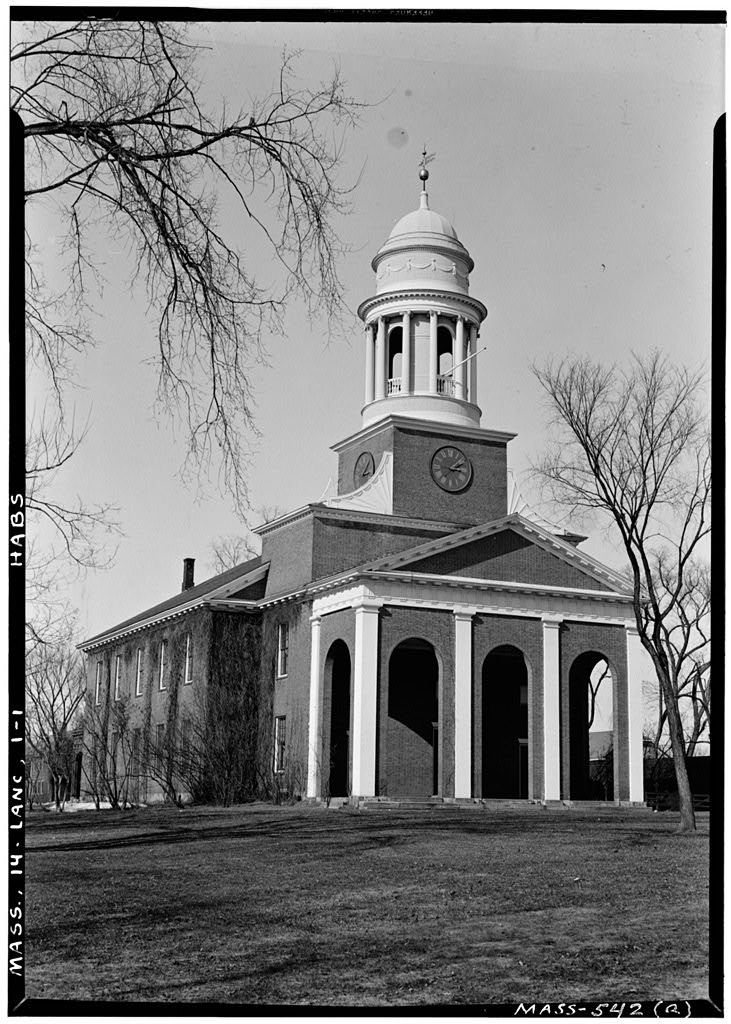
The historical significance of the Atherton Bridge was only dimly understood by most members of the community. In the meantime, the engineers had also closed the Ponakin Bridge, adding it to the threatened structures list. Fortunately for the bridges, Lancaster had an active preservation movement. The town center included a beautifully restored Bullfinch meeting house, a town green, neoclassical library, and numerous examples of eighteenth- and nineteenth-century domestic architecture. A group of citizens led by Bill Famsworth, a town selectmen, and Phyllis Farnsworth, chairperson of the Lancaster Historical Commission wondered if the bridges could be saved. Phyllis Farnsworth wrote an article for the paper pointing out that the Atherton Bridge was Lancaster's first iron truss.
The LHC became aware of the bridges' national significance when an inquiry to the Historic American Engineering Record brought a letter from Douglass L.
Griffin, HAER Historian, who wrote back that "Taken together, the [Atherton and Ponakin Bridges] comprise a unique pair of structures representing an important aspect of American's engineering heritage, and HAER encourages your efforts to nominate them to the National Register of Historic Places." After receiving HAER's letter, Phyllis Farnsworth began an aggressive campaign of publicizing the bridge's historic significance and contacted Lancaster's congressman for assistance.38 In a stroke of good luck, an incomplete federal flood study of the Nashua River temporarily halted the replacement of the Atherton Bridge in This allowed the Historical Commission time to apply for, and receive, National Register certification on both the bridges, thus barring the from using federal funds to demolish the bridges, and bringing the replacement project to a halt.
Some members of the community hailed this action, but others disdained the further inconvenience created by closed bridges. The controversy over Lancaster's Post trusses has attracted the ATHERTON BRIDGE (BOLTON ROAD BRIDGE) HAER No. MA-17 (page 14) attention of amateur and professional historians, engineers, and industrial archaeologists. Since the late a number of reports and studies have been made. In early students from Worcester Polytechnic Institute completed two projects, the first reviewing the Ponakin bridge's structure and history, and the second developing a public promotion plan for Lancaster bridge preservation. A scenic greenway along the Nashua River is also on the drawing table, and the bridges might be incorporated in a bike and walking path.
In the Lancaster Historical Commission accepted responsibility for the care and maintenance of the Atherton Bridge from the Barring misfortune or neglect, Lancaster's Post trusses may survive another century or more.39 ATHERTON BRIDGE (BOLTON ROAD BRIDGE) HAER No. MA-17 (page 15) CT< 00 CO i-l tt 5 in - =J W u 0) H DO o u H tn U o (P P-< d cfl td o 4-1 M o i-i *-< (3 rt 3 erf n tr C i HI 'i-t U o H 1-1 <u w & M O 0) M a fa o o o J s ATHERTON BRIDGE (BOLTON ROAD BRIDGE) HAER No. MA-17 (page 16) 226 AMERICAN RAlLROAli JOURNAL. Ibis duty they have assumed, this the Jaw imposes rails, and will be opened in a few weeks.
It Accordios to ihn miecoing definitions the on them, and thia those for whom they acthiiva a expected also thai by the first of October next, j weights (A, B and C) are in equilibrium. A and Fight to expect. Thev are not permitted to watch orer their own interests; they cannot speak in the road will be opened to Jamestown, a distance B, as components, act upon the point D, with the their own bebalf; thej must trust (o the fidelity of 104 miles from St. Louis.
same effect as their resultant 0, But, the force A of their agents: If they discbarge those impor- The receipts of Transportation Department is equally the resultant of B and C, as components : tant duties aud trusts faithfully, the law interposes from opening of road to March 1, and U may, also, be considered the resultant of A iU shield for their protection and defence : if they were 02 depart from the line of their duty, and waste or Total expenses of Transportation andC. take themselves, instead of protecting, the prop- Fig. 2. Department to same date &4 erty and interests confided to.
them, the law, on the application of those thus wronged or despoil- Cash balance 48 ed, promptly steps in to apply the correction, and which sum has been applied to the payment of return to the injured what has been lost by the unfaithfulness of the agents. interest on Stale bonds, and has reduced the in- This right of the cestux que trust to (me the terest account on the books of the company to tale vacated and set aside, when his trustee is the tbat amount. purchaser, is not impaired or defeated by the cir- It is estimated tbat it will require to cumstances that the trustee purchased for another. complete the road to Kansas City. [CiliDR eccparte Benoet. 10 Ves.
It follows, therefore, that if defendant Sherman was incapa- cited to purchase for himself, he was equally inca- pacitated to act for the defendant Dean; and if TREATISE OH TH Dean were sole purchaser, the purchase would be set aside. PRINCIPLES of
Neither are the duties or obligations of a direc- AS APPLIED TO THE - tor or trustee altered from the circumstance that he ia one, of a number of directors or trustees, CONSTRUCTION of WOODEN aHIDQES. I). If a rod be fixed vertically between the and that this circumstance diminishes his responsi- point D and the ceiling or some other immovable bility, or rejieves.bim from any incapacity to deal By S. S. POST, Civil Engineer, with the property of his testui que trust. The same And late Chief Engineer of the If. Y. Erie R. R. object then by removing the weight 0 principles apply to him as one of a number as if he the point D remains in the same position as be- were acting as a sole trustee. fore, [Ilia Honor next proceeds to decide that the ac- 1.
Force is an agency which, applied to a The pressure upon the rod will be equal to the tion of the stockholders at the meeting of June, load, tends to impart motion to it, or to retard it. In ratifying the dealings with Sherman and or to bring it to a state of rest. weight C removed, and is the resultant of the Dean, was not such a ratification as prevents the weights A and B. 2. When two or more forces acting upon a company freca maintaining their suit; forlhegen- Fig. 3. eral reason tbat they had not knowledge of ail body neutralize each other, the result is an equilib- facts. lie then states the tinal conclusion to which rium, called pressure.
he arriTes.] Two weights or pressures are equal when I have arrived at the conclusion, entirely clear one may be substituted for another with similar to my own mind, that this deed and contract can- not be sustained. results. I have arrived at the result without considering ^4. If two or more forces act upon the same the question of fraud raised in the complaint and point, their united edect is called the resultant denied by the affidavits. I have chosen to place of these forces. my decision on higher and more satisfactory (j 5. The several forces, whose combined effect grounds.
For the reasons I have stated, the plain- tiffs having established a prima facie right to have is equivalent to a single force are called the com- the deed and contract case called and the lands ponents of that force. sold reconveyed to them, it is my duty to restrain $ 6. The resultant ia mechanically equal to its the defendants until the hearing of this cause, as components, and can ho substituted therefor; or, asked for in the complaints and supplemental complaints. the components for the resultant, without change The plaintiffs have tho right to their real estate, of condition. The point D, instead of being supported by or anything into which it has been transmuted.
This proposition may be illustrated as follows: It is, therefore, proposed to restrain the defend- weights, acting in the direction Da and Do, may ant from transferring the atock owned by tbem in Fig. 1. be sustained by rods or struts (DFandDH,) press- the Hoffman Coal Company, which but represents ing against it. The same weight (C) being sus- the real estate of the plaintiffs, and the privileges pended from the point 1), the rod DF will sustain and advantages secured by the transportation con. tracts. a force equal to that which was in the former The motion for injunction is therefore granted. case exerted by the weight B in the direction Jib j and DH a force equal to that which was exerted Pacific Railroad. At the meeting of this company held in St. by the weight A in the direction Da.
Louis on the ulL, the following gentlemen 7. If three forces act upon one point, and were elected Directors, viz : J. P. II. Gray, H. L. keep it at rest, then those tliree forces are propor- tional to the three sides of a Irianpte, to which Patterson, James E. Veatman, A. Meier, Geo. R. sides, also, the directions in which they act are Taylor, Joseph Cbarless, Robert Campbell. T.iomas parallel. Alien, Daniel R. Garrison, John M. Wiuier, ,1. W. Fig. L Glover, Robert Barth. The report of the company made to the stock- a.
Let a line line he passed over two putties holders states that on the 4lh of May last, there were (a and b) fixed against a vertical plane or wall, 25 miles of new road opened from Jefferson City and let known weights (A and B) be attached to to California, in Monileau county ; and on the the ends of the line. At some point (D) in this of July following, Yl% miles additional of line, between tho pufties, knot another line wi'.h track was opened ; making 371 miles of new track a third weight (C) attached. If the weight C be added to the Pacific road durins the year. In less than the sum of the other weights (A and II) addition to this, 19 miles of track on the South- the knot will assume a certain position and it west Branch, from Franklin to St.
Clair station, will be found to return to the same point as often hai been opened. A length of six additiocai as the experiment shall he tried, unless some one miie* on the Southwest Branch ia ready for the or more of the weights be chaoged. APPENDIX A: Page from Post's "Treatise on the Principles of Civil Engineering, as Applied to the Construction of Wooden Bridges," ATHERTON BRIDGE (BOLTON ROAD BRIDGE) HAER No. MA-17 (page 17) CO U C 0) P. 4J W o W CM PL. <3 ATHERTON BRIDGE (BOLTON ROAD BRIDGE) HAER No, MA-17 (page 18) "FIGURE 2: Union Pacific Railroad Bridge, Omaha, Nebraska. (Condit, American Building Art. p. ATHERTON BRIDGE (BOLTON ROAD BRIDGE) HAER No. MA-17 (page 19) ENDNOTES 1. Carl W. Condit, American Building Art: The Nineteenth Century (New York: Oxford University Press, pp. 2.
The author has heard of only two other surviving Post trusses: the Bell's Ford Bridge in Seymour, Indiana, and another bridge in Newark, Ohio. Committee on History and Heritage of American Civil Engineering, "American Wooden Bridges," (New York: American Society of Civil Engineers, 3. The authority for the classic Post truss is an illustration from Theodore Cooper, "American Railroad Bridges," Transactions of the American Society of Civil Engineers, vol. 21 plate 26. The Atherton Bridge differs in so many ways from the classic design, that a case could be made that it is not a Post truss, but an extremely unusual hybrid truss form. Nevertheless, historically the Atherton Bridge has been described as best resembling a Post truss, and will be treated as such in this report. 4.
"Memorial to Simeon S. Post," Proceedings of the American Society of Civil Engineers. vol. 19 pp. 5. William H. Wisely, The American Civil Engineer. The History. Traditions, and Development of the ASCE (New York: American Society of Civil Engineers, pp. 6. Condit, pp. 7. Ibid., pp. 8. Ibid,, p. 9. "Memorial to Simeon S. Post," p. 49. 10. Daniel H. Calhoun, The American Civil Engineer. Origins and Conflict (Cambridge, pp. "Memorial to Simeon S. Post," p. 49; and, Wisely, pp. 11. Even though Whipple's book had been published over a decade earlier, it still had not made much impact upon bridge builders. Simeon S. Post, "Treatise on the Principles of Civil Engineering as Applied to the Construction of Wooden Bridges," American Railroad Journal, vol. 15 (April- November pp. and 12.
Victor Darnell, Directory of American Bridge Building Companies. (Washington, DC: Society for Industrial Archeology, pp. vii-Ix. ATHERTON BRIDGE (BOLTON ROAD BRIDGE) HAER No. MA-17 (page 20) 13. Post's patent drawings closely match the configuration of joints at the Ponakin Bridge (HAER No. MA-13). Simeon S. Post, "U.S. Patent No. June 16, 14. "Memorial to Simeon S. Post," p. 50. 15. Ibid. 16. Condit, pp. 17. Ibid.; and Tyrrell, pp. Whether Post, or firms licensed by Post, built these bridges is unknown. Research in the Midwest would be necessary in order to build a fuller picture of the history of the Post truss. 18. A good introduction to nineteenth-century trusses can be found in: T. Allan Comp and Donald Jackson, Bridge Truss Types: A Guide to Dating and Identifying.
Technical Leaflet 95, American Association for State and Local History, May 19. Col. William E. Merrill, Iron Truss Bridges for Railroads: Methods of Calculating Strains with a Comparison of the Most Prominent Truss Bridges, and New Formulas for Bridge Computations: also, the Economical Angles for Struts and Ties (D. Van Nostrand, pp. and 20. Squire Whipple, "On Truss Bridge Building," Transactions of the American Society of Civil Engineers, vol. 1 pp. 21. As part of their senior thesis on the Ponakin and Atherton Bridges, Gregory P. Stanford and Michael A. Thompson (Worcester Polytechnic Institute) claimed that their structural analysis of the Ponakin Bridge probably proves that Post had economy of material in mind when he inclined the truss's posts.
However, without further evidence, this assertion cannot be verified. Gregory P. Stanford and Michael A. Thompson, "Structural and Historic Aspects of Post Patent Trusses in Lancaster, Massachusetts," Senior Thesis, Worcester Polytechnic Institute, May 20, 22. Photocopies of photographs in a letter from Douglass L. Griffin (HAER) to Phyllis Farnsworth, July 26, Ponakin Bridge file, Lancaster Historical Commission, Lancaster, Massachusetts. 23. J.A.L. Waddell, Bridge Engineering (New York: John Wiley & Son, p. Darnell, p. 33; Condit, pp. and, Comp and Jackson, p. 3. 24. George Fillmore Swain, Structural Engineering; Stresses, Graphical Statics, and Masonry p. 25. Abijah P. Marvin, History of the Town of Lancaster.
(Lancaster, Massachusetts: Town of Lancaster, ATHERTON BRIDGE (BOLTON ROAD BRIDGE) HAER No. MA-17 (page 21) 26. Ibid. 27. Ibid., pp. 28. Henry S. Nourse, "Annotations of Marvin's History of Lancaster," p. Lancaster Historical Commission Collection. 29. Comp and Jackson, p. 2; Tyrrell, pp. Reports of the Town of Lancaster, various years, Lancaster Public Library Collection. 30. Lancaster League of Historical Societies, Towns of the Nashaway Plantation (Lancaster, Massachusetts: Lancaster League of Historical Societies, pp. Andrew E. Ford, History of the Origin of the Town of Clinton. (Clinton, and, "Ponakin Mills Closed Ponakin Mills File Lancaster Historical Commission. 31. "Nathaniel Thayer," Dictionary of American Biography. Vol. IX (New York: Charles Scribner & Sons, pp. and, Dr.
Thompson, personal journal, p. 91, Lancaster Historical Commission Collection. 32. "Report of the Bridge Committee, Cabinet #2, Drawer #3, Folder #3, Lancaster Historical Commission; and Town Reports. p. 7. 33. The town treasurer kept a detailed record of bridge expenses. Cofrode & Company received for the iron truss, and the total cost of the bridge amounted to Town Reports. p. 7; and, The Lancaster and Sterling Directory. Dec. 34. Ford, History of Clinton, pp. and, Clinton Courant. Nov. 5, 35. Thompson, personal journal, p. 91. 36. Town Reports. p. 38. 37. Kathleen Shaw, "New Bridge Waits as Planners Work," Worcester Telegram. Aug. 26, Phyllis Farnsworth, "Atherton Bridge Threatened," Clinton Daily Item, Sept. 3, and, Ponakin and Atherton Bridge files, Lancaster Historical Commission.
38. Douglass L. Griffin to Phyllis Farnsworth, July 26, Atherton and Ponakin Bridge files, Lancaster Historical Commission. 39. Phyllis Farnsworth to Ellen Digerinimo, November 3, Atherton Bridge files, Lancaster Historical Commission. ATHERTON BRIDGE (BOLTON ROAD BRIDGE) HAER No. MA-17 (page 22) BIBLIOGRAPHY "Atherton Bridge," clipping and photo file, Lancaster Historical Commission, Lancaster, Massachusetts. Calhoun, Daniel H. The American Civil Engineer. Origins and Conflict. Cambridge, Massachusetts, pp. Clinton Courant. Clinton, Massachusetts, Committee on History and Heritage of American Civil Engineering. "American Wooden Bridges." New York: American Society of Civil Engineers, Comp, T. Allen and Donald Jackson. Bridge Truss Types: A Guide to Dating and Identifying.
Technical Leaflet 95, American Association for State and Local History, Condit, Carl W. American Building Art: The Nineteenth Century. New York: Oxford University Press, Cooper, Theodore. "American Railroad Bridges," Transactions of the American Society of Civil Engineers. vol. 21 plate 26. Darnell, Victor. Directory of American Bridge Building Companies. Washington, DC: Society for Industrial Archaeology, Lancaster League of Historical Societies. Towns of the Nashaway Plantation. Lancaster, Massachusetts: Lancaster League of Historical Societies, pp. Marvin, Abijah P. History of the Town of Lancaster. Lancaster, Massachusetts: Town of Lancaster, "Memorial to Simeon S. Post," Proceedings of the American Society of Civil Engineers. vol. 19 pp. Merrill, Col. William E.
Iron Truss Bridges for Railroads: Methods of Calculating Strains with a Comparison of the Most Prominent Truss Bridges, and New Formulas for Bridge Computations: also, the Economical Angles for Struts and Ties. D. Van Nostrand, pp. "Nathaniel Thayer," Dictionary of American Biography, vol. IX. New York: Charles Scribner & Sons, pp. "Ponakin Bridge," clipping and photo file, Lancaster Historical Commission, Lancaster, Massachusetts. ATHERTON BRIDGE (BOLTON ROAD BRIDGE) HAER No. MA-17 (page 23) Post, Simeon S. "Treatise on the Principles of Civil Engineering as Applied to the Construction of Wooden Bridges," American Railroad Journal. vol. 15 (April-November pp. Post, Simeon S. "U.S. Patent No. June 16, Stanford, Gregory P. and Michael A. Thompson.
"Structural and Historic Aspects of Post Patent Trusses in Lancaster, Massachusetts," Senior Thesis, Worcester Polytechnic Institute, Worcester, Massachusetts, May 20, Thompson, Personal journal. Collection of Lancaster Historical Commission, Lancaster, Massachusetts. Town of Lancaster, Massachusetts. Annual Reports. Tyrrell, Henry Grattan. History of Bridge Engineering. Chicago: Tyrrell, Waddell, J.A.L. The Designing of Ordinary Iron Highway Bridges. New York: John Wiley & Sons, Whipple, Squire. "On Truss Bridge Building," Transactions of the American Society of Civil Ensineers. vol. 1 pp. Wisely, William H. The American Civil Engineer. The History. Traditions, and Development of the ASCE. New York: American Society of Civil Engineers,
 Block
Block