The Lexington & West Cambridge Railroad, incorporated by the legislature in was built to link Lexington and Arlington (then called West Cambridge) with the new line of the Fitchburg Railroad in North Cambridge. The line was completed in and the first train to use the line, on August chanced also to be the first train to enter the Fitchburg1s depot on Causeway Street in Boston. But as an independent line without right to haul its own traffic on the main line, it could attract little freight, and the company soon petitioned the Fitchburg to purchase the road outright. This the Fitchburg declined to do.
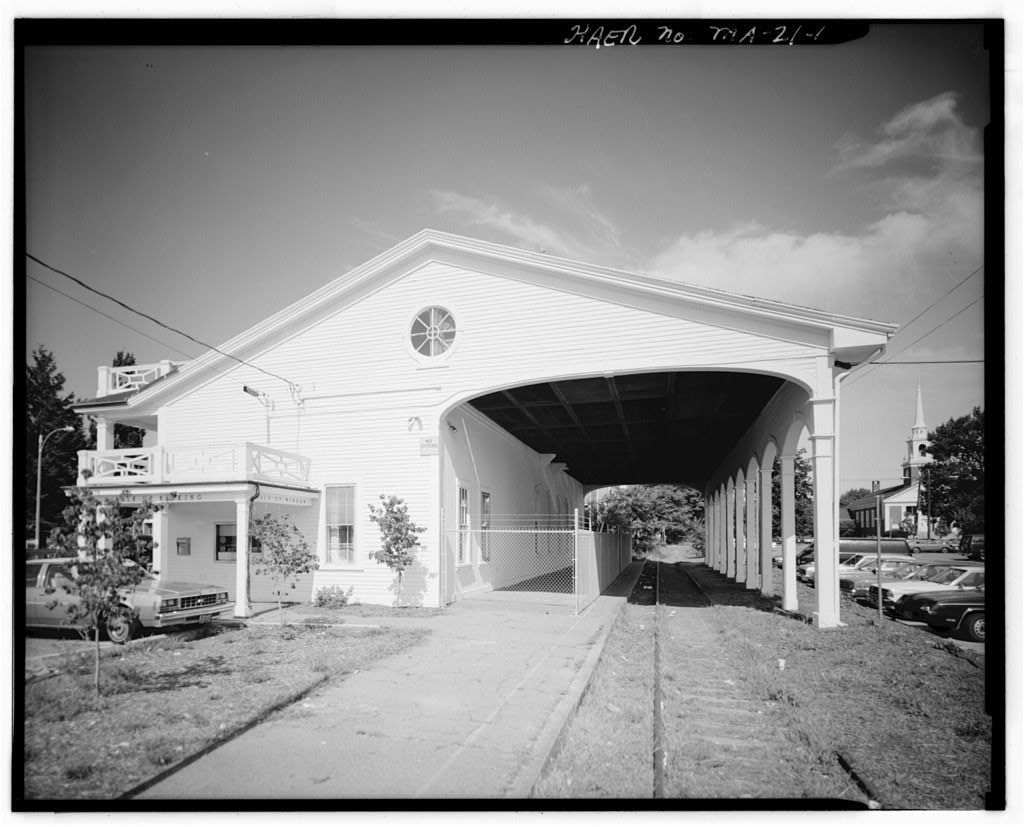
Instead, the Boston & Lowell Railroad, reaching after suburban traffic, discovered in the branch a possible feeder and bought control of the road, building a short strip of track from its line at Somerville Junction to Lake Street in Arlington. Renamed the Middlesex Central Branch, the line was extended to Concord in 18 74. The Lexington station, probably built about is the only known survivor of a railroad station form that in the and 50s was very common, incorporating beneath the station roof, track space for the engine and Lexington & West Cambridge Railroad: Lexington Depot HAER No. MA-21 (Page 2) cars. Although damaged by fire in the station retains the original eliptical trainshed opening. Along the outer rail, the roof is supported by a row of eleven boxed columns.
In the early 192 0s, the Boston arc-itectural firm of Kilham, Hopkins & Greeley gave the building its present Colonial Revival details including cupola, roof balustrade, and colonnade along the front of the station. The interior has recently been renovated for use as a bank. References: Wellington, George Y., "Origins of the Lexington & West Cambridge Branch Railroad," Lexington Historical Society Proceedings 3 pp. Parker, Charles S., Town of Arlington, Past & Present (Arlington: C. S. Parker & Son, pp. Kelley, Beverly Alison, Lexington, A Century of Photographs (Lexington: Lexington Historical Society, pp. The American Architect 20 December p. Transmitted by Jean P. Yearby, from data compiled by Peter Stott
 Block
Block