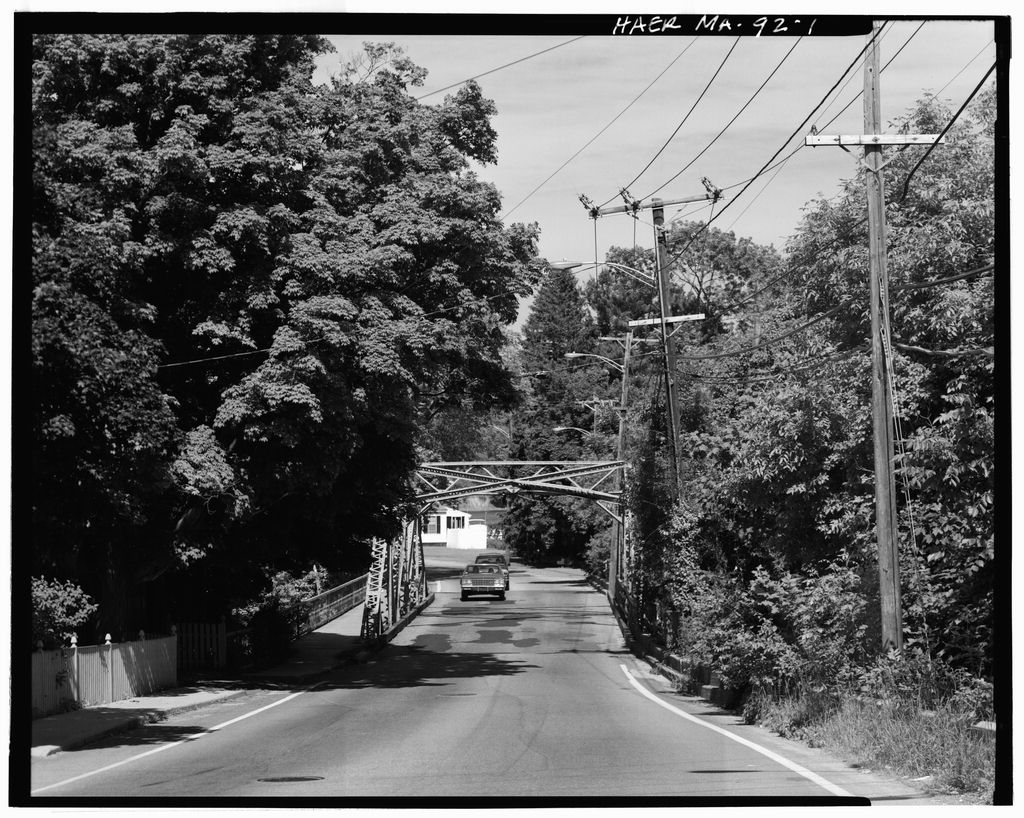
Documentation of the Essex-Merrimac Bridge is part of the Massachusetts Historic Bridge Recording Project, conducted during the summer of under the co-sponsorship of HABS/HAER and the Massachusetts Department of Public Works, in cooperation with the Massachusetts Historical Commission. Patrick Harshbarger, HAER Historian, August ESSEX-MERRIMAC BRIDGE (CHAIN BRIDGE) HAER No. MA-93 (page 2) Description The Essex-Merrimac Bridge spans the Merrimac River between Newburyport and Deer Island, about three miles west of downtown Newburyport. A residential neighborhood occupies the bank near the south approach.
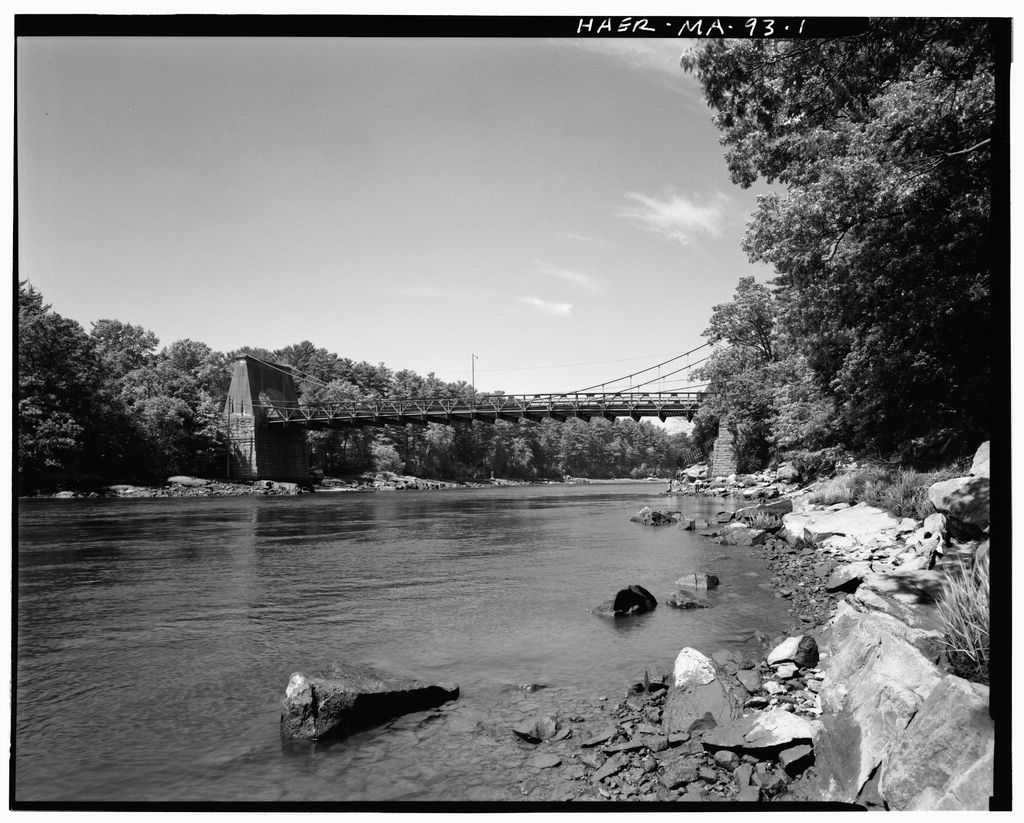
To the north of the bridge, Deer Island, a relatively small outcropping in the middle of the Merrimac River, is the site of a private residence and a small wooded park often used by fishermen. A swing bridge connects the north side of Deer Island with Amesbury on the opposite shore. The Essex-Merrimac Bridge is a single-span, steel-wire cable suspension bridge. It is sometimes also called the Chain Bridge, in reference to an earlier suspension bridge made with wrought-iron links. The bridge measures from center to center of towers, and 10'-IV from center of tower to face of abutment. The total length, from anchor to anchor, is The width of the bridge from center to center of towers is The principle structural members of a suspension bridge are its cables.
Anchored at either end of the bridge by the weight of massive stones and concrete blocks, the cables stretch up over the bridge's towers and across the river. The bridge's deck hangs from the cables by means of wire-rope suspenders, thus the name "suspension bridge."(See Figure 1.) The Essex-Merrimac Bridge follows a modern design that incorporates the strength of steel cables and stiffening trusses with an economy of material to make the bridge as light and inexpensive as possible. There are four main cables, two on either side of the bridge. Each cable is 3V in diameter and contains 210 individual steel wires, each about V in diameter, laid parallel to each other, and wrapped in soft iron wire about V in diameter.
The IV wire-rope suspenders attach to the main cables by means of a bolted clamp. The suspenders start at one cable, pass around a circular bearing on the floor beam, and return to the other cable of the pair. A turnbuckle is used for the adjustment. The floor beams are made of girders, approximately 33" in depth. The stiffening trusses reduce vertical vibration and oscillation, and distribute the load more evenly to the cables, thereby preventing distortion of the deck under partial or moving loads. The trusses are riveted Warren trusses with double-angle members and are hinged at midspan and at the piers. The stiffening truss depth is approximately From tower to tower the stiffening trusses number eighteen panels, each long.
The stiffening truss has a camber of 6" that gives a bowed shape to the bridge. The bridge roadbed is made with Irving open steel grid decking. The early saw a great deal of innovation in the use of reinforced concrete. Up until that time, a lack of definite knowledge about the behavior of concrete under live loads and its deterioration over time limited its use to smaller highway and foot bridges. The towers of the Essex-Merrimac Bridge are outstanding examples of the engineers' creative use of reinforced concrete. They stand 31'above the roadbed of the bridge and have a single 26'-wide archway through which traffic passes. At their bases the towers are approximately and at the top they taper to The interiors of the concrete towers are hollow. ESSEX-MERRIMAC BRIDGE (CHAIN BRIDGE) HAER No.
MA-93 (page 3) At the top of each tower are two cast steel fixtures, shaped something like tortoise shells, called saddles. The saddles allow the cables to move over the towers to adjust for partial loading conditions. The saddles move back and forth on top of eight cast steel rollers that sit on a smoothly- planed steel plate. The sliding motion of the saddles relieves the cables from undue strain. An important factor in the engineering of a suspension bridge is the secure anchoring of the main cables.(See Figure 2.) Each of the cables in the Essex-Merrimac Bridge is anchored at either end by two eyebars, one on either side of the cable. A pin goes through the eyebars and through a loop on the bridge socket that is attached to the cable.
The sockets, in turn, attach to eight steel eyebars buried in each of the four concrete anchorages. The eye bars extend into the ground to a depth of approximately 13' and attach to four steel I-beams, measuring Each eyebar and I-beam anchorage is individually surrounded by up to 115 tons of concrete embedded with boulders.1 Earlier Bridges The fame of the two earlier bridges that spanned the Merrimac River at this site overshadows the history of the current bridge. For example, a bronze plaque bolted to the southern tower portal reads: On this site the first bridge over the navigable waters of the Merrimac River was erected by Timothy Palmer in It was superseded in by a chain suspension bridge built by John Templeman, from plans furnished by James Finley of Fayette County, Pa.
February 6, the supporting chains gave way and the bridge with a heavily loaded ox cart fell into the river. It was rebuilt during the following summer and maintained as a toll bridge until August 4, when it was laid out as a public highway. Under authority of an act of the general court of it was again rebuilt in by the county commissioners of Essex County. Although the bridge retained none of the materials of the previous chain bridge, community attachment to the old structure ran so strong that engineers even designed the new bridge to look like the old one. In fact, some residents still mistake the bridge for Finley and Templeman's bridge.
Since the building of the current structure reflected on the history of two previous bridges, it is important to recount more than the usual information about them. The Merrimac River is the first large river north of Boston. In the colonial period, a number of ferrymen received charters to operate their services between Newburyport on the southern bank and Salisbury on the northern. The ferries capably handled the transportation needs of the local citizens until the late when overland haulages began to play an ESSEX-MERRIMAC BRIDGE (CHAIN BRIDGE) HAER No.
MA-93 (page 4) increasingly important role in the local economy, especially with the increase of manufacturing along the Merrimac River.2 When a group of local citizens petitioned the state legislature for a bridge across the Merrimac at the site of Deer Island, the local shipwrights opposed the matter, claiming that the bridge would obstruct the flow of ice in the time of spring freshets and make the ferries obsolete. Nonetheless, arguments for progress, as well as local political influence, carried the bridge's proponents, and in the legislature authorized a group of local proprietors to begin building a new bridge.
Palmer Bridge The proprietors chose Timothy Palmer, a local bridge builder, to construct the span at a cost of Palmer designed two timber arch spans, one long between Newburyport and Deer Island, and the second long between Deer Island and Salisbury.(See Figure 3.) The piers and abutments were heavy timber cribs filled with stone. It is unknown where Palmer received the inspiration for his innovative arch design, except that it may have derived from local traditions of ship building.
Following the success of the Essex-Merrimac Bridge, Palmer went on to build a number of other significant spans including the Merrimac River Bridge, Andover, Massachusetts Piscatauqua Bridge, Portsmouth, New Hampshire Haverhill Bridge, Haverhill, Massachusetts Potomac River Bridge, Georgetown, Maryland Schulykill River Bridge, Philadelphia, Pennsylvania and the Delaware River Bridge, Easton, Pennsylvania Palmer's bridges can be dated contemporaneously with the work of Theodore Burr of Pennsylvania, to whom the initial use of a truss strengthened by an arch is attributed in America.4 Finley Bridge Twenty years was an average life span for an uncovered wooden bridge, such as the one designed by Palmer at Newburyport.
In the proprietors decided to replace the timber arch between Deer Island and Newburyport with a chain suspension bridge, the first in New England. They chose John Templeman of the District of Columbia to build the new bridge based upon the suspension design of James Finley of Pennsylvania.5(See Figure 4.) Finley pioneered the construction of suspension bridge building in America. His design called for wrought-iron bar chain links passed over masonry or timber towers with suspended wood floors.
Finley received a patent for his design in and it has been estimated that he built well over forty bridges between and Among the most prominent of these were the Potomac River Bridge, District of Columbia Schuylkill River Bridge, Fairmont Park, Philadelphia, Pennsylvania and the Delaware River Bridge, Northampton, Pennsylvania The Essex-Merrimac chain bridge measured long, from center to center of the towers. The towers rested on massive granite piers and consisted of heavy timber framing. A total of ten chains, each long and made from wrought iron links measuring were anchored to the ground, ESSEX-MERRIMAC BRIDGE (CHAIN BRIDGE) HAER No. MA-93 (page 5) passed over the towers, and connected by suspenders to the floor joists. The chains supported two roadways, each about 14' wide.
Iron rods supported the floor beams except at the center of the bridge where the road way lay directly on the chains. Two portals in each tower admitted traffic to the bridge.7(See Figures 5 and 6.) The Essex-Merrimac Chain Bridge proved unexpectedly durable during its 100-year life. The only disaster that ever befell the bridge occurred during the winter of After a heavy snow fall, a loaded wagon with a team of six oxen and two horses attempted to cross the bridge. The combination of weight and extreme cold caused five of the chains to snap, sending the ox cart and portions of the bridge into the river. Remarkably, the horses and men made the shore, but the oxen drowned.
The proprietors quickly rebuilt the bridge, this time with twelve chains, rather than ten.8 In the Massachusetts legislature passed an act laying out the toll bridges across the Merrimac River as public roads. The Essex County commissioners awarded the proprietors of the bridge and assigned its care and maintenance to the towns on either side of the river. In the towns paid to have all of the woodwork on the bridge replaced, but the iron work remained as originally built, except for occasional repairs. By the late-nineteenth century, time and wear had begun to take their toll on the chain bridge. Heavier traffic, especially the laying of a street car line in first horse-powered but later electrified in placed the bridge under considerable strain.
In and again in the local citizens called special legislative committees to the bridge to inspect its safety. One person recalled that horses could not run across the bridge because the floor vibrations would knock them from their feet. Many street car passengers refused to ride the trolleys across the bridge because of the severe sways and bucks, preferring to walk across, and reboard on the opposite side. The vertical distortion finally became excessive under the moving loads of the street cars, and in the towns hired John A.
Roebling & Sons, builders of the Brooklyn Bridge, to strengthen the bridge chains with steel cables, particularly on the side of the bridge that carried the tracks.10 In the Mayor of Newburyport presented a petition to the legislature claiming that the town could no longer maintain the bridge. In March a special committee held a hearing in Newburyport and inspected the bridge. The mayor complained that he was in constant conflict with the street railway company over repairs to the bridge and the apportionment of their cost. Some local citizens expressed sentiment for the old bridge, but admitted that it was in serious need of repairs or replacement.
By Chapter 640 of the Acts of the legislature placed control of the bridge with the county commissioners, and authorized and directed them to reconstruct the Chain Bridge. The commissioners hired George Fillmore Swain, a noted structural engineer and professor at Massachusetts Institute of Technology, to examine the bridge. George Fillmore Swain Swain seemed the ideal man for the task. He epitomized the modern image of a professional engineer, and he walked into the politically charged ESSEX-MERRIMAC BRIDGE (CHAIN BRIDGE) HAER No. MA-93 (page 6) atmosphere with a reputation for impartialness and the engineers' eye for economy and practicality. Swain's formal education did not rely so much on practical experience as it did on theory and mathematical training.
Swain came from a New England whaling family. He had attended a military academy as a boy and had entered Massachusetts Institute of Technology (M.I.T.), one of the nation's top engineering schools, at the age of 16. He graduated in with a degree in civil and topographical engineering. Seeking a "breadth of view and experience in life," he traveled abroad and began studies at the Royal Polytechnicum at Berlin, where he studied engineering under the German masters. In Swain returned to the United States to a job with the census, investigating the amount of water power used by American manufacturers. He worked under the direction of Gen. Francis A. Walker who became president of M.I.T.
in Shortly thereafter, Swain received an appointment in the school's Civil Engineering Department, and by had risen to the rank of full professor and chair. As a professor at M.I.T., Swain held a position of enormous influence, setting educational standards for a new generation of professional engineers. In Swain rose to national attention as a witness in the Bussey Bridge Disaster trial. His ability to analyze the cause of the wreck that occurred on a crowded train headed into Boston at rush hour, so impressed the Massachusetts Railroad Commission that he was appointed the Commission's first expert engineer. Swain held that office for over twenty years and implemented many important reforms in bridge-building practice.
In this capacity, Swain spent from three to four weeks every summer visiting large bridge works in America and Europe for the purpose of studying their process of manufacture and methods of design. In Swain became a member of the Boston Transit Commission and had oversight of the construction of the Charlestown Bridge as well as the harbor tunnel. Swain is known to have consulted on the construction of at least ten highway bridges still surviving in Massachusetts, including the New Bedford and Fairhaven Bridge at New Bedford (HAER No. MA-101), and the Merrimac Bridge at Haverhill/Newbury (HAER No. MA-103). In Swain accepted the Gordon McKay Professorship of Civil Engineering at Harvard University.
Throughout his career in education, Swain worked to elevate the professional status of engineering and to demand rigorous standards of engineering students. He became well-known for his courses devoted to structures, and his book Strength of Materials remained a standard text for many years. Swain played an active roll in the professional engineering societies, and among his many honors, he served as President of the American Society of Civil Engineers (ASCE) in Swain would have been well-aware of nineteenth-century advances in suspension bridge building technology.
Beginning in the John Roebling had pioneered in the use of iron and steel wire cables, which replaced the wrought iron chains that had proved less than desirable because of their greater weight, higher variability in strength, and susceptibility to corrosion and fatigue. Suspension bridges offered advantages to builders, like Roebling, who wished to span rivers where the depth and current limited the amount of falsework, and where ships needed high vertical clearances. ESSEX-MERRIMAC BRIDGE (CHAIN BRIDGE) HAER No.
MA-93 (page 7) Engineers chose suspension bridges for some of America's most monumental spans such as the Ohio River Bridge in Cincinnati Niagara-Clifton Bridge Brooklyn Bridge and the Manhattan Bridge Construction of the Essex-Merrimac Bridge Rebuilding the Essex-Merrimac Bridge in the form of the old Chain Bridge presented a challenge to Swain. At first inspection, Swain realized that the old chains, towers, stiffening truss, and anchors would prove inadequate for the durability and strength required of modern bridges. In the winter of Swain drew up specifications for a new bridge that made use of some modern materials but acquiesced to popular demands that the bridge still look like the old bridge.
Swain called for steel towers to be enclosed in a restored wooden framework with sheathing and shingles essentially like the old structure's. He also made specifications for rehanging the old chains, although they were to be merely ornamental; steel cables hung parallel to the chains would actually carry the bridge's load. Swain was unhappy with the plan, and by January in consultation with the county's engineer, Robert R. Evans, who would supervise the construction, Swain had decided to present a revised plan to the county commissioners that called for reinforced concrete towers and a significant enlargement of the anchorages.
Public opinion having died down somewhat, the commissioners took the engineer's advice and accepted his plans in March 1909.u The commissioners placed the project to bid and awarded the contract to Holbrook, Cabot & Rollins of Boston. Subcontracts for the steel cables went to John A. Roebling's Sons Company of Trenton, New Jersey; for the cable fittings and anchorages to the United Construction Company of Albany, New York; and, for the steel truss work and erection, the American Bridge Company. I3 Work commenced removing the old Chain Bridge in July In August the builders closed the bridge to trolley traffic. Passengers, however, could walk across the bridge and catch a streetcar on the opposite side.
Cold and inclement conditions stopped work during the winter of Construction continued in the spring and the bridge opened in June Conclusion Since alterations to the bridge have been minimal. When built, the bridge had a timber deck with streetcar tracks on the downriver side. In and the county replaced the wood deck, and in removed the tracks and replaced the roadbed with Irving open steel grid deck. In the stiffening trusses were strengthened with rebuilt hinges. In the early the rewrapped the wire cables. In the county commissioners considered closing the bridge when the state built a new four-lane bridge across the river at Newburyport as part of the by-pass. This possibility aroused local opposition to the bridge's closing.
Concerned citizens held an open meeting where many citizens complained of the possible inconvenience, and a few expressed sentimental ESSEX-MERRIMAC BRIDGE (CHAIN BRIDGE) HAER No. MA-93 (page 8) feelings for a relic of the past. The bridge has remained open ever since. In the citizens of Newburyport and Amesbury reported that they were pleased with their bridge, and the local newspaper contentedly stated that Approaching the bridge from a distance it is difficult to see any special difference in the general facia from that which has been so familiar to all.... At the same time the new bridge is strongly and substantially built and calculated to inspire confidence in its stability.
It is creditable alike to the engineer who planned it and to those who have had a part in its construction.17 Apparently, this assessment of the Essex-Merrimac Bridge has also stood the test of time. Local citizens, often generations removed from any memory of the bridge's construction, sometimes confuse the bridge for the one built in Paradoxically, the engineers who inspect the bridge for the Massachusetts Department of Public Works call the Essex-Merrimac bridge "an essentially modern design."18 ESSEX-MERRIMAC BRIDGE (CHAIN BRIDGE) HAER No. MA-93 (page 9) I I 2: i CO- CD' i-l H- t- 0> to XI H ca ' 5. P H CO- o JO}. 0) to CO Ex3 & 4J CO: & r-l 4). M fa ESSEX-HERRIMAC BRIDGE (CHAIN BRIDGE) HAER No.
MA-93 (page r-H I r-i I h- & to r-4 H <U to H )-l PQ O 5 CO ESSEX-MERRIMAC BRIDGE (CHAIN BRIDGE) HAER No. MA-93 (page XI) CO cc CO 0) : * ' i-l : ? F . CO v.- 8 i I H a: o H (M CD o < C w CO CNJ H CO CO r-- ESSEX-MERRIMAC BRIDGE (CHAIN BRIDGE) HAER No. HA-93 (page 12) cr- oc 00 r-t V3 QJ to H U (ti o. u u H u QJ & O H u CO o CO i-H O v 8 ESSEX-MERRIMAC BRIDGE (CHAIN BRIDGE) HAER No. MA-93 (page 13) 00 60 u tO o M H g O H 01 & o H o CO o CC a) . ? u' s a fc I in ESSEX-MERRIMAC BRIDGE (CHAIN BRIDGE) HAER No. MA-93 (page 14) o u o 1 c & o CO -i-H 2 o oo I 00 o cc -H u 0) CO ESSEX-MERRIMAC BRIDGE (CHAIN BRIDGE) HAER No. MA-93 (page 15) ENDNOTES 1. "Bridge #A-7-14/N-lI-10," Massachusetts Department of Public Works Bridge Section files, Boston.
(Copies of the original plans for the bridge are contained in the field records for this report.) 2. John J. Currier, The History of Newburyport. Massachusetts. (Somersworth, New Hampshire: New Hampshire Publishing Co., reprint of ed., pp. 3. "Essex-Merrimac Bridge Historical Notes," located at the Amesbury Public Library, Amesbury, Massachusetts. 4. Currier, pp. and, Theodore Cooper, "American Railroad Bridges," Transactions of the American Society of Civil Engineers, vol. 31 pp. 5. The relationship between Templeman and Finley is unknown, although apparently Templeman had license to use Finley's design and may have been either a friend, partner, or student of Finley's.
Some evidence suggests that Timothy Palmer handled the contractual arrangements for the Chain Bridge, and may have also played a significant role in the supervision of its construction. 6. Henry Grattan Tyrrell, History of Bridge Engineering (Chicago: Tyrrell, pp. 7. For an interesting analysis of the varying strengths of the chain links, see A.P. Mills, "Old Essex-Merrimac Chain Suspension Bridge at Newburyport, Mass., and Tests of Its Wrought-Iron Links After 100 Years' Service," Engineering News, vol. 66 (August 3, pp. 8. Currier, pp. 9. "Free Bridges Over the Merrimack," Villager. 16 April in "Essex- Merrimac Bridge Historic Notes," Amesbury Public Library. 10. Mills, pp.
and, Grace Louise Colby, "Talk About Abandoning of Bridges Spurs Interest in History of River Span," Newburyport Daily News. 23 August 11. Newburyport Daily News. 6 March 12. "George Fillmore Swain," memorial notice, Journal of the Boston Society of Civil Engineers, vol. 19 pp. Massachusetts Board of Railroad Commissioners, "Special Report by the Massachusetts Board of Railroad Commissioners to the Legislature in Relation to the Disaster on Monday, March 14, on the Dedham Branch of the Boston and Providence Railroad," ESSEX-MERRIMAC BRIDGE (CHAIN BRIDGE) HAER No. MA-93 (page 16) (Boston: Wright & Potter, p. The National Cyclopedia of American Biography, vol. 14 (New York: James T. White, p. and, Dictionary of American Biography, vol. 11, sup. 1 (New York: Charles Scribner's Sons, p. 13.
Tyrrell, pp. 14. Essex-Merrimac Bridge Plans, Massachusetts Department of Public Works Bridge Section files; and, Edward C. Sherman, "The Reconstruction of the Old Chain Bridge at Newburyport, Mass.," Engineering News, vol. 70 (September 25, pp. 15. An estimate of the exact cost of the bridge was unavailable in the County records. The local newspaper mentioned that Holbrook, Cabot & Rollins received but this amount seems rather low for the total cost. Newburyport Daily News. 11 June 16. The newspapers did not cover the building of the bridge very closely, and no construction photographs have been discovered. The Bridge Section has a set of construction plans.
The bridge appears to have been built as designed by Swain, except for some alterations made in the process of constructing the southern approach. 17. Newburyport Daily News. June 11, 18. "Bridge #A-7-14/N-ll-10," Massachusetts Department of Public Works Bridge Section files, Boston. ESSEX-MERRIMAC BRIDGE (CHAIN BRIDGE) HAER No. MA-93 (page 17) BIBLIOGRAPHY "Bridge #A-7-14/N-ll-10," Massachusetts Department of Public Works Bridge Section files, Boston. Colby, Grace Louise. "Talk About Abandoning of Bridges Spurs Interest in History of River Span," Newburyport Daily News. August 23, Cooper, Theodore, "American Railroad Bridges," Transactions of the American Society of civil Engineers, vol. 31 pp. Currier, John J. The History of Newburvoort. Massachusetts.
Somersworth, New Hampshire: New Hampshire Publishing Co., reprint of ed., pp. "Essex-Merrimac Bridge Historical Notes," at the Amesbury Public Library, Amesbury, Massachusetts. "George Fillmore Swain," memorial notice, Journal of the Boston Society of Civil Engineers, vol. 19 pp. Massachusetts Board of Railroad Commissioners. "Special Report by the Massachusetts Board of Railroad Commissioners to the Legislature in Relation to the Disaster on Monday, March 14, on the Dedham Branch of the Boston and Providence Railroad." Boston: Wright & Potter, p. Mills, A.P. "Old Essex-Merrimac Chain Suspension Bridge at Newburyport, Mass., and Tests of Its Wrought-Iron Links After 100 Years' Service," Engineering News, vol. 66 (August 3, pp. Newburyport Daily News. Newburyport, Massachusetts.
"Plans for the Essex-Merrimac Bridge, Massachusetts Department of Public Works Bridge Section files, Boston. Sherman, Edward C. "The Reconstruction of the Old Chain Bridge at Newburyport, Mass.," Engineering News, vol. 70 (September 25, pp. "Swain, George Fillmore," biographical sketch, Dictionary of American Biography, vol. 11, sup. 1. New York: Charles Scribner's Sons, p. "Swain, George Fillmore," biographical sketch, National Cyclopaedia of American Biography, vol. 14. New York: James T. White, p. ESSEX-MERRIMAC BRIDGE (CHAIN BRIDGE) HAER No. MA-93 (page 18) Tyrrell, Henry Grattan. History of Bridge Engineering. Chicago: Tyrrell, pp.
 Block
Block