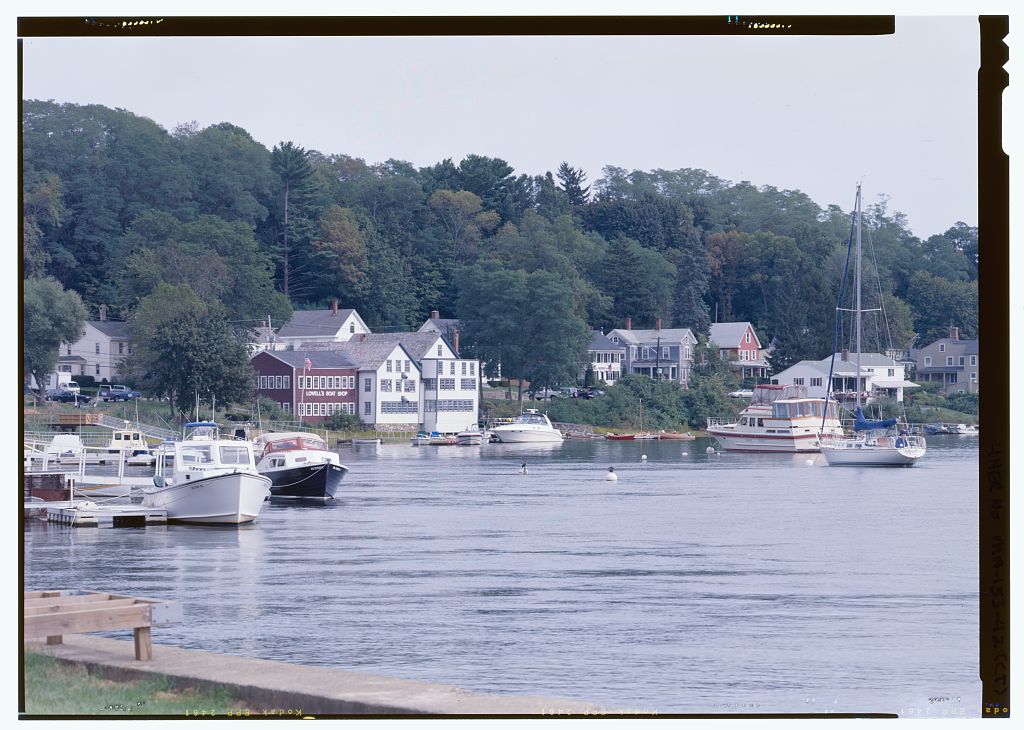
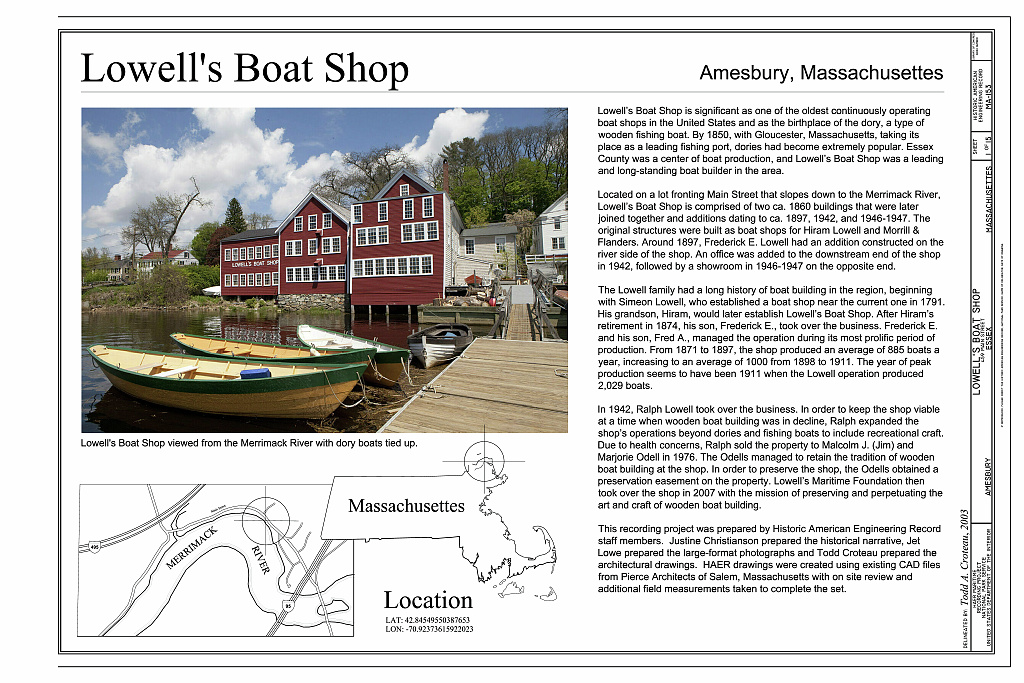
Lowell s Boat Shop is significant as one of the oldest continuously operating boat shops in the United States and as the birthplace of the dory, a type of wooden fishing boat. 1 Note that there are conflicting dates for the construction of the earliest sections of the shop. The National Historic Landmark nomination states the original shop dates to ca. with a second shop built in by a competitor named True who moved it to the adjacent lot in However, more recent research dates both original shops to ca.
noting that maps do not reveal any structures on site in the See Lowell s Boat Shop website, History, accessed January 6, Winter Street Architects, Lowell s Boat Shop, Amesbury, Massachusetts (August 6; James Delgado, Lowell s Boat Shop, National Register of Historic Places nomination, Section 7. LOWELL S BOAT SHOP HAER MA-153 (Page 2) Description: Located on a 1/3-acre lot fronting Main Street and sloping down to the Merrimack River, Lowell s Boat Shop is comprised of two wood-frame structures later joined together plus various additions built to accommodate changing operations. The entire building is clad in either clapboard siding or wood shingles. The foundation of the original structure is fieldstone with additional posts bearing on boulders. The addition has a concrete foundation.
The Lowell and Morrill & Flanders shop portions of the building have front gable roofs while the additions have side gable roofs. There are two brick chimneys. Described as a Greek Revival style building, Hiram Lowell s original structure measured approximately 25' x 46' and was stories tall on the street side and stories tall on the riverfront. The former Morrill & Flanders shop, also described as being in a Greek Revival style, was built almost immediately adjacent to Hiram s shop, also ca. At some point, the two buildings were joined and formed the central core of the shop. Around Frederick E. Lowell had an addition built on the river side of the original Lowell shop.
The front fa ade of the original Lowell shop has double doors flanked by six-over-six-light double-hung windows with a loft door above and a six-over-six-light double-hung window in the gable. The rear fa ade of the ca. addition has a ribbon of six-over-six-light double-hung windows on the first floor and six-over-six-light double-hung windows on the remaining floors. The former Morrill & Flanders shop also has six-over-six-light double-hung windows, with a second-story loft door on the front fa ade and a fixed window in the gable. The rear fa ade features a ribbon of six-over-six-light double-hung windows on the first floor and paired and single six-over-six-light windows on the remaining floors. On the downstream end of the shop is the office addition with a shed behind it.
The office is wide and long, with a single door on the front fa ade providing access. There are six-over-six-light and three-over-three-light windows on the rear fa ade facing the river. A deck is located at the downstream end of the building, with a ramp leading to a dock in the river. The last addition to the building occurred in when Ralph Lowell built a showroom at the upstream end of the original Morrill & Flanders building. This addition is nearly 36' wide and 33' long and stands one story at street level. Like the rest of the building, the showroom has six- over-six-light double-hung windows. A garage door is located on the front fa ade while a double gate door is found on the upstream fa ade.
History: Shipbuilding was an important industry on the Merrimack River in Massachusetts due to the depth of the waterway and the abundance of local timber. After purchasing land from Jonathan Edmunds in Simeon Lowell established a boat shop in Amesbury on the river, just three lots from the current shop s location. In and Simeon purchased two more lots from Israel Currier and Jacob Bagley Currier, which would form the current site.
Simeon s sons Stephen and Benjamin operated S & B Lowell, Shipbuilders from Benjamin s LOWELL S BOAT SHOP HAER MA-153 (Page 3) son, Hiram, inherited his father s business and established what would become Lowell s Boat Shop.2 Hiram Lowell was remembered as one of the old Salisbury stock which for many generations had been prominent in the business and civic history of the town. He was described as rather reserved, of an exceedingly quiet temperament, but also courteous, affable and kind with a tolerant disposition. 3 In addition to boat building, from which he retired in at the age of 60, he was also president of the Merrimac Hat Company, a leading hat manufacturer in the United States, for nearly twenty years. In Hiram had the initial structure comprising Lowell s Boat Shop built.
A local newspaper reported in that Lowell s Boat Shop employed five men who produced 243 boats a year. Contemporary accounts reveal that Hiram paid workers by the piece.4 Meanwhile, Morrill & Flanders constructed a boat shop immediately adjacent to Lowell s shop around Owners George H. Morrill and Francis W. Flanders had purchased the lot from the Lowell family and then sold it back to Frederick E. Lowell in An Sanborn map depicted the Lowell shop as a two-story building with a basement with the separate Morrill & Flanders two-story frame building (interestingly labeled carpenter ) next to it. By the turn of the twentieth century, the two buildings had been joined.5 After Hiram s retirement in his son, Frederick E. took over the business. In Hiram conveyed the property to him.
One of the most highly respected and valued citizens of the town with a retiring disposition, Frederick E. and then his son, Frederick Austin (also called Tink or Tinky ), managed the operation during its most prolific production period. From to the shop produced an average of 885 boats a year and expanded production to include a 13' recreational rowing skiff. The peak production period was to when an average of dories were built each year. The most the Lowells built in a year was in as memorialized in an inscription in a beam in the shop. In Frederick E. deeded the property to his son.6 Soon after taking over the operations, Fred A.
oversaw the conversion of the shop from steam to electric, which allowed for the removal of the boiler and steam engine in the basement and 2 Essex County Land Records, Book Page Book Page and Book Page See also Lowell s Boat Shop History, website; Winter Street Architects, 3. 3 Delmar Rial Lowell, The Historic Genealogy of the Lowells of America from to (Rutland, VT: The Tuttle Company, 4 The Salisbury Dory, Amesbury and Salisbury Villager, September 10, 8; Lowell s Boat Shop History, website; Hiram Lowell, Amesbury Daily News, April 17, 2; Hat Shop History, Amesbury News, April 23, Winter Street Architects, The Villager, May 11, 2.
5 Sanborn Fire Insurance Map, June Amesbury, Massachusetts, 13; Sanborn Fire Insurance Map, March Amesbury, Massachusetts, 15; Winter Street Architects, 6; Essex County Land Records, Book Page 6 Lowell s Boat Shop History, website; Winter Street Architects, Frederick E. Lowell, Died at Home Saturday, Amesbury Daily News, January 8, 3; Lowell, Historic Genealogy, Where the Dory Is Built, Amesbury Daily News, August 14, 2; Amesbury Daily News, August 6, 3; Essex County Land Records, Book Pages and Book Page LOWELL S BOAT SHOP HAER MA-153 (Page 4) conversion of that space into a paint shop.7 The basic floorplan of the boat shop remained the same, although flooding in necessitated the replacement of windows in the basement and the relocation of the outhouse and sawdust chutes.
A WoodenBoat magazine article from included an interview with Aubrey Marshall, a former employee, who recalled the demanding work schedule that had employees working fifty hours a week and making 40 cents an hour. Workers were given a one-hour lunch break and five-minute water breaks. In Fred A. transferred the business and property to his grandson, Ralph P. Lowell (b. Ralph was the seventh generation to operate the family business. He had an office addition constructed in but further improvements were stalled by World War II. A Small Business Administration loan in allowed Ralph to remove a storage shed on the property, rebuild the dock, and replace a ramp and lumber storage building with a show room.
The removal of part of the west wall of the former Morrill & Flanders building plus the use of a roof truss meant the showroom interior was a flexible, open space. In order to keep the business viable at a time when wooden boat building was in decline, Ralph expanded the shop s operations beyond constructing dories and fishing boats to include recreational boats for use by the Boy Scouts and summer camps. Ralph also experimented with designing and building a 33'-day cruiser to serve as a demonstration and charter boat that would ply the Northeast fishing grounds and Florida in the winter. The shop also built a modified 23' Banks dory with an outboard well for use by the Arctic Institute of North America in an exploration trip to the South Pole.
The modified dory had runners that allowed it to be hauled over the ice and used in conjunction with the government research vessel USS Altan.9 Due to health concerns, Ralph sold the property to Malcolm J. (Jim) and Marjorie R. Odell in Jim had reportedly always wanted to be a boat builder and planned to continue the Lowell business. The sale coincided with increasing interest in wooden boatbuilding. By there were five craftsmen at work in the shop building as many as fifty-five boats a year in addition to working on existing boats. Odell continued using New England pine and oak in his boats rather than fiberglass.
However, in a nod to modern techniques, he did utilize epoxy resins on the bottoms and garboards as well as those portions of the stems and transoms that came into contact with water, remarking we make the boats the way they have been made for 200 years, but we add the epoxy. It s a useful compromise. The Odells converted the second floor of the former Morrill & Flanders building into storage space for sawdust and to hold HVAC equipment while the showroom became the paint shop. Finally, in they installed plumbing and a restroom in the basement.10 7 The Sanborn Fire Insurance Map noted that painting occurred in the basement and woodworking elsewhere. See Sanborn Fire Insurance Map, April Amesbury, Massachusetts, 8.
8 Winter Street Architects, Sanborn Fire Insurance Map, September Amesbury, Massachusetts, 14; Essex County Land Records, Book Page 9 Winter Street Architects, They ve Been Building Boats for 172 Years, Amesbury News, September 22, 15; Thirty-Three Foot Day Cruiser Will be Launched Today at Lowell Boat Shop, Amesbury Daily News, July 27, 10 Anita Shreve, The Oldest Boatyard in America, Motor Boating & Sailing (February Essex County Land Records, Book Page Winter Street Architects, LOWELL S BOAT SHOP HAER MA-153 (Page 5) Over the decades, the Lowells shipped dories across the country and abroad. By the end of the nineteenth century, there were Lowell dories in France, Portugal, and the Azores.
In the early twentieth century, the company was shipping dories to the West Coast via steamer through the Panama Canal. One newspaper acknowledged that it was curious the Lowells did not make dories on the Pacific Coast where lumber was readily available but pointed out the cost of shipping the boat components to the West Coast and then paying for assembly there was more than the cost of shipping already assembled boats. In a Honduran mining company ordered three types of dories for use in moving ore from the shore to its vessels anchored in the harbor. By the Lowell s Boat Shop was also supplying dories to the U.S. Navy and Life Saving Service for use as lifeboats.
As fishing techniques shifted to trawling with nets, the need for dories in fisheries declined; however, the Lowell operation managed to stay in business as one of just four boat shops still building dories.
The Lowells supplied dories to the Federal government and the military in World War II and produced recreational and other types of wooden boats.11 Lowell s Boat Shop was listed in the National Register of Historic Places in and was designated a National Historic Landmark in In order to preserve the shop, the Odells conveyed the property to the Trust for Public Land in Two years later, the Trust for Public Land conveyed a preservation easement on the property to the National Trust for Historic Preservation with the purpose of preserving and protecting those architectural, historical, cultural and aesthetic values and features of the Property, including the Improvements located thereon, which made the Property eligible for designation as a National Historic Landmark and listing on the National Register of Historic Places.
12 Although the property was safe from being redeveloped or altered, there were renovations that needed to be done. The shop only had one employee left, and the owner at the time Newburyport Maritime Society was in debt. The society decided that adding educational and cultural programming would help keep the shop going and supplement income from boat building. Lowell s Maritime Foundation then took over the shop in with the mission of preserving and perpetuating the art and craft of wooden boat building by continuing to build dories and skiffs and offering educational programs and exhibits. Further recent improvements to the building and fundraising efforts have focused on the foundation and interior structural system as well as installation of a fire suppression system.
By the shop had raised more than over a two-year period to restore and conserve the buildings as well as expand programming.13 Dories Simeon Lowell is credited with developing the surf dory, characterized as a radical innovation that resulted in the elimination of the complex, hand-carved keel of small boats and 11 Lowell s Boat Shop History, website; To Honduras Amesbury Built Dories Are Going, Amesbury Daily News, July 6, 2; Dories, Business at Point Prosperous, Amesbury Daily News, January 29, 3; Boat Building, Oldest Local Industry Survives, Amesbury Daily News, August 18, 1, 4; Amesbury Daily News, July 19, 6; It s Sink or Swim, for Lowell s, Amesbury News, September 1, 1, 3; Delgado, 12 Essex County Land Records, Book Page 153 and Book Page 13 It s Sink or Swim for Lowell s, 1, 3; Essex County Land Records, Book Page Merrill Kaltz, Rolling on the River, Amesbury Daily News, August 30, 9; Jack Shea, Lowell s Boat Shop Completes Fundraising Campaign, The Daily News, October 14, available online at accessed January 6, LOWELL S BOAT SHOP HAER MA-153 (Page 6) the substitution of a simple, flat, football-shaped bottom.
14 This reduced the necessary framing and planking and made the boats less expensive to build. The design responded to the need for a boat capable of navigating the 3-knot current of the Merrimack River and appears to have been based on the French-Canadian bateaux. James Delgado argues in the National Historic Landmark nomination that Simeon Lowell s boat is credited by local tradition as being the first true North American dory, though it was more likely a product of gradual evolution among the boat building community in which Simeon Lowell was a leading member. Its relationship to the English wherry is also uncertain but elements of that vessel design appear to have been incorporated.
The term dory was reportedly first used by Lowell in a account book.15 By with Gloucester, Massachusetts, taking its place as a leading fishing port, dories had become extremely popular. Essex County was a center of boat production, and the Lowell operation was a leading and long-standing boat builder. As described in a article, the Lowell dories were characterized by lap-straked sides which means that the boards that make the sides overlap with one another and carvel-style bottoms that were imitated all over the world. 16 In order to accommodate changes in fishing practice, the Lowells straightened the frame and flattened the sides of the dory to create a vessel that could be stacked on the deck of a schooner. The new dory design could also hold pounds of fish.
In Walter Lowell further modified the dory design to include a transom well for outboard engines.17 Aubrey Marshall, a boat shop employee, remembered the layout of the building and how dories were constructed. Lumber was stored in the attic. On the second floor, the bottoms of the dories (called skillets ) were assembled. The beveler stood nearby to bevel the bottom for the garboard. The laps were also beveled in the center of the second floor and then installed. Once complete, the dory was taken to the finishers. The movement of the dories during construction through the building may have been facilitated by exterior ramps flanking the connected and Morrill & Flanders Shop buildings as well as exterior hoists and interior hatches and stairs.
Band saws on the first floor were used to make the risings, which were then planed and placed on racks. Finishing, which included putting in the risings and caulking the boat, took place at the southeast corner of the first floor. The boat was then pushed out the east door onto a platform that could be lowered to the basement level. Painting, using a mixture of white lead, linseed oil, and powder, was done in the basement. Once the dories were they were stacked on a platform east of the original building.18 14 Lowell s Boat Shop History, website. 15 The Salisbury Dory, Amesbury and Salisbury Villager, September 10, 8; Where the Dory Is Built, Amesbury Daily News, August 14, 2; Delgado, 8-3 quote from p. 16 Kaltz, 9. 17 Lowell s Boat Shop History, website. 18 Winter Street Architects, 11.
LOWELL S BOAT SHOP HAER MA-153 (Page 7)
 Block
Block