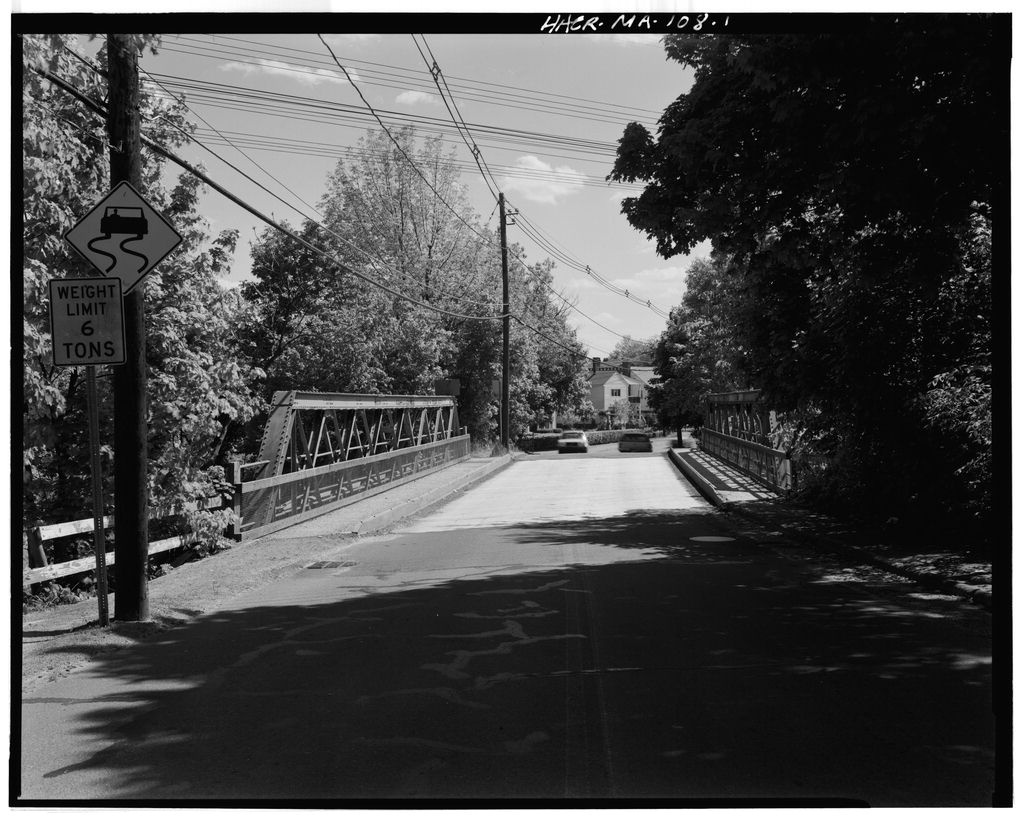
Documentation of the Marion Street Bridge is part of the Massachusetts Historic Bridge Recording Project, conducted during the summer of under the co-sponsorship of HABS/HAER and the Massachusetts Department of Public Works, in cooperation with the Massachusetts Historical Commission. John Healey, HAER Historian, August BOSTON & ALBANY RAILROAD: MARION STREET BRIDGE HAER No. MA-108 (page 2) The Marion Street Bridge is one of three similar bridges documented by the Massachusetts Historic Bridges Recording Project during the summer of The other two are the Weston Road Bridge in Wellesley (HAER No. MA-118) and the Kingsbury Street Bridge in Wellesley (HAER No. MA-117) .
All three bridges are double-intersection Warren pony trusses, manufactured and erected for the Boston & Albany Railroad by the Hawkins Iron Works of Springfield, Massachusetts. Since all three share a common history and configuration, much of the material has been repeated in all three reports, with the exception of the descriptions. Description The Marion Street Bridge is a riveted steel, double-intersection Warren pony truss, measuring long, high, and wide. The bridge bears a builder's plate, with the Hawkins name and the date, on the southeast endpost. The trusses, each having nine panels, are skewed at an angle of 44 degrees. The web system in each truss is asymmetrical in design, but the two trusses are diagonally symmetrical. Sidewalks are provided within the trusses.
The bridge sits on abutments of large cut blocks of coursed granite. The southern abutment has straight, stepped wingwalls, while the northern abutment has a straight, stepped wingwall to the east and a sharply- angled wingwall to the west. The upper chord, with inclined endposts, is comprised of open box section, deep and wide. The strength of the member along its length is varied by more sophisticated means. In the first panel, latticing replaces the top plate, moving inward a single top plate Is then substituted, which is reinforced in the center three panels by the addition of angles within the box structure. The chord is in three sections with connections made by riveted gusset plates. The details are similar to those found In the Kingsbury Street Bridge (HAER No. MA-117).
There is a single additional top plate gusset, while side plates have both internal and external gusset plates. There are three bottom brace plates per panel. The inclined endposts have a similar configuration but are only deep and lack the addition of a bottom flange. The bottom chord also varies from panel to panel. It is a paired 9-inch plate. Beneath the inclined endpost and the first half of the next panel, It is reinforced at the base by angles riveted to the outside of the plate. From this point until the second half of the next panel an additional angle is added to the inside of the plates, finally additional strength is obtained, towards the center of the span by doubling the chord plates.
The arrangement of the panels to accommodate the skew is more complex than that of the Weston Road Bridge (HAER No. MA-118). Each panel measures between and long, except the two southerly end panels of the west truss and the northerly end panels of the east truss, which measure long. The diagonals are the usual paired angles, those sloping outwards have the usual plate braces, however their number has been increased to six per unit. The inward-sloping diagonals--in common with those found at the Weston Road Bridge and the Kingsbury Street Bridge--have no bracing plates. At their intersection they are riveted via joint plates. Where they meet the upper chord triangular BOSTON & ALBANY RAILROAD: MARION STREET BRIDGE HAER No. MA-108 (page 3) plates are inserted.
They are absent at the center, and increase In size toward the ends of the bridge. In comparison to the Weston Road Bridge and the Kingsbury Street Bridge, the Marion Street Bridge has fewer graduations in member size, all are except in the end panel where the outward-sloping member is Hip verticals of paired 3-inch angles are present. Outrigger sway braces are located at every panel point. The floor beam section appears to be similar to those found in the Weston Road Bridge. Bridge Design In parallel-chord trusses, such as the Warren truss, the stresses within the chords increase towards the center of the span. Within the diagonals the stresses increase outwards from the center of the span.
Under static loading conditions, the diagonals sloping outward from the center are In compression, while those sloping inward are in tension. Under live loading conditions, such strain patterns may be temporarily reversed. Doubling the number of diagonals increases the compressive loads that the structure is able to bear, while maintaining truss height. Hawkins Iron Works Like many of his peers in the bridge manufacturing business, Richard Fenner Hawkins received no formal engineering training. He was said to have been a "natural mechanic," although he was assisted by William H. Burrall as Consulting Civil Engineer, E.B. Jennings as Engineer, and Charles H. Mulligan as Superintendent.
Spanning the era of the evolution of the American railroad truss bridge, the company history is long and complicated, but its lineage is directly related to William Howe, the inventor of the Howe truss. The Howe truss, originally designed as a composite wood and iron structure, was pre-eminent in pioneering railroad construction, and a large number of railroad bridges were built to this design in the mid-nineteenth century. Howe, a native of Massachusetts, was contracted by he Western (Massachusetts) Railroad to construct bridges along its line. The most formidable of these crossings was over the Connecticut River at Springfield. In constructing the pioneering 1,260-foot span, Howe was associated with his brother-in-law, Amasa Stone.
In the two men set up a shop to construct the bridge, at the location which would later become the site of their permanent bridge manufactury. In following the successful completion of the bridge in the previous year, Stone formed a partnership with Daniel L. Harris, when was paid to Howe for exclusive production rights in the New England states. During those early years the business was known as Stone & Harris. Azariah Boody was also associated with the business between and and during this period the company was sometimes known as Boody, Stone & Company. In Stone left the business, and Harris was joined in partnership with Albert D. Briggs. Briggs, the holder of the patent rights for New York State, had earlier been employed by Boody, Stone & Company.
In spite of the changes in ownership, the company retained the old title until when it became Harris, Briggs & Company. In at the age of 16, Hawkins joined the Stone & Harris firm BOSTON & ALBANY RAILROAD: MARION STREET BRIDGE HAER No. MA-108 (page 4) as an office boy. Nine years later, Hawkins married William Howe's niece, Cornelia Howe. That same year, he was made a partner with Harris & Briggs. Shortly thereafter, Briggs left the partnership to form his own bridge building company, specializing in Truesdell patent bridges. Briggs's departure brought about a change in title, and from to the company was known as Harris & Co. Hawkins became a senior partner in and until Harris's retirement, in the company was briefly known as Harris & Hawkins.
Upon assuming full control in Hawkins took into partnership Burrall, who had been employed as engineer to Harris & Company since and He r thai, a St. Louis inventor and engineer. Hawkins, Herthal & Burrall traded from advertising the patented bridge design of Herthal. Herthal's association with the company appears to have been short- lived, for in the title changed once more to Hawkins & Burrall. In the company changed title to Hawkins Iron Works, though Burrall remained associated with the company, serving as its Consulting Engineer. Around Hawkins established a branch of the Springfield works at St. Albans, Vermont, the Vermont Construction Company, which built a number of notable spans for the Central Vermont Railroad.
By the time Hawkins had taken control the works had moved to Brightwood. In the company moved to a purpose-built plant at Liberty Street in Springfield. For convenience of shipment the works were situated adjacent to the Boston & Albany Railroad. An lithograph of the plant and Sanborn fire insurance maps of and show the details of the facility. The plant occupied two acres, and its seven shops were powered by two steam engines. The shops included a central foundry with cupula furnace, machine shop, boiler-plating shop, bridge shop, carpenter's shops producing both patterns and templates, all equipped with the "latest improved machinery and tools known to the iron working trade," including a steam-powered riveter in the bridge shop.
In addition to bridges, the company manufactured a diversity of products, including structural and decorative architectural ironwork, boilers, and railway turntables. In it appears that the company was still producing the Howe bridge, though in an all-iron form, in addition to "lattice and plate girder bridges. In the shops were said to employ between 120 to 150 people. By 200 were said to be employed, though the works configuration remained the same. In that year the company supplied twenty- three railroad bridges, and thirty highway bridges, employing about 200 men, between spring and fall, to erect the structures.
As successor to the Western Railroad, whose bridge requirements had provided the original impetus to locate in Springfield, the Boston & Albany Railroad remained closely- associated with Hawkins, and was a major source of orders. In Hawkins received all the railroad's bridge contracts, supplying twenty-four bridges, Hawkins Iron Works benefitted greatly from the railroad's policies of replacement of wooden bridges, and the elimination of all grade-level crossings on its main line. BOSTON & ALBANY RAILROAD: MARION STREET BRIDGE HAER No. MA-108 (page 5) The Boston & Albany Railroad The Boston & Albany Railroad, on its route through Wellesley and Natick, had begun as the Boston & Worcester Railroad.
This railroad was authorized on June 23, opening through Wellesley on September 22, The tracks were doubled between and after the original single track was found inadequate for the increasing traffic. On October 18, the line merged with the Western Railroad to form the Boston & Albany Railroad. As the premier route to the west from Boston, the Boston & Albany Railroad was a wealthy concern with forward-thinking directors who were not averse to reinvesting their profits in railroad improvements. As originally laid out, pioneering American railroads tended to be minimally engineered, and were often handicapped by severe grades and curves. Grade crossings became an increasing concern as communities grew along the course of the railroad.
By the Boston & Albany had replaced all except two of its main line wooden bridges with spans of iron.2 During the last two decades of the century the company applied itself to other major improvements, investing substantial sums in the quadrupling of tracks, the easing of grades and curves, and the elimination of road-level road crossings. At certain locations many of these improvements could be brought about simultaneously by the creation of cuttings, and embankments either on the old or a new alignment. Such solutions were applied from through to in improving the line through Wellesley and Natick. The schemes in these two towns were representative of the sorts of improvements made to the line. In the main line was crossed at grade by over 145 highways.
On this date the Directors became concerned about their elimination, and made it a matter of policy to provide bridges.3 However, until a change in the law in the legal process could be protracted, particularly in regard to the apportionment of costs. Up to the year of passage of Act 33, level crossings had been eliminated at a cost of In the company issued $1 million of stock to pay for improvements "especially in the matter of eliminating grade crossings. Under Chapter 428 of the Acts of "to promote the abolition of grade crossings," the apportionment of cost was fixed, such that the railroad paid 65 percent, and the balance was funded by the state and town, the latter being liable up to a maximum of 10 percent. State expenditures were limited to in any one year.
Following the passage of this act, the rate of removal of grade crossings increased. By an additional sixty-five had been eliminated at a cost of It was hoped that all would be removed by As the preferred supplier, Hawkins benefitted greatly from the grade-crossing elimination program, and the company's characteristic overbridge design became a recognized feature of the entire main line. Marion Street Bridge Reference to Natick and Wellesley town maps shows the nature of the improvements.7 An early, undated map of Natick shows a double track line through the town, with all crossings at grade level. The town map of BOSTON & ALBANY RAILROAD: MARION STREET BRIDGE HAER No.
MA-108 (page 6) shows the railway to have been realigned through the town center, placed in a cutting to eliminate all level crossings, by overbridging the quadrupled track. Similar improvements occurred at Wellesley. An town atlas depicts a double-track railway passing through the town. The Blossom Street Bridge (later to become the Weston Road Bridge, HAER No. MA-118) was already in place and crossed the tracks by means of an overbridge. Kingsbury Street had not yet been laid out, and all other crossings in the town center were at grade level. By little had changed, although Kingsbury Street was now shown crossing the line at grade. By many changes had occurred. Overbridges had been built at all crossings, the road layout in the town center having been changed.
The running lines had been quadrupled, and the curvature of the line eased, the entire line having been sunk deeper in a cutting. Blossom Street Bridge spanned four tracks on the reduced curve, and Kingsbury Street Bridge spanned the four running tracks, plus a siding track. In as part of a long-term policiy to increase track capacity, the Boston & Albany quadrupled its tracks from Boston as far as Riverside (a total of 9.4 miles). Between and the quadrupled track had been completed to Wellesley Farms miles), and between and it had been completed to Lake Station miles) in Natick.
By the quadrupled line extended through Natick, eventually reaching Framingham in As part of the line improvement program, the Boston & Albany provided Norfolk County with a plan, dated May detailing their proposals for eliminating grade crossings, and improving both the alignment and the gradient of the line at Wellesley. The plan involved depressing the line In a cutting wide enough to accommodate four tracks or more. The steep curve at Wellesley Station was to be eased by moving the tracks northwards. A new bridge was required at Blossom Street (now Weston Road), and one was to be provided for the first time at Kingsbury Street. Within the town center, two new bridges were to be provided at Woodland Avenue and Worcester Street.
To the east of Kingsbury Street a replacement for the bridge at Linden Street required a degree of road realignment. A petition "for the common convenience and necessity" was made by James Gray (presumably of the railroad) to the Commissioners of the County of Norfolk on June 7, with regard to the bridging arrangements. On June 2, the Commissioners met with town selectmen at Wellesley Town Hall to view the proposals. On June 5, the meeting continued at Dedham, the county seat, and specifications for the bridges were laid down. In the case of the bridge at Blossom Street, it was to be built of "wood or iron ... [and be] at least 35' in width, with a roadway not less than 23' in the clear, . . .
[with approach gradients] not to exceed in The proposals were accepted by the County Commissioners in on July 5. The work had to begin within two years of this date, and was required to be completed within six months.10 The annual report for the railroad stated that "work was in progress in the town of Wellesley to improve the alignment." Once approved, work must have proceeded apace. The Blossom Street Bridge (HAER No. MA-118) was fabricated in and installed the following year. The Kingsbury Street Bridge (HAER No. MA-117) was also built that year. Apparently, Hawkins Iron Works supplied all the bridges. Although the quadruple track was not scheduled to reach Wellesley for another four years, spans were built to BOSTON & ALBANY RAILROAD: MARION STREET BRIDGE HAER No.
MA-108 (page 7) accommodate them.11 Negotiations at Linden Street were apparently rather more protracted, and approval was not finally granted until possibly delaying the advent of four-track operations through Wellesley.12 On December 21, the railroad company petitioned the Massachusetts Railroad Commissioners to eliminate the grade crossings to the west of the town of Natick by the construction of overbridges at Speen Street, Mill Street and Mill Lane.13 The bridges were to accommodate four tracks, although large-scale works were required within the town in order to lay four tracks.
Four years later, the railroad company petitioned the Railroad Commission for permission to eliminate grade crossings at Marion Street, Washington Street, Main Street, Spring Street and Cochituate Street in Natick.14 The annual report for the railroad company states, "The work of separating the grade at Natick began last year, has been steadily carried on and is now substantially completed." The same report anticipated completion of the project by September of that year, the work having cost The elimination of the crossings required substantial depression of the track in the town center, where approach gradients to the new bridges were very low.
Maintenance Once completed, the bridges required little maintenance, except for the replacement of timber decking for the first three to four decades of their lives. The Weston Road Bridge (HAER No. MA-118) had floor beams repaired in and more major repairs were carried out to beams and braces in In the timber stringers were replaced. Today, apart from minor repair to some diagonals and sway braces, the trusses remain substantially original. Similarly, by all seven original steel floor beams at the Marion Street Bridge required replacement. At the same date most of the steel stringers were replace with new wooden stringers. In additional bracing plates were added to the lower chord. No repair records can not be found for the Kingsbury Street Bridge (HAER No.
MA-117), although two panel diagonals appear to have been replaced. BOSTON & ALBANY RAILROAD: MARION STREET BRIDGE HAER No. MA-108 (page 8) BOSTON & ALBANY RAILROAD: MARION STREET BRIDGE HAER No. MA-108 (page 9) ENDNOTES 1. Professor Daniel Schodek, Harvard University Graduate School of Design, personal conversation with author, July 2. Boston & Albany Railroad, Annual Report. p. 9. 3. Annual Report. p. 7. 4. Annual Report. pp. 5. Annual Report. p. 8. 6. Annual Report. p. 7. 7. Atlases in the collection of the Massachusetts State Library, Boston. 8. Boston & Albany Railroad, Annual Report, 9. Boston & Albany Railroad, Plan for Eliminating Grade Level Crossings, Entry Map Book 10, Norfolk County Engineer's Office, Dedham, Massachusetts. 10. Norfolk County Record Book 13. pp. 289 and 11.
The progress of the quadrupling may be measured by reference to the track mileage records appearing in the Annual Reports of the Railroad Commissioners of the Commonwealth of Massachusetts, located at the Massachusetts State Library, Boston. 12. Norfolk County Record Book 14. p. 13. Massachusetts Board of Railroad Commissioners, Annual Report. p. 14. Ibid., p. BOSTON & ALBANY RAILROAD: MARION STREET BRIDGE HAER No. MA-108 (page 10)
Boston & Albany Railroad. Annual Reports. Boston & Albany Railroad. Plan for Eliminating Grade Level Crossings, Entry Map Book 10, Norfolk County Engineer's Office, Dedham, Massachusetts. "Bridge Massachusetts Department of Public Works Bridge Section files, Boston. "Death of Hawkins: A Pioneer Bridge Builder," obituary in The Springfield Daily Republican. March 6, King, Moses, ed. Hawkins Iron Works," King's Handbook of Springfield. Massachusetts. Springfield, Massachusetts: James D. Gill, Publisher, pp. Norfolk County Record Books. Norfolk County Engineer's Office, Dedham, Massachusetts. Hawkins," obituary in The Springfield Express. March 6, Hawkins Iron Works," Commerce, Manufactures and Resources of Springfield. Mass.: A Historical. Statistical and Descriptive Review.
Springfield, Massachusetts: National Publishing Co., Hawkins Iron Works," Inland Massachusetts Illustrated. Springfield, Massachusetts: Elstner Publishing Co., p. 45. Hawkins Iron Works," Springfield. supplement to The Springfield Daily News. June 26, p. 58. "Sanborn's Maps of Springfield, Massachusetts, and New York: Sanborn Map and Publishing Co., and
 Block
Block