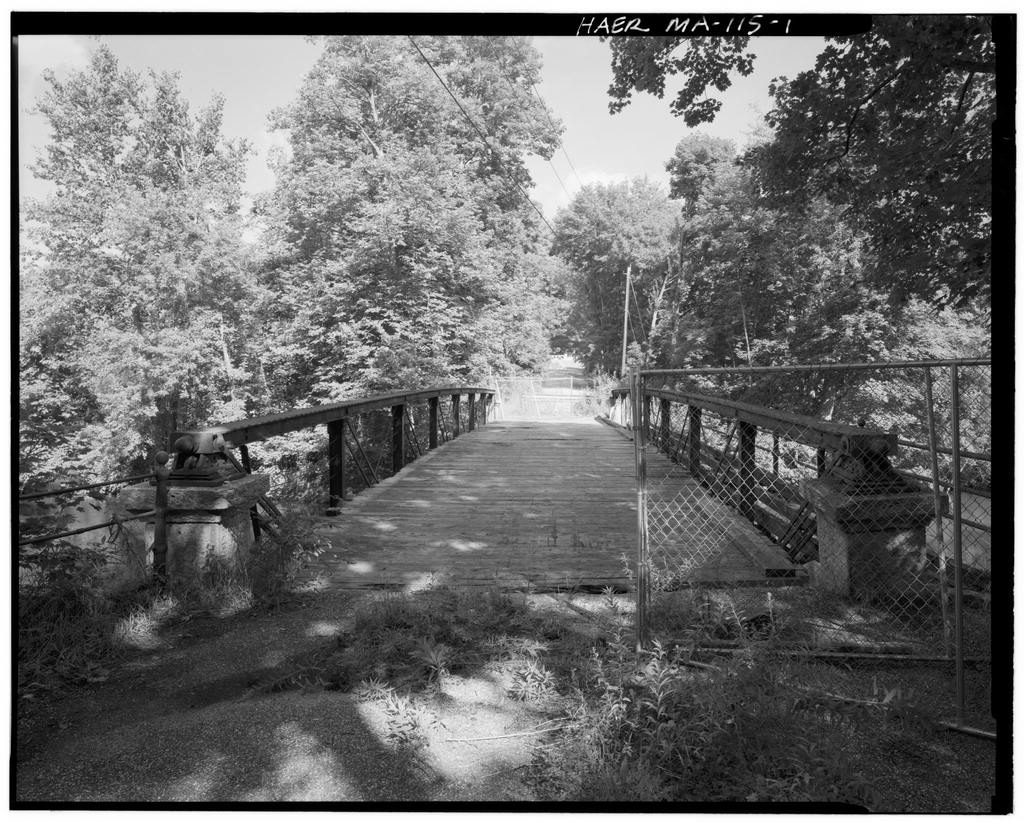
Documentation of the Butler Bridge is part of the Massachusetts Historic Bridge Recording Project, conducted during the summer of under the co-sponsorship of HABS/HAER and the Massachusetts Department of Public Works, in cooperation with the Massachusetts Historical Commission. John Healey, HAER Historian, August BUTLER BRIDGE (LESTER BRIDGE) HAER No. MA-115 (page 2) Description The Butler Bridge carries Butler Road (previously known as North Glendale Road) across the Housatonic River, one mile west of the village of Stockbridge, Massachusetts. The setting is entirely rural, the river being bounded by woods and meadows, as it flows placidly across a broad flood plain.
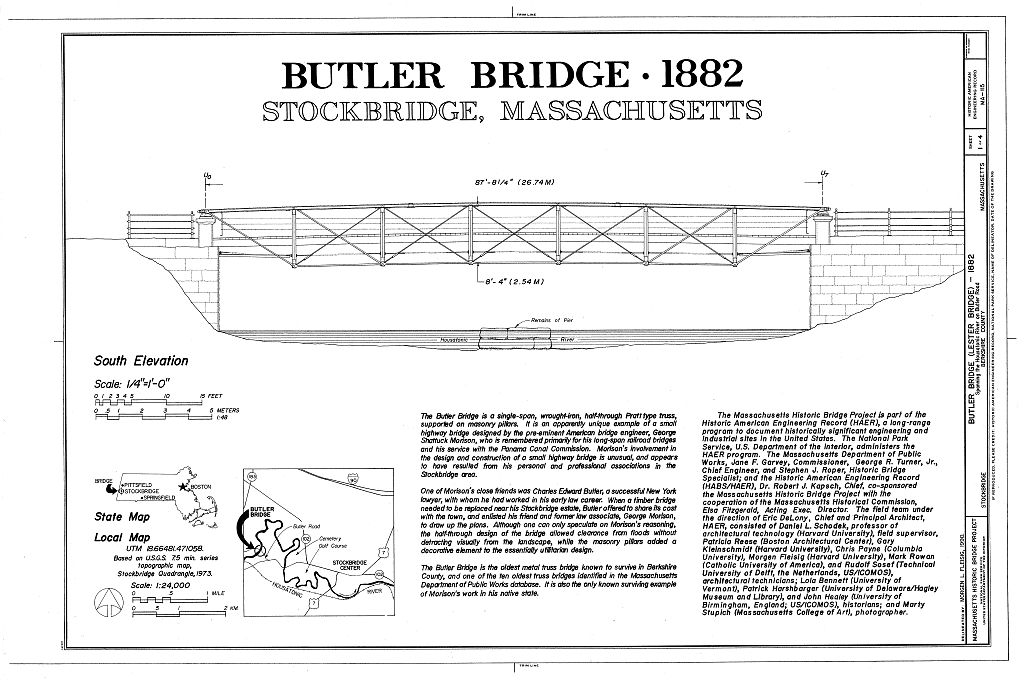
Just to the east, the remains of the center pier of an earlier bridge, historically known as the Lester Bridge, can still be seen. The Butler Bridge is a single-span, wrought-iron, half-through Pratt-type truss, having seven panels. The span measures 87' long and wide, not including the 4'- 11" sidewalk, which was added later. The height from the lower chord to summer water level is about 9'. The abutments are well-dressed rusticated Lee marble, with drafted margins at the corners. The ends of the trusses rest on bearings atop masonry pillars, each comprised of a single upright stone block with drafted margins and a molded cap stone. On top of the pillars are the bridge bearing shoes, which are fixed at the west end, and are on rollers at the east end.
The vertical plates of the bearing shoes are bored to receive the pin for the lower chord connections. At the west end, the shoes are bolted directly to the pillars, while at the east end, a carriage of rollers run on a track bolted to the pillars. A cast-iron end plate with stylized acorn detail completes this assembly. The upper chord is a built-up member, comprised of two channels, tied at the top by a riveted plate and at the bottom by bar lacing. The member dimensions remain a constant (overall) across the span. The chord is highly cambered, rising to the center line. Along its length it has three splices formed by lapped gusset plates.
The bottom chord is comprised of wrought-iron eyebars, the size and number of the bars varying according to the determined stresses within the structure. Within the end panels the bottom chord rises diagonally to the upper chord at the bearing shoe, where it is pinned. The upper and lower chords are connected by built-up vertical members, comprised of two angles and a plate. The verticals are pin-connected to both upper and lower chords. The floor beam is of considerable depth, and forms an integral unit with the uprights to which it is riveted, to form part of the web member. Diagonals and counter diagonals are provided in all but the end panels. The diagonals are paired rods, which decrease in size towards the center panel.
The counter diagonals are single rods in all except the center panel, and decrease In size towards the end panels. The counters are tensioned by elegantly executed turhbuckles. A lower lateral system consists of rods bolted to tangs which are riveted to the floor beams. These rods are tensioned by turobuckles similar to those of the diagonal counters. The decking is a conventional wooden structure of transverse planks nailed to longitudinal stringers. Elegant railings, comprised of iron tube passing through cast iron posts, affords protection to those on the abutments. A sidewalk, of later date, has been cantilevered from the north truss. It is thought to be of steel, and is fixed by means of bolts to the verticals.
Its detail Is clearly sympathetic to the main structure--in particular, the railings reflect the design of the abutment railings. BUTLER BRIDGE (LESTER BRIDGE) HAER No. MA-115 (page 3) Bridge Design The design of the Butler Bridge has been likened to a design patented in by August Borneman, an Ohio mechanic-engineer with no formal training. The patent (U.S. Patent is based on the concept of a half-through truss with its bearings raised on stone pedestals to the height of the truss upper chord. Morison's overall concept for the Butler Bridge Is strikingly similar to Borneman's patented design, but no conclusive evidence could be found to indicate a connection between the two designs.
Scholars can only speculate that Morison must have been aware of Borneman's patent through engineering and trade journals, and may have made use of Borneman's concept (vastly improved upon) in his design for the Butler Bridge. The bridge may also have simply been the engineering answer to a design problem. The configuration is logical, as the determined minimum elevation of the bottom chord was set to clear the floods and ice flows, the road elevation was pre-determined to meet existing conditions. A pony truss could have been used, although the length was near the limit because of the lateral stiffness of the top chord. A through truss would have detracted from the landscape because of its height and overhead bracing.
A half-through truss answered all of the problems by providing the necessary clearance above the water, while the floor beams anchored the web verticals which in turn stiffened the top chord. The usual endposts would have been dirt traps, but stone piers were both decorative and eliminated the dirt problem. George S. Morison George S. Morison was an engineer of international standing, famed for his long-span railroad bridges across the Missouri and Mississippi, and his pioneering use of steel in those structures.
Born in New Bedford, Massachusetts, December 19, Morison received a Harvard education in law, and was admitted to the New York bar in He joined the New York firm of Evarts, Southmayd & Choate, and although he only practiced briefly, the connections made at this time were not without significance with regard to the Butler Bridge. During this period in New York Morison decided to "go west as a civil engineer". In he began work on the Kansas City Bridge, where, despite his lack of engineering training, he rose to the position of Associate Engineer under the tutelage of Octave Chanute. From there, Morison went to work for six years on the construction of the western railroads, but returned in to work under Chanute on the construction of the Erie Canal.
International prominence was conferred upon Morison in following the rebuilding of the Portage, New York, viaduct. The new iron structure was long and high, yet from design to completion the work took only eighty-six days. From to Morison organized the bridge contracting company of Morison, Field & Company, of New York and Buffalo. Having relinquished his associations with this company in Morison concentrated on bridge design work, and over the next decade was responsible for engineering numbers of monumental and innovative bridges. He designed bridges over the Missouri River at Plattsmouth Bismarck Blair Omaha Rulo Nebraska City Sioux City BUTLER BRIDGE (LESTER BRIDGE) HAER No.
MA-115 (page 4) Bellefontaine and Levenworth(1893); over the Mississippi River at Winova Burlington Memphis and Alton and over the Ohio River at Cairo He also designed several notable spans in the Pacific coast states. The Memphis bridge had, at the time of its construction, the third longest individual span in the world. The two- mile Cairo Bridge was the longest metal structure in the world, yet one of the central trusses was erected in only six days. Those bridges built between and were carried out in a new partnership with E.L. Corthell. The two did not operate a bridge building company, but rather, contracted to execute the design, and subcontracted out the actual fabrication and erection of the bridges.
Some of Morison's earlier bridges were erected by the Keystone Bridge Company and the Detroit Bridge Works. After Morison had a number of contracts with the Union Bridge Company, where his former partner, Field, was director. There is no record of the fabricator or builder of the Butler Bridge, although both Engineering News and The Berkshire Courier reported that Morison of New York will build the ironwork," and that Morison of Buffalo will build the bridge." Morison did not have his own manufacturing facilities, though the reference to Buffalo suggests that Morison maintained his links with the Buffalo based Field, following the dissolution of that partership in Alternatively, it may indicate that the bridge was built in that town.
In this regard, it is perhaps significant that the Central Bridge Company of Buffalo, organized in combined with Kellogg-Maurice (joint contractors at Plattsmouth), to became The Union Bridge Company, which later was to become the major recipient of Morison contracts. Local History Established in Stockbridge township is located on a river terrace immediately above the Housatonic River in western Massachusetts. At this stage in its course, the river meanders across a broad flood plain bounded by rugged hills. For early settlers, the Housatonic Valley provided a natural north-south trade route, while the breaks in the surrounding hills allowed east-west routes to develop.
Thus, the Boston, Springfield, Albany "Great Road" passed directly along Stockbridge's Main Street, crossing the principal north-south county road in the town center. Hamilton Child's map of Berkshire County shows only one crossing of the Housatonic River within Stockbridge township. This bridge on South Street carried the north-south county traffic. By when James Baldwin surveyed possible routes for the Springfield-Albany railways, several more river crossings had been constructed. Baldwin's survey provides the earliest record of a bridge at the site of the Butler Bridge.(See Figure 1.) At this date, the bridge was known as the Lester Bridge. The survey shows it to be part of a network of roads extending from West Main Street, and crossing the Housatonic's meanderings.
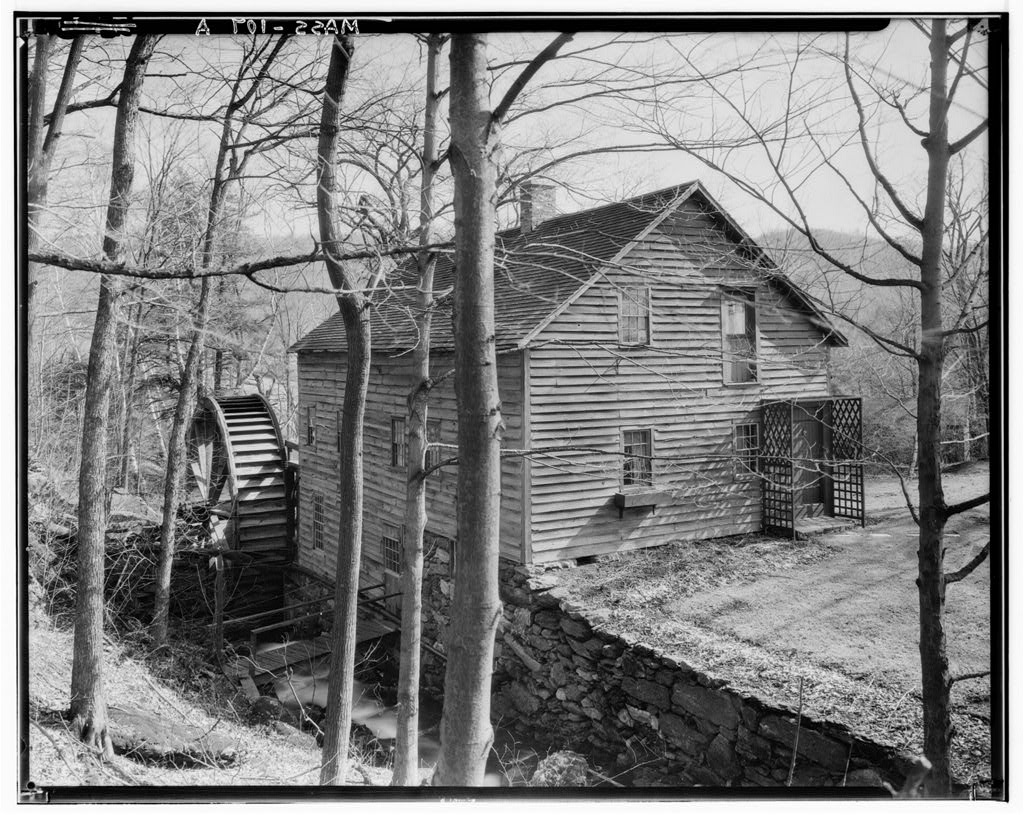
At the foot of West Main Street a new bridge had been constructed, which would later become known as the Old Red Bridge. Beyond this point the new road divided, one fork led across the Lester Bridge to serve West Stockbridge, the other bridged the Housatonic a mile or so downstream at Mill Hollow, which would BUTLER BRIDGE (LESTER BRIDGE) HAER No. MA-115 (page 5) later become Glendale. By this date water-powered Industries had become established along the Housatonic, particularly in the area to the west of the town, and it seems likely that the local road network was developed substantially to service these mills. In a grist mill and saw mill were built at Mill Hollow. Further developments occurred in when a woollen factory was established at the same settlement.
Baldwin's survey refers to the site as Seley's Factory. In the Housatonic's power was further developed when a cotton factory was established between Mill Hollow and Lester's Bridges. By both mills had been acquired by Lester Avery & Company, manufacturers of cotton sheeting. The coincidence of the name suggests that the first crossing at the site of Butler's Bridge was undertaken by the mill company, although no record of the crossing can be found in either town or county records.
Eventually, water regulation problems caused the enterprise to be abandoned, but the lower factory site was later reestablished by the Glendale Woollen Mills in For a period of some two to three decades from the the clays to the west of Stockbridge supported a brickmaking industry, and apparently the factory was located near the location of Butler's Bridge. An town surveyor's plan shows that one-third of a mile of new town road led from the bridge to "the old brick kilns." The town's annual report from contains an account of for a "Bridge at Brick Factory*1. No more specific information is given, but it is probable that it refers to the Butler Bridge site.
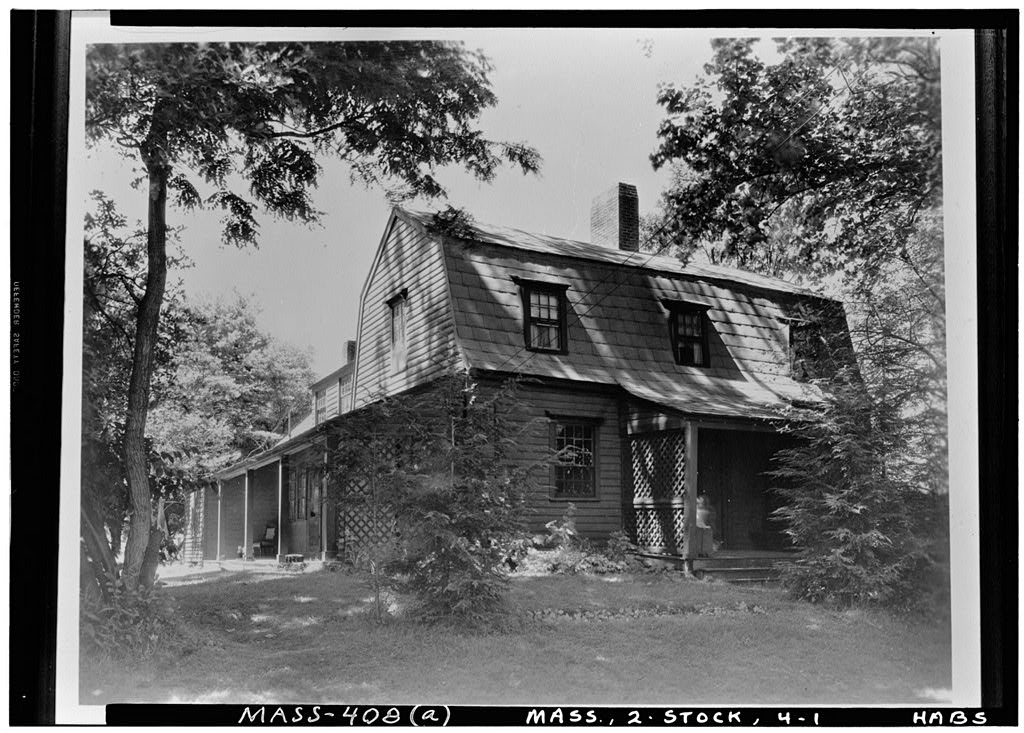
Charles Butler The arrival of the Housatonic Railway, in the mid opened up this attractive hill country to wealthy New Yorkers, who began to establish both seasonal and permanent residences in the township. Among the early arrivals was Charles Edward Butler, a successful New York lawyer. Initially he practiced in the firm of Hall & Butler, followed by Butler & Evarts in Later, Charles H. Southmayd and Joseph H. Choate became members of his firm. In at the age of 40, Butler retired from the practice, purchasing eighty acres of land to the west of the Lester Bridge. In the following year, he built a residence, "Linwood House," on this land. In he returned to the bar, In the firm of Evarts, Southmayd & Choate. Four years later, the recently-graduated George S. Morison joined this firm.
During his short legal career, Morison developed a long-lasting friendship with Butler, a friendship which subsequently admitted Morison to exclusive social circles in Stockbridge. Both Southmayd and Choate eventually joined Butler in Stockbridge, building their own estates in close proximity to Butler's, along the banks of the Housatonic River.3(See Figure 2.) The town of Stockbridge appears to have had both the foresight and the financial resources to begin replacing its wooden bridges at a relatively early date.
In for example, the town paid for the construction of a Moseley iron truss bridge to replace the wooden structure crossing the Housatonic in Glendale, and in they replaced the South Street bridge over the Housatonic, near the depot, with "an iron bridge of span."4 In both Butler and Southmayd, in improving access to their BUTLER BRIDGE (LESTER BRIDGE) HAER No. MA-1X5 (page 6) estates, took the opportunity to enhance their status in the community by becoming public benefactors.
At the annual meeting on December 4, the town voted to build "a new bridge near Thomas Wells similar to the one near the depot, upon condition that two thousand dollars of the expenses are paid by Messers Butler and Southmayd as proposed by them, and that four thousand dollars be raised by the town." The bridge was to replace the timber structure at the end of South Main Street, and was known as the Tuckerman Bridge. The town report of April 1, shows that Hawkins & Burrall of Springfield were paid a total of for the bridge, a price that included the stone abutments.5 Such acts of generosity by the men were to be repeated.
The town report of April 1, notes that "Messers Butler, Southmayd and Tuckerman have begun to improve the road near their houses at their own expense," and it was considered that they deserved "an expression of thanks for their generous contributions."6 Butler Bridge Several years later, the town report of April, noted, Butler has at his own expense, macadamised, and put in fine condition a large piece of the town road," and then, the report goes on at length about the bridge near Butler's house: The north abutment of the bridge, near Mr Butler's, has got to be rebuilt, a portion of it fell down last summer making the bridge unsafe for use. We put a timber support under it which has answered the purpose so far, but a new stone abutment should be made as soon as practicable.
The bridge itself is becoming rotten, and there will soon have to be a new one.7 The account for the year shows that was spent on these repairs. Little is known of this bridge, although the remains of a central pier can still be seen, suggesting that it may have been a two-span timber truss bridge. The report continues, Mr Butler is very desirous that a new iron bridge should be built this season. He has left in our hands plans and specifications of an iron bridge that will cost about three thousand dollars, towards which he authorizes us to say he will pay one thousand dollars.8 At the same meeting, the town voted to "raise and appropriate to be used in connection with promised aid from Mr.
Butler for rebuilding the bridge on the Housatonic near his residence," and that, "the Selectmen be limited to for rebuilding the said bridge."9 By the time Butler retired permanently to Stockbridge that same year, Morison was a regular visitor to the Butler household. Morison was also a frequent visitor at the home of a major railroad stockholder, a Ward of Lennox, while he commissioned the prominent Stockbridge sculptor Daniel BUTLER BRIDGE (LESTER BRIDGE) HAER No. MA-115 (page 7) Chester French to make a bust of his father.10 Morison's seemingly unique involvement in the building of a small highway span becomes explicable in light of his personal and professional relationships in the Stockbridge area. On June 25, Morison "spent the morning with Mr.
Butler looking at the bridge across the Housatonic which he proposes to build", later spending the day "taking tea in the company of Miss Emily and Lucy." Within a few weeks, the contracts had been let, and the newspaper reported "the new iron bridge, near C.E. Butler's is soon to be built." It was also reported that Burghardt & Co.
of Curtisville will do the stone work," while Morison would "build the iron work." It was said that when complete "[the bridge] will be one of the finest in the town." Morison again visited Stockbridge on September 30, where he "saw work done on the small bridge." The Berkshire Courier of December 7, in a scarce report on progress at the bridge site, noted that, "the mason work for the new iron bridge south of the Butler's house is ready for the bridge to be built," and added, "should we have as cold a winter as we did last, someone will have cold fingers before the bridge is finished." By late February the bridge was nearly complete, and on February 23, an assistant at the New York office, Parkhead, left for Stockbridge "to adjust the little bridge there." In their report to the town on April 1, the Selectmen noted that the bridge was complete, "except for painting." The tone of the report suggests that all were pleased with the bridge, stating that it was "strong and excellent." Morison returned to Stockbridge on June 29, and "had a pleasant morning with Mr.
Butler going down with him to look at the new bridge."11 The accounts in the Town Reports for and contain an error and it is not certain whether the total cost of the bridge was or The account shows that Morison was owed yet the account shows that he was only paid In view of Morison's estimates it would seem that the account is correct, thus Morison received in total for the ironwork, while Burghardt received for the masonry work. No record could be found of the account for the addition of the sidewalk, although the abutment railings appear to be original E.P. Tanner being paid for posts and railings in the account. Maintenance Paint analysis has shown that the bridge has received only four coats of paint during its life, the original color being gray.
Little else is known of the bridge's maintenance history, although the decking must have been replaced many times. Following the collapse of the Glendale lenticular span in the Butler Bridge was heavily trafficked until the new Glendale Bridge was completed. On December 31, the Butler Bridge was closed to vehicular traffic. It remains so today. The firm of Keyes Associates has drawn up plans for a new concrete structure which would incorporate the original trusses as non-structural embellishments. The estimate for this proposal Is while the same report estimated rehabilitation costs to be To date, no decision has been reached on the matter. BUTLER BRIDGE (LESTER BRIDGE) HAER No. MA-115 (page 8) to 3 l-I CQ CO CM CO t-4 i-l 1-1 so o u w BUTLER BRIDGE (LESTER BRIDGE) HAER No.
MA-115 (page 9) o co T) H U ao o 4-1 CO w o M BUTLER BRIDGE (LESTER BRIDGE) HAER No. MA-115 (page 10) ENDNOTES 1. Design analysis based on editorial comments from the Massachusetts Department of Transportation and the Massachusetts Historical Commission--ed. 2. Engineering News. September 3, p. The Berkshire Courier. August 31, 3. Gerard Chapman, article on Charles Butler, in The Berkshire Courier. November 10, 4. Town of Stockbridge Annual Reports. April 1, pp. and Records of the Town of Stockbridge. November 2, 5. Town of Stockbridge Annual Report. April 1, pp. and Records of the Town of Stockbridge. April 12, 6. Town of Stockbridge Annual Report. April 1, 7. Annual Report. April 1, 8. Ibid. 9. Ibid. 10. George S. Morison, personal journals, in the collection of the George S.
Morison Archive, Smithsonian Institution, Washington, DC. 11. The construction account is drawn from entries in Morison's personal journals, BUTLER BRIDGE (LESTER BRIDGE) HAER No. MA-115 (page 11)
History of the County of Berkshire, by Gentlemen in the County. Baldwin, James. "Survey for the Springfield-Albany Railroad, Collection of the Pittsfield Public Library, Pittsfield, Massachusetts The Berkshire Courier. Chapman, Gerard. Article on Charles Butler, in The Berkshire Courier. November 10, Child, Hamilton, compiler. Gazetteer of Berkshire County. Mass.. Syracuse, New York: Journal Office, Child, Hamilton. "Map of Berkshire County, Clarke, Richard. "Plans of the Towns of Stockbridge and West Stockbridge, Collection of the Stockbridge Public Library, Stockbridge, Massachusetts. "Early Presidents of the Society: George S. Morison, Journal of the American Society of Civil Engineers. April p. Engineering News. March 9, p. "George S. Morison," obituary, in Engineering News.
July 24, p. "George S. Morison, Past President of ASCE," obituary, in Journal of the American Society of Civil Engineers. June pp. Morison, Etling E. "The Master Builder," American Heritage of Invention and Technology. Fall pp. "Morison, George National Cyclopaedia of American Biography, vol. X, p. Morison, George S. "Butler Bridge," original drawings. Collection of the George S. Morison Archive, Smithsonian Institution, Washington, DC. Morison, George S. Personal journals. Collection of the George S. Morison Archive, Smithsonian Institution, Washington, DC. Obituary for George S. Morison, in Journal of the American Society of Mechanical Engineers, vol. 24, pp. Records of the Town of Stockbridge. Stockbridge, Massachusetts. BUTLER BRIDGE (LESTER BRIDGE) HAER No.
MA-115 (page 12) Simmons, David. Telephone conversation with author, July "Sketch of the Housatonic River Turnpike, Collection of the Stockbridge Public Library, Stockbridge, Massachusetts. Town of Stockbridge Annual Reports. Stockbridge, Massachusetts.
 Block
Block