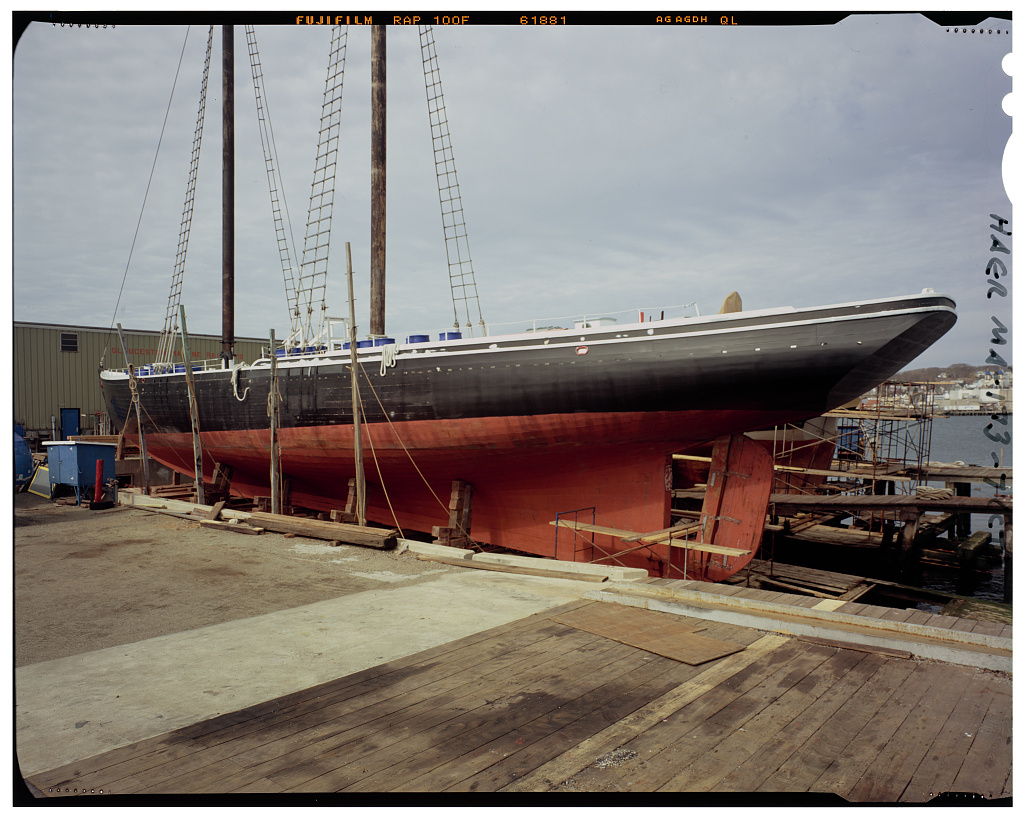
Schooner Adventure, official number was designed by Thomas J. McManus and built in in Essex, Massachusetts, by the John F. James and Son Shipyard. She measured in length, in breadth, and in draft. Her gross tonnage was 130 and her net tonnage 62. When built, Adventure was powered by a 120-horsepower engine turning a single screw in a cutout space in the rudder. When she was converted for passenger cruising, the engine, propeller, and prop shaft were removed. Masts (maximum height above deck) Foremast 77' Mainmast 85' Topmast Sails Total area square feet Jig Headsail Jumbo Headsail Fore Sail Main Sail Main Top Sail Queen Top Sail SCHOONER ADVENTURE HAER No. MA-173 (Page 3) Hull Adventure is the last example afloat of a knockabout style schooner in the United States.
Boston fish dealer and vessel designer Thomas F. McManus designed the first round spoon bow hull form in with the Schooner Juniata, inspired by advanced yacht designs of the period. The schooner had a short keel inclined upwards from the stern, long overhangs at bow and stern, a large amount of deadrise, and a gentle curve to the bilge. The McManus hull form was very maneuverable, fast, able to counterbalance a large rig, yet slack-bilged enough to give an easy motion that would not endanger the large rig. The hull is constructed of white oak planking and hard pine inner ceiling over sawn oak double frames trunneled together. Heavy structural members are fastened with iron spikes and drift pins; trunnels were used for the remainder.
A heavy oak clamp runs around the inside of the frames above the ceiling on which the deck beams rest. White pine waterways cover the upper ends of the frames, serving also to hold the deck beams securely to the clamp. Below Decks The hull was divided into four watertight compartments when Adventure was fishing. The forward compartment was the forecastle for the crew, and aft of that the galley, separated by a bulkhead from the fish hold. The majority of the crew berthed here in wooden bunks fitted along the sides of the space. The next space aft, the fish hold, was designed with many bays separated by light planking opening into a central passage.
Vertical stanchions between each bay held removable boards, so that as salted or iced fish filled the bays, the boards would be added to help hold the preserved fish in place as the ship moved. Aft of the fish hold was the engine room. The aftermost space was the main cabin, home to the captain and five other men. It was the most elaborately finished, with bunks, individual lockers, and cypress and fiddleback maple paneling. The area below decks has seen the majority of changes to the vessel since she was launched. The forward part of the forecastle has been partitioned off for use as a bosun s locker for sails, line, blocks, and other gear. The remainder of the forecastle is little changed from its appearance when new.
The wood-burning iron cook stove has been replaced with a similar model and the berths have been removed. The fish hold and engine room were modified to carry passengers in small cabins on each side of the central passage. In effect, passengers replaced fish in this adaptive reuse. The main cabin aft is now accessible through an opening in the bulkhead to the fish hold, allowing one to walk nearly the length of the vessel below decks. Main Deck The deck is not level from end to end, but rather is raised slightly from a point forward of the mainmast, where the great beam crosses the deck. The decking is 3"-thick white pine except along the thicker 4" strongback along the centerline, which gives longitudinal strength to the hull structure.
The original Gloucester-built wooden log and iron anchor windlass is located forward of the foremast. The forecastle companionway is immediately behind the foremast and leads below by means of a steep ladder. Aft of that is the galley skylight, then an additional companionway for direct access to the passenger cabins. Further aft, a skylight replaced the original fish hatch. The SCHOONER ADVENTURE HAER No. MA-173 (Page 4) main cabin trunk extends across most of the deck, with a companionway in the middle of the rear side. The iron ships wheel and steering gear, cast by A. P. Stoddart of Gloucester, are located behind the cabin trunk. The wheel moves a worm gear which turns the rudder. A heavy wooden trunk covers the steering gear.
The ship s compass is visible to the helmsman through a sliding door in the binnacle, which is built into the rear of the main cabin to starboard of the companionway. A steel pipe boat davit is mounted over Adventure s stern for the motor-driven pushboat used to ease the schooner into and out of her berth. Rigging The sailing rig of a knockabout schooner is finely balanced so that a small working crew can sail her while the fishermen work their trawls. The two masts are each supported by three shrouds to port and starboard, designed to prevent sideways motion. A single backstay on each side, and the forestay, main topmast stay, and triatic stays support the masts fore and aft.
The fore and main sails each set from gaffs spars sliding up and down the masts and are laced to mast hoops and the booms. The jib is also laced to a boom at its foot. Four more staysails make up the remainder of the suit of sails. The forwardmost sail is the loose footed "jumbo" which is set from the jumbo stay. A triangular main topsail can be set with a four-sided fisherman staysail from the mastheads. A gaff topsail could be set above the mainsail. The sailing rig was reduced during Adventure s fishing career but was enlarged when passenger cruising commenced. Presently, she sails with the jib, jumbo, foresail, mainsail, main topsail, and a main topmast staysail. No fisherman staysail is carried. Changes Over Time Capt.
Jeffrey Thomas modernized Adventure in or to keep up with competition. A 180-horsepower Fairbanks-Morse engine replaced the original engine. A pilothouse was erected on deck over the wheel and rear of the cabin, and a riding sail substituted for the mainsail and main boom. Later, the owners installed a still larger engine. The pilothouse was replaced in after a huge sea carried away the wheel house and two crewmen, William Nolan and Alexander Muise.
Other repairs included: major hull work after a grounding at Sheet Harbor, Nova Scotia, in December a new rudder after losing one at sea; work on the bow following a collision on March 20, work on the stern quarter following a second collision in and hull repairs after springing a leak at sea in The present condition of Adventure is quite good although routine hull inspection and repairs are needed. Unlike many museum ships, Adventure goes sailing regularly with an all-volunteer crew led by a professional captain. All repairs under the present owner have been carried out to the Secretary of the Interior s Standards for Historic Vessel Preservation. SCHOONER ADVENTURE HAER No.
MA-173 (Page 5) OPERATIONAL HISTORY: Fishing Vessel Schooner Adventure fished for cod, haddock and halibut in Georges and Browns Banks. Carrying a sailing rig, diesel engine, and fourteen dories, Adventure was an exceptionally fast and able vessel, the ultimate evolution of the fishing schooner. Schooner Adventure was a highliner, the biggest moneymaker of all time, landing nearly $4-million worth of cod and halibut during her fishing career. When retired in Schooner Adventure was the last American dory fishing trawler left in the Atlantic. Operated Under: Capt. Jeffrey Thomas of Gloucester, Massachusetts Capt.
Leo Hynes of Gloucester, Massachusetts Windjammer In Schooner Adventure was retired from fishing and converted into a windjammer for passenger cruising, removing the engine, propeller, and prop shaft. Adventure carried passengers along the coast of Maine until Her grace, beauty, and prowess as a sailing vessel earned her the nickname Queen of the Windjammers. In Adventure was given to the people of Gloucester to be preserved as Gloucester s historic tall ship and to be used to inform and educate the public about the important role of fishing in American history. Operated Under: Capts. Don Hurd and Newt Newton Capt.
Jim Sharp Museum Ship / Maritime Education / Memorial Captain Sharp donated Adventure in to The Gloucester Adventure, Inc., a non-profit group formed in Gloucester, Massachusetts, to preserve the schooner, as a monument to the history of Gloucester and for the education and pleasure of the public. The group is dedicated to preserving Adventure and operating her at sea; developing educational programs; and heightening public awareness of Gloucester s role in the development of the American fishing industry and the importance of maintaining and protecting the fisheries. A rare survivor, Adventure is an irreplaceable artifact from an extraordinary era in American history.
A prominent destination site on the Essex National Heritage Area Maritime Trail, Adventure was listed in the National Register of Historic Places in and was designated a National Historic Landmark in Adventure serves as a living memorial to the more than Gloucester fishermen lost at sea and was honored to be selected as an Official Project of Save America s Treasures by the National Trust for Historic Preservation in Adventure was undergoing maintenance and repairs on the Gloucester Marine Railway at the time of this documentation project in
 Block
Block