Smith Road Bowstring Arch Bridge, Spanning Sycamore Creek at Smith Road (TR 62), Lykens
Smith Road Bowstring Arch Bridge, Spanning Sycamore Creek at Smith Road (TR 62), Lykens, Crawford County, OH. Surveyed as HAER OHIO,17-LYK.V,1-, with 1 photograph, 1 measured drawing and a 1,392-word written history.
From the record
“This is the oldest bridge in Crawford County, Ohio.”
Written record, HAER OHIO,17-LYK.V,1- survey. Machine-read text.
surveyed by the federal HAER program as HAER OHIO,17-LYK.V,1- · the record runs 1392 words · one of 2 surveyed structures published for this county.
Source document
Quoted word for word from HAER OHIO,17-LYK.V,1-.
Not written, edited or summarised by this site.
This is the oldest bridge in Crawford County, Ohio. It also provides a prime, existing example of a wrought iron tubular arch design, patented by Zenas King of Cleveland's King Iron Bridge and Manufacturing Company in and improved upon in The patenting and manufacturing of the prototype of this design, among the first in the United States for an iron bridge, launched the career of this bridge designer and builder, ^he bridge, listed on the National Register of Historic Places as the Smith Road Bridge, is scheduled to be replaced by Federal aid has been requested to fund the replacement. Report prepared by: Randall S. Gooden Pro.iect Historian Ohio Historic Bridge Project Summer sriTH ROAD BRIDGE HAER No.
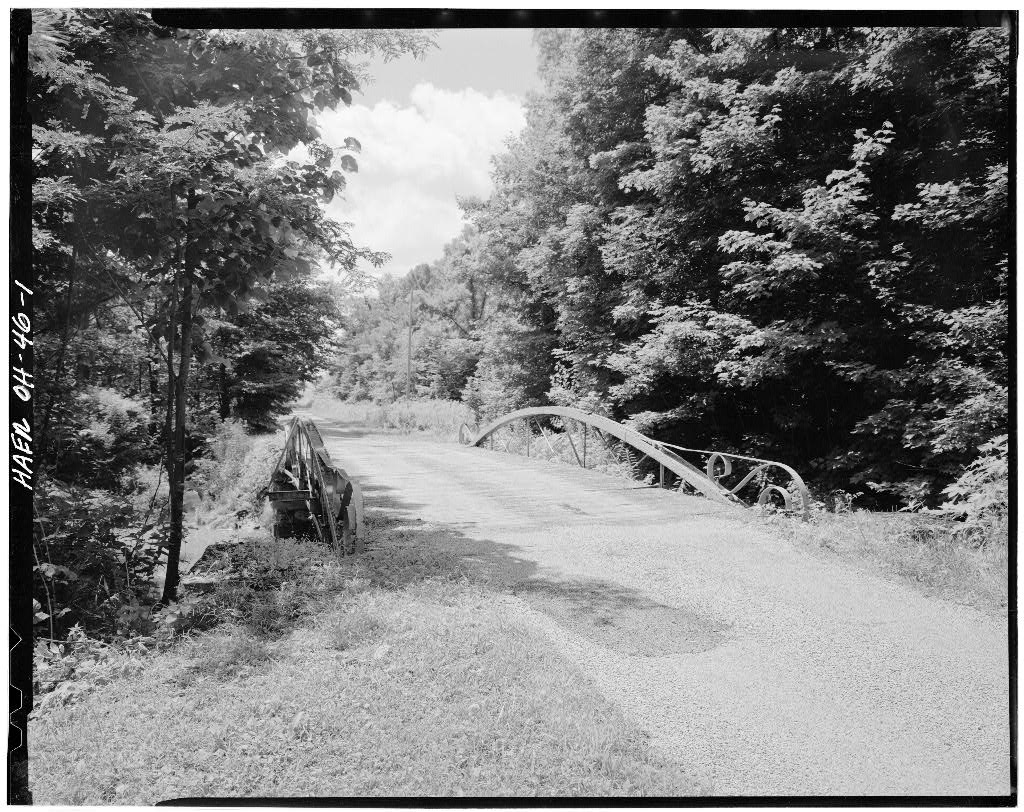
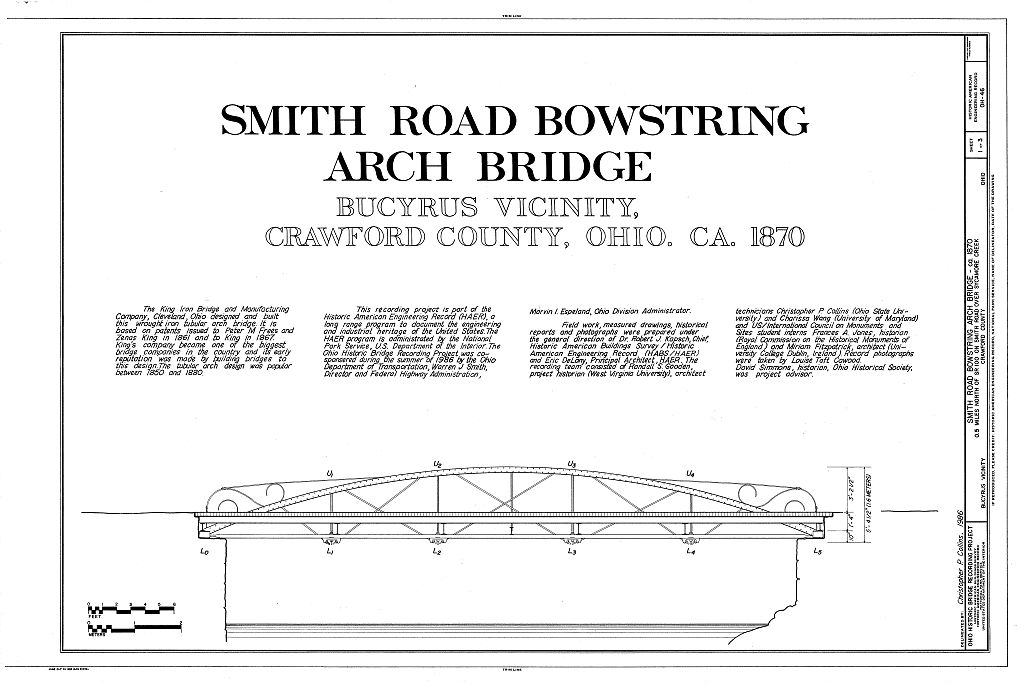
OH-46 Page 2 ""he Smith Road Bowstring Arch Bridge identified in some records as Bunker Hill Bridge, exemplifies the wrought iron tubular arch design patented by Senas King in abd It has an overall span of 43 feet 6 inches, and a overall width of 1? feet. The bridge deck is approximately 2 feet above the bearing point, leading some experts to believe that the bridge was not built to suit this site but relocated, m possibly in from another site. hrough no evidence was found to justify the ca. date attached to the bridge, the character and detailing of the cast-and-wrought iron bridge members is indicative of bridges fabricated in the lS^O's. By the 18 the bowstring arch design had been supplanted by more conventional Pratt, Warren and Parker trusses.
Thus, the assumption that the bridge originally dates from the and was relocated to the present site in The truss verticals are cast-iron members, cruciform in section, whose ends have been rounded and threaded through the top chord and connected by cast iron washers and nuts. This characterises bridges patterned after Zenas King's patent. King intended his tubular arch bridges to be adjustable to adapt to varying loads. The upper chord of the bridge is a rectangular tubular arch made up of channels and plates rivited together. This rises to a height of 3 feet at its highest point above the deck and 4 feet 6 inches above the bottom chord. The bridge has five panels varying in length from 7 feet 6 inches to 9 feet 6 inches at the ends.
"S" shaped brackets support a SMITH ROAD BRIDGE HAER Wo. OH-46 Page 3 m railing at the ends of the arches. he bottom chord consist of two x ?" iron bars whose ends have been forged to 1 3/4 inch diameter to fit through openings in the shoe and threaded to receive tightening nuts. m 2 hese features also characterize King s tubular arch bridge patents.' '"he first prototype of the wrought iron tubular arch bridge launched Zenas King into his highly successful bridge building business. King, a native of Vermont, first gained knowledge of iron manufacturing while working as a salesman for a Cincinnati agricultural machinery firm and, later, learned about bridge building as an agent for Mosley Bridge Company.
While in Cincinnati, King met Peter , Frees, a boiler maker, and formed a business partnership with him in to build arch and swing bridges. They received a patent for their wrought iron bridge in This initial bridge design was among the first in the united States for an iron bridge and lead to King's career as a manufacturer of iron bridges. They moved their business to Cleveland in and the partnership in their bridge and boiler business lasted until When the partnership dissolved, King retained the bridge manufacturing interests, and Frees kept the boiler making portion of the business.
As a result, King filed for a new patent for the wrought iron tubular arch bridge in order to verify his full rights to it and received the patent on July 30, Despite King's rights to the patent and the addition of the adjustable hangers to the patent, the plaque on ~Y& Smith Road Bowstring Arch Bridge credits both King and Frees for the 4 bridge design. ROAD BRIDGE HAFR Wo. OH-46 Page 4 In his tubular arch and subsequent bridge innovations had given him enough success to incorporate his business as the King Iron Bridge and Manufacturing Company with a capital stock of Ke and Freez had begun business in with an investment of only By King's sales reached ill million as the result of his reputation for iron arch bridges.
As his career advanced, King expanded his manufacturing plant and the range of bridge designs, giving him a national reputation for iron bridges, (See Harrison Road Camelback Through Truss Bridge, HAER OH-49). ^he Smith Road Bowstring Arch Bridge crosses a tributary of Sycamore Creek known as Geiseman Ditch. In the county surveyor widened and improved the natural channel of the stream, and the ditch was named for 7 local property owner William Geiseman. It seems logical that a bridge would have been built across the ditch when it was created. However, county records give no indication of a bridge at this site in and the county engineers records give as the date of construction for the present bridge.
The possibility exists that the present bridge was actually built in and the engineers records give an estimated date of construction. Still, no contemporary records of the bridge's construction exist showing evidence of a bridge at the site in either the or One may theorize that if the bridge was in fact relocated from another site, it was located at this site as an emergency replacement for a bridge built in Such an emergency relocation of a bridge to replace a destroyed one would not have SFITH ROAD BFIDGF HAER Ho. OH-46 Page 5 necessarily been accomplished by a contractor. If the county surveyor performed the work, no clear record would have necessarily been made by the board of commissioners of work at the site.
If the present bridge was indeed an emergency replacement for a former bridge, that would explain the fact that the present bridge does not fit the road level and stream width. However, these theories bear no substantiation since there are no contemporary records for a bridge at the site in either or Likewise, no evidence exists of another wrought iron tubular arch bridge in Crawford County, and it seems too difficult and costly for the county government to import an ill-fitting bridge from another county to a comparatively insignificant stream crossing. Thus, this bridge's history poses a number of questions that might never be answered.
Nevertheless, this prime example of a King wrought iron tubular arch bridge deserves note as a Rational Register of Historic Places property that is threatened by the advances of age and the resulting plans for its replacement. SFITH ROAD BRIDGE HAER Wo. OH-46 Page 6 NOTES * U.S., Department of Commerce, Office of Patents and Trademarks, Improvement in Bridges Patent Reissue No. ? Ibid. -' Crisfield Johnson, comp. , History of Cuyahoga County, Ohio (Cleveland: D. V. Ensign & Co., pp. 4 U. S. Department of Commerce, Office of Patents and Trademarks, Improvement in Bridges. 5 Johnson, History of Cuyahoga County, p. 6 William Ganson Rose, Cleveland: The Making of a City (Cleveland: World Publishing, p. 7 Ohio County of Crawford, Office of the County Engineer, Crawford No. 10, Bridge Files,
Bibliography
Johnson, Crisfield, comp. History of Cuyahoga County, Ohio. Cleveland: D. . Ensign & Co., Ohio, County of Crawford. Office of the County Engineer. Crawford No. 10. Bridge Files. Rose, William Ganson. Cleveland: The Making of a City. Cleveland: World Publishing, U. S. Department of Commerce, Office of Patents and Trademarks. Improvement in Bridges. Patent Reissue No.
The original filed report, and the sheets the survey produced. Those published here appear above.
Also surveyed in Crawford County
1 record
The federal survey recorded these other structures elsewhere in Crawford County. These are the other structures
they measured and filed a report on, longest report first.
 Block
Block